July 30, 2023
The former community of Malvern has disappeared under a massive railyard and multiple industrial buildings. There are still a few houses remaining that once stood on the outskirts of the town. Prior to 1850 the hamlet was known as Malcom’s Corners because John and Robert Malcom operated the Speed the Plough Inn and had a harness shop at the intersection of modern Sheppard Avenue and Markham Road. Senator David Reesor thought the community had the potential to become the capital of Scarborough Township and in 1857 he set out a plan to sell 50 foot by 150 foot lots for housing. He chose the name Malvern after a town in England where the water was said to cure the sick. Locals had told Reesor that the waters around Malvern would also cure the sick. He also planned for a grammar school, a fair grounds and a large community hall. The hall was built in 1860 and named Mammoth Hall. When it burned down in 1879 it was soon rebuilt. Unfortunately, an arson burned it down in 1988 and it was lost forever.
The map below is a section of the 1877 County Atlas and shows the location of the various properties that are pictured in this post. Three stone houses belonging to Weir, Stirling and Neilson and the school. Also circled is the Primitive Methodist Church that is pictured as an historical photograph.

For years there were two general stores that were operated by a series of men starting with Duncan Malcom. The village also had a blacksmith, a wagon shop, two hotels and a large woolen mill as well as a saw mill. One hotel was Thompsons Temperance Hotel and General Store and it contained the post office from 1865 until 1929 when the building was lost to a fire. The post office then moved to Cowans General Store in 1930 and remained there until 1956. The other hotel was the Standard Hotel where one could purchase an alcoholic drink that wasn’t available in the Temperance Hotel.
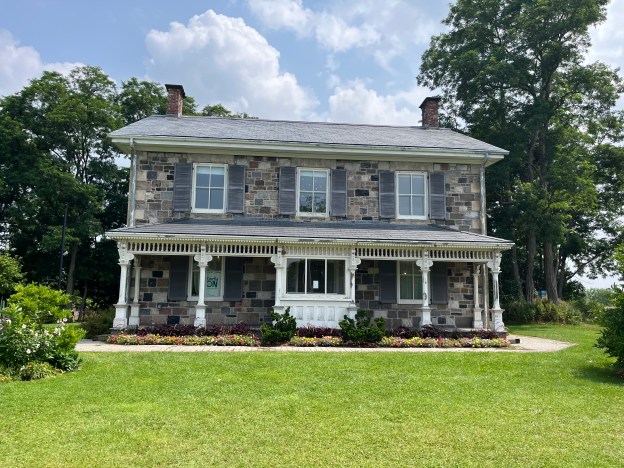
One of the prominent houses was the Neilson House which was built in 1856 and remains on Neilson Road today, serving as a community centre. It was partially destroyed by two fires in the 1970s but was restored and opened as the community centre in 1988. The cover photo shows this beautiful stone house from the front.
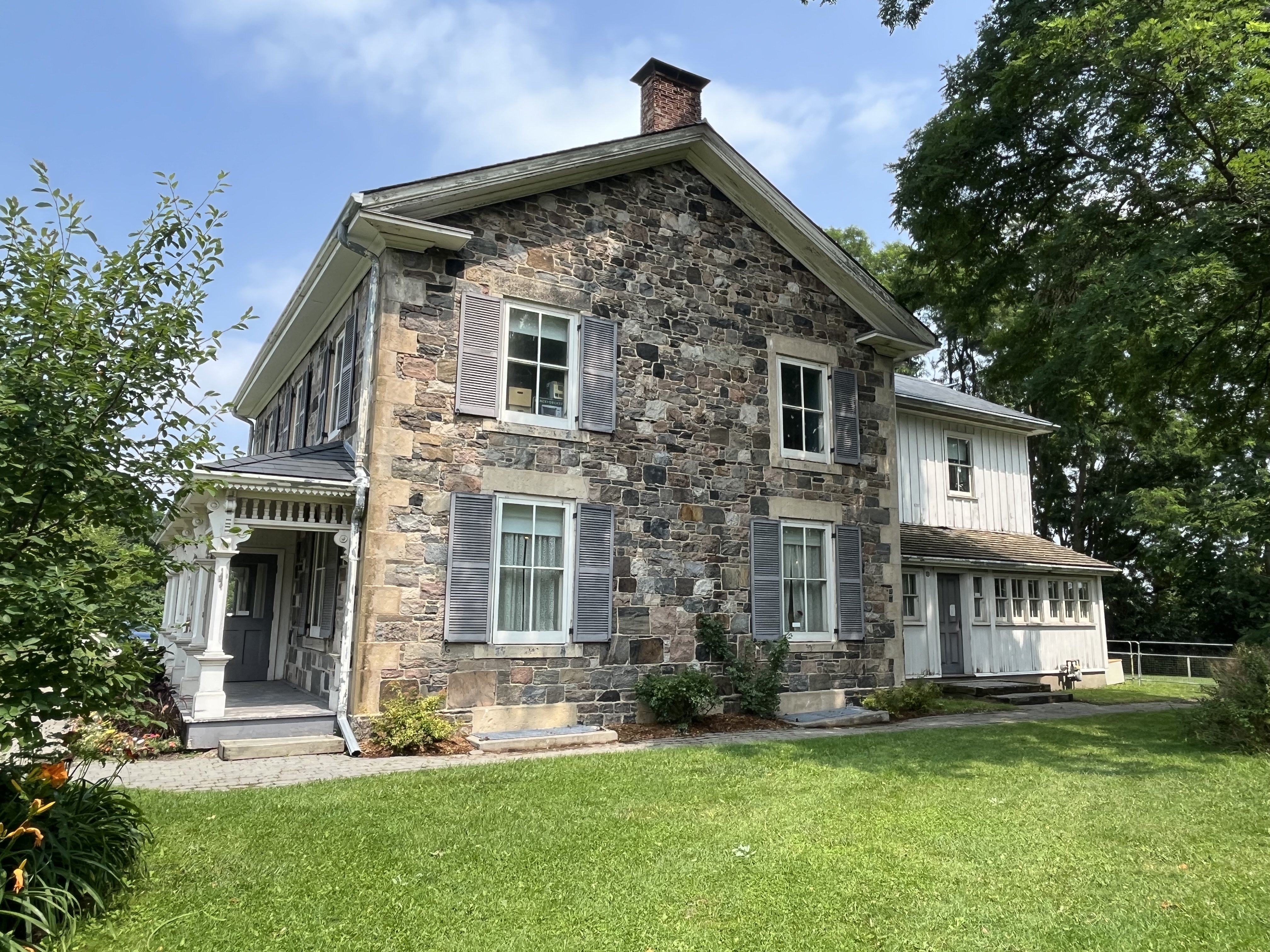
Malvern was a thriving farm community through the 1880s but when the railway bypassed it in favour of Agincourt that community prospered and Malvern went into decline. The Canadian Northern Railway built a station there in 1911 but it went bankrupt in 1917 and was taken over by the Canadian National Railway. Passenger traffic ceased in 1926 and the community stagnated until the 1950s when the Canadian Housing and Mortgage Company expropriated large tracts of land to build a housing development. One of the houses that was spared demolition was the James Stirling house which was built in 1860. This is another of the field stone houses that used to be found in the community.
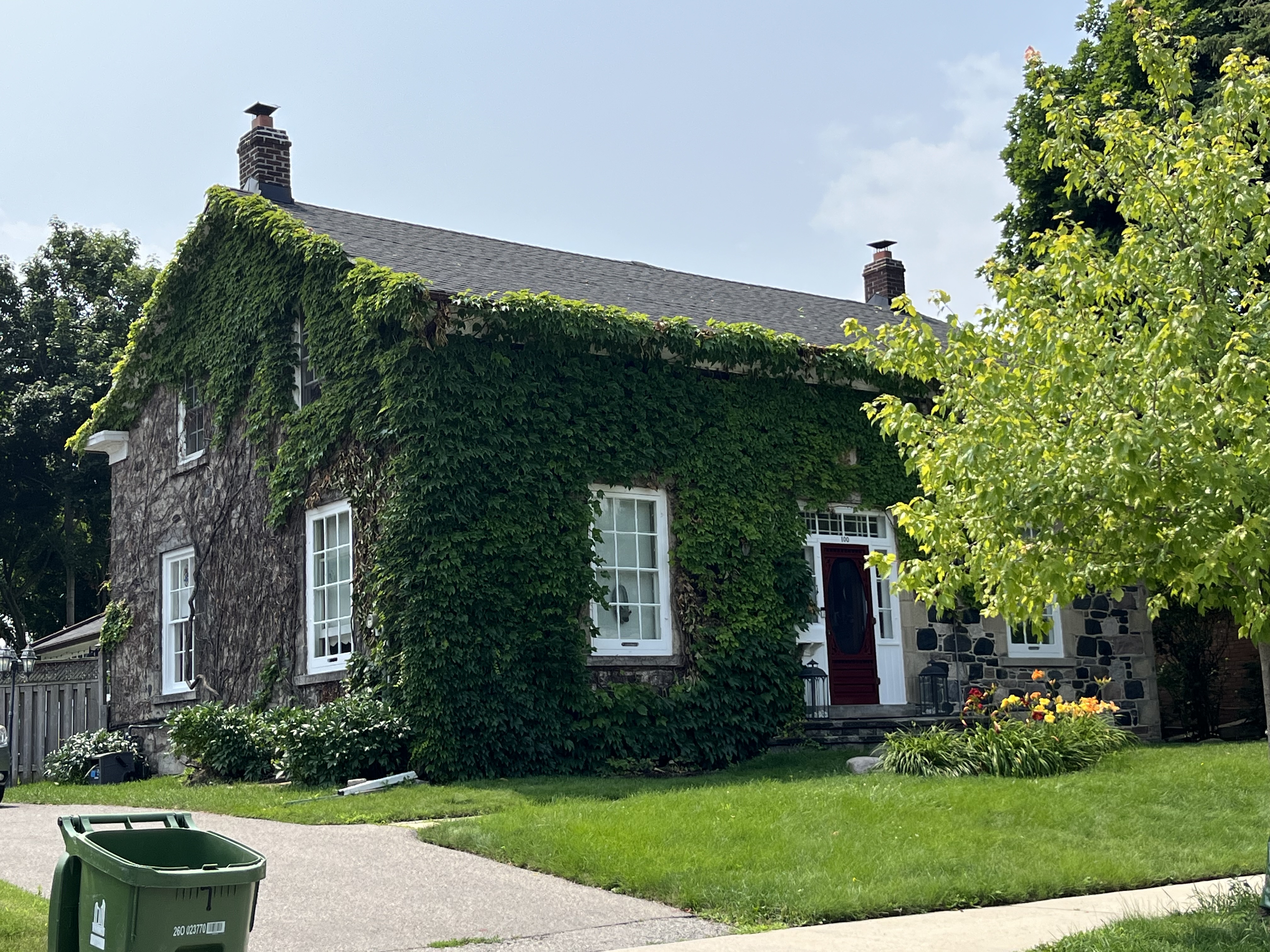
James Weir came to Scarborough in 1833 from Scotland and worked against the Mackenzie rebels in the 1837 Rebellion. He settled on this lot in 1840 and became a successful farmer, livestock importer and ploughman. Eventually he became one of the wealthiest landowners in Scarborough and erected this home made of fieldstone in 1861. The lintels above the windows and quoins on the corners are made of Kingston Limestone. The house used to stand in the middle of the property but in 1975 it was moved about 400 yards west to its present location.

The door on James Weir’s house is the most decorative part of the structure. It has side lights and windows in the transom above the door. It is also one of only a few historic houses that I have photographed that has a name plate and date stone, in this case just above the door. James Weir, 1861.

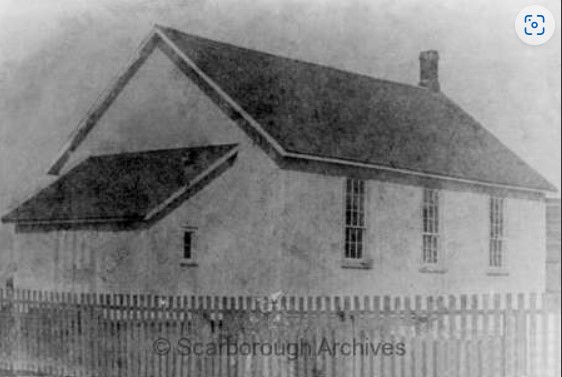
Malvern had a single church which was built in 1864 by the Primitive Methodist congregation. The building was demolished in the 1970s although some pieces of wainscotting and flooring were reused in the Scarborough Historical Museum. A small cemetery was located beside it and this still survives on the east side of Markham Road just north of Sheppard Avenue. The image below is from the Scarborough Historical Society website.
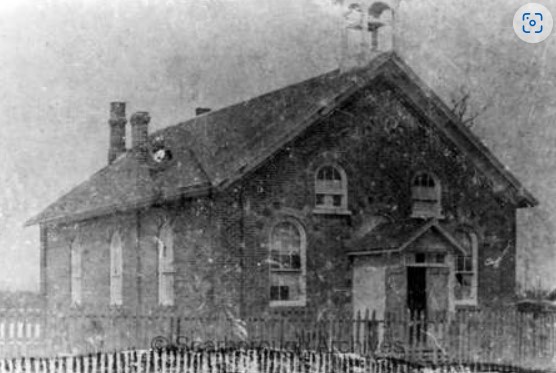
A log school house served the community from 1847 to 1851 when it was replaced with a small frame school which was built on the Stirling Farm. Alexander Muir got his start teaching in the log school house and his story can be found in our post on Burke Brook. The school was replaced again in 1872 by a one room brick school which still stands at the corner of Finch Avenue and Neilson Road.

The image below was taken from the Scarborough Historical Society and shows the school when it was surrounded by open farmland.
Whypers Boot and Harness Shop was relocated to Markham Museum where it is on display along with about 30 other historical buildings. Today the former community of Malvern is a thriving part of the uban sprawl of Scarborough and is commemorated in the names of streets, malls and the public library.
Related Stories: Markham Museum, Burke Brook, Agincourt
Google Maps link: Malvern
Like us at http://www.facebook.com/hikingthegta
Follow us at http://www.hikingthegta.com
Also, look for us on Instagram
 Hiking the GTA
Fabulous article. I remember when one could see two Golf Courses that used to be right near the Old Bailey Bridge on what is now Finch. I miss seeing that and also a road that took you over a bridge that ended up connecting I think to Morningside. This would be in the early 1980s
As always an interesting read. (Sheppard not Shepard)
Thank You!
Hi – the picture posted here as the Primitive Methodist Church is actually the Armadale Free Methodist Church, which still stands. The Scarborough Historical Society does have a picture of the Primitive Methodist Church and you can even see a couple of headstones in that picture.