Monthly Archives: July 2024

Lime Kiln and Chipmunk Trail

July 27, 2024

On a recent business trip to Ottawa I had a few hours of off time so I Googled to see what the top trails in the area were. One of them caught my attention because of the name. So, I decided to go investigate the Lime Kiln and Chipmunk Trail. This is just one of the trails that are part of the Greenbelt Trail Network.

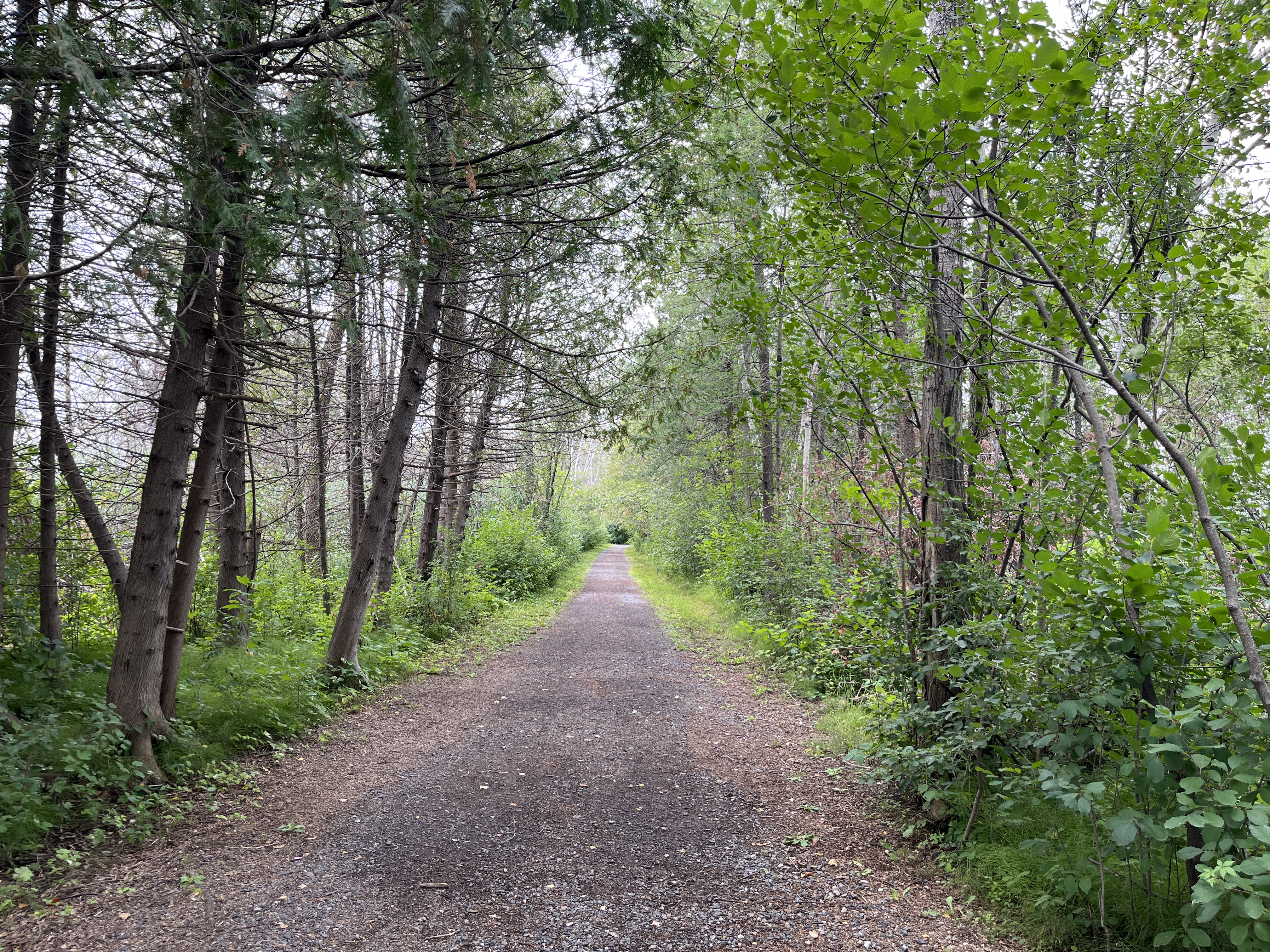
There is a wide trail that leads away from the parking lot and this set of trails would be considered easy to moderate in difficulty. There is little change in elevation and no rough ground to be covered.
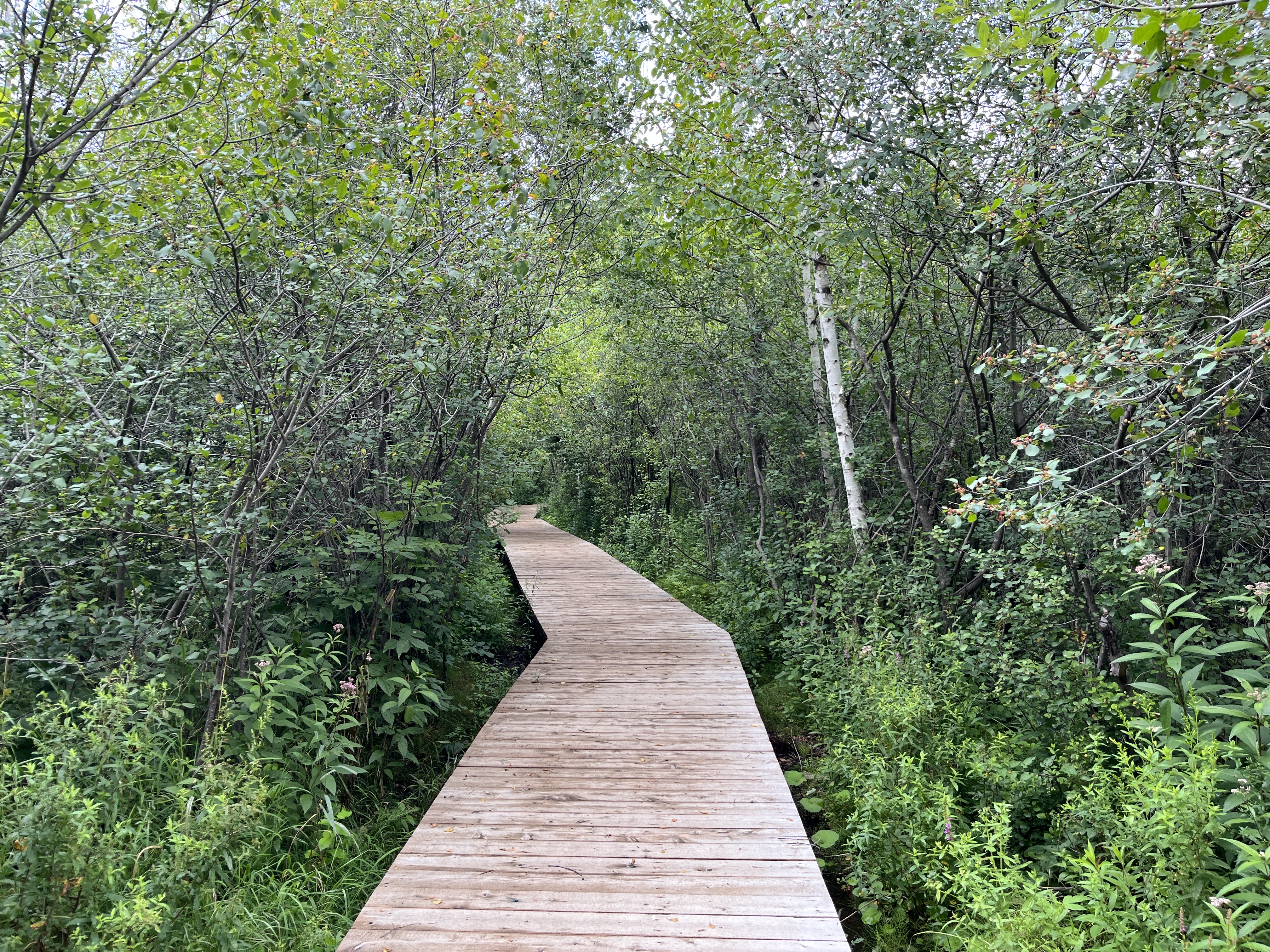
There are a few swampy sections that have been made accessible through the addition of some boardwalks.
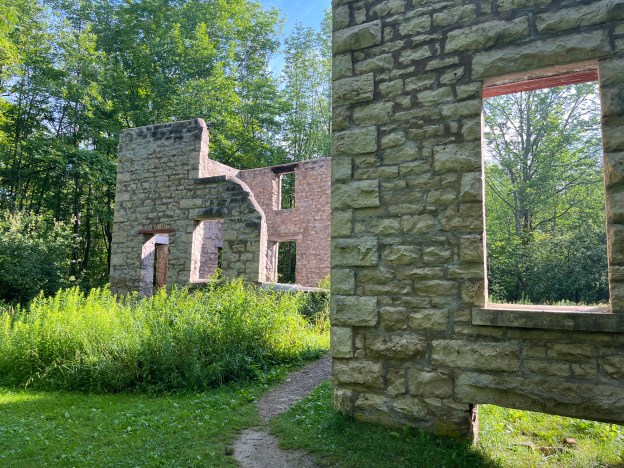
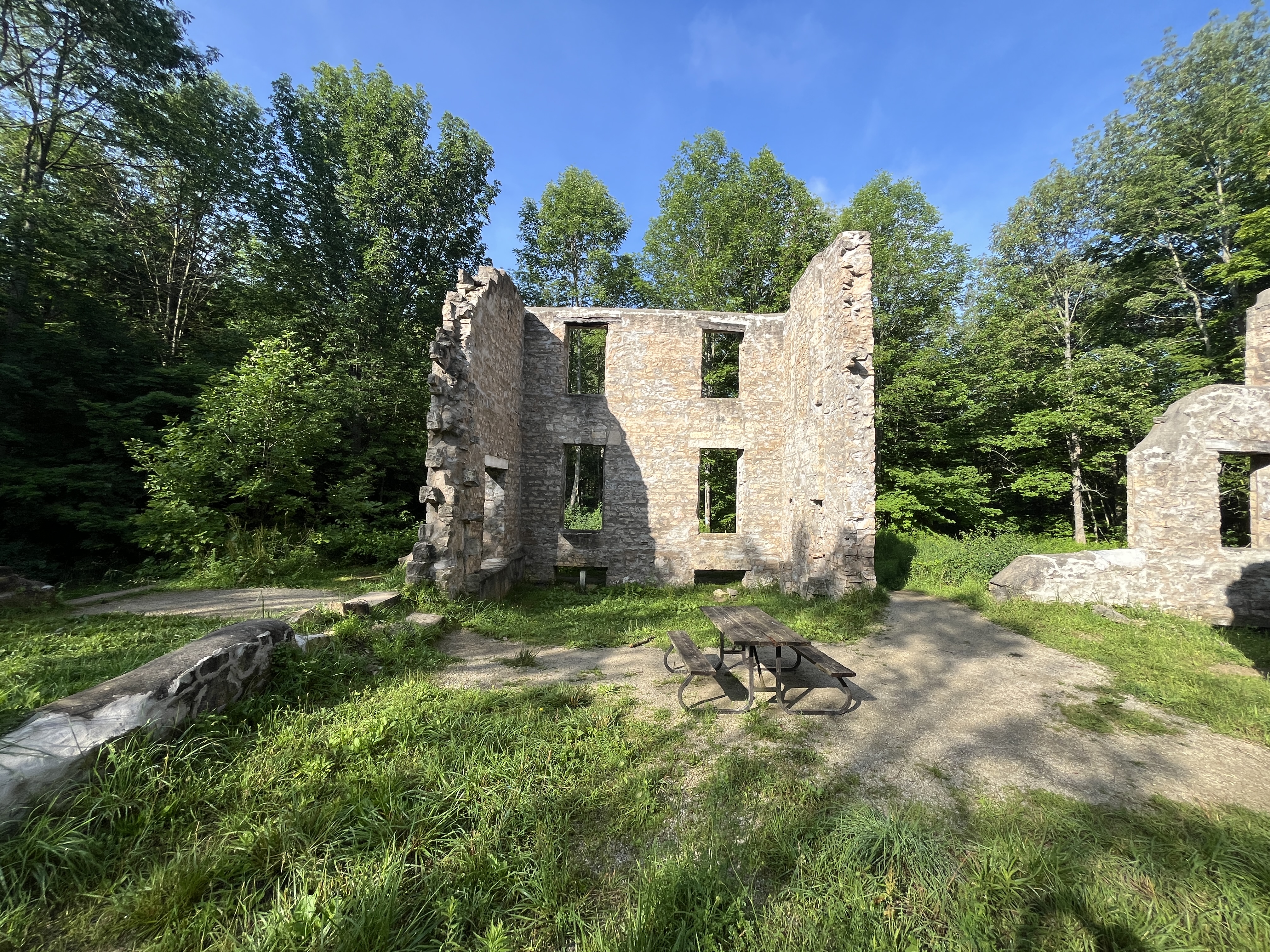
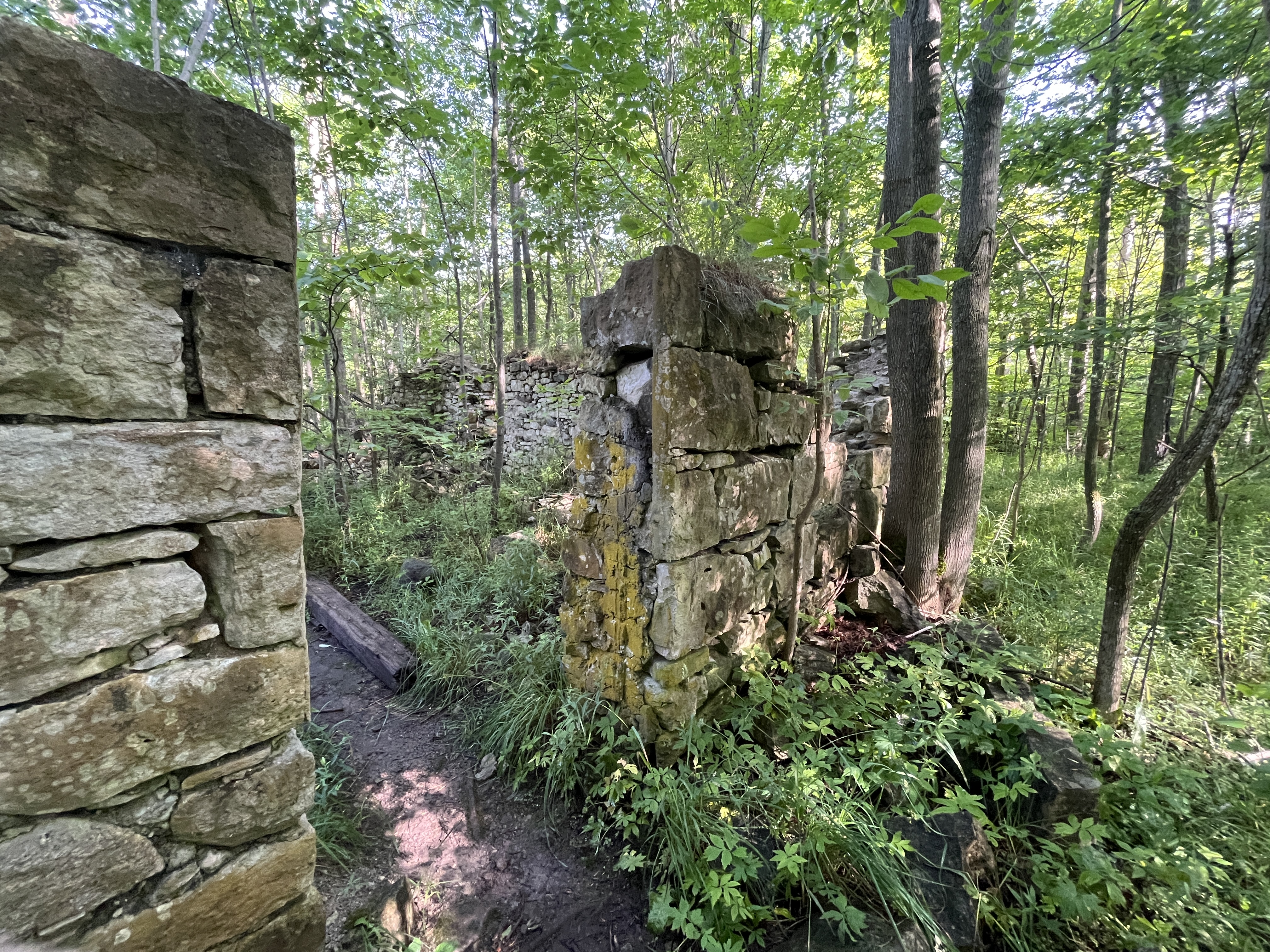
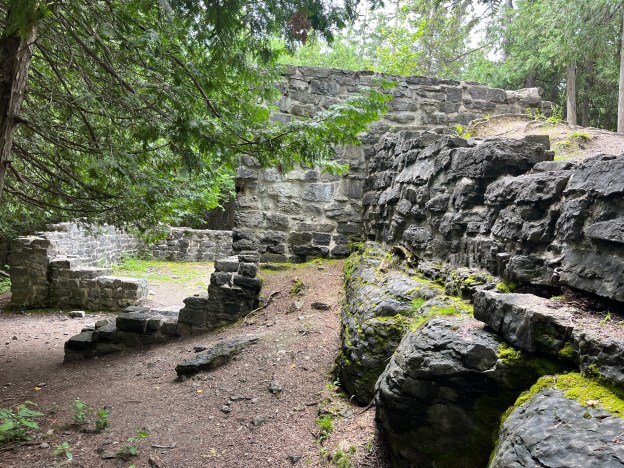
After a short hike you will come to the ruins of the Flood Lime Kiln. The former industrial site was comprised of several buildings. There were five buildings that surrounded the circular kiln. There was also a separate building where the finished lime was stored before being taken to market. An additional building was the powder magazine where the black powder was stored that was used to blast the limestone that would be made into the lime. The first set of foundations that you will see are those of the powder magazine.
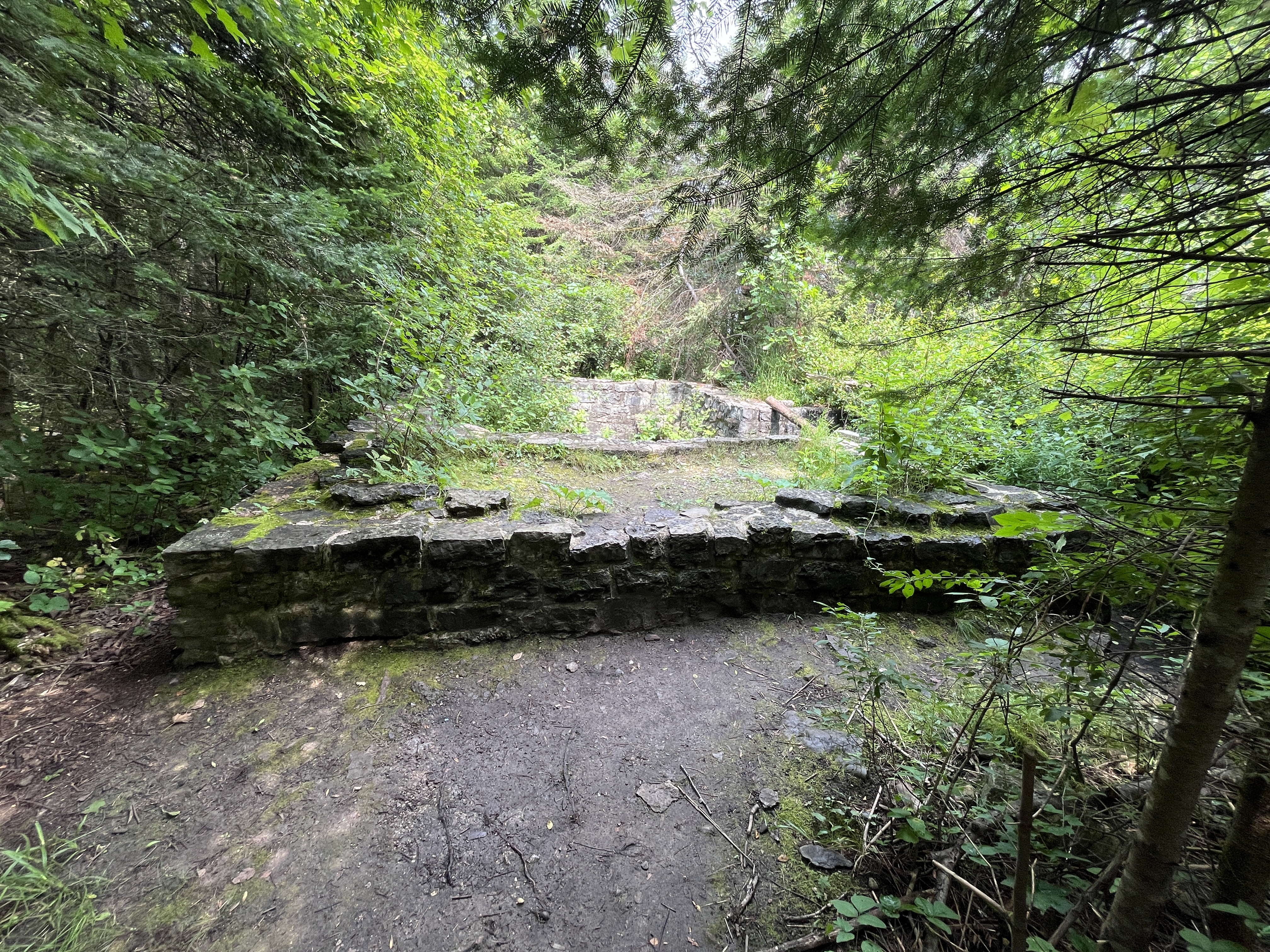
Francis Flood built this lime kiln in the late 1800s and operated it until around 1906. The lime was used to make mortar to chink log houses as well as to make whitewash, plaster and many other household products. By the early 1900s larger industrial kilns were being run and Portland cement began to replace lime as a building material. Most of these small kiln operators went out of business. The Flood kiln was abandoned and left to deteriorate.
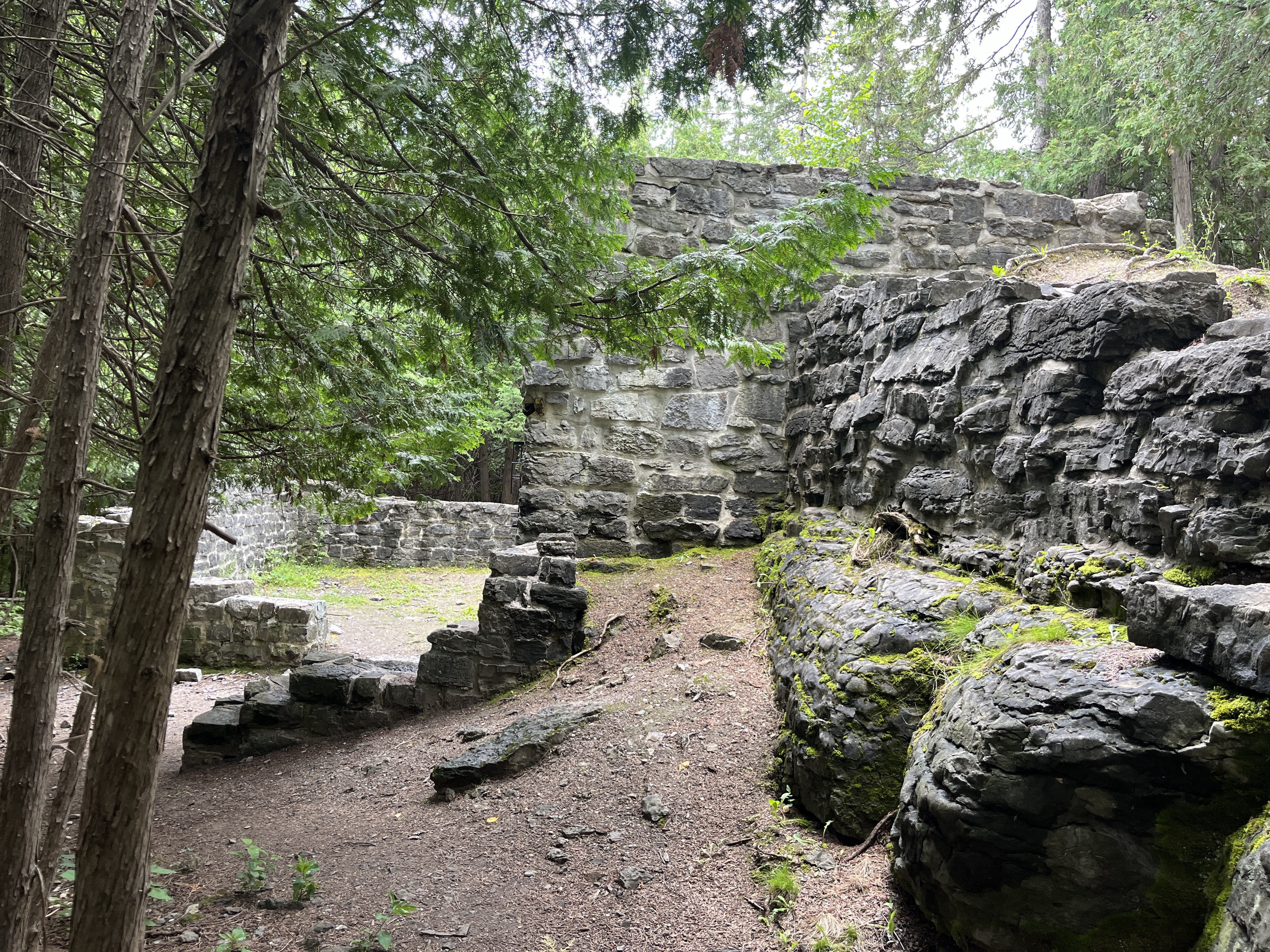
The Flood Kiln was known as a pot kiln or a set kiln. Limestone and wood were loaded into the kiln and left to burn for several days. The lime and ash were then removed through this opening and stored to be taken to market. The Flood kiln was rediscovered in the 1970s and eventually restored to prevent further deterioration in 1999. Today it has several information boards around the site to educate those who come to explore.
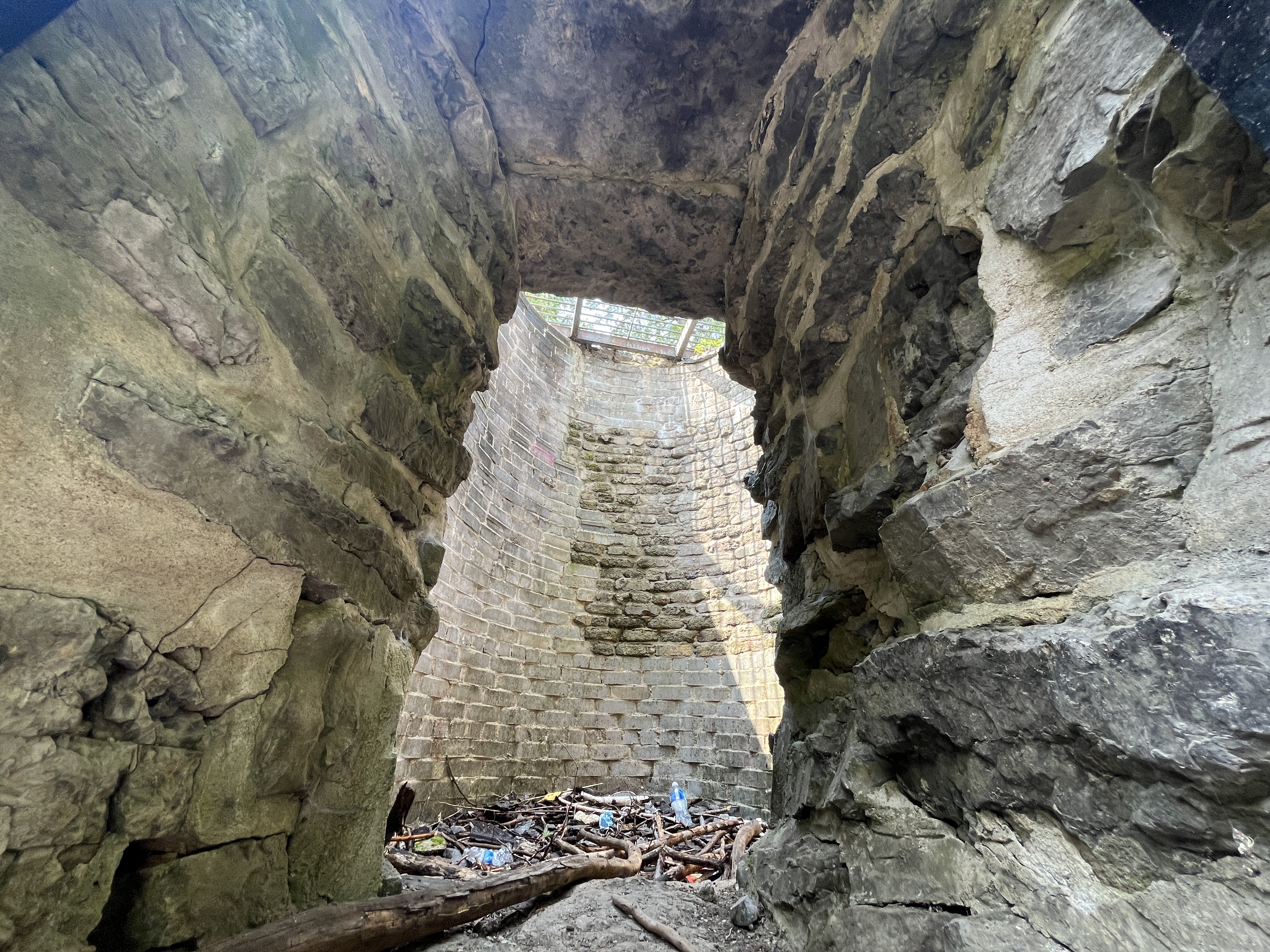
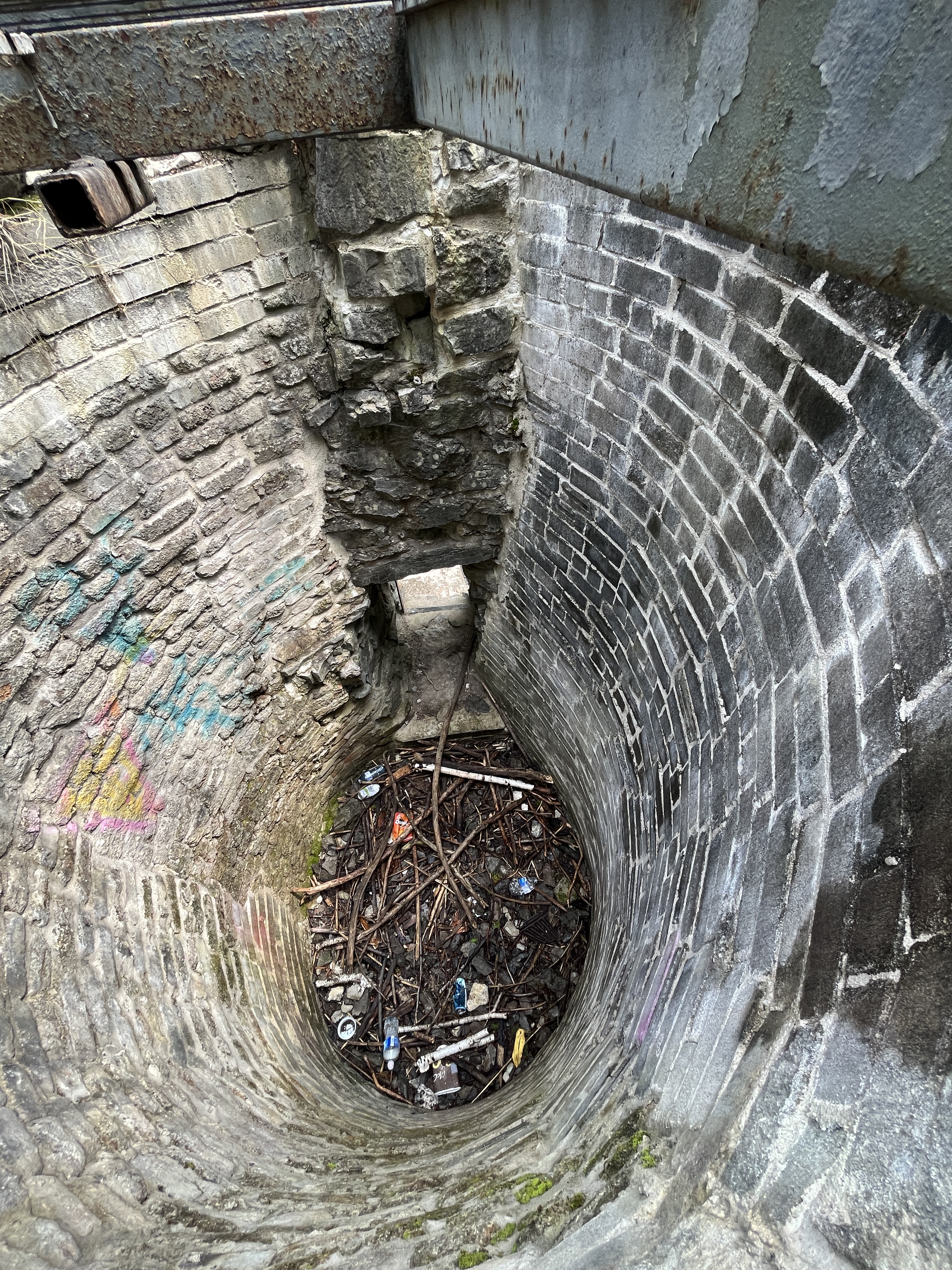
The view from the top of the kiln looking down inside.
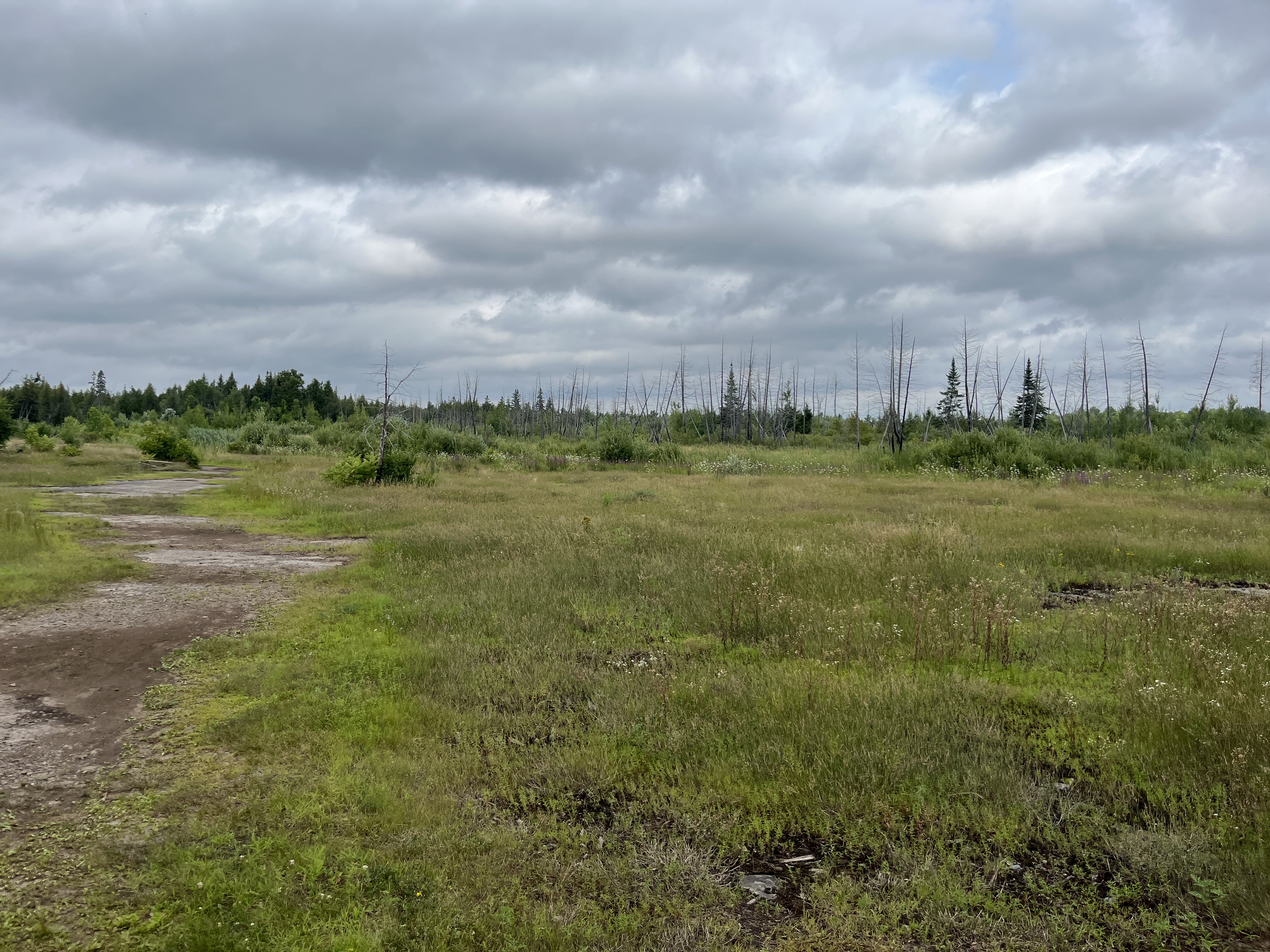
The trail continues past the kiln and leads to an area that is largely devoid of trees. This is the result of a forest fire that spread through the area on July 12, 2012. Forest fires in the greenbelt are dealt with quickly because of the homes and schools that are adjacent to the area. Ottawa Fire Services sent 55 fire fighters, 15 vehicles and several helicopters to try to get the fire under control. It took two weeks to get it extinguished and one of the tools that they used was known as a firebreak. This is a wide stretch cut through the forest that the fire can’t cross because it has no fuel. This limits the spread of the fire. Portions of this firebreak have been converted into the trail system that people enjoy today.
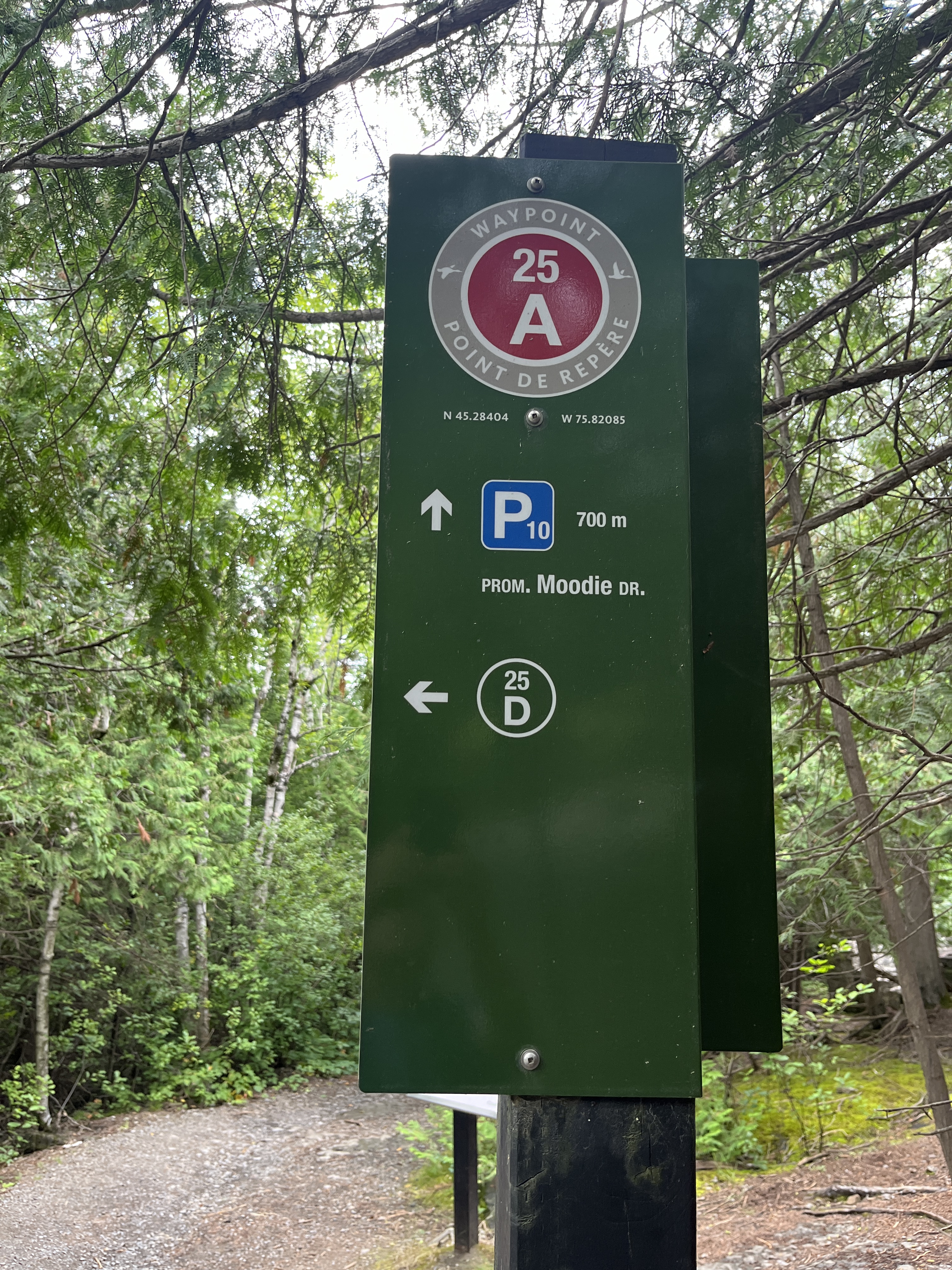
This trail system is very well marked with coloured blazes on the trees along the way. There’s also a series of waypoints that are marked with metal signs pointing out the various trail options. There’s also a map on each post. The waypoint below is at the kiln site.
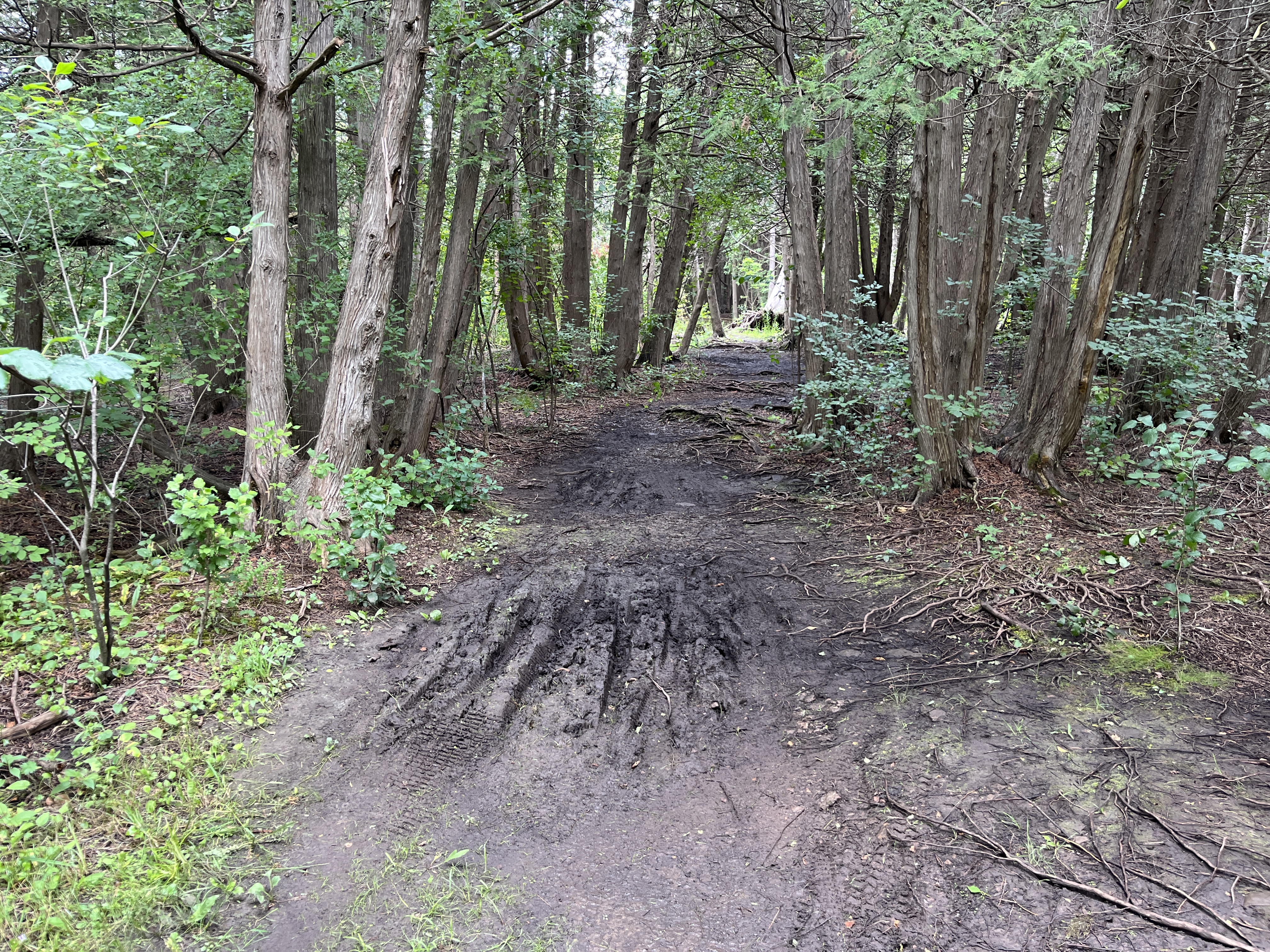
I saw a couple of chipmunks and several birds but not a lot of other wildlife, unless you consider deer flies and mosquitoes to be wildlife. In which case there was more than enough. On reading the reviews for the trail two comments kept coming up. “There’s a lot of bugs and the trail is very muddy”. I didn’t find the bugs to be too bad and never had to stop to apply bug spray. The trails are quite well maintained and there isn’t any mud on the main trails in spite of the heavy rain the night before. If you find muddy trails it’s a sign that you are no longer on a main trail. The secondary trails are sometimes muddy but also not marked with trail markers or waypoints.
This trail has a small but free parking lot at the trailhead. There are plenty of little parking lots at each access point to the extensive trail system around Ottawa.

Related stories featuring kilns: Limehouse, Balls Falls, Kelso’s Kilns, Devils Pulpit.

Google Maps Link: Lime Kiln Trail

Like us at http://www.facebook.com/hikingthegta

Follow us at http://www.hikingthegta.com
Provincial Lunatic Asylum

June 25, 2023

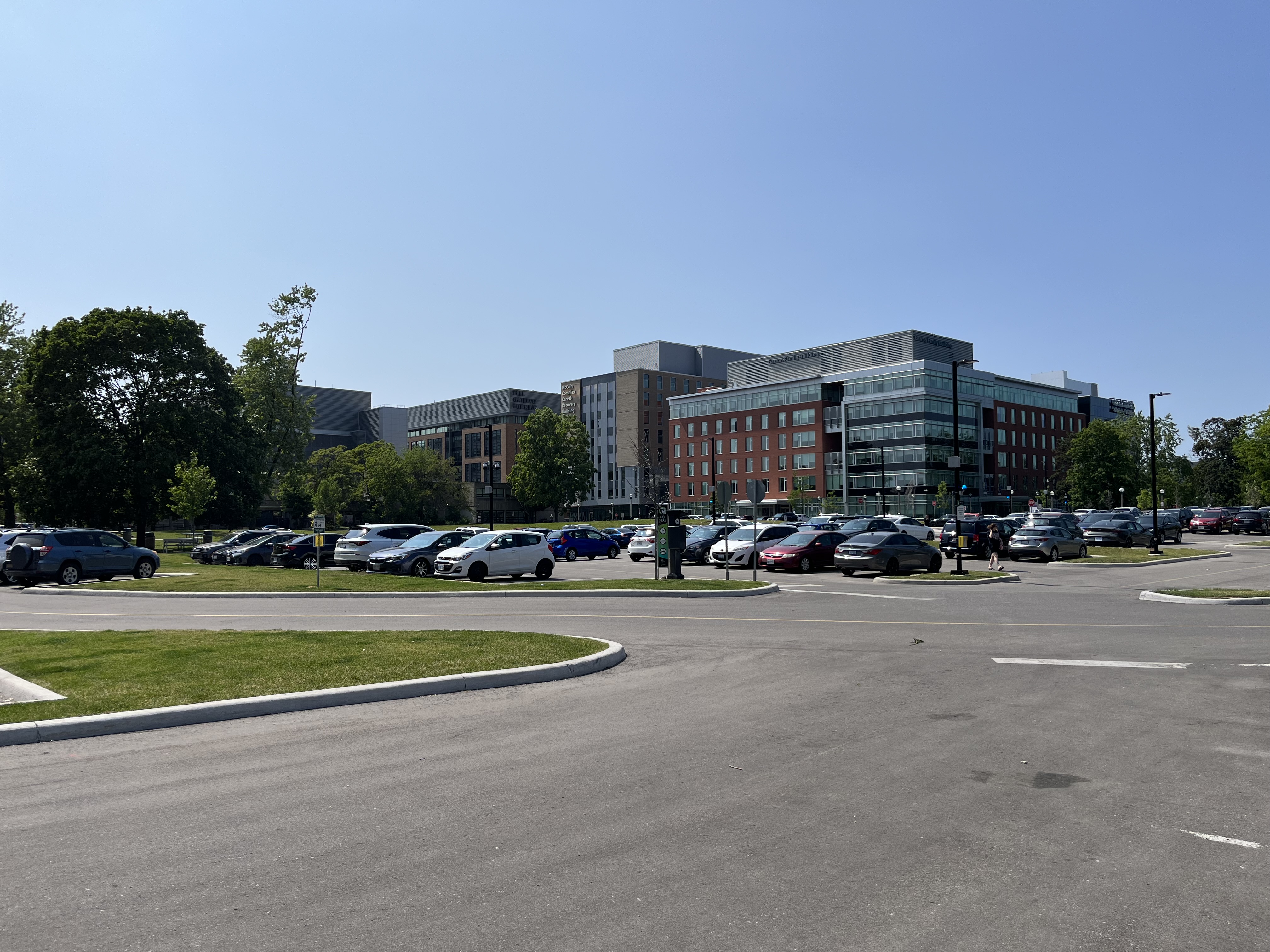
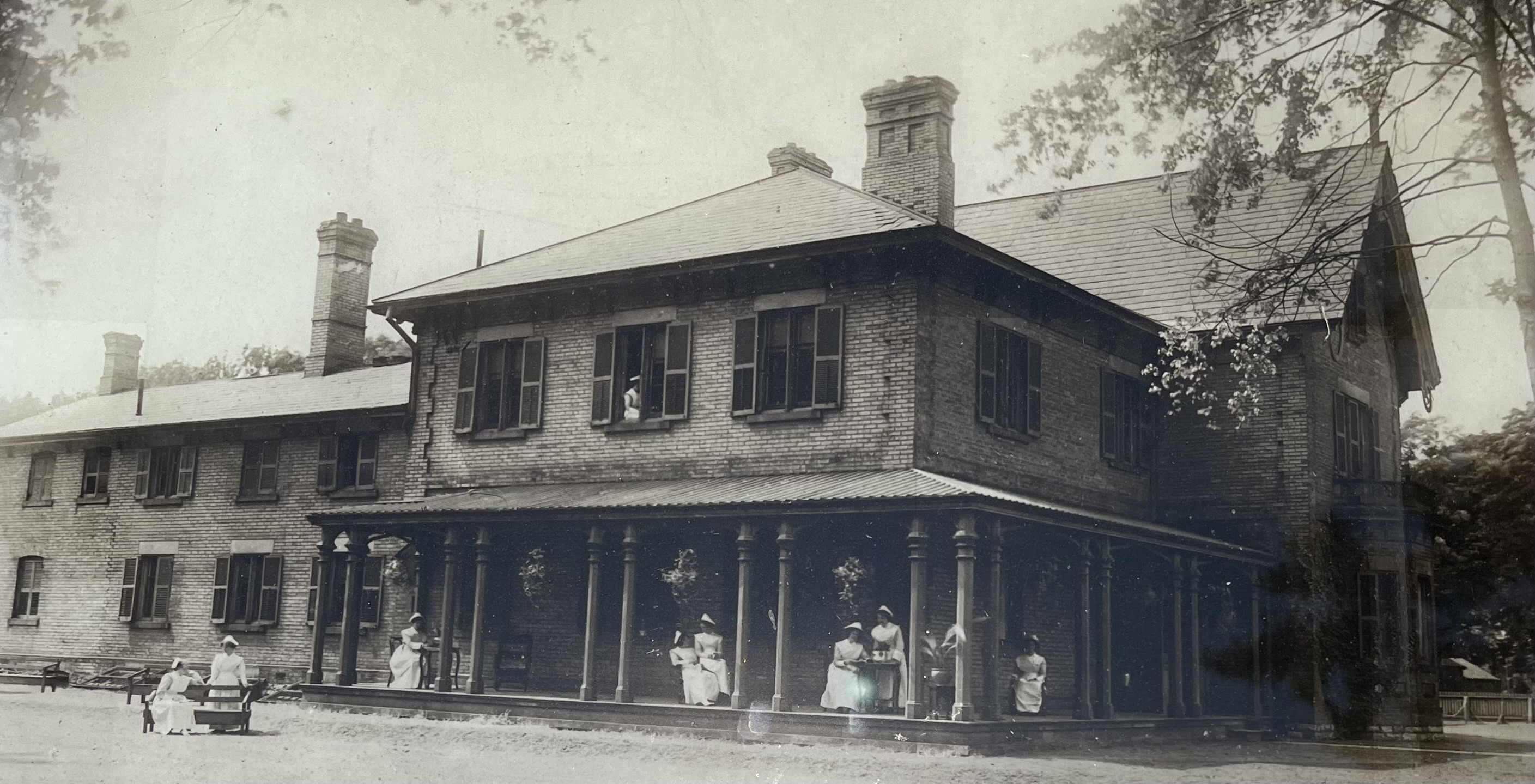
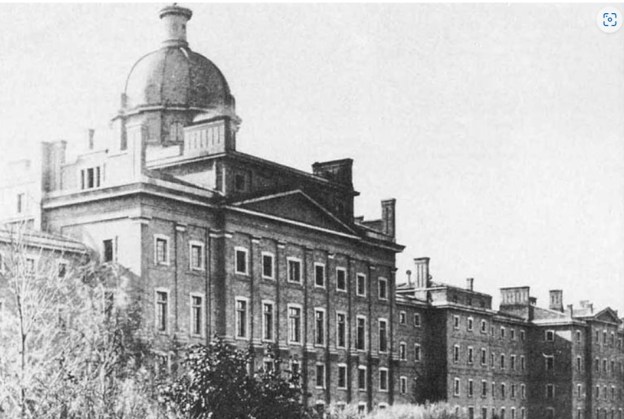
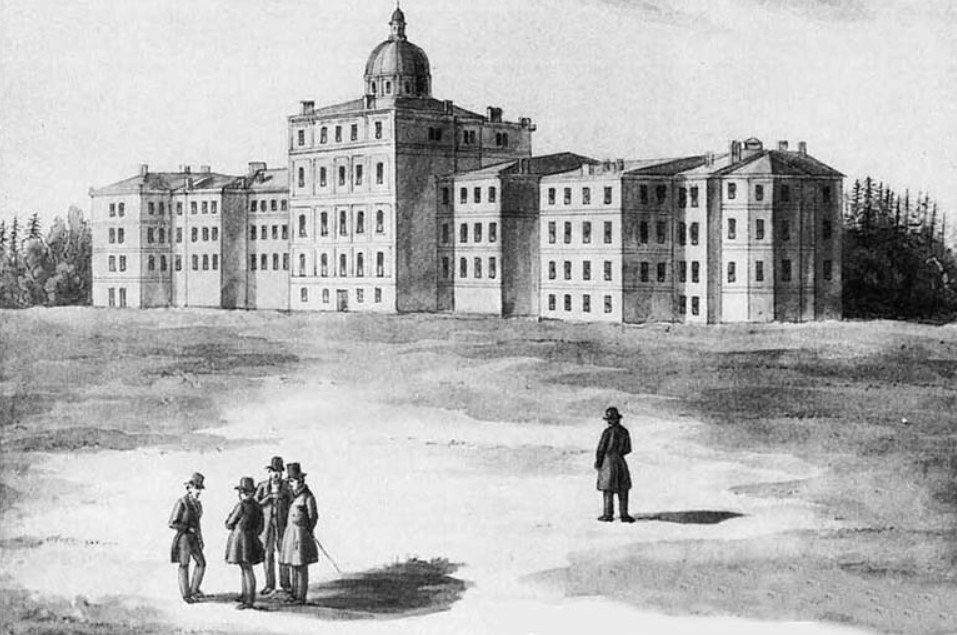
In Upper Canada slavery was officially abolished in 1793 but some forms of slavery continued for many decades after that. One example is the unpaid, forced labour that was used at the Provincial Lunatic Asylum. In the early years of Upper Canada people who had mental health problems were either locked up in their homes if they were considered to be “quiet lunatics” or if they were “furious lunatics”, put in jail. In 1830 a group of magistrates started calling for a more humane form of treatment. Due to political squabbling nothing was done until 1845. A site was chosen well outside the city limits at what would later be given the address 999 Queen Street West. The image below is a sketch showing the asylum building in 1848.

John George Howard was the first professional architect in Toronto and designed several prominent buildings in the 19th century. One example is the British Bank of North America which was built at Yonge and Wellington Streets. More can be found on this bank in our post Toronto’s Early Banks. He also built Colborne Lodge and later donated it and the surrounding lands to the city to be used as High Park. He would be called upon to design the Provincial Lunatic Asylum which eventually opened on January 26, 1850.

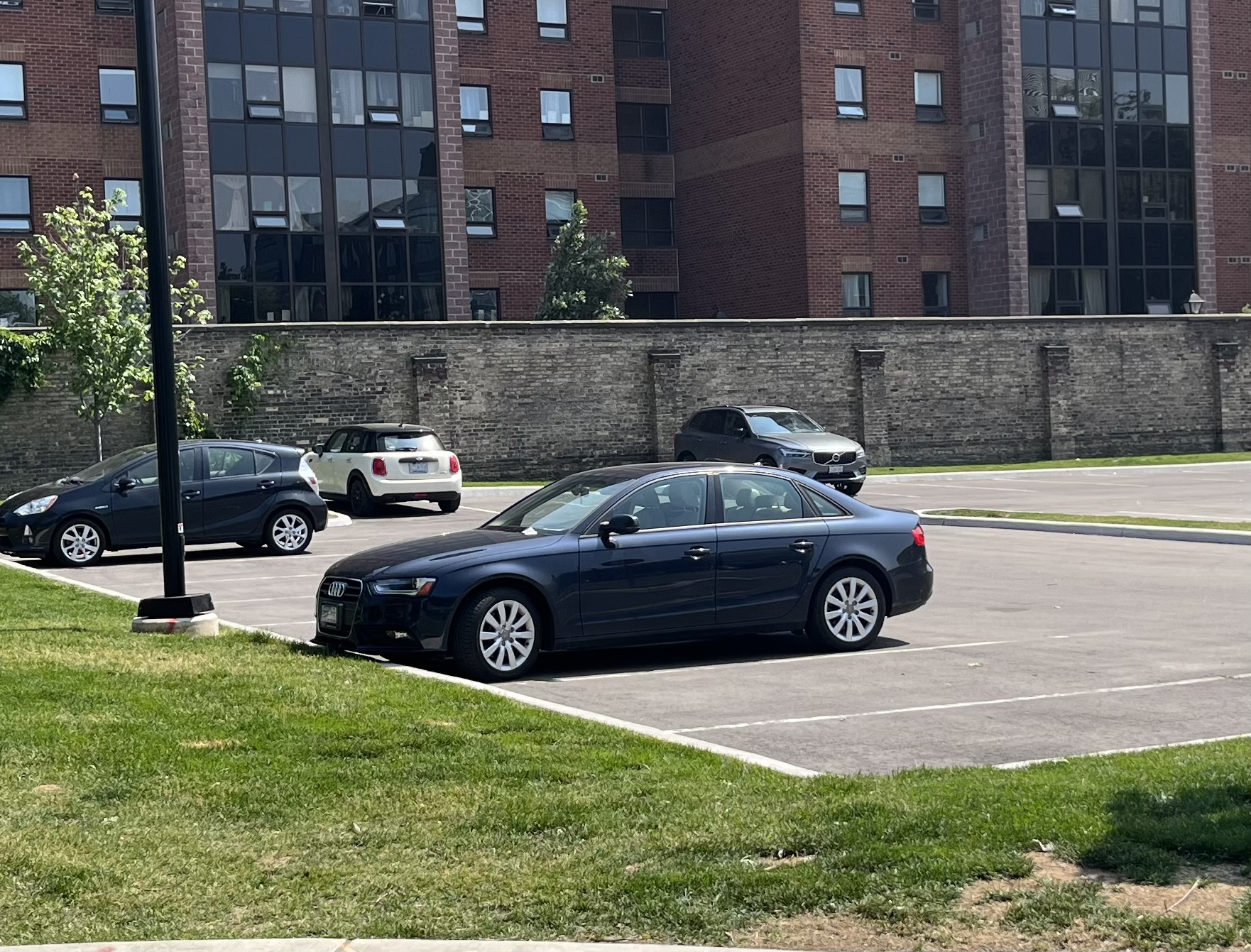
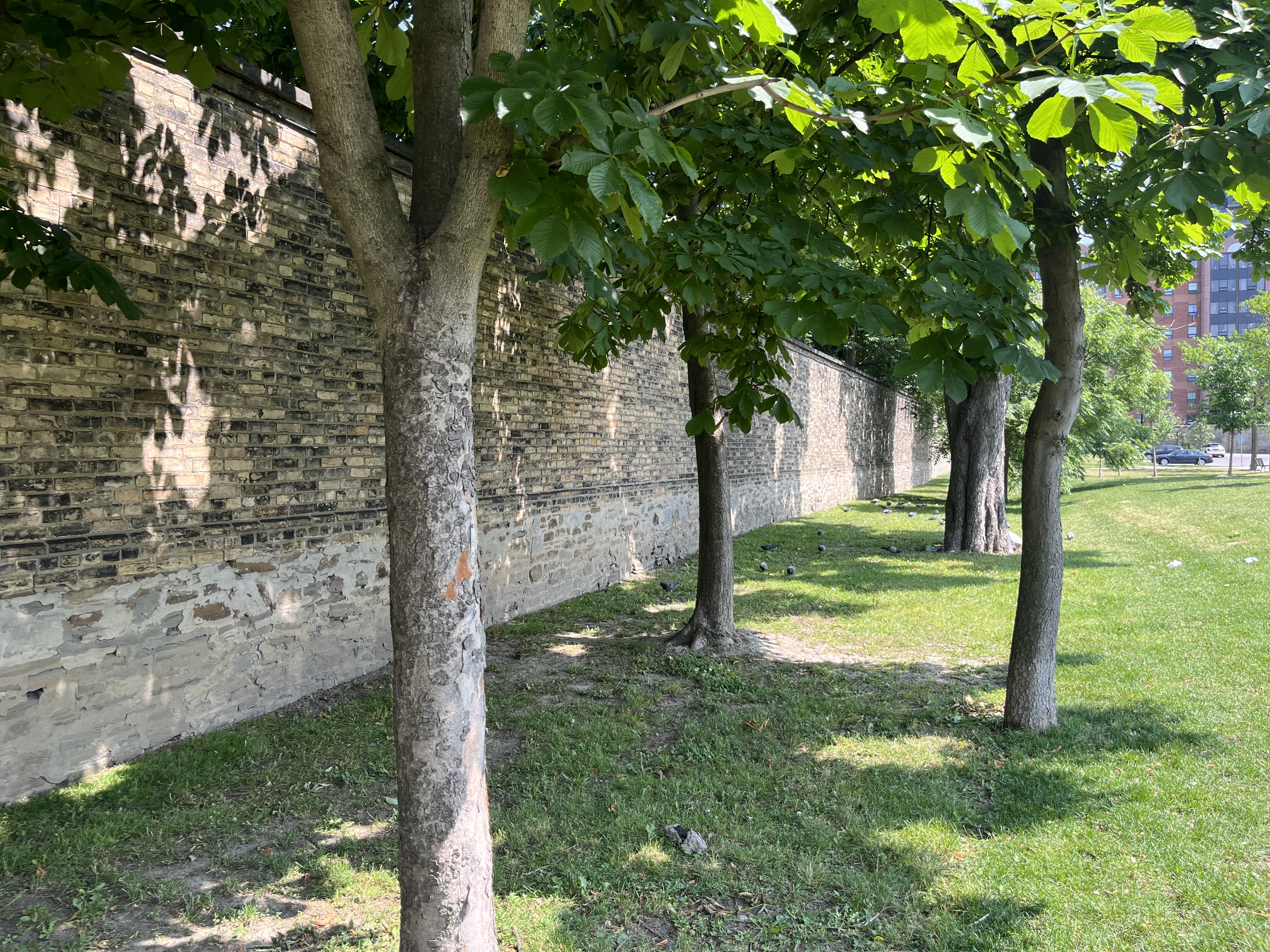
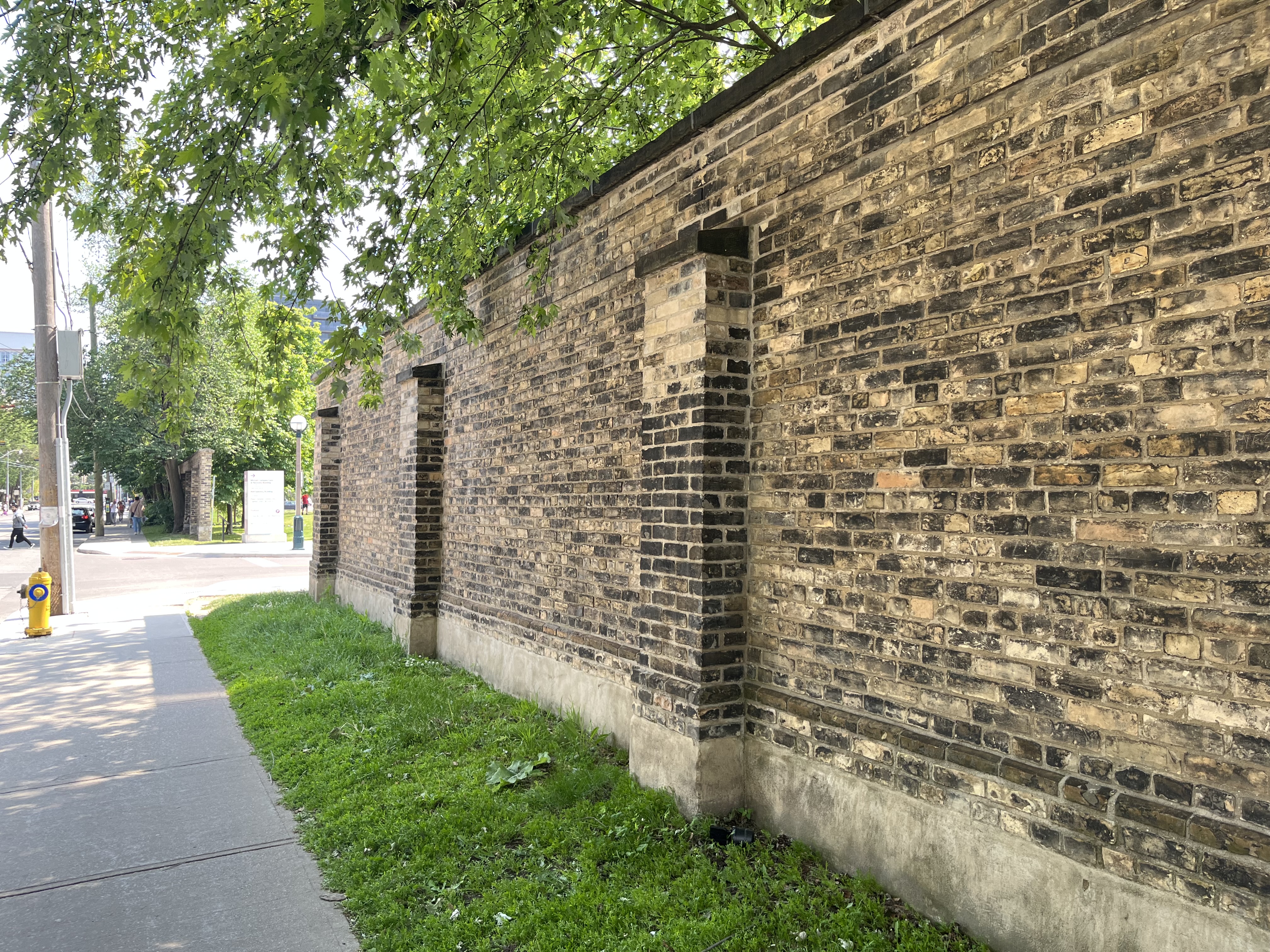
The following year the Provincial Government decided that they should close off the asylum to the rest of the city and a process of building a wall to surround the property was initiated. The wall would eventually encompass 50 acres and reach 2,230 feet long. The 16 foot high structure was built using patients from the asylum who worked for free as part of their “therapy”. The image below shows the southern section of the wall relative to the height of cars in the parking lot.

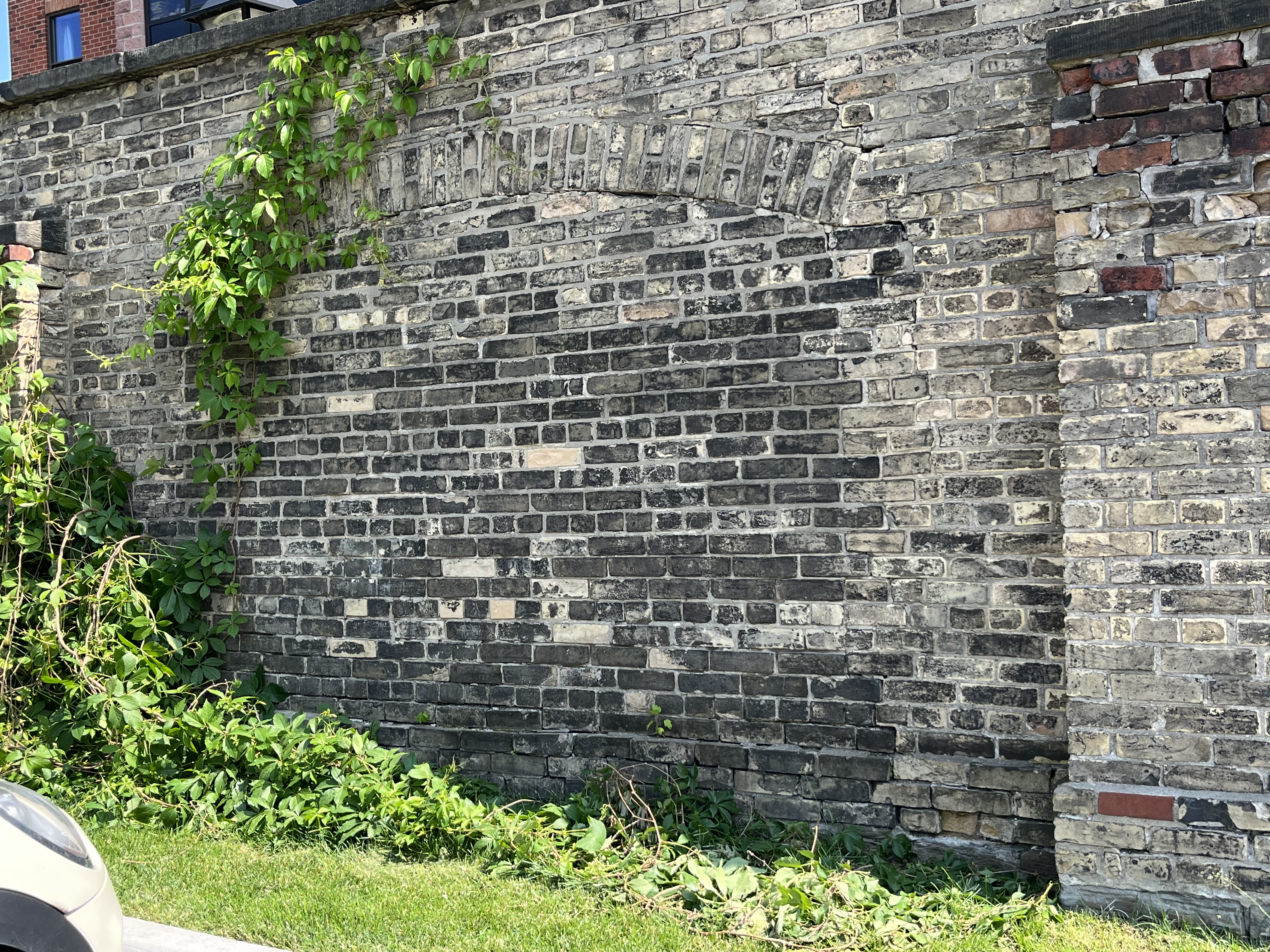
The original wall had a steel fence on top of it but in 1860 this was replaced with a stone cap. When the government sold 23 acres of the property for development, the east and west walls were taken down and moved in to enclose the remaining 27 acres. The bricks in the wall have been etched with people’s names, dates and various comments that record life within the walls. Over 260 inscriptions have been identified on these walls. The picture below shows a section of the southern wall that once had a gateway in it. The gate has been bricked in but the arched brick work still shows the size of the opening.

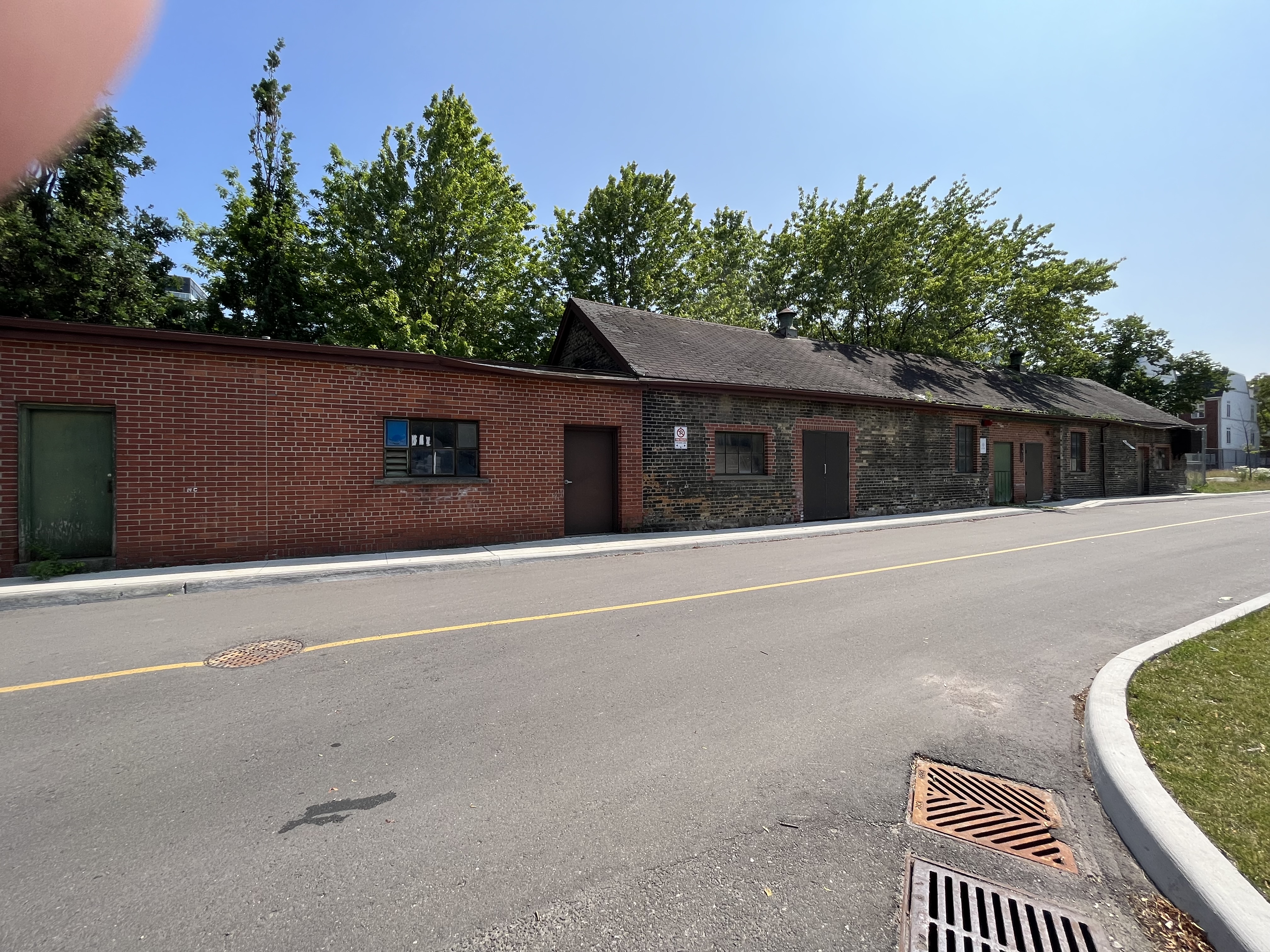
Most of the original buildings on the site have been demolished. Only two remain and they, like the wall, are now protected under an historic designation. The carpentry workshop building was operated by hospital employees who worked along side patients. These patients provided free labour which was used to help keep the costs of running the asylum down. Patients also worked in a sewing room making and repairing clothing. They worked in the kitchens and performed many other tasks involved in keeping the place running.

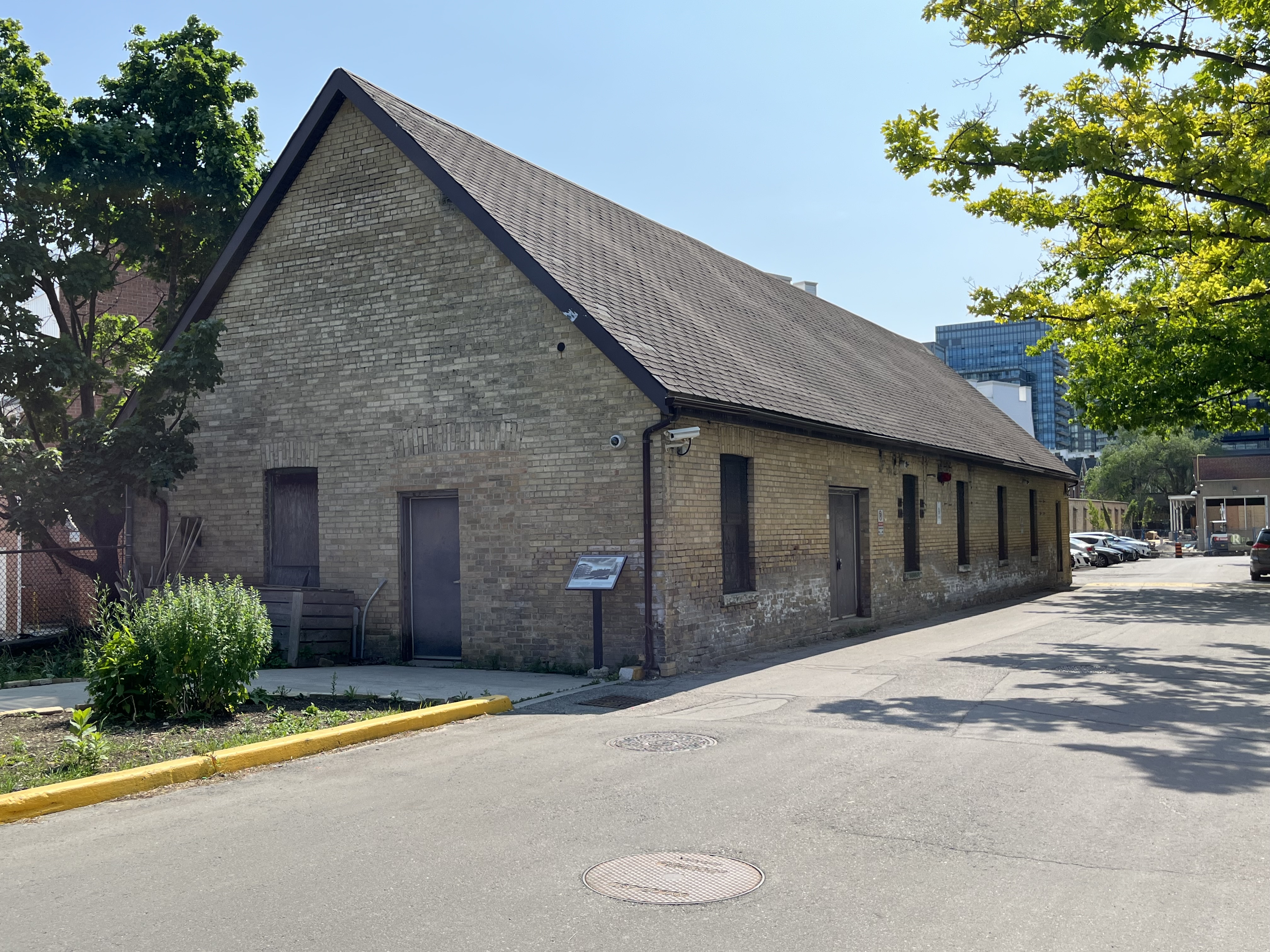
Like the carpentry building, the combined tin shop and mattress shop was built by male patients in 1898. One patient, identified as Jim P., worked in the tin shop from 1898 until he passed away in 1941. This meant that he provided 43 years of unpaid labour for the asylum. Men and women were housed in separate parts of the compound because it was feared that they would form relationships and give birth to children who would also have mental issues.

Over the years the name of the facility changed many times which reflects the attitudes of society toward the conditions of the patients. When it was opened it was known as the Provincial Lunatic Asylum. In 1871 the name lunatic was removed and it became the Asylum For The Insane. The name was changed to the Hospital For The Insane in 1907 and again to The Ontario Hospital in 1919. It became Queen Street Mental Health Centre in 1966. During the 20th century new buildings were added and in 1976 the original cluster of buildings were demolished. Then, in 1979 the street address was changed to 1001 Queen Street West to disassociate it from the negative connotations that 999 Queen Street had developed. Finally the hospital seen in the image below was given the name CAMH, or Centre for Addiction and Mental Health in 1998.

Meanwhile, a sister facility was opened in Mimico which was originally known as the Mimico Branch Asylum. Constructed with labour from the patients at 999 Queen Street it was opened in 1890. We have covered it in detail in a separate post that can be found at the link above. There were several other buildings on the site and these can be seen in a series of information plaques which are placed around the walls. The image below is of the superintendent’s house where women patients worked on laundry, cooking and other household chores.

People were locked up inside the walls of the asylum for many reasons, only a few of which would be considered actual mental disorders in today’s society. You could be admitted for suffering from grief, reading too much, fasting, slander and unemployment. Sunstroke, defective diets and masturbation could also land you in here, perhaps for the rest of your life.

The remaining walls are now preserved as a testimony to our past and the attitudes that society had with regards to those who suffered from mental disorders.

Related stories: Toronto’s Early Banks, Colborne Lodge, Mimico Branch Asylum

Google Maps Link: 999 Queen Street West

Like us at http://www.facebook.com/hikingthegta

Follow us at http://www.hikingthegta.com
Also, look for us on Instagram

Spirit Rock Conservation Area

July 13, 2024

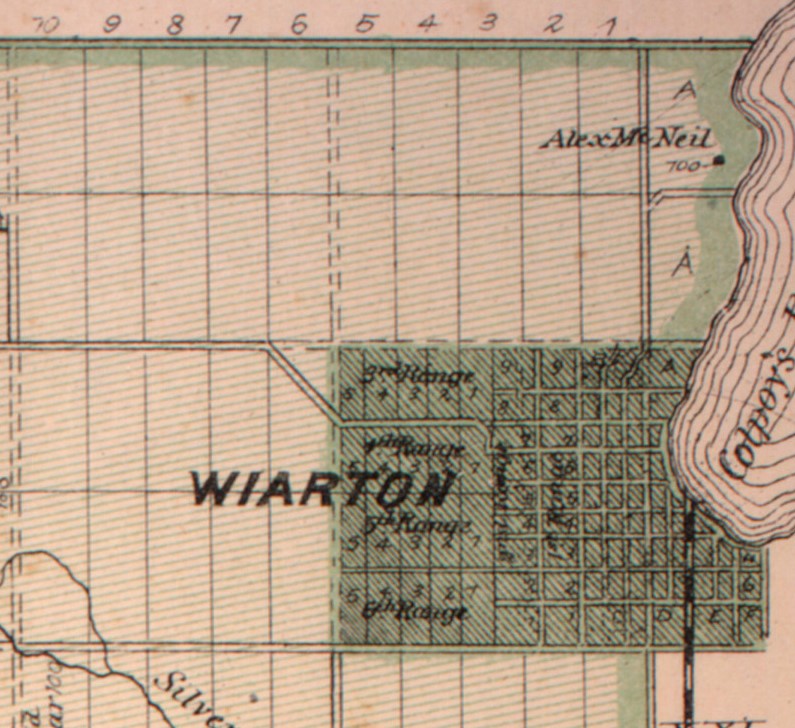
Alexander McNeill was born in The Corran, County Antrim, Ireland on May 10, 1842. When he was 30 he married his second cousin Hester who was recently widowed. That same year of 1872 they emigrated to Canada and settled on his brother-in laws farm in Elderslie Township. Hester and Alexander lived there until 1881 when he bought a 300 acre property just north of Wiarton. Alexander was a member of the Liberal-Conservative party and was elected to the House of Commons for the riding of Bruce North in 1882. He held this seat through the next 4 elections but his victory in the 1900 election was overturned the following year and he was never re-elected. The map below is from the 1882 county atlas and shows the McNeill property just north of Wiarton on Colpoy’s Bay.

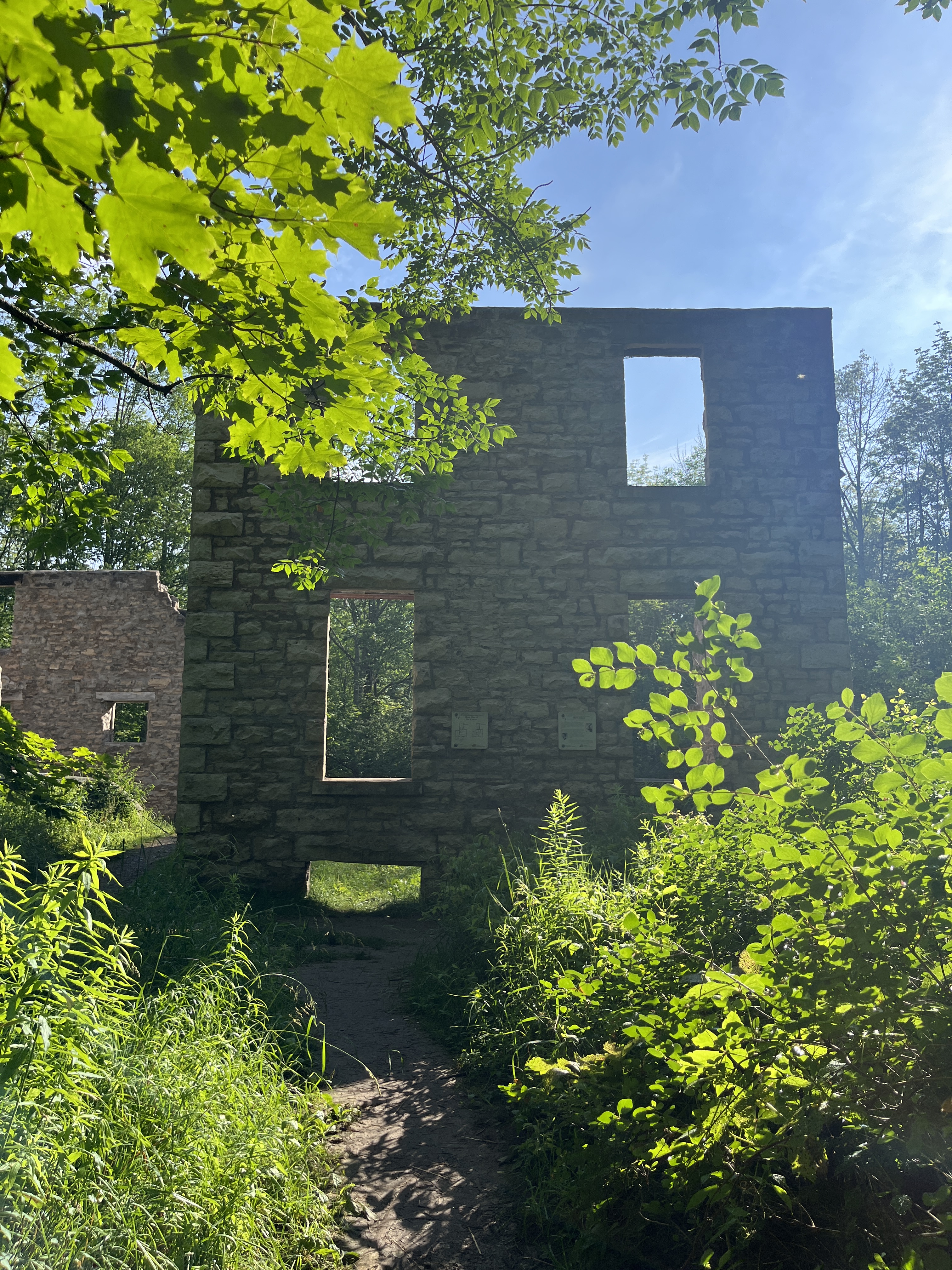
In 1882 McNeill commissioned a mansion for himself and Hester which was designed to have 17 rooms. It was the first estate mansion to be built in Bruce County. He called the 300 acre estate and the mansion The Corran after his birthplace in Ireland. It took several years to build and Hester died in 1890 before it was complete. Alexander was left with his 16 year-old son Malcom whom he willed the estate to when he passed away.

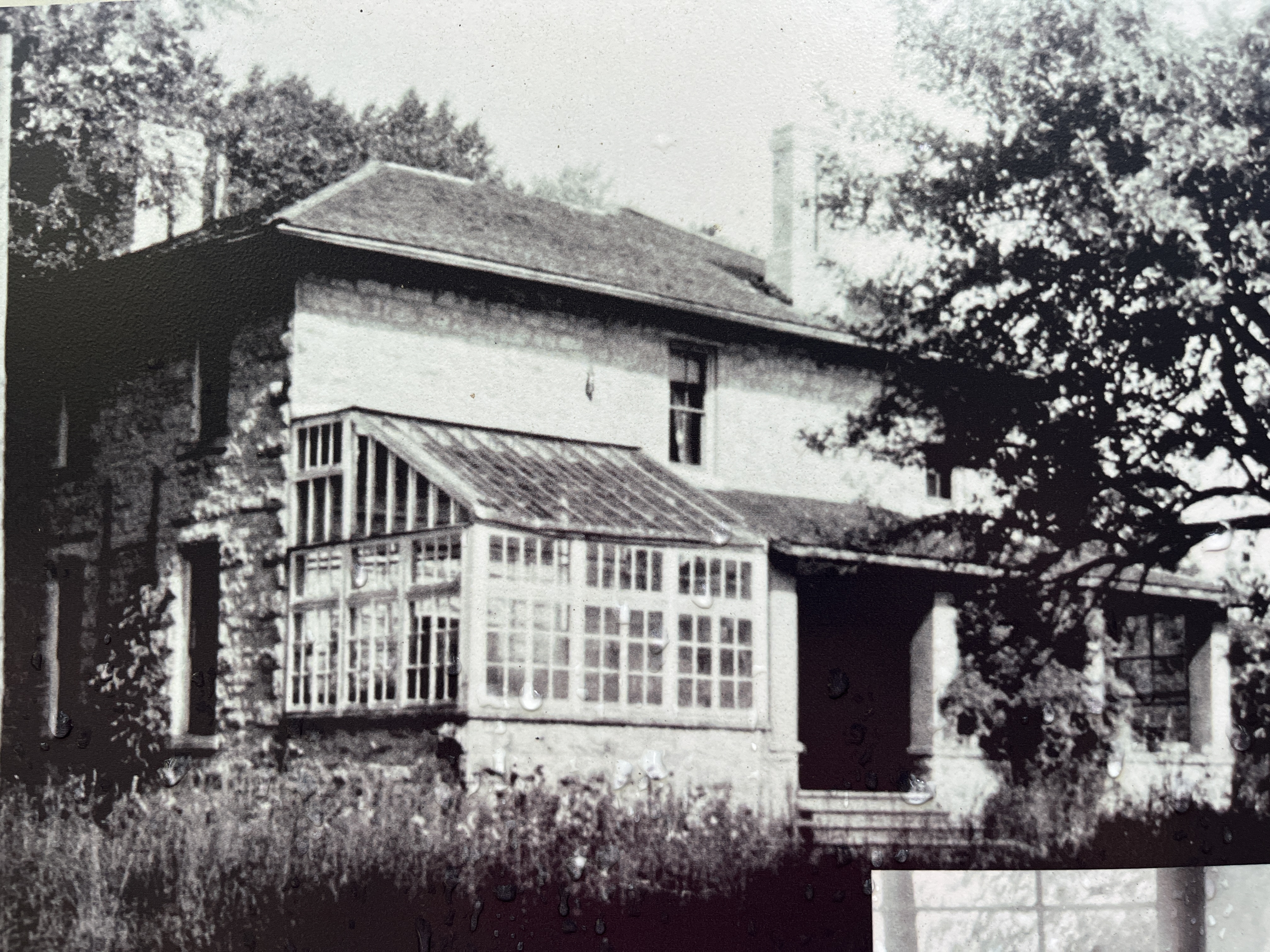
There were three acres of gardens which included over 500 rose bushes. Alexander couldn’t maintain it and serve as an Member of Parliament in Ottawa at the same time. So, he asked an old friend Alfred Lewis to move from England with his family and become the estate manager. The historical image below shows the estate in its prime. The front entrance and steps were crossed by many famous politicians and prominent citizens over the years.

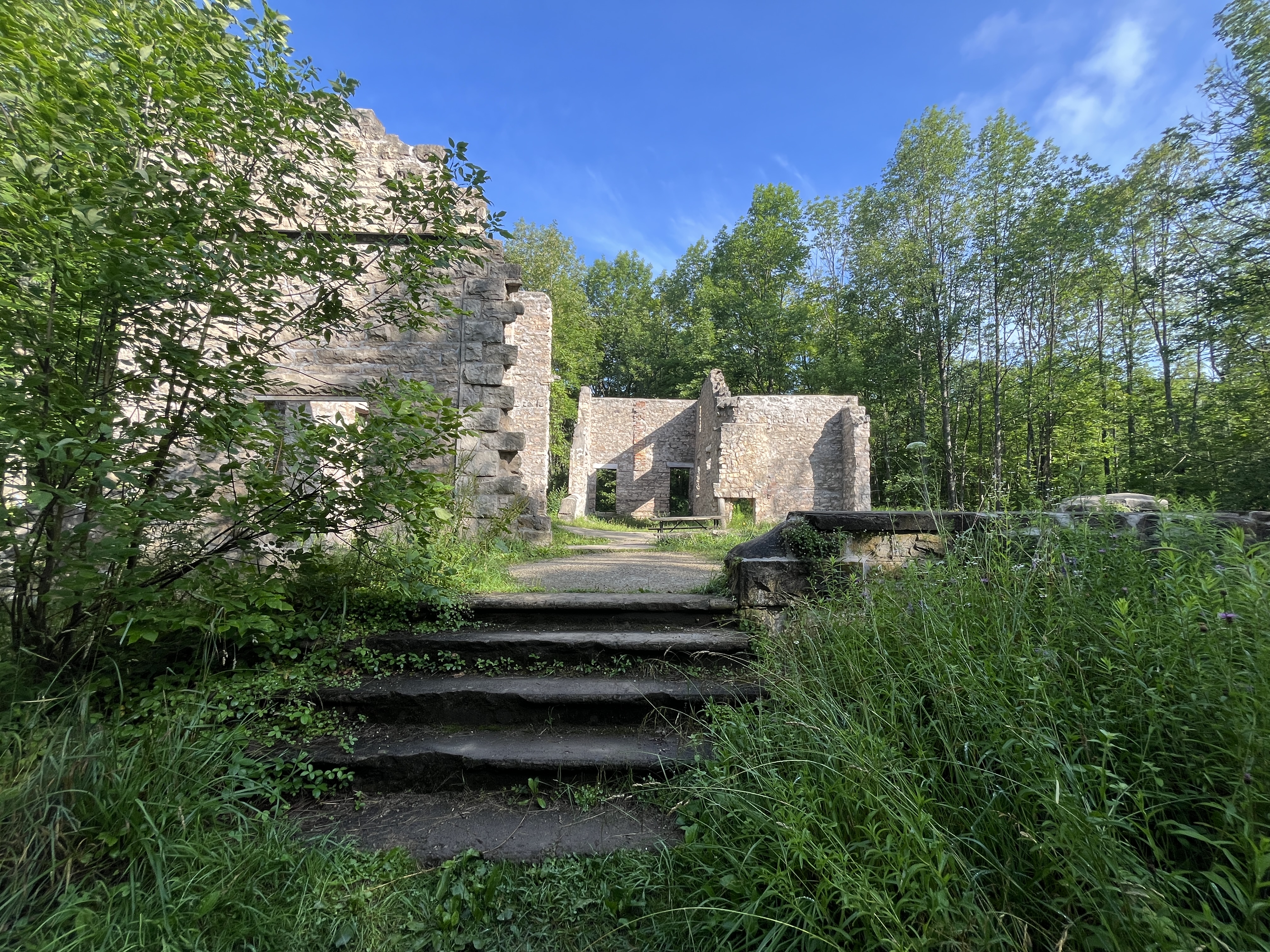
The same front steps can be seen in the image below. Lavish parties were hosted in the gardens and amongst the roses and peonies. Over 500 fruit trees were also planted on the grounds. One such party was held on July 1, 1901 when guests enjoyed violin music in the gardens.

Alfred Lewis was killed in 1931 when he was hit by a car. This was the very first hit and run accident causing a fatality to occur in the Bruce Peninsula. Alexander McNeill died on April 18, 1932 and left the property to his son Malcom, who had never married. Malcom was too generous with his newfound fortune and soon it was disappearing on him. He eventually had to sell off 20 acres of the estate to pay back taxes. When Malcom passed away in 1956 he left the house to his longtime housekeeper Sally Simmons. By the time the estate debts were settled, there was little money left and Sally closed up most of the house and lived in the kitchen. She sold the house to a man from Willowdale in 1960. Since he didn’t live in the house it was easy for vandals to access because of its secluded location. By 1964 the house was in bad shape with all the windows broken and most of the interior stripped away. Grey Sauble Conservation bought the property in 1971 but the break-ins continued until 1976 when the house burned down in a final act of vandalism.

Alexander ran a successful cattle breeding farm which raised Durham Shorthorns from England. The cattle barn is gone but the stone foundations remain a short distance from the house.

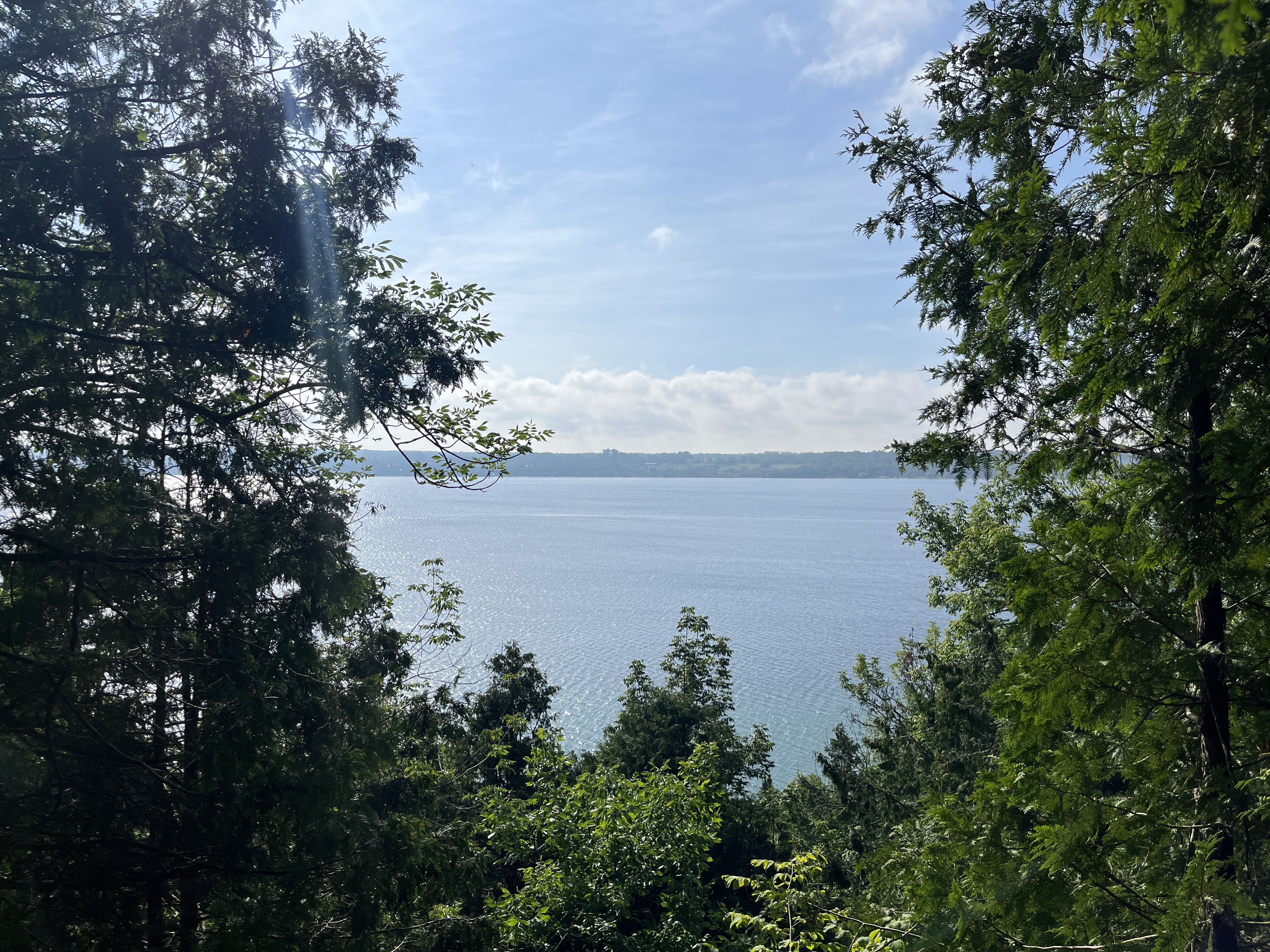
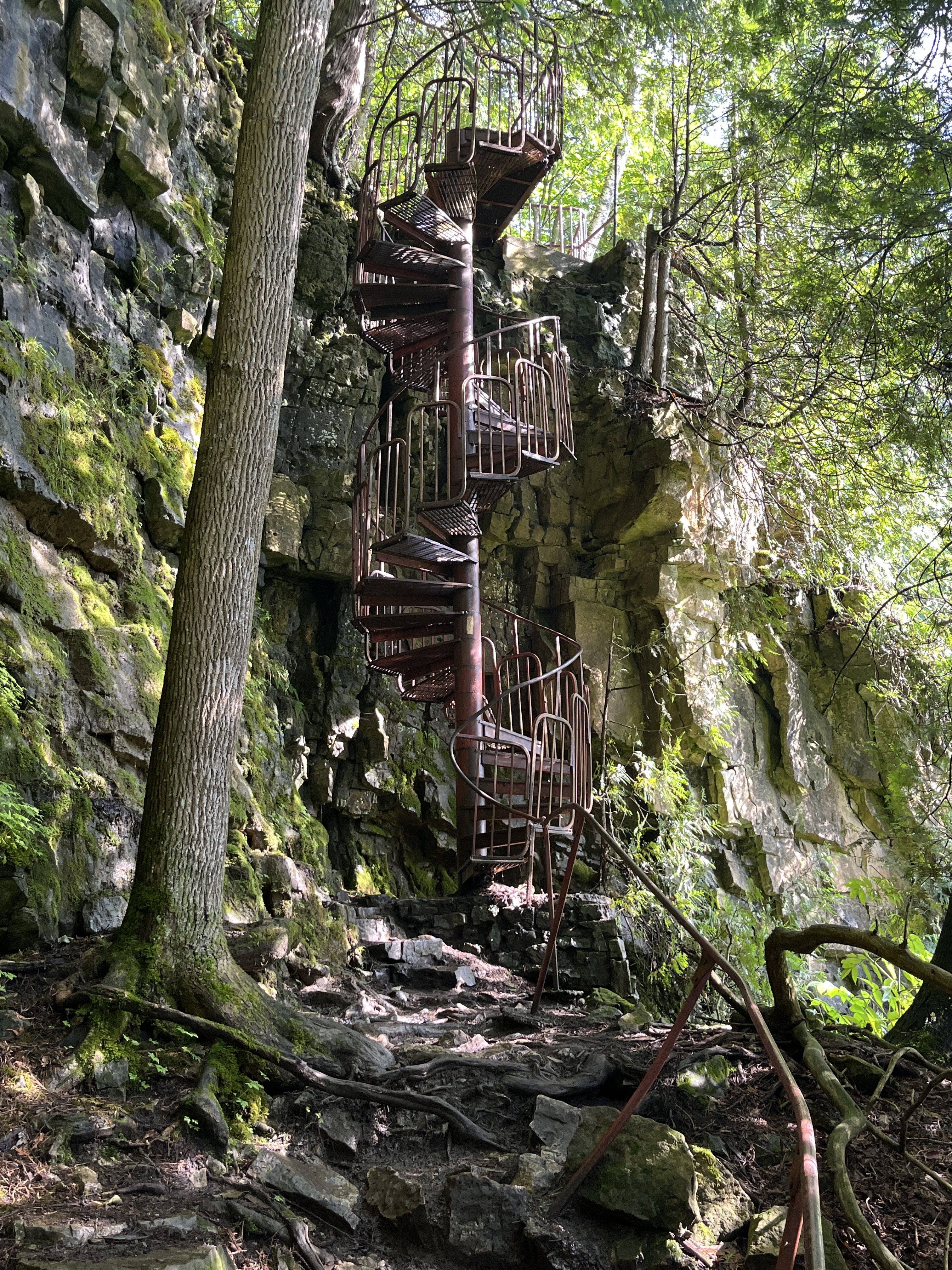
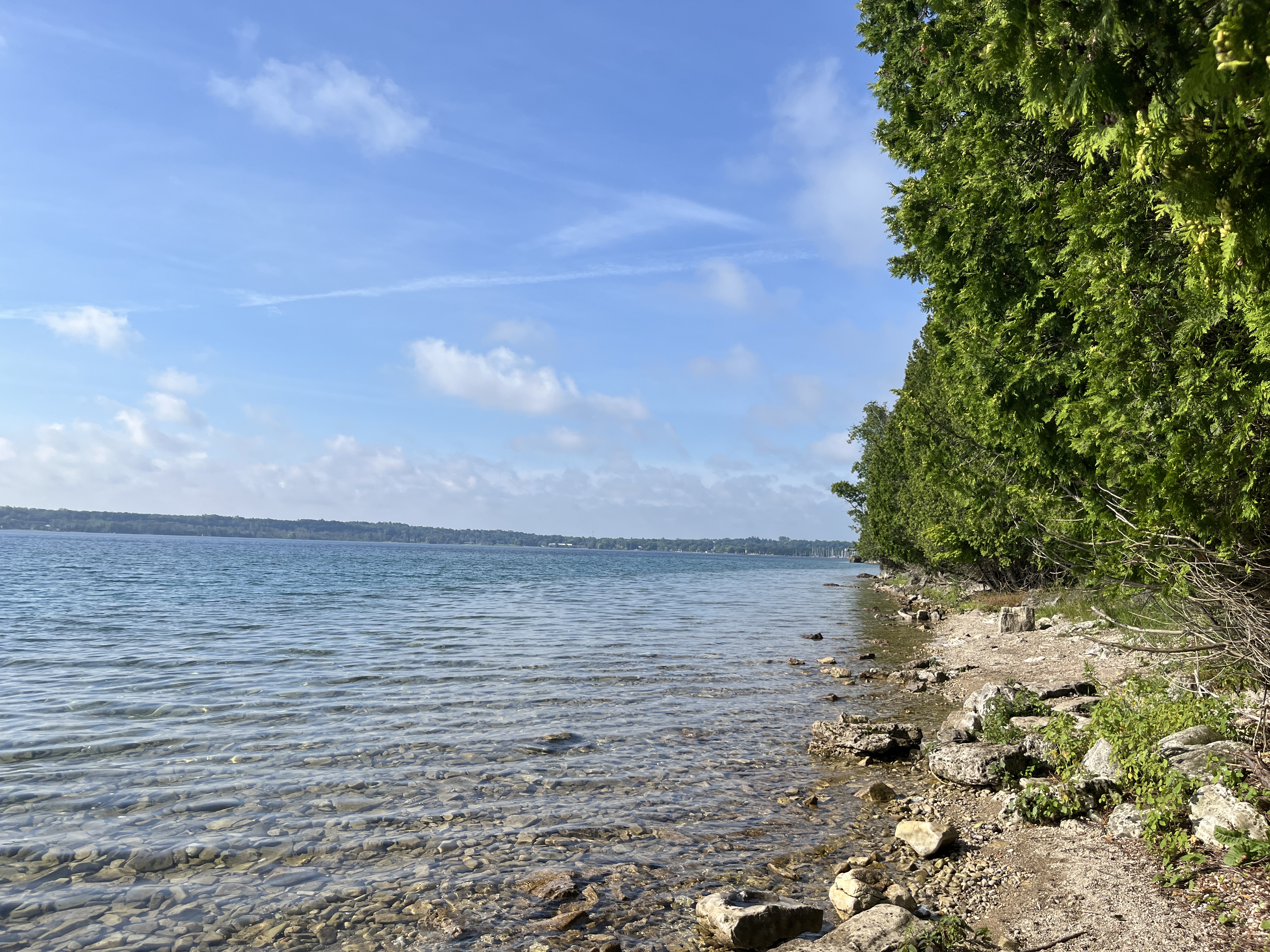
The estate was built with a beautiful view of Colpoy’s Bay and there are over 5 kilometres of trails that wind through the park, which has become known as Spirit Rock Conservation Area. The Bruce Trail passes through the estate as well as the Spirit Rock Trail. There are several great places to look out over the bay including the Spirit Rock Lookout. Because I was visiting the park for a short time before I had to go to a nearby inspection I didn’t have time to get to the lookout. Instead I headed for the spiral staircase where I was rewarded with the view in the image below.

The Spiral Staircase makes 3 turns and used 30 steps to bring you down the first steep section of the escarpment.

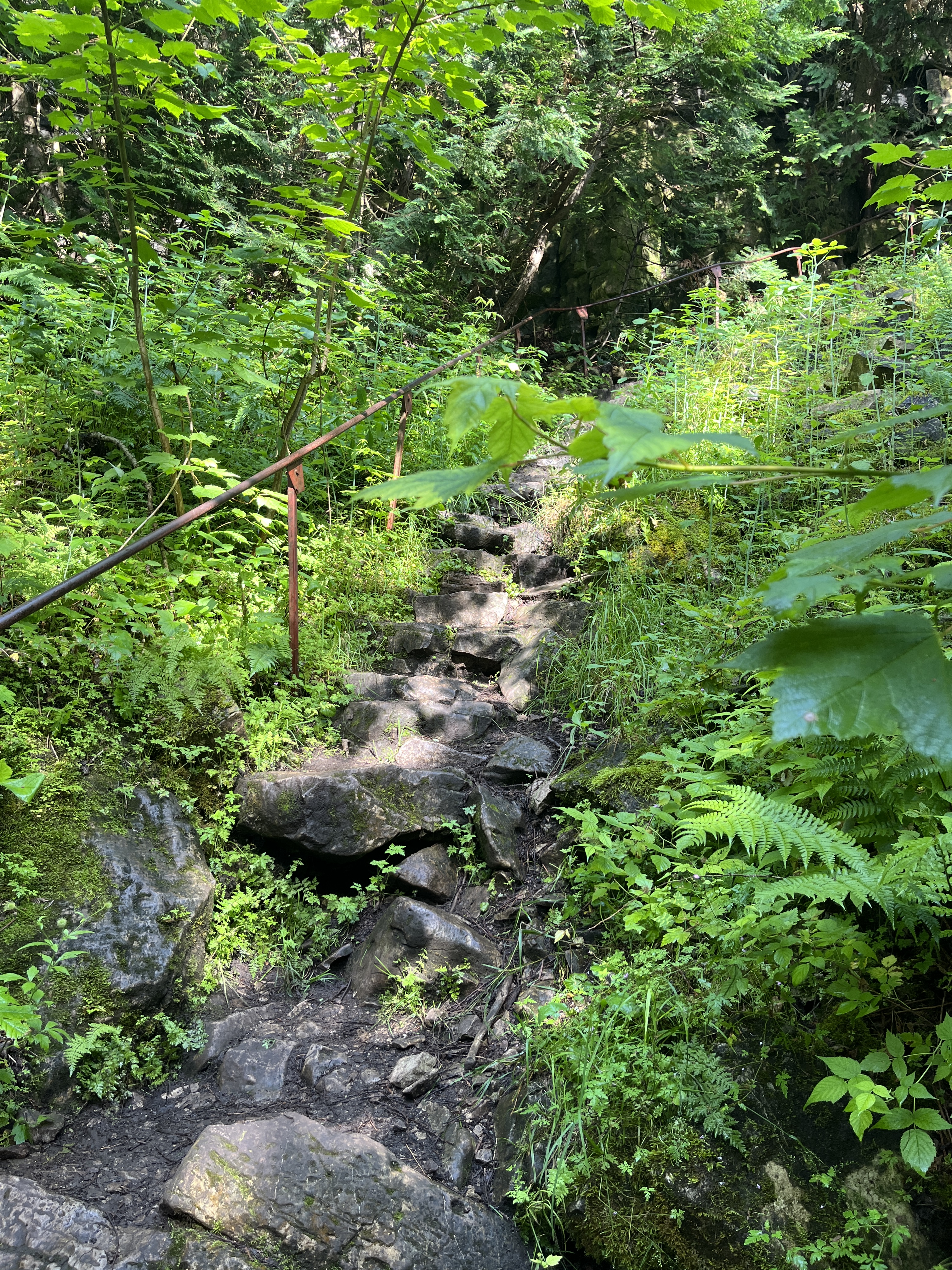
You are left with a mildly challenging section of trail that leads down to the Lake Huron shore. Fortunately, there is a handrail here. The footing was slippery on the morning that I visited and I was glad for the handrail. The mosquitos were famished and I was bitten about 30 times in 30 minutes.

The trail continues along the lakeshore but a lack of time and excess of mosquitos led me to decide to go back to the car. I previously hiked through this section of the Bruce Trail on a short vacation to the Bruce Peninsula in the early 1990s and enjoyed it then.

Spirit Rock Conservation Area has a $10 per day parking fee but the trails and history are well worth exploring.

Google Maps Link: Spirit Rock Conservation Area

Like us at http://www.facebook.com/hikingthegta

Follow us at http://www.hikingthegta.com
Also, look for us on Instagram

Fort Henry

July 6, 2024

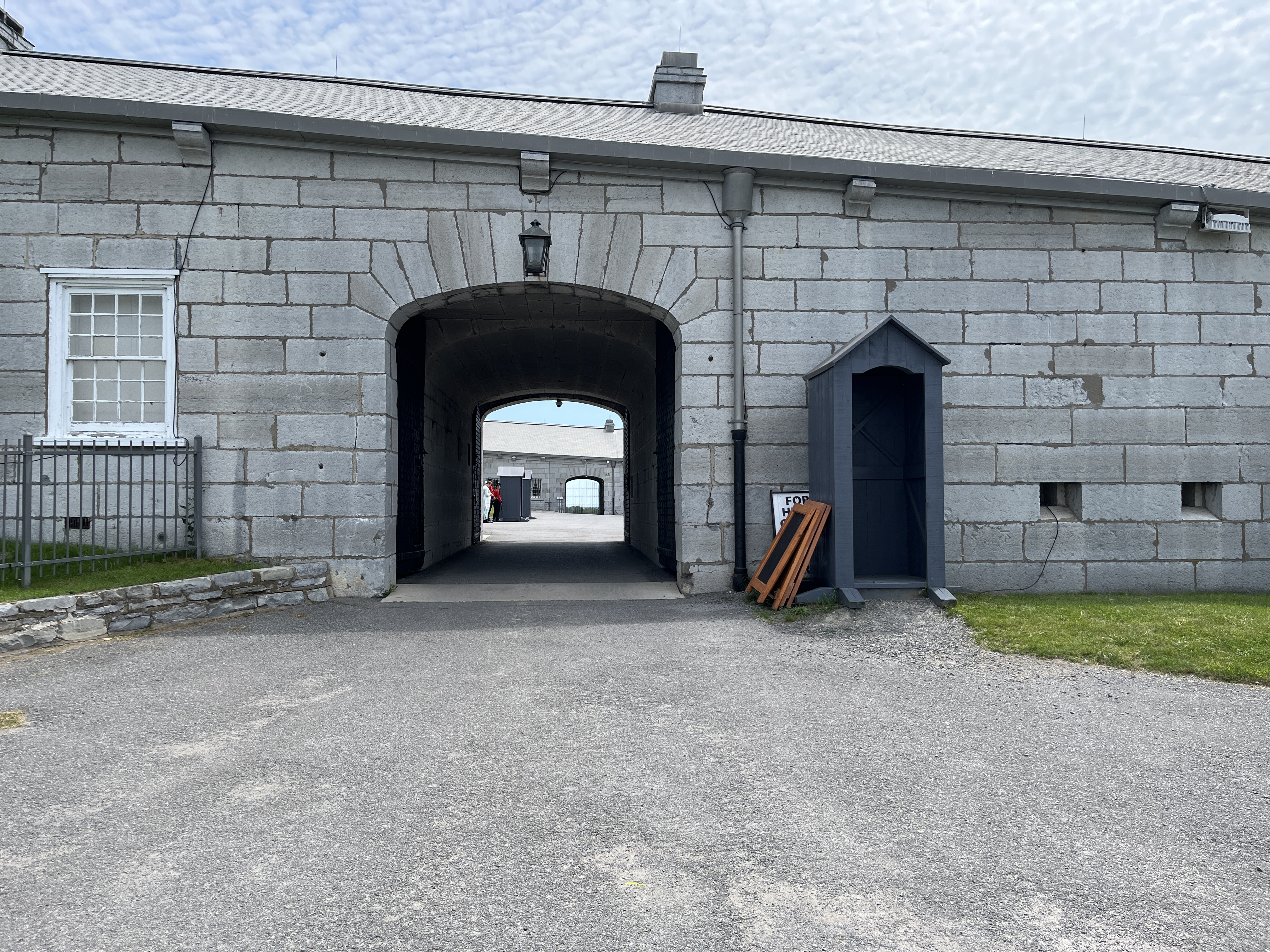
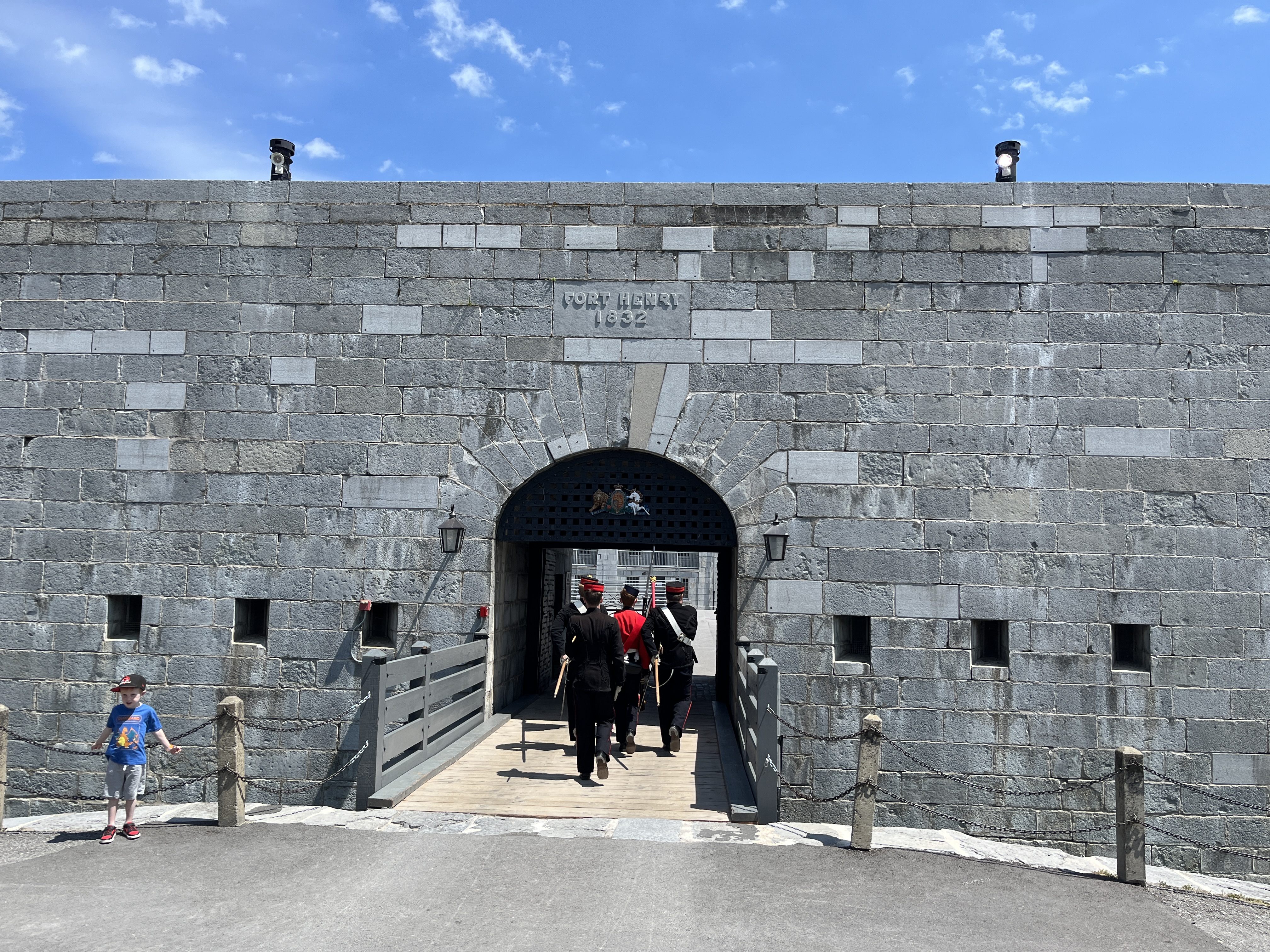
During the War of 1812 the British built a fort on Point Henry in Kingston with the purpose of defending the naval shipyards located near the mouth of the Cataraqui River. When this war finished in 1814 a period of infrastructure building was undertaken in response to possible future threats. One of these projects was the Rideau Canal. Due to the need to defend the canal, a new fort was built between 1832 and 1837 on the site of the earlier Fort Henry. This new fort was occupied by the British until 1870 when responsibility for self defense was passed on to the newly created Dominion of Canada. The Canadian military garrisoned here until 1891 and then the fort was abandoned for several decades during which time it fell into disrepair. In 1936 it was restored and then opened as a military museum. Fort Henry was the largest fortification west of Quebec city and cost the equivalent of $35 million dollars to complete. The image below shows the main gates, which could be closed with a set of double doors.

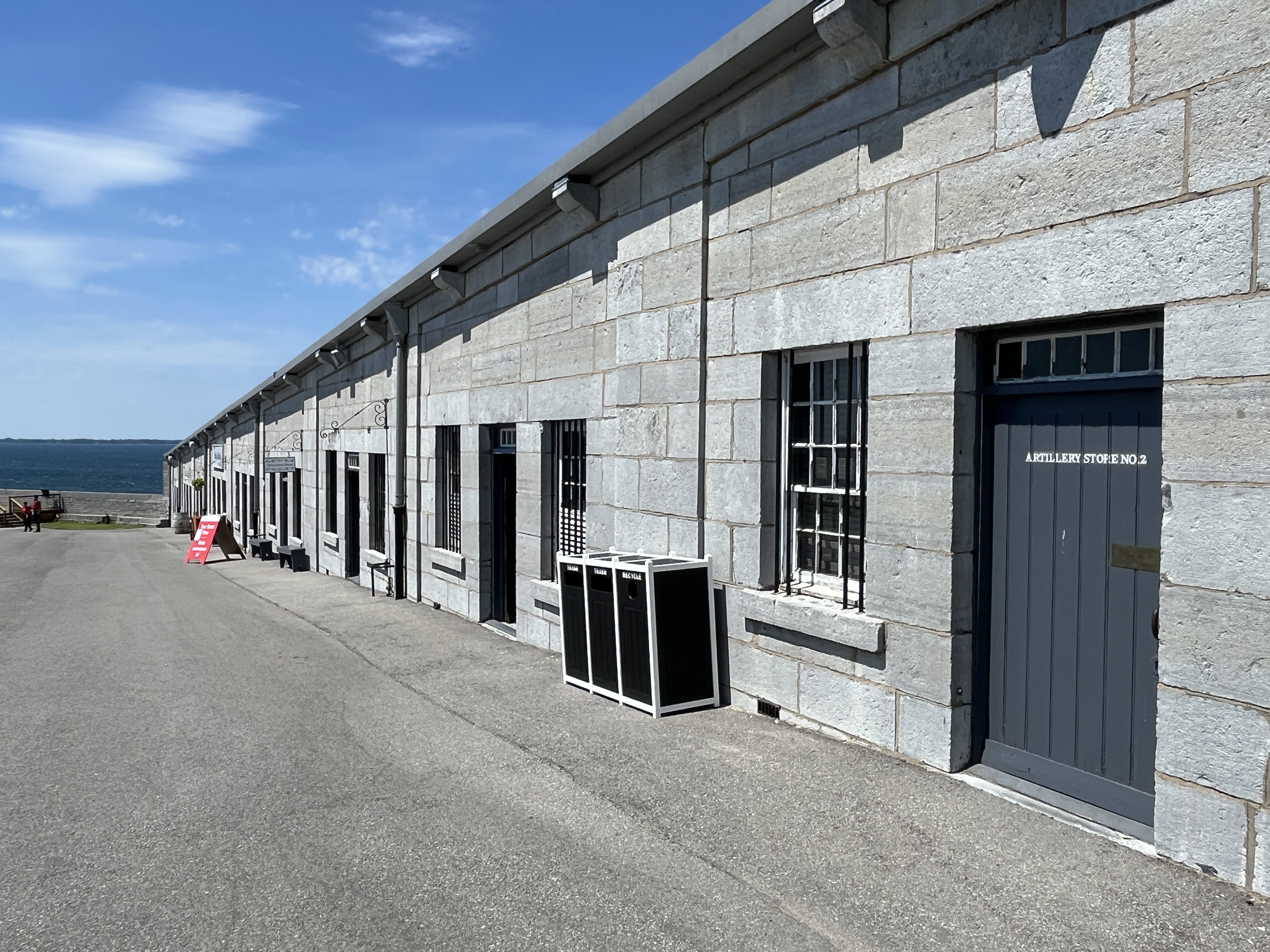
The upper fort, or advance battery, was initially separate from the main redoubt. It had 32-pounder guns that protected the entrance to the naval dockyards as well as Kingston Harbour. It had two lengthy buildings, one of which can be seen below, which held the Commissariat Stores. These rooms held various functions that were not required to be in the main redoubt. Today they house a restaurant and a few shops including the souvenir stand. Each room has an arched ceiling that was called a casement. These were deigned to protect the occupants from the effects of explosive cannonballs.

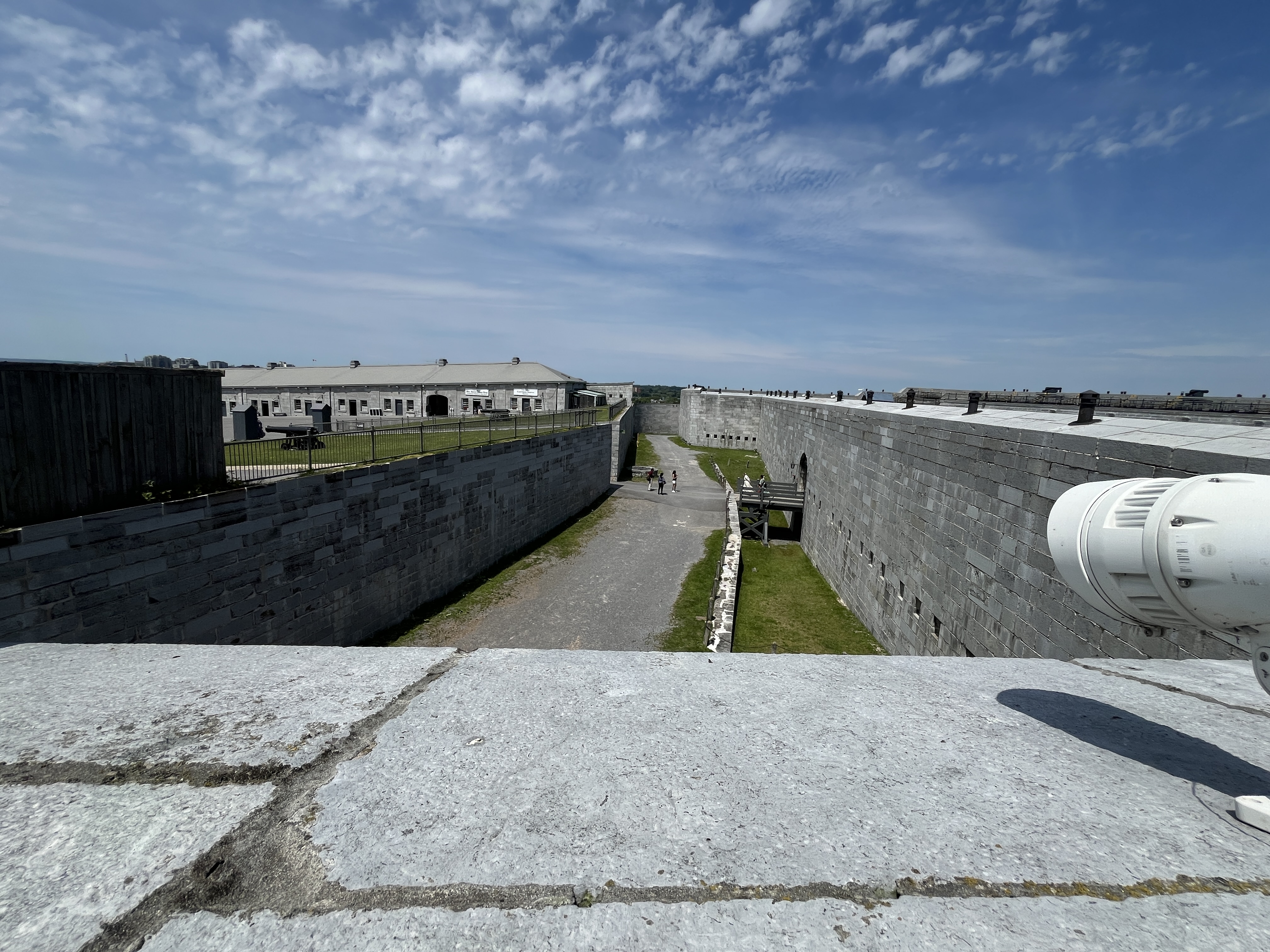
A dry ditch surrounds the entire fort and separated the upper and lower parts. It was designed to be difficult to cross. It was 12 metres wide and 9 metres deep with the facing made of cut stone blocks. If attackers got into the ditch they would face rifle fire from the little loopholes that lined the walls.

The main redoubt, or lower fort has only one entrance from the upper fort. It is protected by a drawbridge that could be closed if the upper fort was compromised. A date stone above the door reads “Fort Henry 1832”.

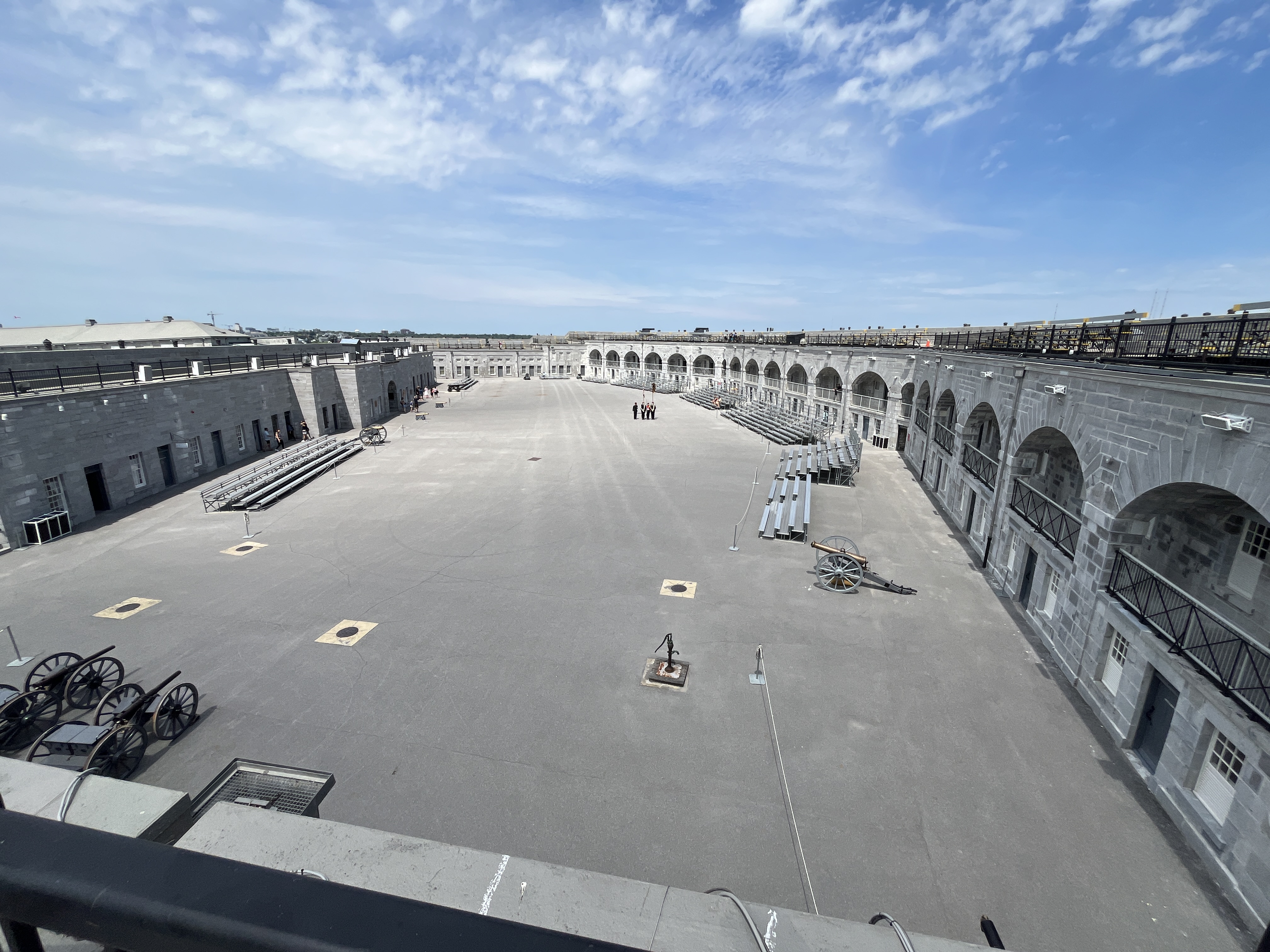
The central part of the lower fort was known as the parade square. This is where the infantry soldiers drilled and also where special events took place. The upward firing mortars were located here as well. Under the parade square were five large cisterns which held the forts water supply. This water served all the needs of the fort including a supply that was held behind a sluice gate. Occasionally the gate would be opened and water would rush through the men’s and women’s privies. This would flush the waste through a tunnel and into the Navy Bay.

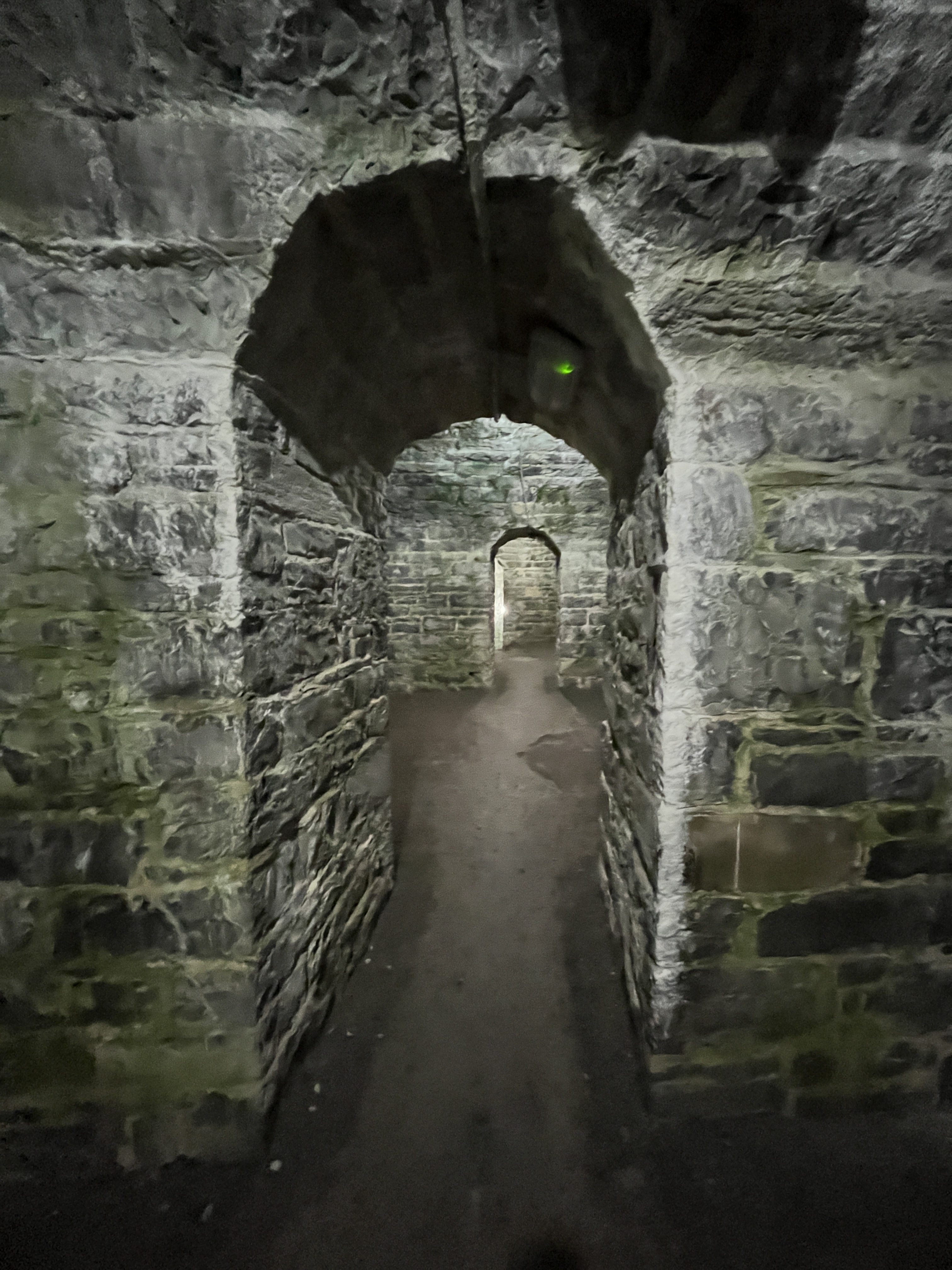
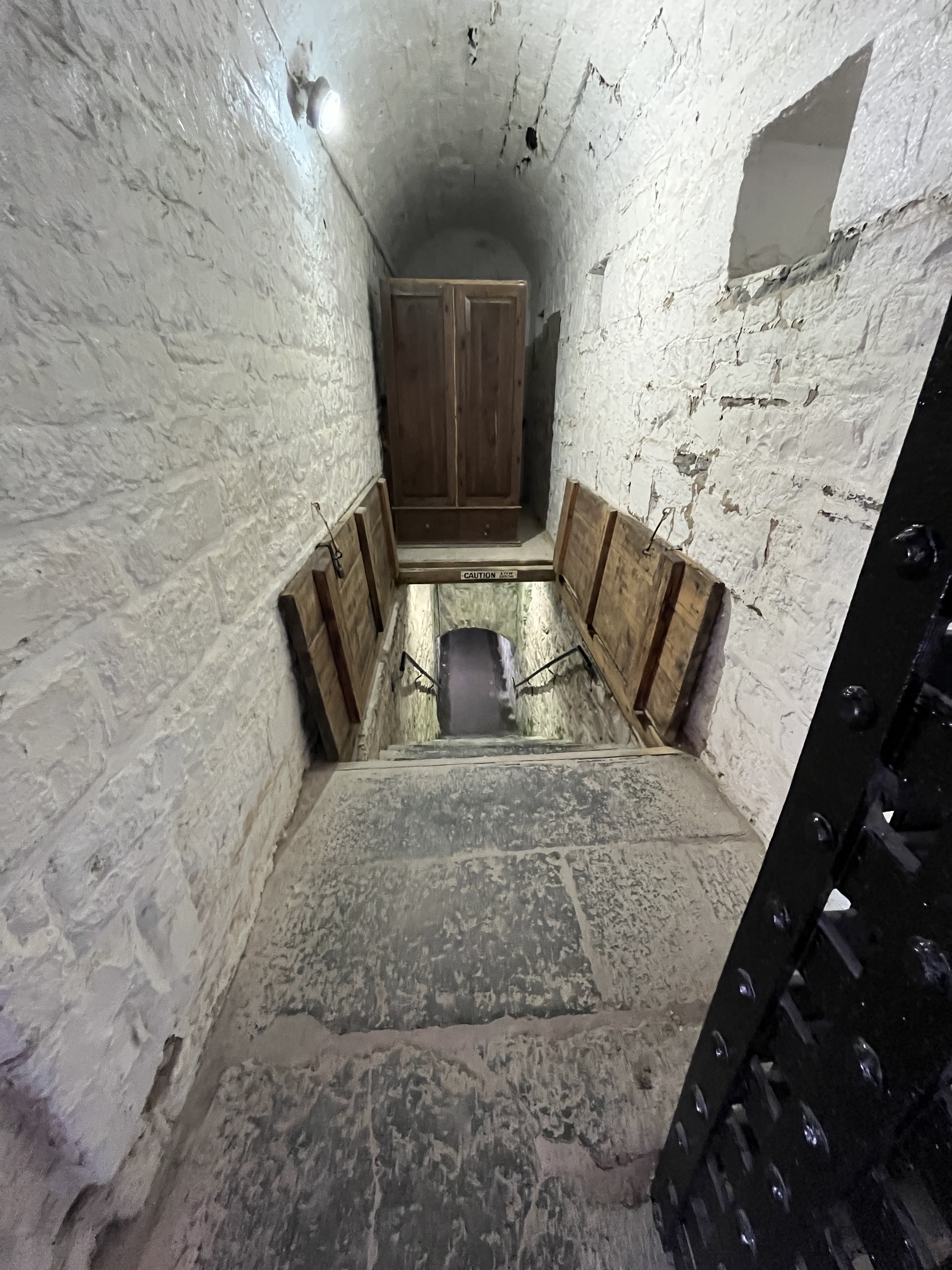
There are a series of tunnels through the walls which connect the guns on the roof to the soldiers quarters which were located on the second floor. They also connected the reverse fire chambers to the rest of the fort. The lower floor of the main building contained things like the officer’s quarters, cookhouse, schoolroom and bakery.

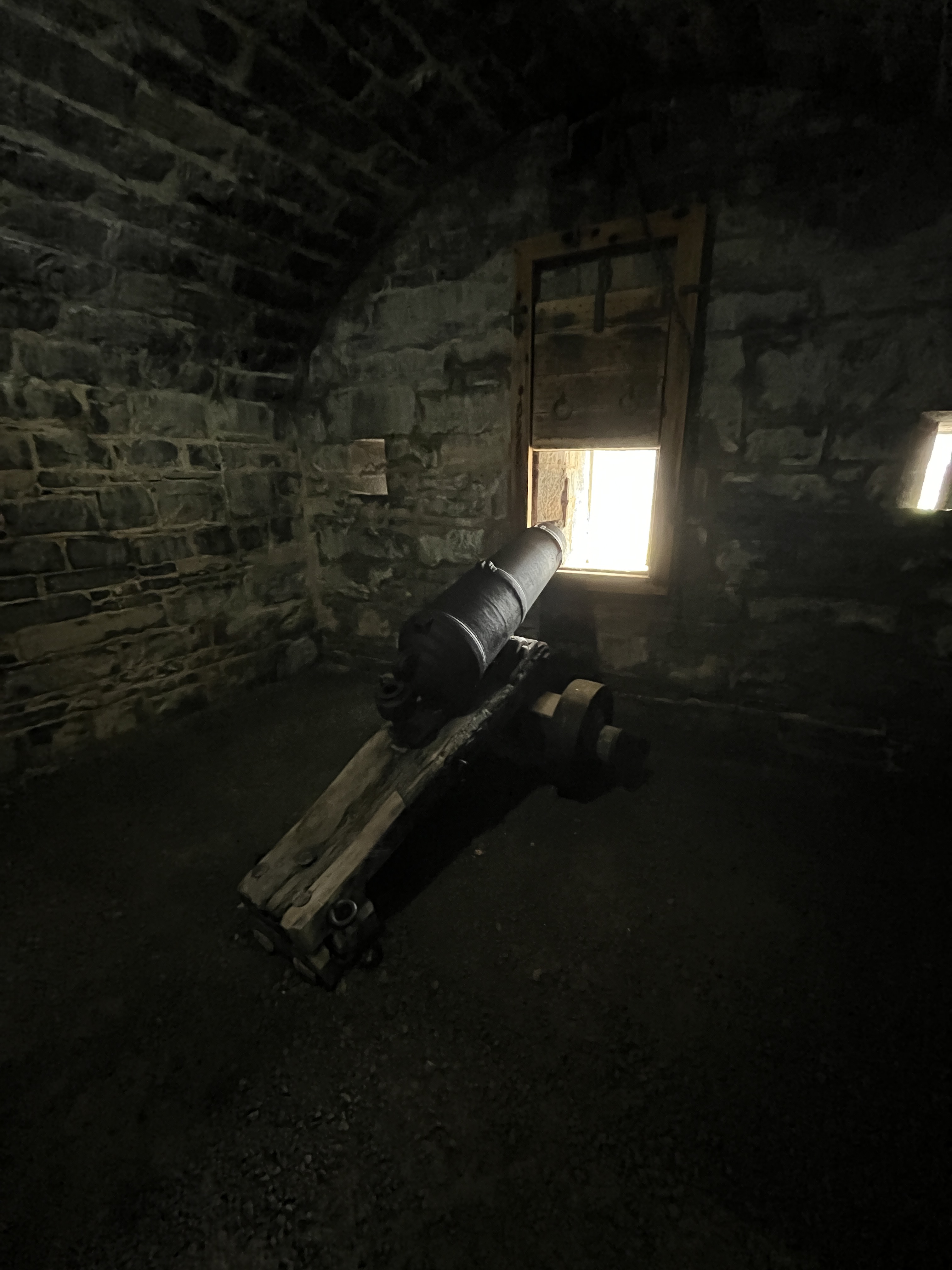
Hidden inside the north-west and north-east walls were reverse fire chambers. Each side had three gun ports that faced the redoubt’s walls. This meant that any attacker who tried to cross the dry ditch or scale the walls would face fire from 18-pounder cannonades.

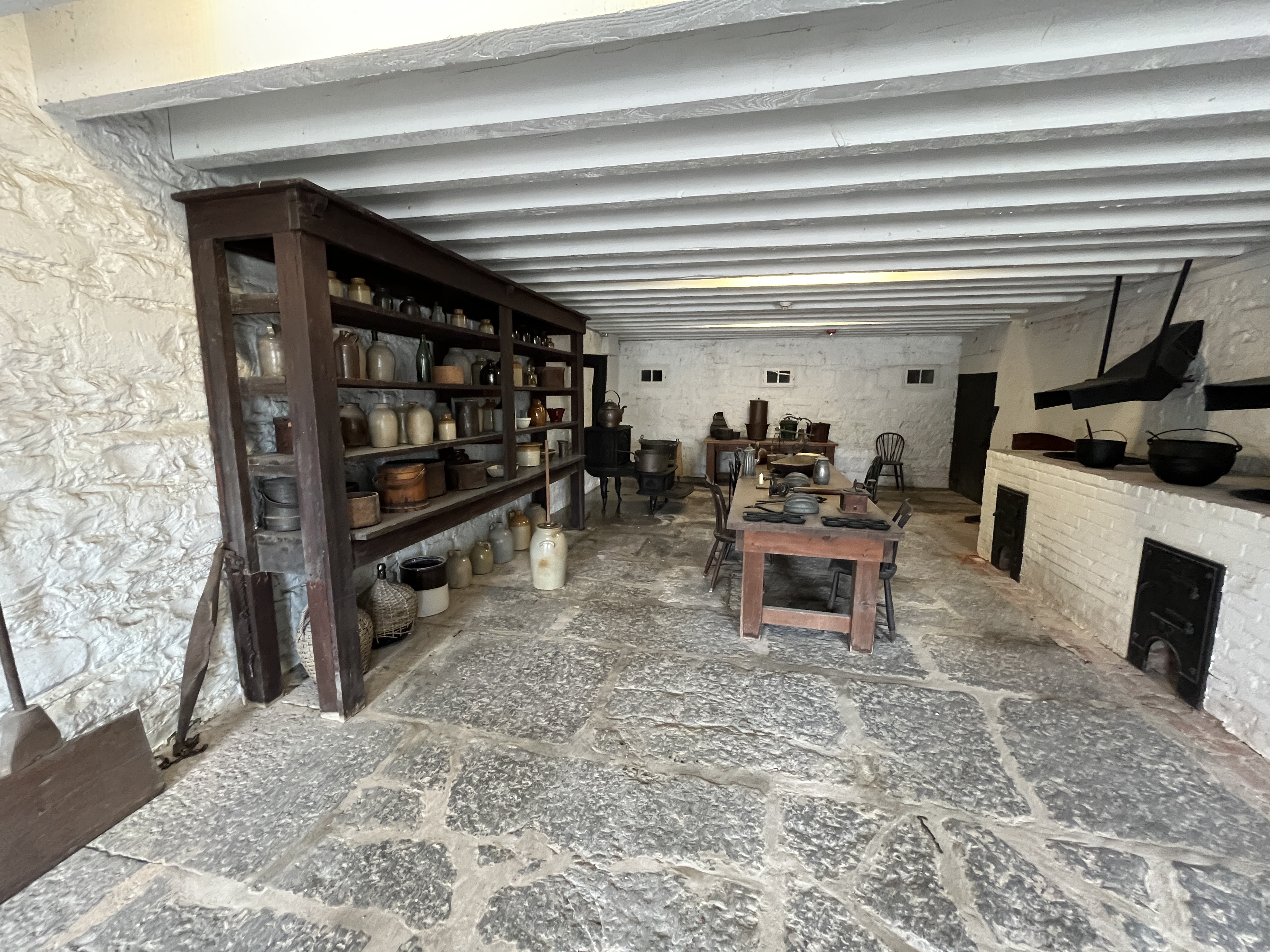
The cookhouse, along with the bakery, was set up to ensure that the soldiers could continue to be fed in the case of a siege. Each solder had a daily ration of about 1.5 pounds of bread, 1 pound of potatoes and 3/4 pound of meat. They also got rations of coffee, tea, sugar and beer or wine. A beef stew was the main meal that was prepared and unmarried soldiers took turns being the company’s cook. They took on a week’s duty but were often lacking in cooking skills and didn’t prepare the best of meals.

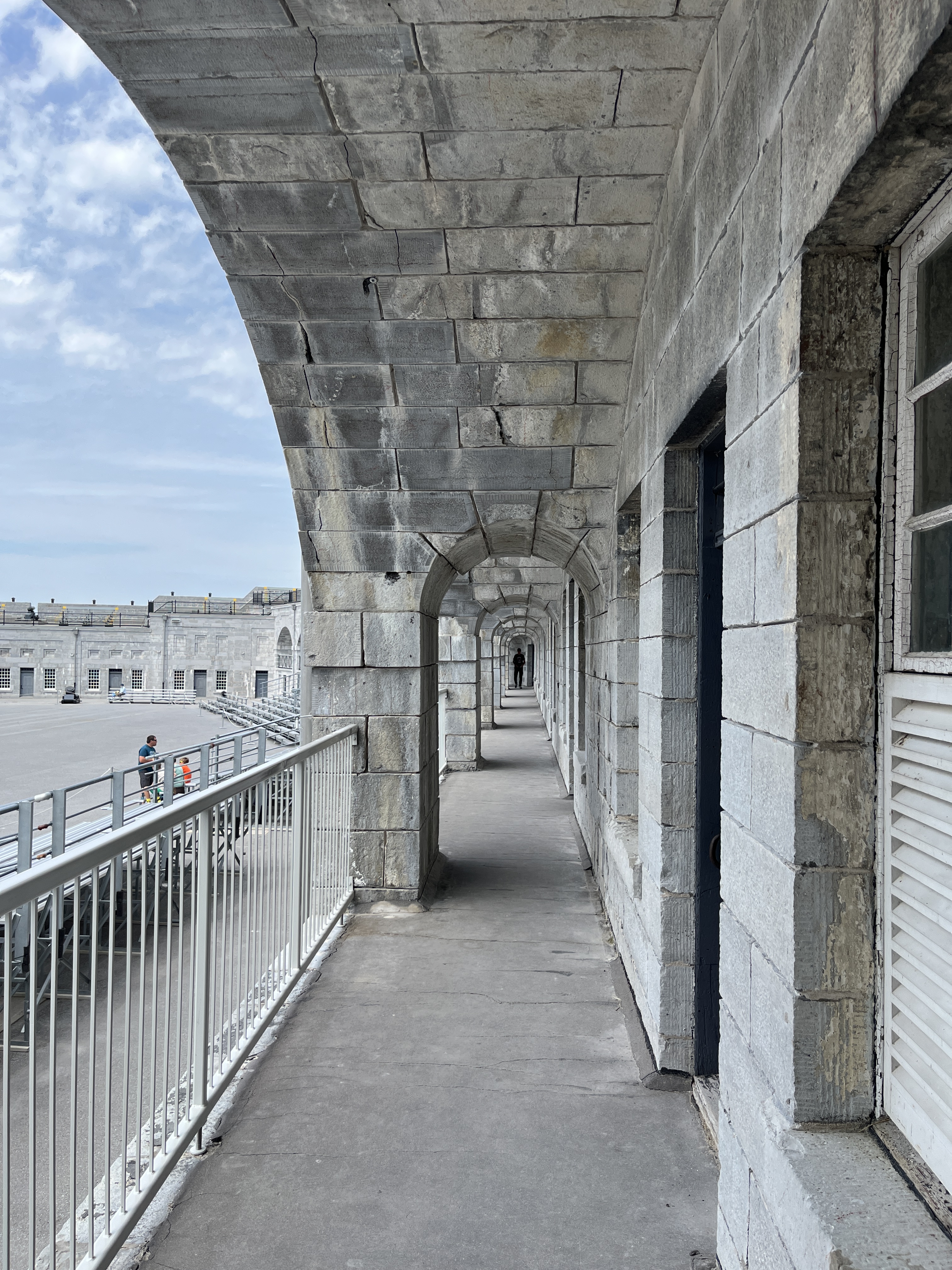
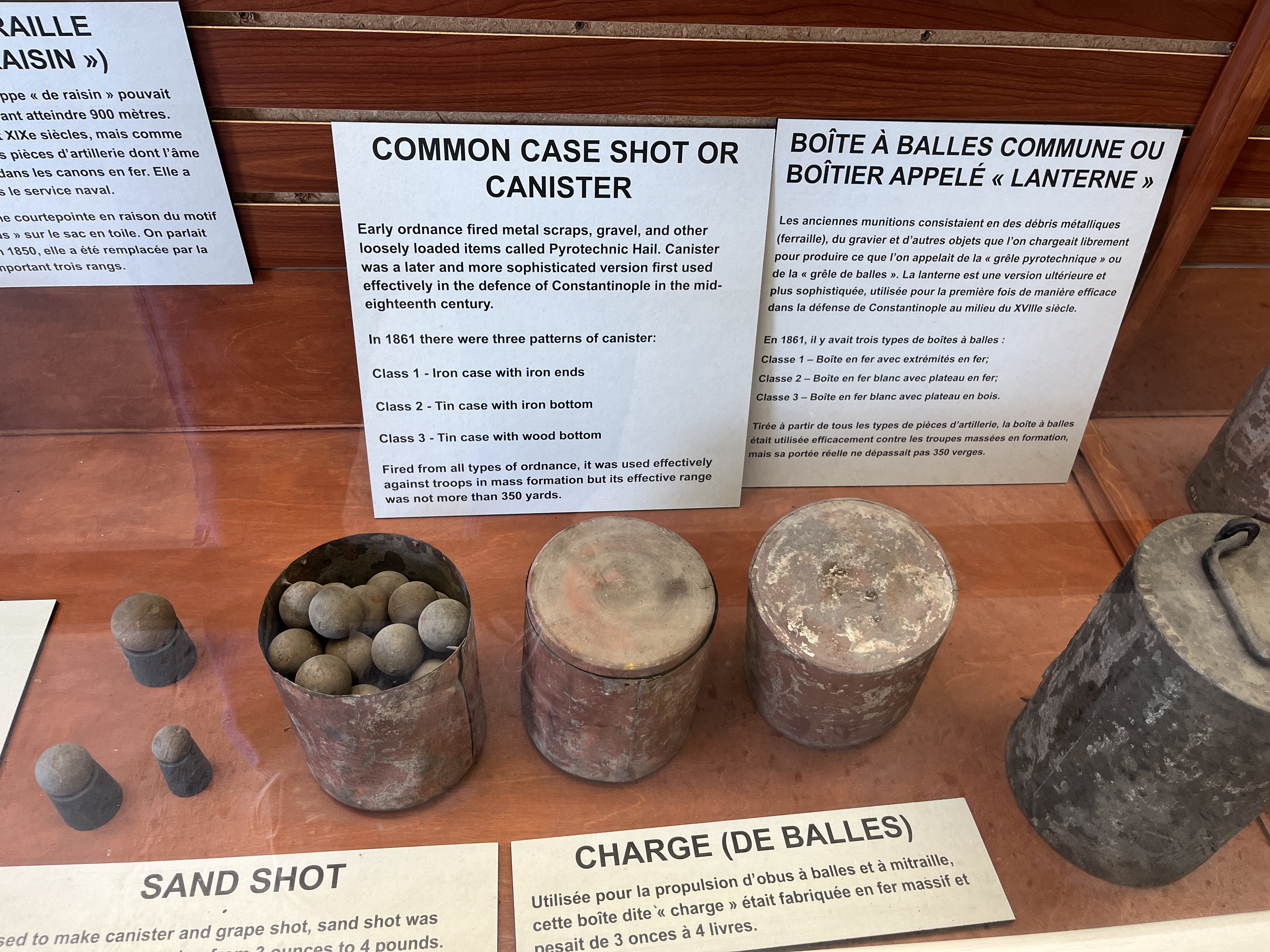
The balcony rooms on the second floor of the north wall originally housed the soldiers quarters but have been converted to display museum exhibits. These detail various parts of Fort Henry’s history including weapons that were typical of the British military of the period.

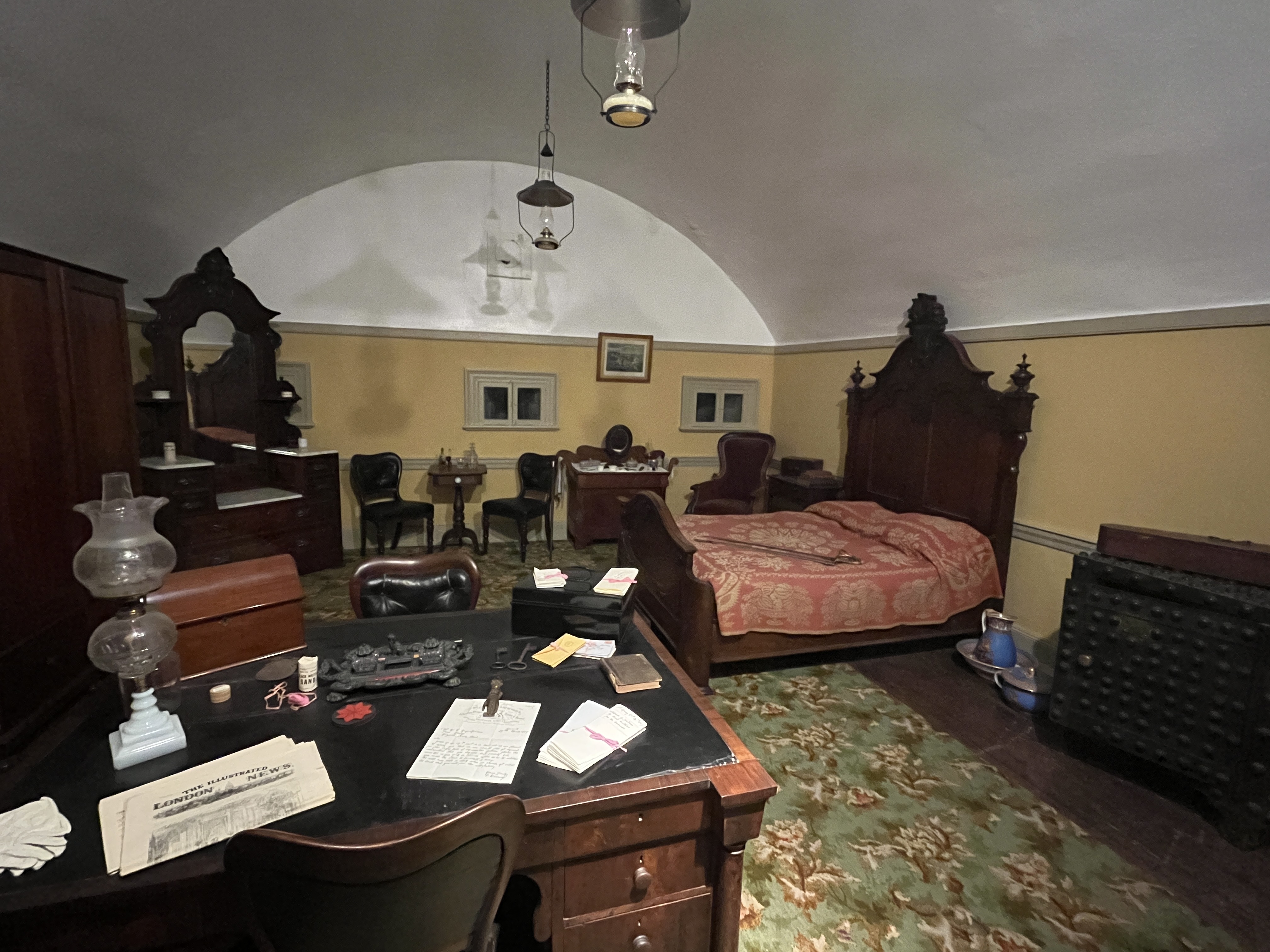
The Commandant’s quarters have been furnished to illustrate how the Captain who was responsible for running the daily operations of the fort lived. Their quarters also served as their office and a lot of paperwork was required. Important documents were tied in “red tape” and sent by military courier to headquarters in Quebec or on to England.

The museum exhibit that shows the weapons used over the decades is particularly interesting for anyone who is interested in the evolution of the methods of killing opposing soldiers.

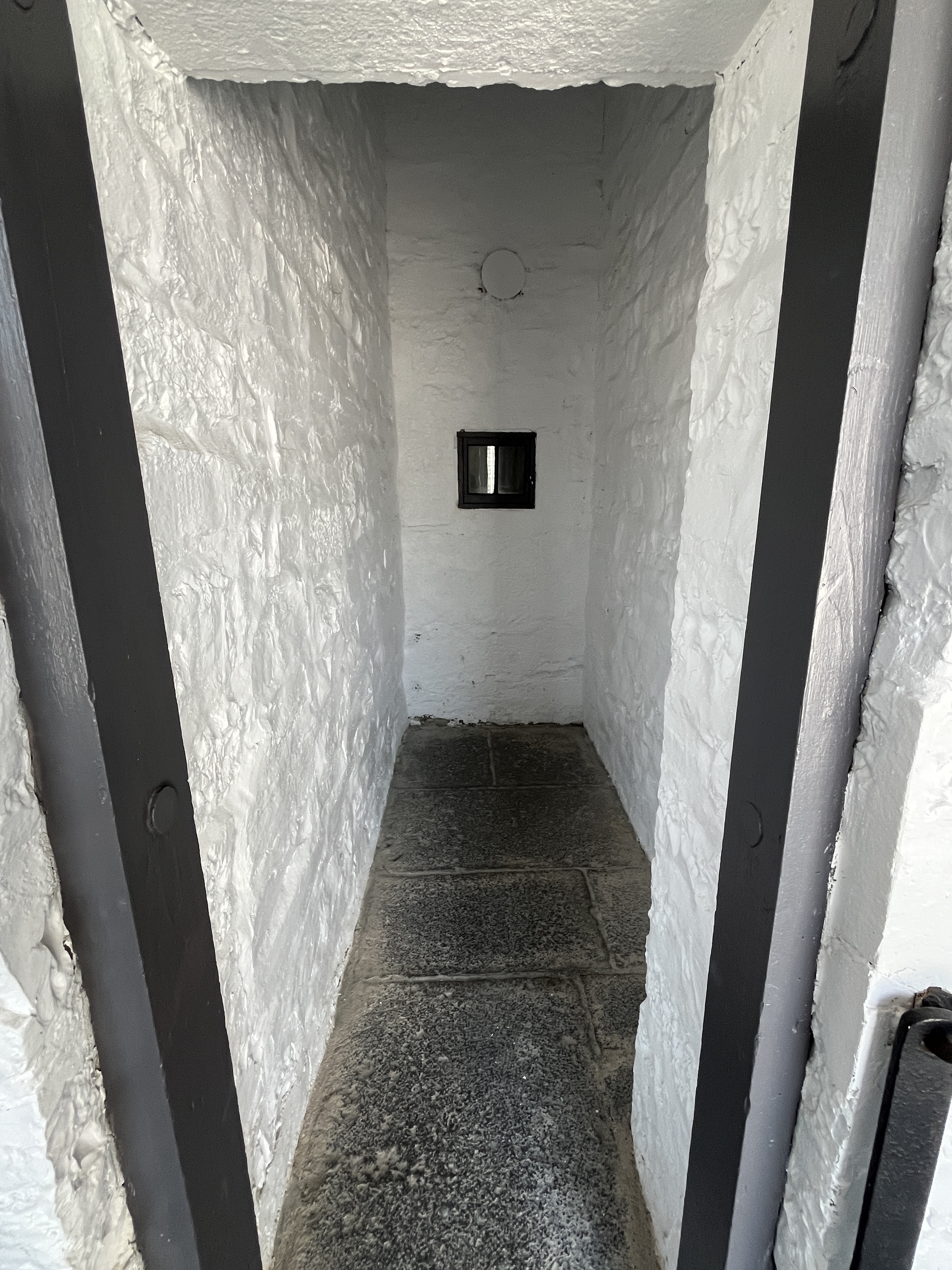
There are four sets of garrison cells that were used for punishment of soldiers. The most common offence was drunkenness. Soldiers could be locked up in these tiny cells which barely had enough room for them to lay down. Punishment might simply be confinement with short breaks for fresh air or it might also include hard labour. This would entail extra cleaning duties or possibly breaking rocks.

Fort Henry never saw active fighting during a war but was used as an internment camp during the rebellions of 1837-1838 as well as both World Wars. Shortly after the building was completed rebellions happened in both Upper and Lower Canada. A number of rebels in Upper Canada, including John Montgomery who owned the tavern where they met, were arrested and found guilty of treason. They were sent to Fort Henry to await their sentencing, either death or exile. Montgomery and 14 others were made aware by a sympathizer of the tunnels that led through the walls to the reverse fire chambers. After removing the mortar between some of the stones in a sealed up doorway, the 15 men made their escape on the night of July 29, 1838. In the darkness Montgomery fell into the drop ditch and broke his leg but was able to get away. Two prisoners were recaptured but the other 13 made their way along the river toward Gananoque and stole boats with which they rowed across the river to the United States. When amnesty was declared in 1843 Montgomery and several others returned to Upper Canada. You can read more about the rebellions in our story on William Lyon Mackenzie.

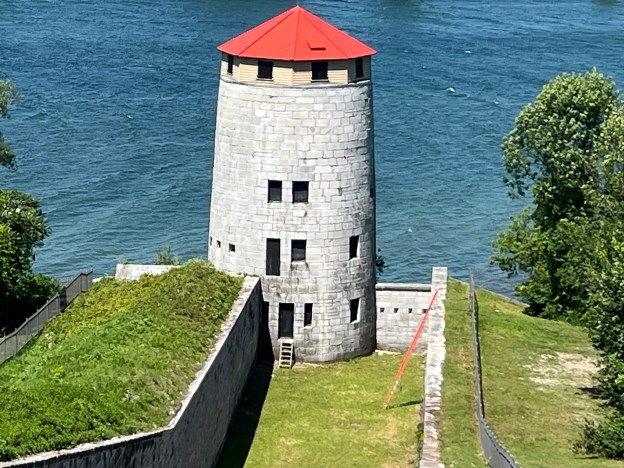
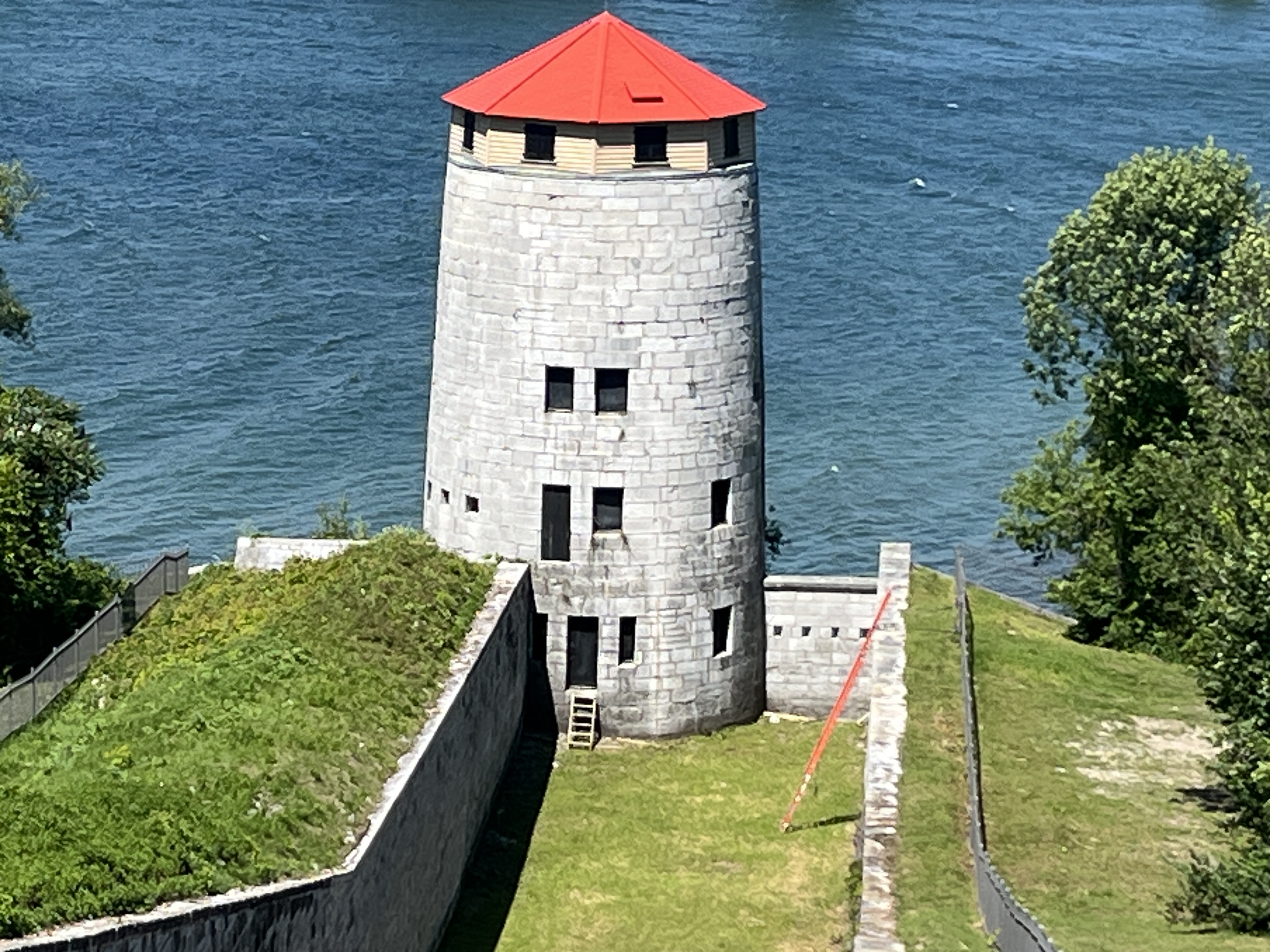
Four Martello Towers were built in Kingston, two of which can be seen from Fort Henry. In addition, two tall, thin towers were built on the ends of the dry ditches. These towers were added between 1842 and 1848. The towers were built within sight of each other so that they could pass signals between them. The pointed roof could be removed quickly providing access to a cannon that could swivel giving it a 360 degree range. The image below shows the dry ditch tower on the Navy Bay side of the fort.

Fort Henry is a National Historic Site and has served as a museum since August 1, 1938. It is well worth a visit if you are in the Kingston area.

Related Stories: Fort York, William Lyon Mackenzie

Google Maps Link: Fort Henry

Like us at: http://www.facebook.com/hikingthegta

Follow us at http://www.hikingthegta.com