Sunday, May 24, 2020
The first person to emigrate from England and build a home in the future Teston was named Thane and for a short time the village was named Thanesville. When the post office was opened in 1868 the name was changed to Teston. Below is a clip from the 1877 County Atlas which shows the hamlet including the post office and wagon shop which belonged to Joseph Lund. With the restrictions on parks and trails being lifted for the first time since the pandemic had begun two months earlier it seemed like the trails would likely be busy and the wildlife scarce. Therefore we decided to leave the trails for a little longer and be safe. Teston isn’t far from my work and so I was able to explore it over the course of two sunny lunch breaks this past week.

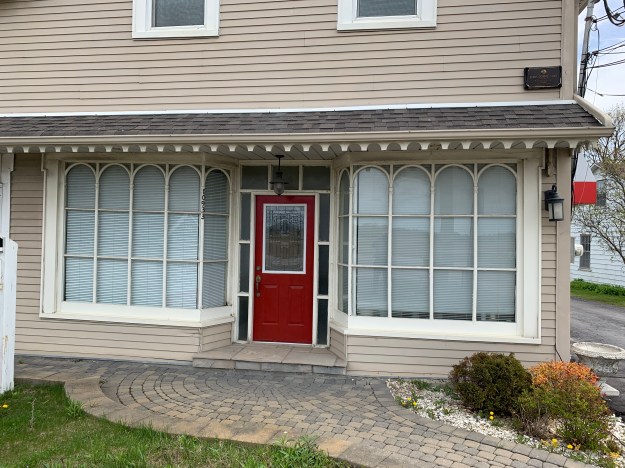
Lot 27, Concession 4 was originally deeded to Kings College who sold it to John Hadwen in 1865. On December 26th that year Joseph Lund bought 2 acres in the south west corner of the lot. Lund’s General Store was built in 1870, as the story goes, after Joseph decided that Mr. Wilson was charging too much for coal oil at the only store in the hamlet. For this reason the store had the nick name “Spite Store”. The building also served as a residence with the plain door on the north end leading to the home while the more ornate door on the south led to the mercantile section.

Joseph Lund was quite the entrepreneur who also owned a wagon making shop and a blacksmiths forge. In 1868 he announced that he had gone into the undertaking business and was able to provide a handsome hearse and black horses. The store was built from vertical wooden planks that were later covered over with red insulbrick. More recently the structure has been covered over with siding. Fortunately, the beautiful store windows and door remain and are key to the listing of the property on the heritage register.
Around 1810 a group of Methodists broke away from the Wesleyan Methodist Church and founded the Primitive Methodists. They practiced a simpler form of worship in simple churches where they kept themselves free of liturgy, thinking themselves to practice a purer form of Christianity. Joseph Lund was a Primitive Methodist and was instrumental in the founding of Hope Primitive Methodist Church on Keele Street. Lund would have driven his horse and carriage past the only other church in town, The Wesleyan Methodist, each week on his way to worship.
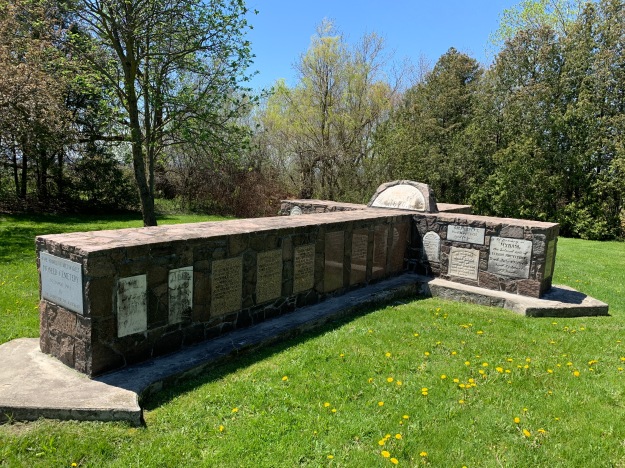
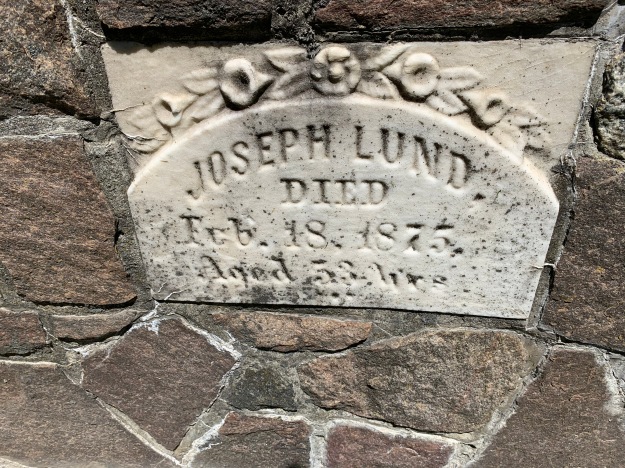
The Primitive Methodists started worship in the Teston area in 1840 and built their chapel in 1870. By 1965 the chapel was gone and the cemetery in disarray. The community gathered all the tomb stones together into a central display in the shape of a large cross. Joseph Lund died in 1875 and was buried in the Hope Primitive Methodist church cemetery.
The Wesleyan Methodists had been meeting in the community since 1811 on property supplied by Isaac Murray. The first chapel was built on the south side of Teston Side road about half way between Jane Street and Keele Street. It was known as Hadwen Chapel after the first pastor to serve there. A new chapel was built in 1872 on another property belonging to Murray. The old chapel was eventually demolished with only a single stone marking the site. The earliest settlers lie in unmarked graves beneath this field.

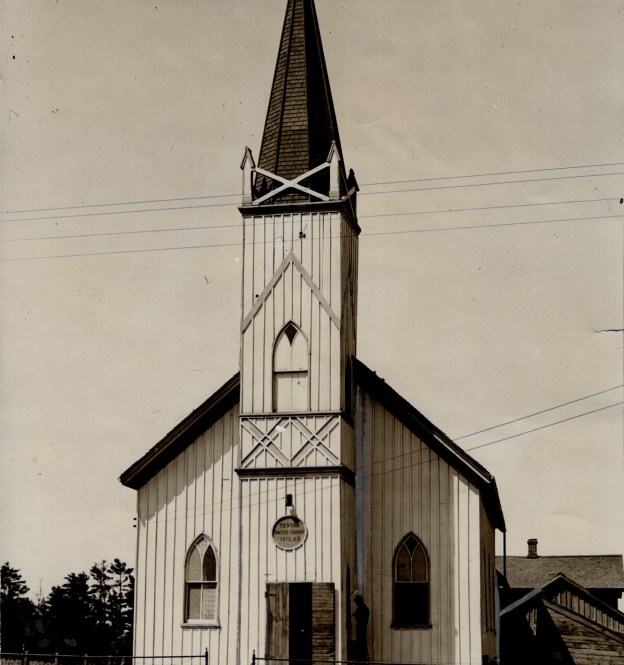
When Abraham Iredell and his team surveyed Vaughan Township in the summer of 1795 there was a slight misalignment of the east-west roads which resulted in a correction at each of the north-south crossroads. Isaac Murray owned the property on the west side of Jane where the survey correction for Teston Road was. It was here that they built the second Wesleyan Church in the community. The photo below shows the church with the entrance completely rebuilt without the tower, although a small part of the spire appears to have been preserved on the roof top. This picture is undated but the photo credit goes to Barry Wallace. The cover photo is dated 1932 and is available in the Baldwin Collection at the Toronto Reference Library. In 2005 it was decided to expand Teston Road to five lanes and take the jog out at Jane Street. This meant that the church would have to be moved to make way. Attempts to save the already unstable church failed and it was demolished instead. Today, the site lies directly below Teston Road.

During the 2005 work to widen the road an old Native Peoples Ossuary was discovered. It was later reburied by members of the First Nations where it sits beneath an unmarked stone. There are hundreds of these old burial sites across the GTA and many of them have been disturbed by work crews. One example is the Taber Hill Ossuary in Scarborough which was uncovered during construction for the 401.
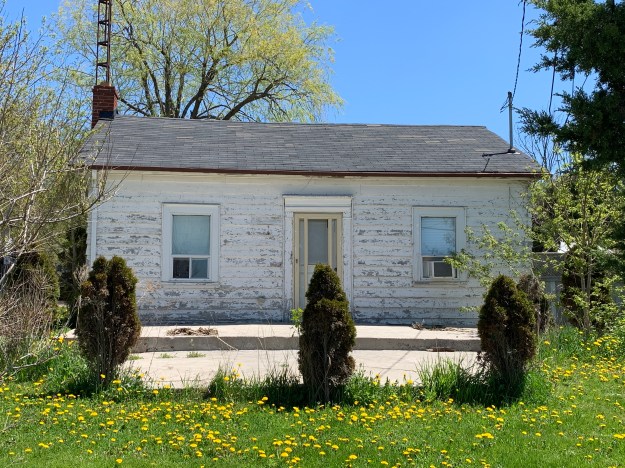
The short main street of Teston hasn’t changed much since it the atlas was drawn. Most of the original homes still line the east side of the street, including the home of the first resident. Two Georgian Style homes stand at the south end of the street and one of them is a likely candidate for this original home.
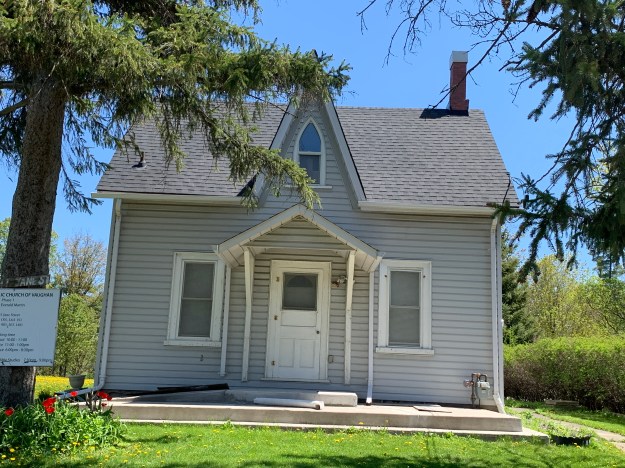
There are also several homes that were built in the gothic revival including the one at 10891 Jane Street. While all the old church buildings have been removed, this old house as taken on the role of Bethel Apostolic Church of Vaughan.
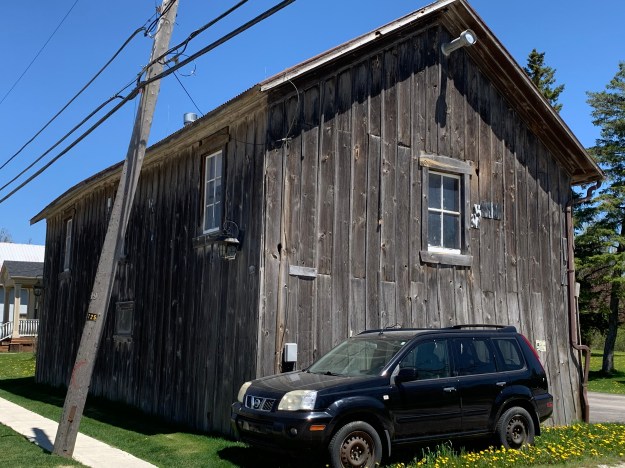
The next building beside the church is an old barn, possibly the original wagon shop.
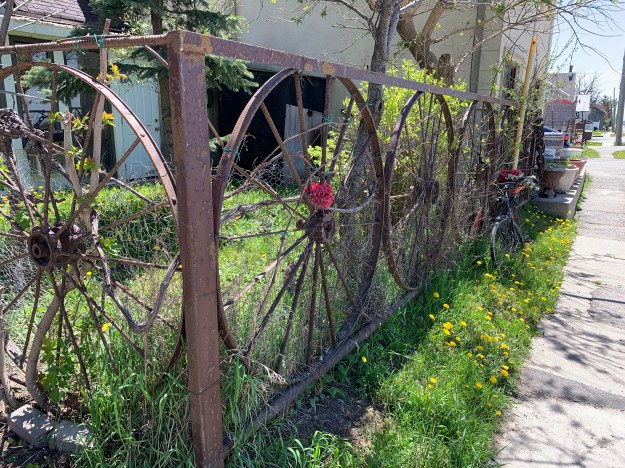
One of the most unique fences we’ve seen has to be this one made of old steel wagon wheels.
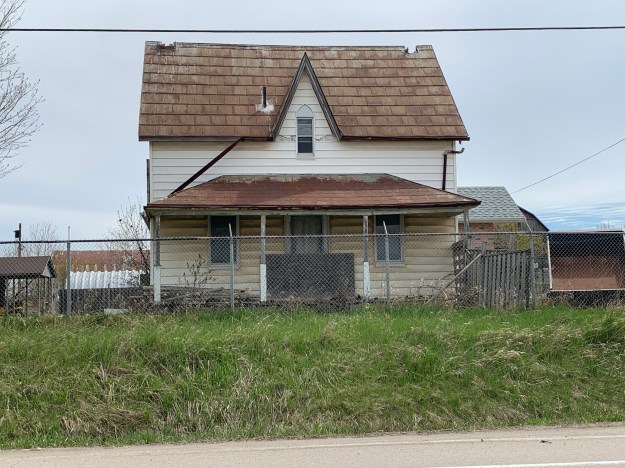
The county atlas shows two homes on the property of Arthur Noble. One of them was this gothic style house that now appears to be deserted.
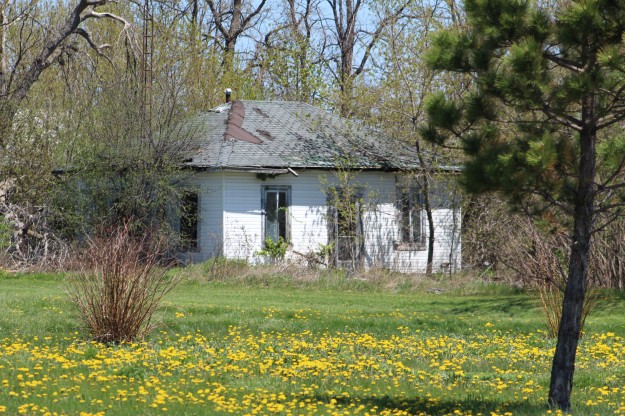
The house on Teston Road that was shown on the 1877 County Atlas as Mrs. Stevenson is one of several simple Georgian style homes in the community. It sits abandoned in an encroaching woodlot on the side of Teston Road.
The Wesleyan Methodist church shown on the upper left corner of the county atlas above was on the corner of modern Weston Road and Kirby Road. Also shown beside it is the school. Apparently it was known as Bryson’s School. It has been converted into an interesting looking home. I wonder why they chose to remove so many of the gothic windows with their pointed arches?
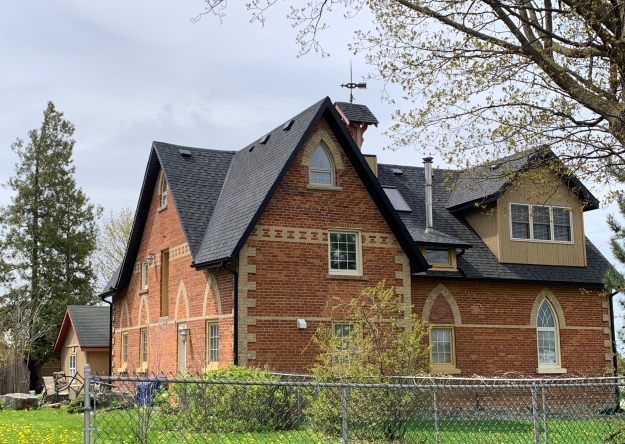
The historic homes in Teston are a little drab because every one of them has been covered over with siding. On one hand I applaud his salesmanship but I really wish he hadn’t been so successful and that we could still see the original craftsmanship and brickwork on these homes.
Also see our posts on the nearby ghost towns of Sherwood and Maple.
Google Maps Link: Teston
Like us at http://www.facebook.com/hikingthegta
Follow us at http://www.hikingthegta.com
Look for us on Instagram
 Hiking the GTA
The Spite Store was also the site of a feed mill run by R. Cooper & Sons. I am the granddaughter of the owner at that time and have many fond memories of life in Teston. I remember this site as the hub of the town when my grandparents ran the general store, feed mill, and gas station.
Circa late fifties, my family lived in a rented farm home about a mile north of Teston, west side, at the time, owned by the Naylor family. I attended Teston United Church every Sunday and recall the strawberry festivals oh-so-well. My sister was married in the church. So sad that it was expropriated. Teston was a charming little village back then. Have been there twice in 2020 and was pleased to see that the charm still exists, particularly on the east side, north of where the church was. But probably not for long based on the construction nearby.
Nice history here. Thanks for making it available. R L
Pingback: Ghost Towns of York Region | Hiking the GTA
I have been living in Hope for 14 years and always wondered about the history and certain monuments around. Thank you for the article and I hope what’s left of the old town is preserved and shared with the generations that come. I will definitely be sharing this with my children. Thank you again.
The photo of the building at the corner of Kirby Road & Weston Road is actually of the old school house. (mother called it Bryson’s School, so it is likely connected to the Bryson family who famed across the road from that lot). My mother was raised on the farm indicated in the map as belonging to Alex Cameron. It was purchased by my grandfather E.A. Carson around 1914, and he farmed there until he sold to Mr. Naylor in 1955 He then retired to a house he had built on the se corner of Jane St. & Teston Rd. across from the church. The Hare family lived beside them (on their respective farms, then as retirees in Teston). Both of those houses are now gone, likely because the wells will have dried up when the subdivision was built nearby. My family often returned to Teston Church, especially for the Strawberry Suppers. or Anniversary Service.
Thank you for adding those interesting details to the story. I’ve also updated the story to include the name of the school. Thanks again!
Joseph Lund is my husbands David Lund’s great, great grandfather, and we have the store record book from the 1800’s, as well as the detailed undertakers funeral book of the deaths and costs, as well as the family bible with pics of Joseph and family
Hi Alda, Just wondering if the funeral book has any details of the death of Robert Carson (1811-1870s) born in County Tyrone N. Ireland, or his wife who died Sept. 10, 1867, or his daughters Ellen Carson (d: Oct. 12, 1867) & Eliza Jane Carson (d: May 14, 1872). Robt. first settled on the rear of Lot 31, Con. 6 Vaughan then moved to Laskay to work as a weaver. One son, Andrew farmed in various locations in Vaughan until his death at the farm on Lot 30 Con. 5 in 1931. Andrew is my great grandfather.
Hi Raymond, The funeral book we have goes from, 1874 – 1886.
Alda Lund, Joseph Lund is also my great great grandfather. His daughter Sarah Lund 1854-1918 and her husband John William Walls 1848-1918 were my great grandparents. John and Sarah’s oldest son Joseph William Walls 1880-1949 was my grandfather and Joseph Walls’ eldest son Arch Walls 1909-1988 was my father.
I have done quite a lot of searching of the English records of Joseph Lund, and found that he was born in 1821 in Heysham Lancashire, in 1841 UK census Joseph is a joiner’s apprentice in Heysham and by 1846 he has emigrated and marries in Toronto. His brother Richard Lund also emigrates – he was a witness at Joseph’s marriage. Joseph’s elder half brother William emigrates to Vaughan earlier than Joseph as he and his family are listed in the 1841 Upper Canada census. And the three men’s father, Richard Lund, emigrates after 1851 and lived in Teston. I have visited Hope Primitive Methodist Cemetery and seen the graves of the various family members who are buried there.
I also visited Heysham in Lancashire in 2008 and found more information about Richard Lund the father from their heritage centre. I have photos of the old 9th century church, St Peter’s, Church of England where all the children were baptized though they all became Methodists & Primitive Methodists after arriving in Canada.
Using online records and borrowing the microfilm from Utah on inter library loan of the Heysham St. Peter’s parish records I found out quite a bit about a few of Joseph’s siblings, both one or two that stayed in England and Richard and William who emigrated. I have followed a number of Joseph’s other children forward but only to 1920 or so since online records stop then.
You mention that your husband has various documentary records and photos. I would love to see a few photos of Joseph Lund and/or his wife Susanna and /or their children, if you can take a few photos and email them to me. I just have one photo of Sarah Lund – a professional photo of John and Sarah and their 6 children around 1898. If you or your husband have any interest in any of my information of other family members or photos of Heysham I would be happy to share them.
Alda, I assumed that you might get my email address so you could reply but it isn’t posted and I notice now that they don’t usually share it. Possibly the moderator can pass my email onto Alda Lund directly since he or she must have Alda’s email too. My email is sharoniwalls@gmail.com. If that isn’t possible I am quite prepared for my email to be shared in the post.
The post says that Joseph Lund was motivated to build his store because the existing store owned by a neighbour Mr. Wilson charged too much for coal oil. Because I have traced the genealogy of my ancestor Joseph Lund 1821-1875 I found that 2 nephews of Joseph Lund, sons of his younger brother Richard Lund, marry two Wilson sisters from Teston, daughters of a George Wilson who is presumably the owner of the store that charged too much. So the families must have got over their spite.
Richard’s son Joseph Lund 1854-1931 (his oldest son that survives to adulthood) marries Mary Jane Wilson in 1877 in Teston. At the time this Joseph Lund is 23, a clerk, & living in Mt. Forest Ontario where other members of his family are living. Teston is a long way away from Mt. Forest and the only way that this Joseph is likely to have met Mary Jane is visiting his uncle Joseph Lund in Teston. According to the 1881 & 1891 censuses this couple live in Grey County where this Joseph Lund has a general store. Many years after the first marriage , Richard’s youngest son Arthur Lund 1872-1931 marries Mary Jane’s younger sister Tammie Wilson in 1898 in Toronto. Arthur Lund was born in Mt. Forest but at the time of the wedding was living in Medicine Hat and working for the railway. Arthur and Tammie emigrate to California in 1907 and his older brother Joseph and Mary Jane follow their siblings to California in 1916 when Joseph is near retirement at 62. The two brothers are recorded as farmers in the 1920 US census: Joseph is an orange grower & Arthur is a poultry farmer. Both die the same year 1931 and are buried in the same cemetery in Ontario, San Bernardino County, California, USA. The two Wilson sisters outlive their husbands but are also buried in this cemetery.
Moderator, is it possible to alert Alda Lund who made an earlier comment on this post of my 3 comments on this post including my email address? Please don’t post this 4th comment. I have tried to find Alda & David Lund by other means but have failed. I would really appreciate your assistance. Thank you.
Pingback: Vanished Villages of Vaughan Township – Teston – Canadian Military History