Category Archives: Uncategorized

The First Three Welland Canals

Tuesday, February 27, 2018

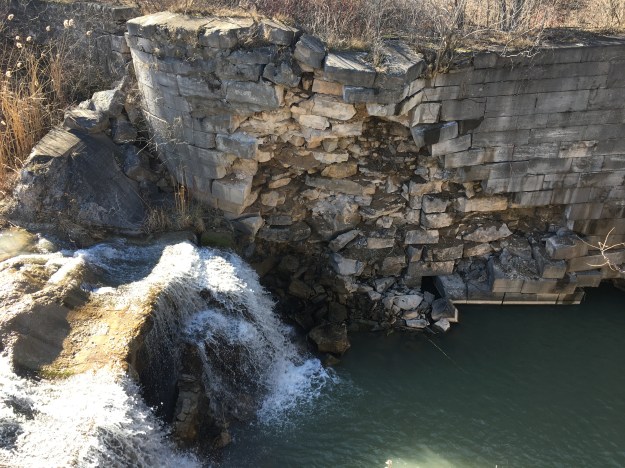
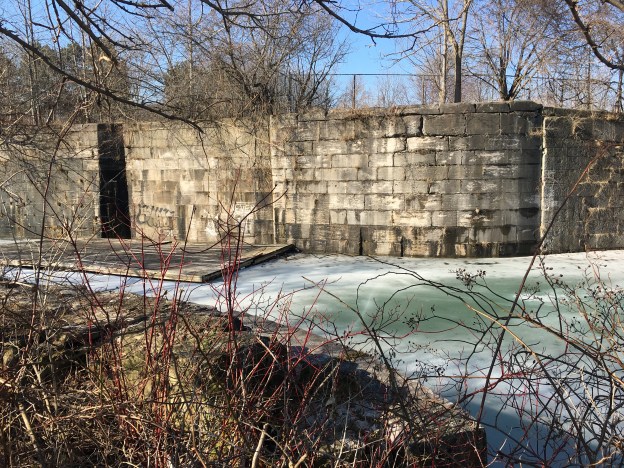
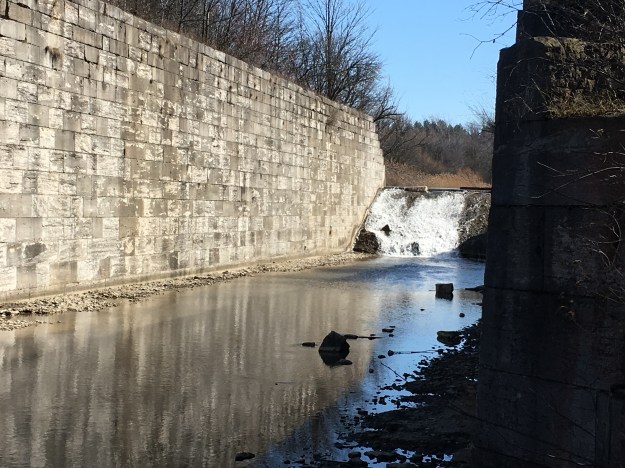
One lesson that was learned in the war of 1812-1814 was the need to move men and goods quickly and a period of road and canal building began.  The British had largely controlled the Great Lakes during the conflict but Niagara Falls prevented movement between the lakes.  In spite of this, the first canal built between the two lakes was a private enterprise.  The government would build the next three Welland Canals culminating in the current Welland Shipping Canal.  The first three canals have been abandoned but sections of each still remain, although active preservation does not appear to be happening.   This picture of lock 15 on the third canal shows the partial collapse and deterioration of everything up to the gate recesses.
IMG_2966

To look at some of the remnants, I made a day trip and planned four stops (to which links will be provided).  The first stop was in St. Catherines to see the second lock on the third canal.  Then to Welland Vale where the first and second canals diverted routes shortly, leaving evidence of both.  Mountain Locks Park along Bradley Street contains a series of second canal locks.  Finally South of Glendale Avenue is a series of third canal locks and the Merritton Tunnel.  Rather than tell this story in the sequence of the visit it is being arranged in the sequence of the three canals.

Shipping on the Great Lakes was confined to Lake Ontario because goods on the Upper Great Lakes had to be portaged around Niagara Falls.  Lake Erie was 325 feet higher than Lake Ontario.  In 1818 a mill operator named William Hamilton Merritt proposed to divert water from the Welland River past his mill in Welland Vale to supplement the water flow of 12 Mile Creek.  The idea was abandoned but just a month later he came up with the proposal that led to the building of the first Welland Canal.  The Welland Canal Company was founded in 1824 to build the 40 kilometre canal.  The channel was dug 24 feet wide and 8 feet deep and 40 wooden locks were built each capable of lifting a boat between 6 and 11 feet.  The picture below shows a section of the first canal in Welland Vale.

IMG_2926

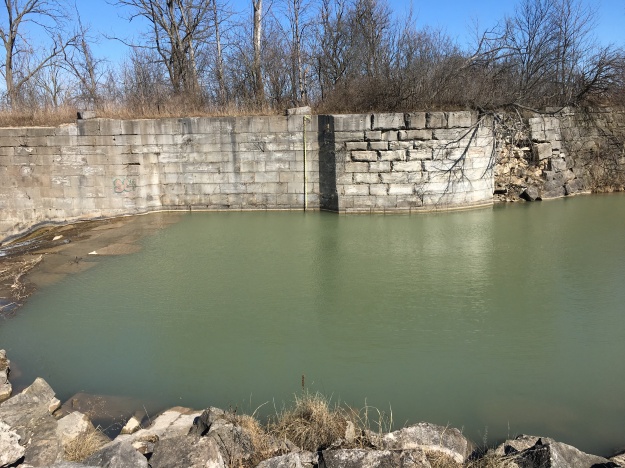
The first canal was operated between 1829 and 1844 but it was clear from the beginning that the wooden locks were too small and required too much maintenance.  In 1841 the government took over operation of the canal and started work on rebuilding it  The path of the canal followed the first one so closely that most of the first canal was lost.  There is a 1 kilometre stretch of the first canal in Mountain Locks Park that was left intact and one wooden lock, number 24, can still be found in that park.  The locks on the second canal were built of stone and to slightly larger dimensions than their wooden counterparts.  The channel was dug 36 feet wide and 9 feet deep with locks that were 150 feet long.  The picture below shows the one of the locks on the second canal at Welland Vale.  The height of the lock has been reduced and the stone work has been completely removed from one side of 12 Mile Creek to improve water flow and reduce flooding.

IMG_2930

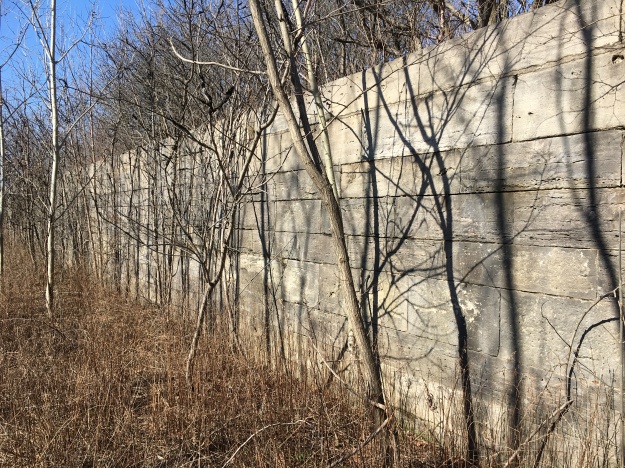
The first and second canals climbed the escarpment in a series of locks that now form Mountain Locks Park.  Lock 19 of the second canal no longer has water flowing through it and this picture was taken from inside the lock
IMG_2941

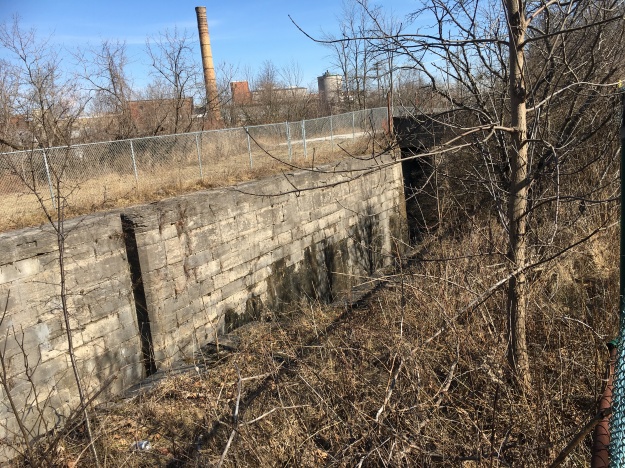
Lock 24 of the second canal is typical of the locks that climb the escarpment as boats moved toward Thorold.  The creek flows deep in the bottom of these locks.  The second canal was used from 1845 until 1935 even though a third canal came into operation in 1932.
IMG_2943

A third, larger canal was started with a new, straighter route in 1872.  It was designed to carry the larger ships that were plying the Great Lakes by this time.  The third canal was completed in 1887.  Lock number two can be found in Jaycee Gardens Park in St. Catharines.

IMG_2911

There is a 50 foot towpath that extends out into Martindale Pond at the second lock that allowed the ships to be towed through the lock.  Towpaths allowed ships to be towed out of the lock by a team of horses until a point where they would have room to sail again. Towpaths were no longer needed when ships were equipped with engines. A concrete pole on the end, and another near the beginning of the towpath mark a later addition of electricity to power the lock.    This relieved a lot of physical labour that was involved in operating the canal gates and was an advancement made on the third canal that wasn’t available on the first two.  The gates from the lock can be seen half submerged beside the towpath.

IMG_2919

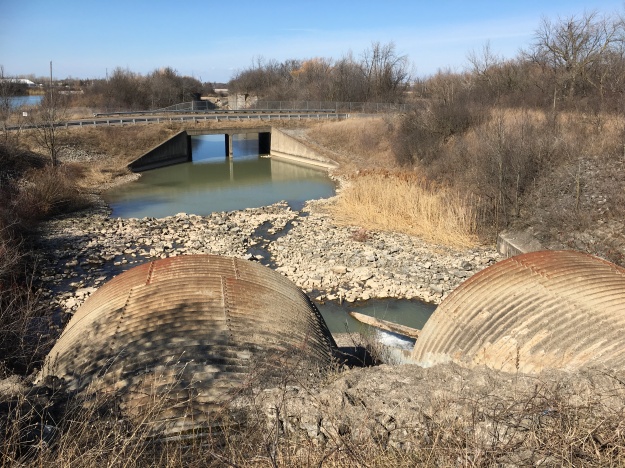
Lock 13 has had two large culverts placed in it to support Glendale Avenue.  From this vantage point, lock number 12 on the third canal can be seen.  Locks 13 through 18 can be found by following the river south.
IMG_2948

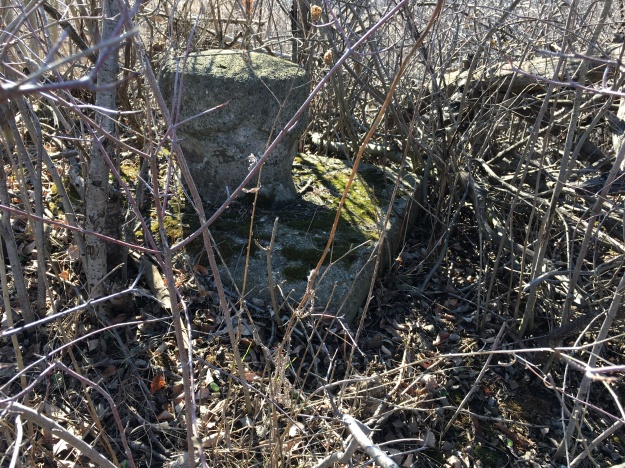
As ships were being raised or lowered in the locks they needed to tie themselves to bollards located along either side of the lock.  Many of these old concrete bollards can be found along the canals.
IMG_2956

When the third canal was abandoned in favour of the new fourth canal, the gates were left in place.  These have all fallen into the locks.  One of the improvements in the third canal was the lining of the bottom of the locks with wood to protect the bottom of the ships as they passed through.

IMG_2960

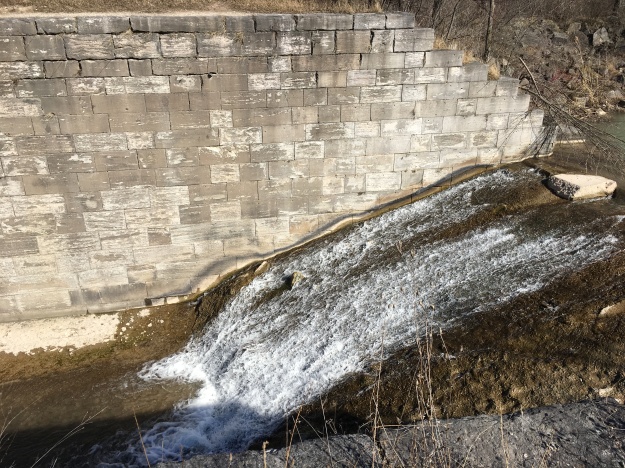
Locks on the third canal were 270 feet long and could lift a boat from 12 to 16 feet.  The locks were 45 feet wide and a minimum of 14 feet deep.  The picture below shows the lift in lock 15.
IMG_2971

One of the innovations of the third canal was the inclusion of the water control system in the lock stonework.  The walls of the locks were recessed so that the gates could swing back to allow clear passage of boats.  The small openings behind the gates allowed water to be flooded into the locks.

IMG_2975

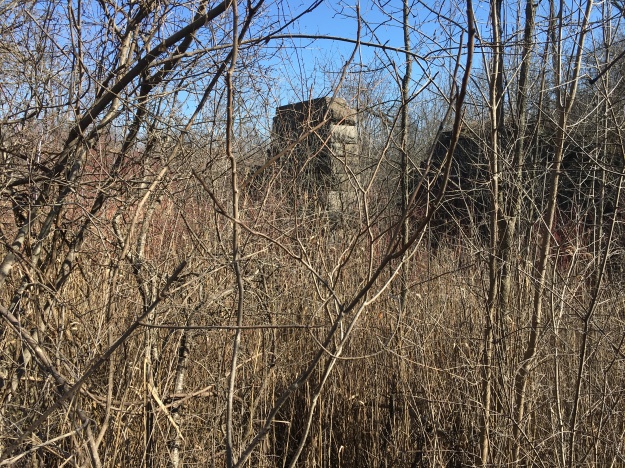
Along the west side of each lock a series of control ponds was built that allowed the locks to be flooded when boats were passing through. Stone sluice gates were used to control the flow of water from the ponds into the locks.  The picture below is taken from inside one of the control ponds looking at the sluice gates.
IMG_2963

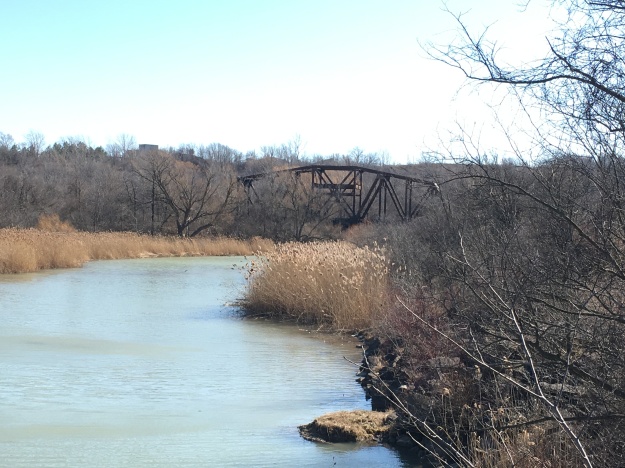
Between locks 16 and 17 there is an old swing bridge for the railway.  It was completed in 1915 and allowed the railway tunnel beside lock 18 to be closed to rail traffic.
IMG_2972

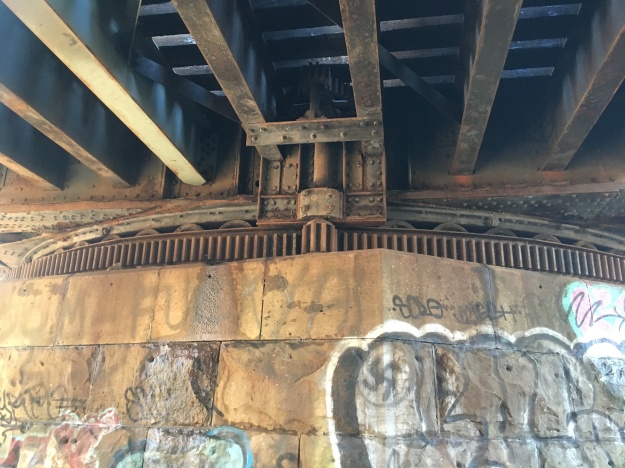
The swing bridge was designed to move out of the way of oncoming ship traffic.  It hasn’t been moved since the canal closed in 1935 and the tracks on the top side have been replaced in such a way that it couldn’t move even if those gears are not seized.
IMG_3004

The Grand Trunk Railway needed to build a tunnel to allow the train to pass under the third canal.  The Grand Trunk Tunnel was completed in 1876 and is discussed in more detail in this separate post.
IMG_2981

The Fourth Welland Canal was opened in 1932 with only 8 locks and a much straighter route.  Very quickly a fifth canal was proposed that would have had only one super-lock.  This 1950’s dream was never built.

There are many interesting places to explore along the old abandoned canals and a return trip would definitely be in order.

Google Map Links: Port Colborne, Welland Vale Road, Thorold

Like us at http://www.facebook.com/hikingthegta

Follow us at http://www.hikingthegta.com
Merritton Tunnel (Blue Ghost Tunnel)

February 27, 2018

As part of a day of exploring the old Welland Canals I decided to look for the Merritton Tunnel.  The story of the first three canals will be told in greater detail in a separate post.  To reach the tunnel you have to walk a fair distance and I parked in a small lot beside the Welland Ship Canal on Glendale Avenue, near the Good Eats Diner.  You will walk past the General Motors Plant which is clearly marked, indicating electronic surveillance and patrols.  I was unsure if this included the old canal and tunnel or not but decided to be wary just in case.

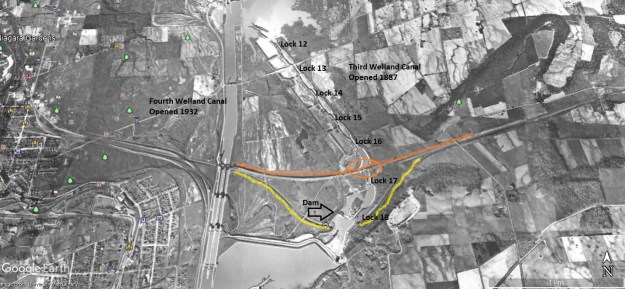
The first Welland Canal was opened in 1829 and consisted of wooden locks.  A second, larger canal was built in 1842-1845 and followed the route of the first but used stone blocks for the locks.  Very quickly it was determined that a third canal, with larger and deeper locks was needed.  It was built between 1872 and 1881 but was modified through to 1887.  It ran straighter and required shorter transit times than the second canal.  The Grand Trunk Railway would need a way to cross the new canal and so in 1876 a tunnel was built.  The Grand Trunk Railway Tunnel is 713 feet long and made of Queenston Limestone.  The tunnel has the formal name of Merritton Tunnel after William Merritt who is seen as the father of the Welland Canal system.  He first conceived the idea of joining Lake Ontario with Lake Erie by canal in 1818.  The nearby community of Merritton was named after him.  On the 1934 aerial photo below the yellow line marks the path of the GTR through the tunnel while the orange line marks the path across the swing bridge.

1934 two Tunnel

Lock 13 of the third canal is crossed by Glendale Avenue and has two large culverts installed to support the road.  The Bruce Trail runs along the east side of the canal but I was hoping to find the west end of the Merritton Tunnel and go through to the east side.  Therefore, I went up the west side leaving the Bruce Trail for the return hike.  Locks 13 through 16 are located between here and the rail bridge.  Lock 16 below shows a drop in river elevation of about 10 feet.

IMG_2970

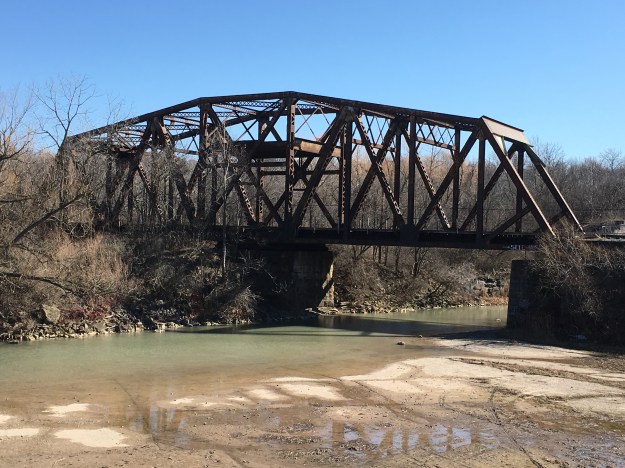
By 1915 the railway had been rerouted away from the tunnel and over a steel Howe Truss bridge.  This bridge was designed to swing out of the way of passing ships and the canal only passes under the west half of the bridge.

IMG_2973

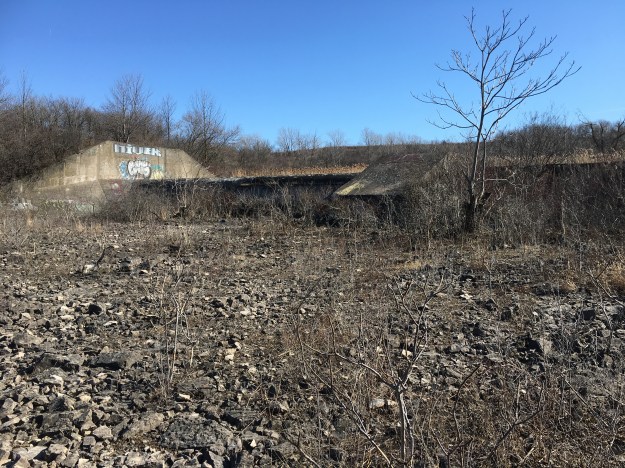
At the end of lock 18 you will be forced away from the river by an old dam that retained the water used to operate the locks.  It allowed ponds to be created behind the west side of each of the locks so that they could be flooded as ships passed through.

IMG_2978

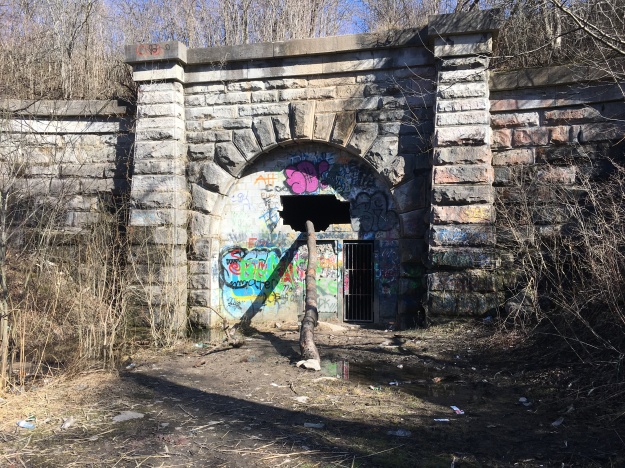
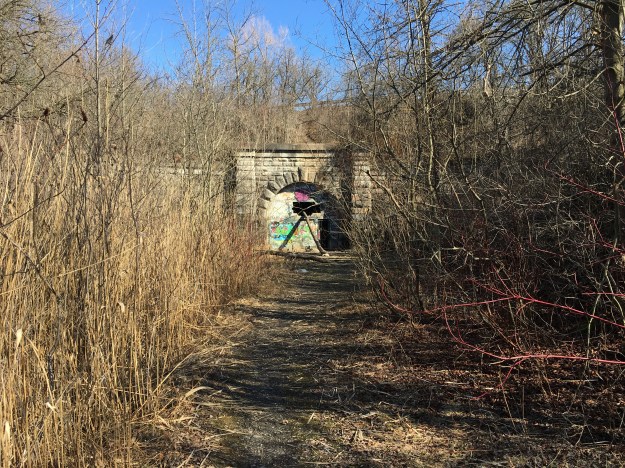
Once you pass the dam you will be forced out onto a service road that isn’t on the archive aerial photograph above.  The road passes along the side of the GM plant and had sparse traffic on it until now, but as I was unsure if I was actually trespassing I crossed it quickly and looked for a trail in the trees on the other side.  Knowing that the train had to approach the tunnel in a ravine that would be close by, I chose to follow the first one.  As you can see in the picture below, the west end of the tunnel has been closed off because it was considered unsafe.  At times, people have made several holes in the concrete blocks and a few of these have been sealed off again.  The door is currently locked but appears to be broken into regularly.  Entering from this end would require going up the log and dropping into the tunnel.  Being by myself  this wasn’t an option.

IMG_2979

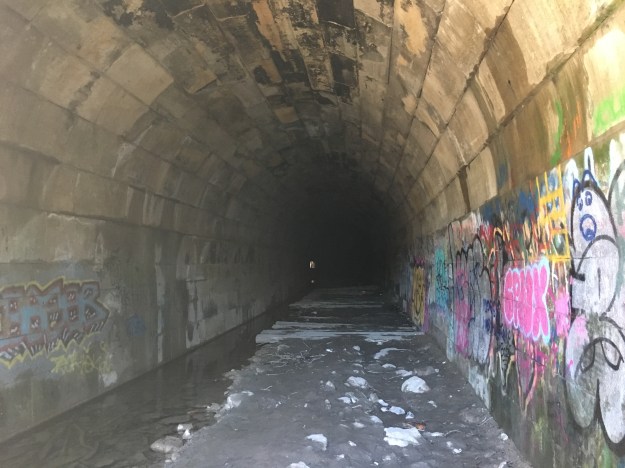
The tunnel is closed but the door, apparently looted from some old jail cell, allows you to reach through the bars and take a picture of the tunnel.  Rail ties can be seen on the floor part way in.  The door can be more clearly seen in the cover photo.

IMG_2983

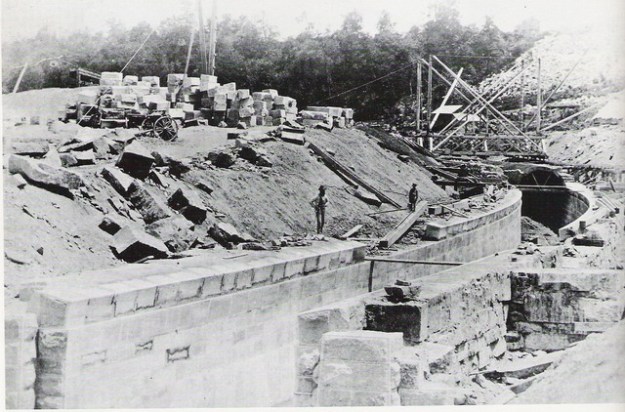
This archive photo shows the construction of the tunnel as the first row of blocks for the start of the curved roof were being laid.  A channel was cut and the tunnel constructed and then covered over.  This was done before the canal was flooded and put into service.

Building The GTR Tunnel

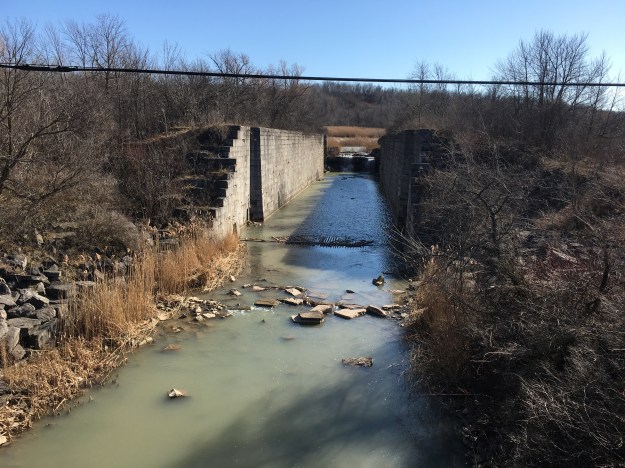
Unable to enter from the east end of the tunnel I determined to cross the canal on the swing bridge and look for the other end.  From the railway bridge you can look up lock 17 and see the height difference that the lock allowed ships to gain as they passed through.

IMG_2985

The canal locks have started to collapse and it is quite dangerous to get close to the edge in some places.  Most of the damage appears on the upstream ends of the locks due to flooding and annual ice flows pushing downstream.  The picture below shows the south-west end of lock 17 where the entire side is in danger of collapse.  Stepping on the wrong stone block to take a picture could result in a long drop with tons of rock crashing around you.

IMG_2986

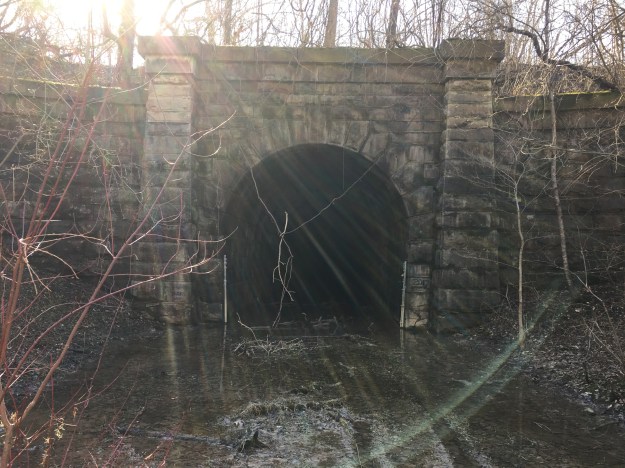
Between lock 17 and 18 you have to go around the back of a wetland area before you cut back toward the canal.  When you find a small ravine you have reached the former rail line.  This will lead you to the east end of the tunnel.  Two metal posts indicate the original attempt to close this end of the tunnel was done using a low fence instead of concrete blocks.  I wonder why the two ends of the tunnel were treated so differently.

IMG_2991

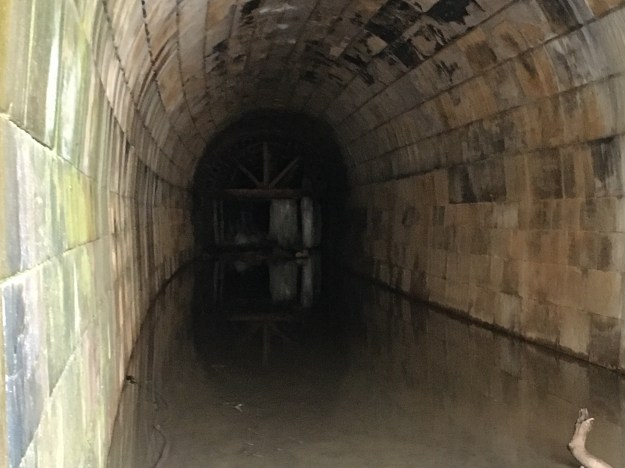
The east end of the tunnel is currently flooded.  Near the curve you can see several support beams that reinforce the tunnel where the river passes overhead.  They have been added since the tunnel was abandoned as they leave no clearance for a train to pass beneath.  Water leaks from the beams and perhaps one day the tunnel will collapse at this point, letting the river above rush in.

IMG_2993

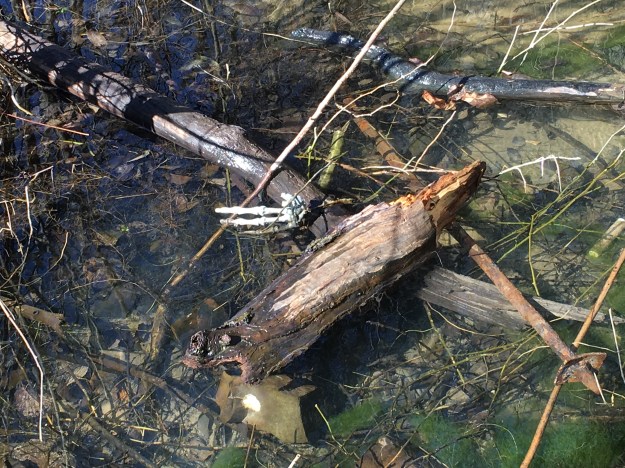
The tunnel is considered to be one of the most haunted places in the Niagara Region.  Various paranormal experiences are reported including voices, cold spots and physical pushing.  A mysterious blue ghost has given rise to the name Blue Ghost Tunnel.  Various reasons are given for this such as the 107 deaths that occurred during construction of canal, including two while building the tunnel.  A head on collision between two trains killed two people and there is also a claim that there may have been hundreds of remains left in a cemetery that was flooded by the dam at lock 18. As usual, any spirits in the area chose not to reveal themselves to me.  The closest I came was this skeletal hand which I hope is a Halloween prop.

IMG_2984

I may think about returning one day when the east end of the tunnel is dry enough to get inside without getting muddy up to the knees.  Pictures from The First Three Welland Canals can be found at the link.

Google Maps Link: Merritton Tunnel

Like us at http://www.facebook.com/hikingthegta

Follow us at http://www.hikingthegta.com
Chedoke Radial Trail

Saturday, February 17, 2018

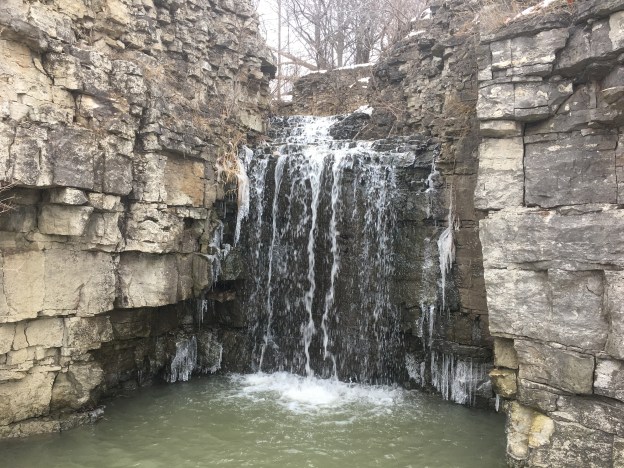
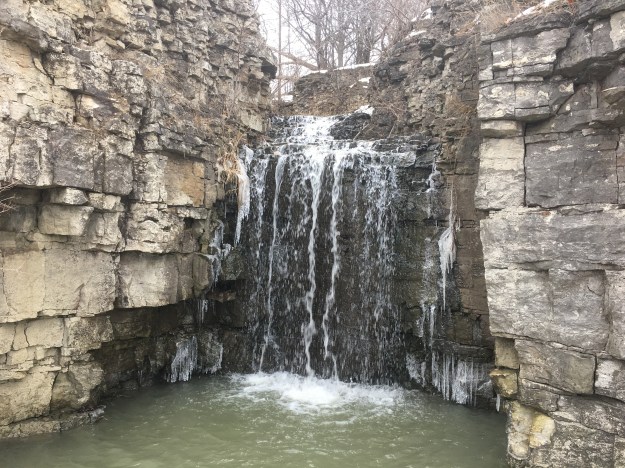
The Chedoke Radial Trail is 2.7 kilometres long, it was opened in 1995 and follows the former right of way for the Brantford and Hamilton Electric Railway.  The word “Chedoke” sounds like a native word but is actually a mispronunciation of the words Seven Oaks and refers to a patch of trees that originally stood in the area.  Several waterfalls can be seen from the trail and so we set off to view the ones between the parking lot on Scenic Drive near Chateau Court and Sanatorium Falls.

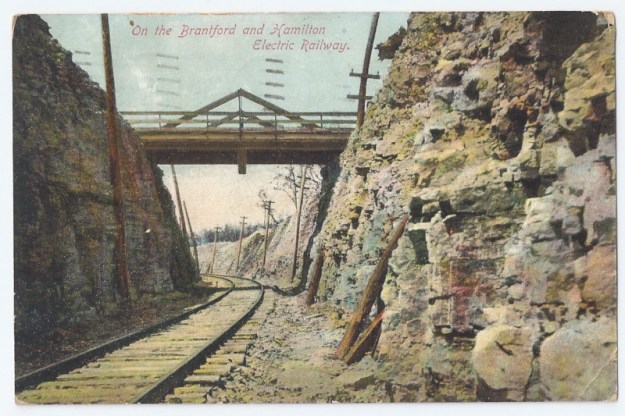
Two attempts were made to build a railway up the escarpment from Hamilton to Ancaster beginning in 1896 before an actual line was built ten years later.  The sod turning ceremony for the railway took place on August 6, 1906 but construction didn’t begin until late in the year.  Service was opened to Ancaster on December 21, 1907 and to Brantford on May 23, 1908.  The rail line runs up the escarpment at 2.5% to 5% incline.  By June 30, 1931 the line was underused and service was discontinued.  The final trip was made using the same cars as the first run up the escarpment.  Hamilton Parks Board was given the former right of way in 1938 but it would take nearly 60 years to become the Chedoke Radial Trail.  The post card below was post marked on October 16, 1909 and shows a bridge over a railway cut along the line.

BHHorning9May1911

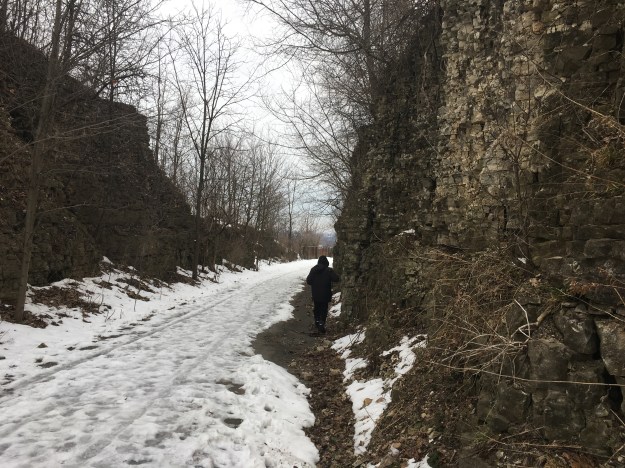
The bridge is long gone, as are the electric poles that powered the railway cars.

IMG_2695

The first set of falls you come to is known as Upper Princess Falls. They are set back in a little limestone cavern and carry Lang’s Creek over a 6.7 metre drop into a deep plunge pool.

IMG_2736

After flowing over Upper Princess Falls this tributary of Chedoke Creek is intended to pass under the trail in a culvert in the bottom of the plunge pool.  Instead, it often flows over the trail and through a fence before dropping 39.5 metres to the level of the 403.  Lower Princess Falls is quite spectacular when viewed from below.

IMG_2702

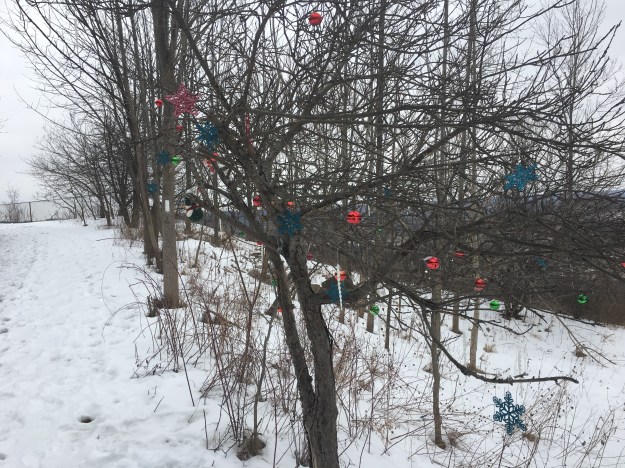
There are a few weeks in the year when Christmas ornaments look pretty on the trees in our parks.  However, after January they start to look like litter hanging in the trees.  Perhaps the people who hang them could come back and retrieve them later.

IMG_2744

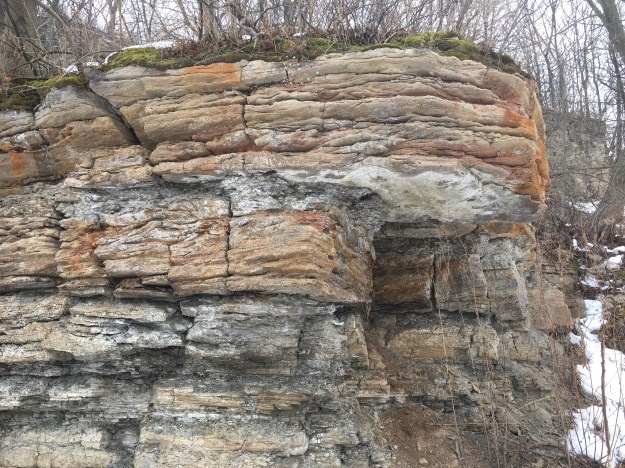
This rock formation can be seen from the trail and is included here as an example of why one must be careful how close they walk to the edge of the escarpment.  This chunk of rock is well undercut and has a large crack along the back of it.  Walking out to the edge could lead to a sudden dislodging of the rock and a nasty tumble.

IMG_2746

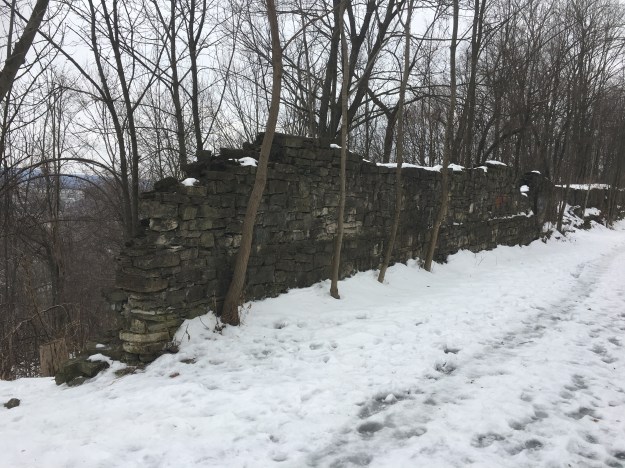
The Royal Hamilton Light Infantry were established in 1862 and used to have a rifle range in West Hamilton.  When the Brantford and Hamilton Electric Railway was built they extended the rock cut with a lengthy stone wall to protect the riders from stray bullets.  Rifle Range Road in Hamilton commemorates the Light Infantry and runs beside Alexander Park which can be seen from the rail line.

IMG_2747

When the Bruce Trail was opened there were three culverts installed and covered with concrete to allow pedestrians to cross Chedoke Creek.  The escarpment face was covered with patterned concrete to create a spillway for the water to flow down before entering the three culverts.  Over the years the concrete has become cracked and the water flows under it and around the culverts.  A bridge was installed in 2007 over the culverts at a cost of $60,000.   Five years later the bridge needed to be replaced and extended due to heavy erosion.  The new bridge ended up with a price tag of $950,000.

IMG_2761

Mountainview Falls is a classical complex cascade that drops 10 metres and has a width of 6 metres.  For a century this waterfall was known simply as the water fall on the mountain.  When a comprehensive listing of the Hamilton Waterfalls was made in 2002 it was given the name Mountainview after a small community that once existed here.  The entire side of the hill was given erosion control below the waterfall but this concrete is broken and being washed away.

IMG_2762

Mountainview Falls are actually quite nice when you get up close and eliminate all the man made concrete below them.

IMG_2766

Construction of Hamilton’s first reservoir began with land acquisition in 1856 and soon the hand dug reservoir had a capacity of 9 million gallons.  Some time in the 1980’s the reservoir was covered over with a concrete shell and grass was planted on top.  After becoming overgrown with hawthorn bushes it was barely discernible.  Recently the shrubs have been cleared away but the sides of the reservoir have become a target for grafitti.

IMG_2774

At the base of Sanatorium Falls is a old hub where a water wheel once rotated.  The main shaft for the wheel would have been made from a single piece of seasoned white oak.

IMG_2789

Sanatorium Falls marks the connecting point to a previous exploration of the Mountain Sanatorium.  At one time a set of stairs connected the railway with the Sanatorium so that workers could use the rail line to get to the hospital.  Every day they would have enjoyed a view of the falls as they started and finished their shift.

IMG_2786

There are several more falls that can be seen along the trail, but these will be saved for a future expedition.

Google Maps Link: Chedoke Radial Trail

Like us at http://www.facebook.com/hikingthegta

Follow us at http://www.hikingthegta.com
The Kissing Bridge

Friday, February 16, 2018

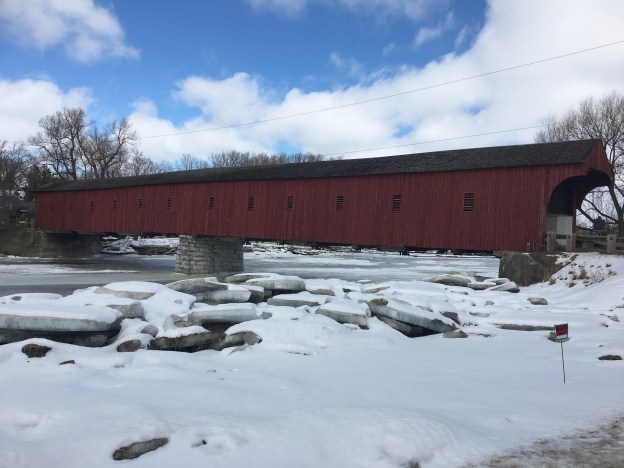
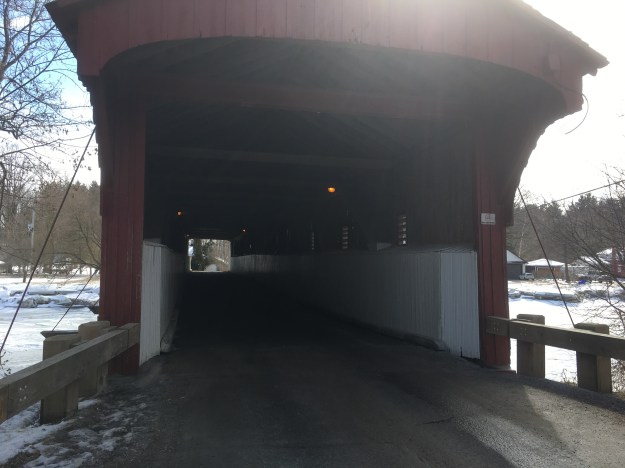
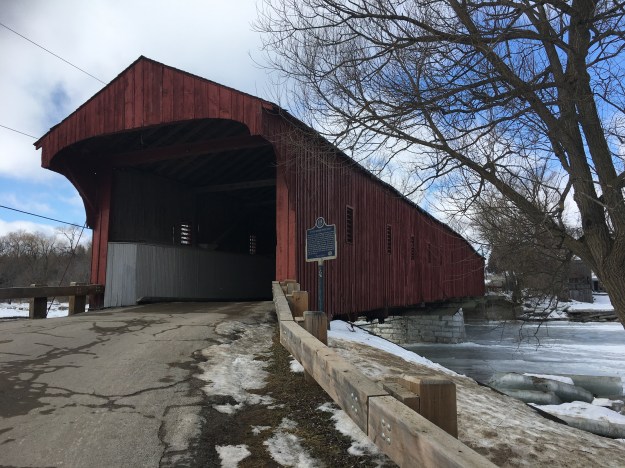
While enjoying a visit to The Shand Dam, I decided to make the side trip to see the last remaining vintage covered bridge in Ontario.

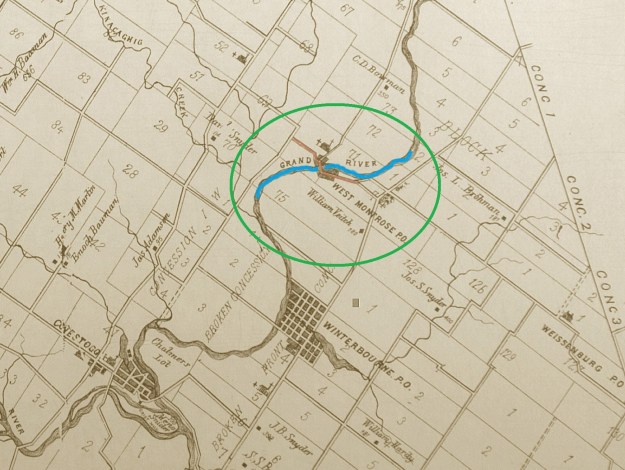
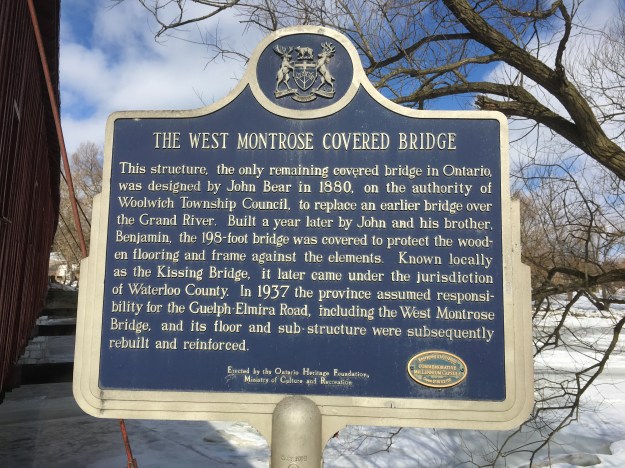
The average lifespan of a wooden bridge in the 19th century was 10 to 15 years.  The bridge marked on the county atlas in 1877 was under continual repair and by 1881 the Woolwich Council decided it was time to replace it.  They tendered the job of replacing the bridge with a covered bridge because it could be expected to last up to 80 years.

West Montrose (2)

The winning tender was from John and Benjamin Bear who agreed to $3197.50 for construction.  John Bear had built several barns but West Montrose would be his first bridge project.  Following this success he would go on to become a well-known bridge designer.

IMG_2665

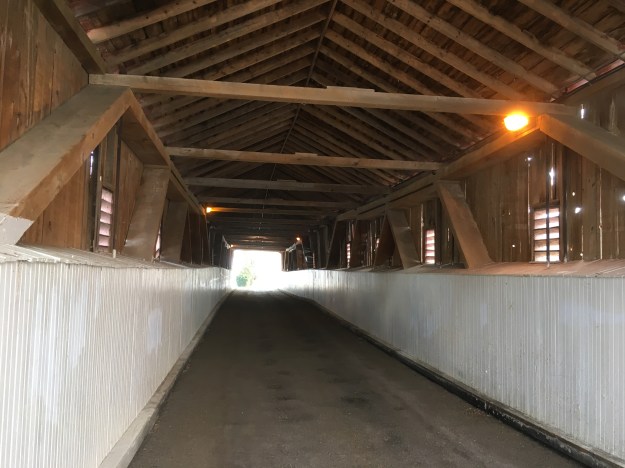
The original bridge decking was wood and the covering protected it from storms and inclement weather.  Ironically, in the winter the town had to pay someone to shovel snow onto the bridge.  Buggies switched to sleigh runners for the winter instead of wheels and the snow was needed to protect the oak planks of the decking.  A second advantage that covered bridges offered was a sense of calm for the horses who didn’t have to view the river during the crossing.  Starting in 1885 the inside of the bridge was lit by coal oil lamps during the over night hours.  Innovation came in 1950 when three electric light bulbs were hung inside the bridge.  After four years of having these smashed by tall trucks, the county paid for proper installation of electric lights.

IMG_2666

The bridge is two spans supported on a stone weir in the river.  The design is a Howe truss bridge but with the addition of needle beams (elongated floor beams) to laterally stabilize the frame.  It is 205 feet long and 17 feet wide.  It has been restored several times and steel Bailey trusses were added in 1959.

IMG_2685

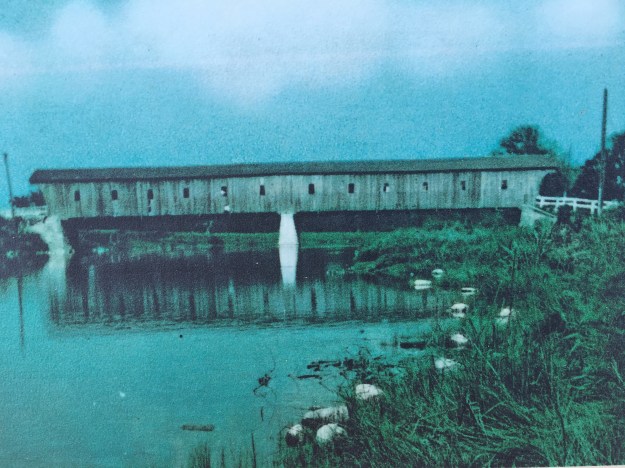
One on-line database lists 35 covered bridges in Ontario, along with pictures.  Only one of these was in existence when this postcard picture was taken in the 1930’s.  At that time there was a 30 foot long pagoda style bridge in Peterborough, among others in the province.  Only the Peterborough bridge survives from this era and it was restored in 1989 and so has an extended future.  Most other covered bridges in the province were built since 1980.  The West Montrose covered bridge is the only Victorian era vehicle bridge still in use in Ontario.  The more famous Hartland Covered Bridge in New Brunswick is much longer at 1282 feet but 20 years newer, having opened in 1901.  It is only one year shy of being the oldest in that province.  Notice how the West Montrose Covered Bridge pictured below had not been painted up until the time of this historic photograph.

IMG_2676

The length of the bridge varies from report to report with 205, 200 and 198 feet being cited.  Perhaps the floor deck is 198 while the roof is 205.  There is a small park near the bridge where you are allowed to park but property on both sides of the river is marked as no trespassing.  I can imagine it garners a fair bit of attention from tourists at certain times of the year.   Especially with a nick-name like The Kissing Bridge.

IMG_2669

As a bonus, Lost Acre Variety at the north end of the bridge has some very tasty home cooked breads and sweets.

Google Maps Link: West Montrose

Like us at http://www.facebook.com/hikingthegta

Follow us at http://www.hikingthegta.com
The Shand Dam

Friday, February 16, 2018

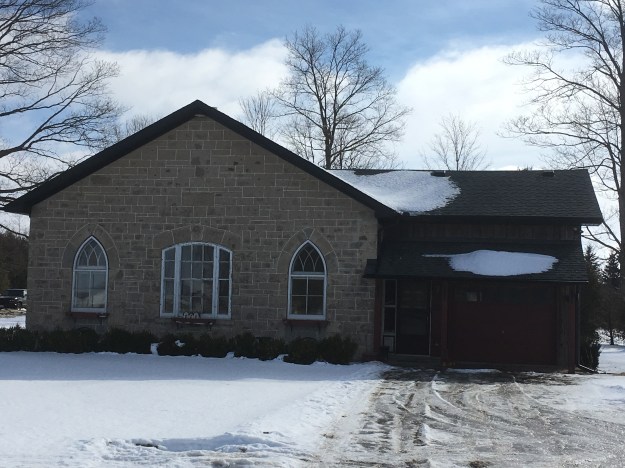
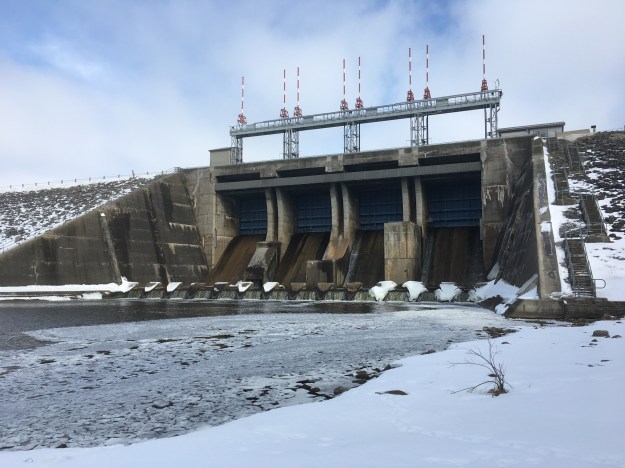
The Grand River Conservation Commission was formed in 1934 and one of their first major projects was the commissioning of the Shand Dam.  A vacation day from work was a good excuse for a road trip and I wanted to go and see the dam.  Rather than park at the Belwood Conservation area adjacent to the dam I decided to hike for 2 kilometres to the dam.  I parked on the Second Line, just west of the conservation area where the old railway line crossed and there are a couple of free parking spots.  This is in the former community of Spier, or Spires, where not much remains except for the  school house.  Forbes Moir had arrived from Scotland in 1858 and bought 250 acres of land and a small settlement was started.  It never grew but became a whistle stop on the Credit Valley Railroad when it passed through Moir’s property in 1879.  He operated a post office from 1882 until 1913.  The school date stone reads School Section No. 1 1872.

IMG_2660

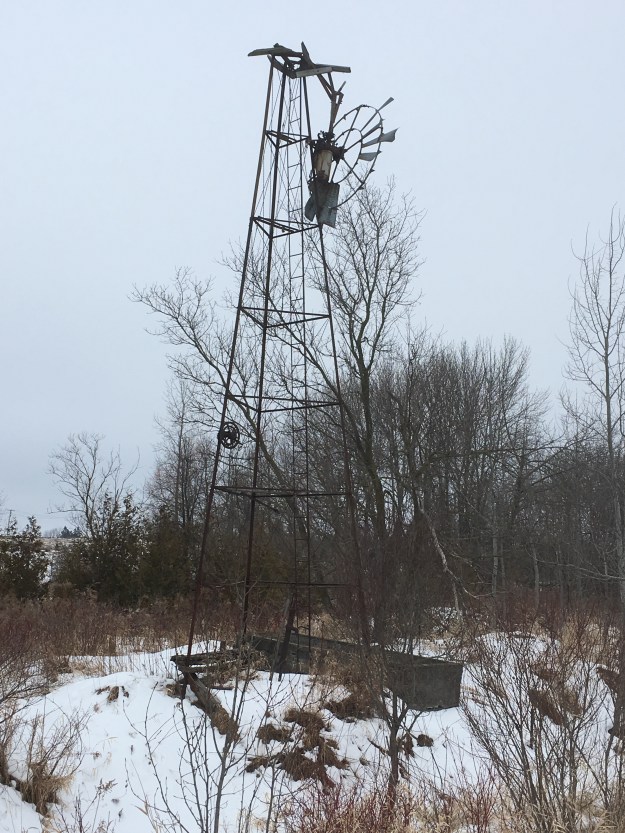
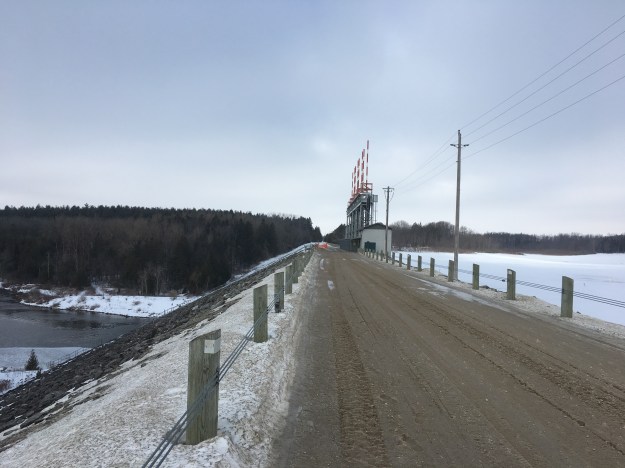
The railway was operated under several names before it was closed by the Canadian Pacific in 1988.  It is now a 47-kilometre multi-use trail known as the Elora-Cataract Trailway.  I entered the trail near the 8 kilometre marker and quickly saw the remains of an old windmill.  A concrete trough stands at the base of the structure where it once contained water for the livestock that grazed in the field.  The wheel is missing most of the vanes and it appears that it will soon be on the ground.  Steel windmills began appearing in the 1870’s but didn’t gain popularity for another 20 years due to the difficulty the farmer faced in repairing them compared to wooden mills. The ladder is still visible on the tower of this mill and one of the most hated jobs of early windmills was the need to climb the tower to lubricate the mill.  By 1912 the self-oiling windmill had been developed and this chore was greatly reduced.  This windmill is a reminder that this plot of land was generating energy long before the arrival of the dam.

IMG_2625

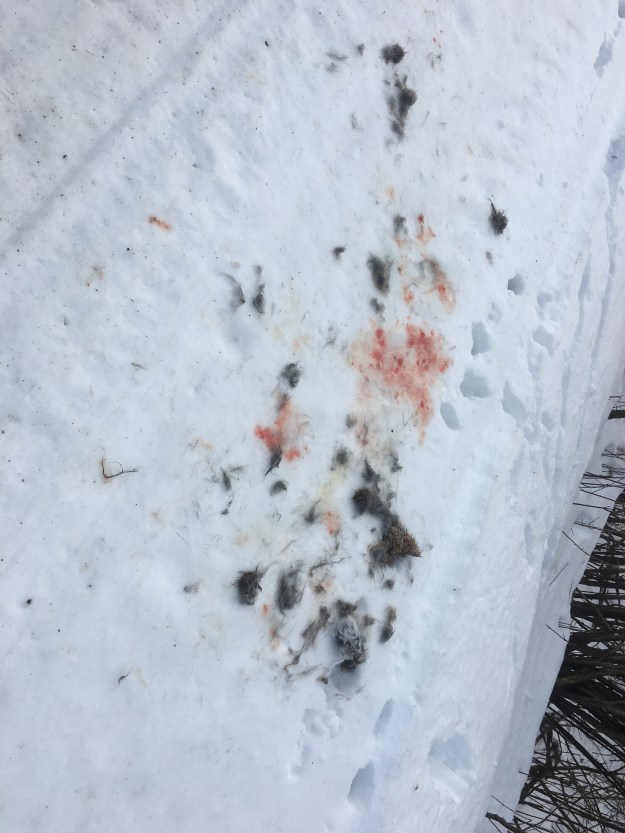
The trail was crossed with several coyote tracks of various sizes. There were several places where there were obvious signs of successful hunting, including this rabbit who didn’t escape becoming a coyote dinner.

IMG_2630

Snowmobiles use the trails during the winter months and there is an intersection of a couple of trails. On this day I didn’t encounter anyone, either on a snowmobile or on foot.  I expect that the trail is considerably busier in the summer months.

IMG_2632

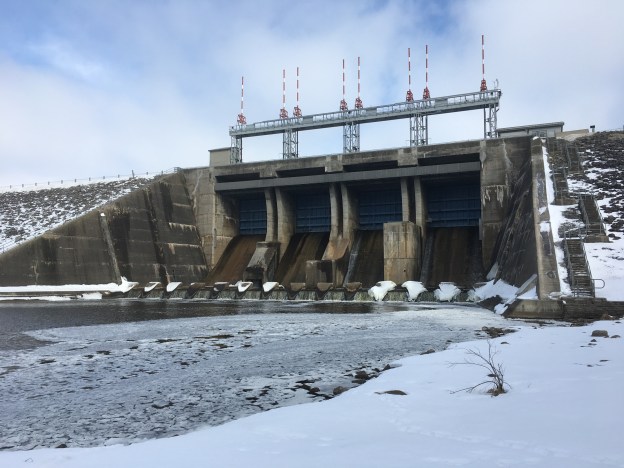
After a two-kilometre hike you will come to the Shand Dam.  The dam cost two million dollars and funding was provided in part by the eight municipalities that made up the conservation commission.  Brantford, Galt, Fergus, Elora, Paris, Kitchener, Waterloo and
Preston each got work for some of the unemployed in their communities.  The federal and provincial governments kicked in the balance in stimulus spending to help ease the effects of the Great Depression that was lingering.

IMG_2638

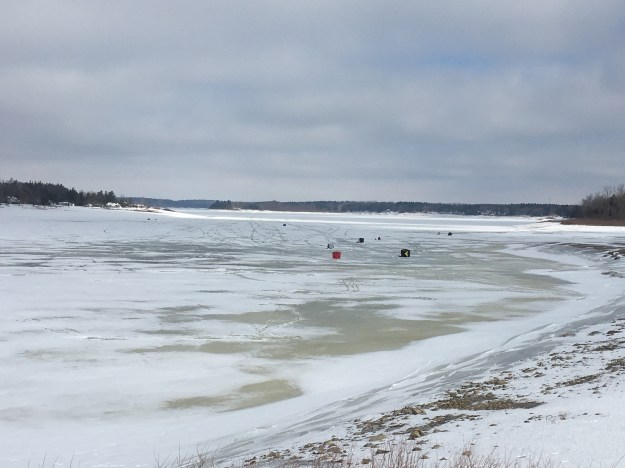
Part of the price of building the dam included the acquisition of 2,000 acres of land that would be flooded by the 12 mile lake that would be formed.  This was the first dam that the conservation commission constructed and remains the largest reservoir they control with a capacity of almost 64 million cubic metres of water.  It was the first dam built in Canada for the purpose of flood control and the provision of drinking water.  Several ice huts can be seen on the lake as people take advantage of the great ice fishing.

IMG_2644

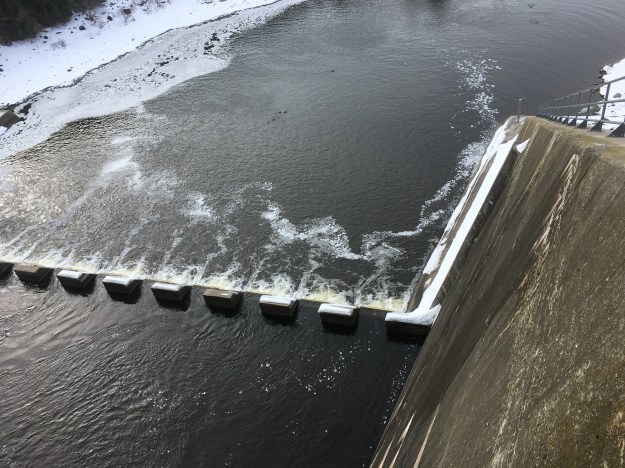
The dam was rushed to completion with the outbreak of the second world war and all Canadian records for construction were broken as the 22.5-metre tall dam was raised throughout 1940.  Crews of men lived on-site as record volumes of concrete were poured and tons of earth were moved in a rush of construction activity.  The dams steel gates were installed in January 1942 bringing construction nearly to a completion.  The CPR had been diverted while the dam was being built and the first train to cross the dam was on March 9, 1942.  The official opening took place on August 7th with 3,500 people in attendance for the ceremony.  The dam was originally called The Grand Valley Dam but tourists looking for the dam and park often ended up in the town of Grand Valley, some 18 kilometres upstream.  As a result, the dam was soon renamed after a local pioneer family named Shand whose land was consumed under the new reservoir.  This picture looks over the side of the dam to the dissipation weir at the bottom.

IMG_2639

One hundred and twenty stairs lead from the top of the dam to the bottom.  This dam proved its value when Hurricane Hazel hit Ontario in 1954 and killed 81 people in the GTA.  No lives were lost in the Grand River watershed.

IMG_2642

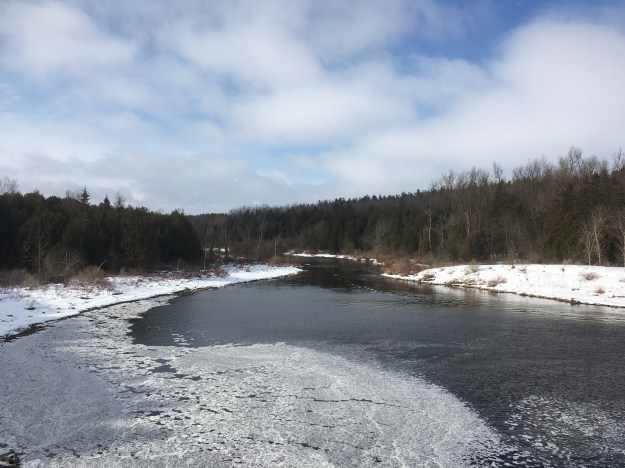
Water levels in the river used to fluctuate from raging highs during spring melting to summer lows when the water was little more than a polluted stream.  Today, the water level below the dam is maintained at a safe and constant level.

IMG_2643

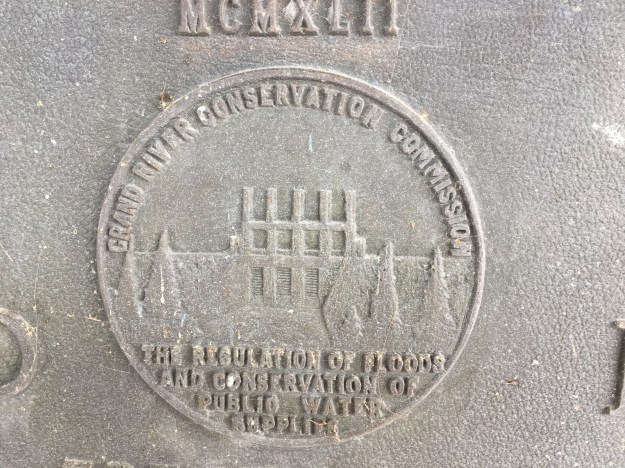
The Roman numerals for 1942 adorn the old conservation commission crest on the control room of the dam.

IMG_2653

Seen from the south, the difference in elevation of the water in the dam is obvious.

IMG_2651

The Elora-Cataract Trailway also serves as part of the Trans-Canada Trail which spans the country and runs to 24,000 kilometres.  The longest connected series of recreational trails in the world.

IMG_2658

Belwood Lake Conservation Area looks like a place to check out again in the summer months.

Google Maps Link: The Shand Dam

Like us at http://www.facebook.com/hikingthegta

Follow us at http://www.hikingthegta.com
 

Snow Day in G. Ross Lord Park

Saturday, February 10, 2018

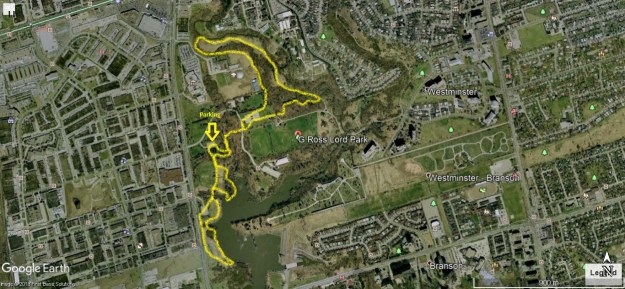
Here we have Hiking the GTA’s White Blog.  It was minus five Celsius and snowing steady the entire time we explored G Ross Lord Park.  The park was the subject of one of our earliest blogs, the seventh one, and so the local history won’t be repeated in this post, you can read it here.  The Google Earth capture below has been marked to show where we wandered from the car,  We did the southern section down to where we could see the G Ross Lord flood control dam.  Then we returned and made our way to the Don River flood plain to check it out.  There is a large section of the park to the east that could serve as an adventure for another day.

G Ross Lord

From the parking lot we went down to where Westminster Creek flows into the G Ross Lord reservoir.  There is a small section of land along the west side of the creek that is home to one of the local coyotes

.  There were coyote tracks everywhere but on this day squirrels were the main wildlife braving the storm.  You have to return to the main path to cross this little industrial outflow.  The foot bridge in the picture below will likely be flooded well above the hand rail during the spring melt when the reservoir is used retain a sudden inflow and then deliver a steady flow of water down stream.  The water level in the entire reservoir can rise by over ten feet in a matter of a day or so making the bridge completely disappear.

IMG_2502

The picture below was taken on May 9th, 2017 when the water level in the reservoir had risen above the level of the hand rails on the bridge.

Bridge in G Ross

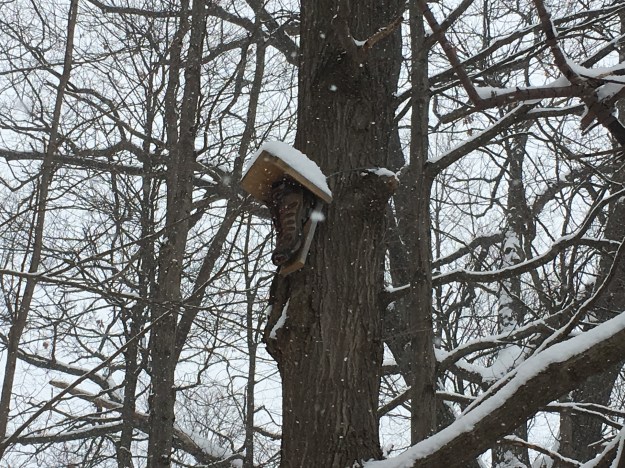
The southern parking lot is closed for the winter but as we passed through we noted this bird house.  It is number 29 and many others can be found throughout the park.  They were added last year.

IMG_2511

There are several different terrain types in the park including grasslands, wetlands and meadows making the park an excellent place for bird watchers.  Teasels grow in abundance in the park and their purple heads are quite spectacular when they are in bloom in early summer.  Today they sport a white cap of snow.

IMG_2515

The reservoir is frozen over but I don’t think the ice is very reliable because the water level fluctuates so much.  The park was created in 1972 and G Ross Lord Dam is one of three flood control dams built following Hurricane Hazel.  The Claireville Dam and Milne Dam are the other two.  Three hydro towers stand on concrete platforms in the middle of the reservoir.

IMG_2519

The picture below shows the reservoir looking north and helps give an idea of the size of the flood control pond.  Also the amount of water required to fill the entire pond to the level seen in the spring flood picture above.

IMG_2521

In a great example of re-purposing old things, a running shoe has been converted into a bird house.

IMG_2528

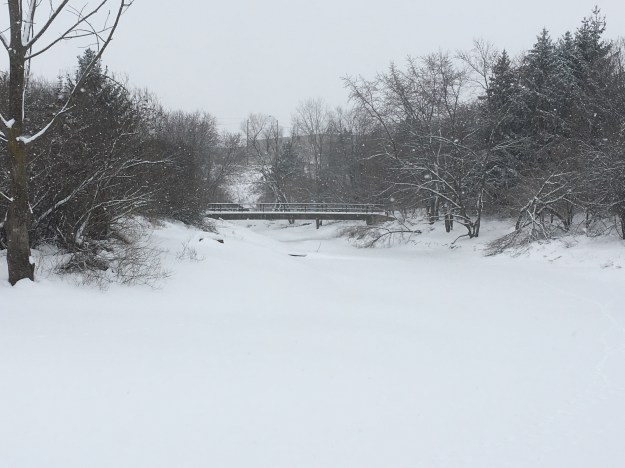
Returning to the bottom of the hill near the parking lot we turned right and crossed Westminster Creek on the foot bridge.  Following the creek for a short distance we came to the roadway and the main parking lot.  Beyond it the West Don River flows through a deep ravine.  The cover photo shows the first of two foot bridges that cross the winding river.  The original land owner was Jacob Fisher and he built a grist mill soon after settling.  Aside from some foundations hidden under snow on the opposite side of the river, the only remaining evidence of his mill is the large earthen berm that used to hold back the mill pond.  River bank restoration in 2017 resulted in the removal of a small amount of concrete from the dam that used to sit in the water.  The berm can be seen on both sides of the trail and is clearly marked by the only row of tall pine trees in the area.  It can be seen in the picture below as the berm rises just beyond the river bank.

IMG_2544

The mill closed in 1912 and the farm was later bought for the use of horse farming to facilitate the production of vaccines.  Connaught Labs was the original facility and has a museum that Hiking the GTA was able to visit with a guided tour.  Today, Sinofi Pasteur is a major provider of vaccines to the world and for decades was the sole producer of insulin for diabetics.

IMG_2548

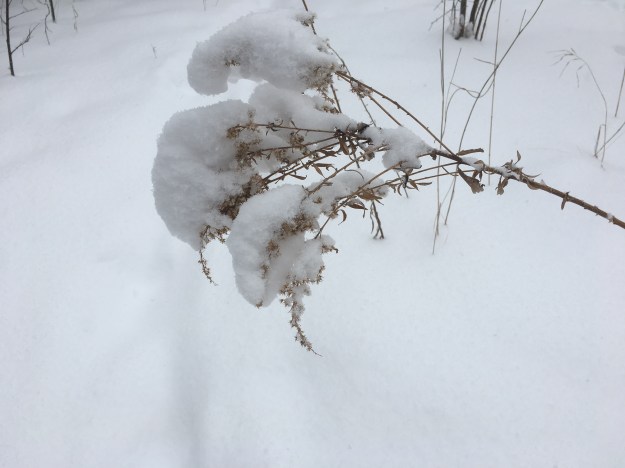
Just before the main trail turns toward Steeles Avenue and the former community of Fisherville, there is a short trail to the top of the ravine.  We made the climb and followed the upper trail back toward the parking lots.  By this time the snow was really starting to pile up and goldenrod were feeling the weight of it all.

IMG_2551

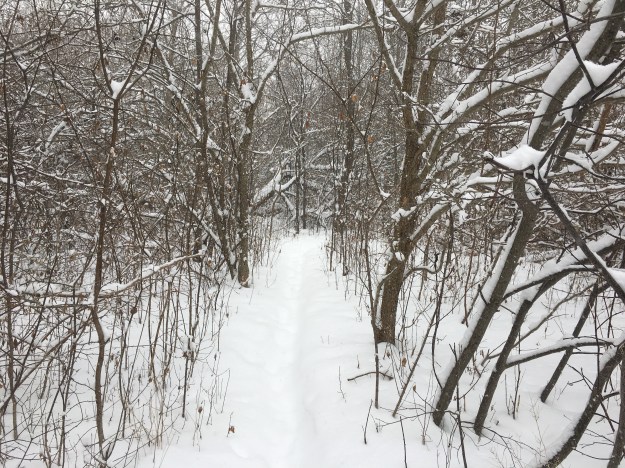
The trails were deserted and the fresh snow made them quite beautiful.

IMG_2554

Here are the links mentioned in the story: G Ross Lord Park, Fisherville, Connaught Labs, Clairville Dam, Milne Dam

Google Maps Link: G Ross Lord Park

Like us at http://www.facebook.com/hikingthegta

Follow us at http://www.hikingthegta.com
Duffins Creek

Saturday, January 20, 2018

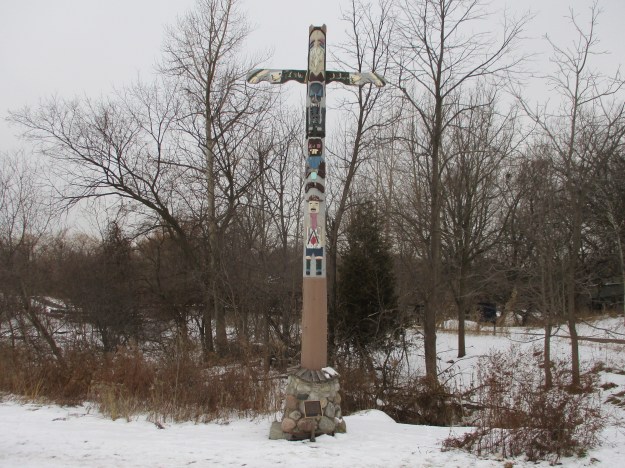
Pickering Township was surveyed in 1791 by Augustus Jones but a trader named Duffins had already been established for 3 years and the local creek had taken on his name.  Major John Smith was awarded 4,800 acres of land in Pickering Township for his services in the Revolutionary War in the USA and soon a small settlement began around the bridge where Kingston Road crossed Duffins Creek.  To supplement the few houses, John’s son David, determined to build a saw and grist mill and an order was placed with the Commissary-General’s department for the issue of the mill stones and hardware.  We parked on Elizabeth Street near the entrance to Duffins Creek Trail.  There is a totem pole in the park which was installed in 2007 to commemorate the 100th anniversary of Scouting.  We had previously visited the remains of the Camp of The Crooked Creek in Morningside Park.

IMG_1673

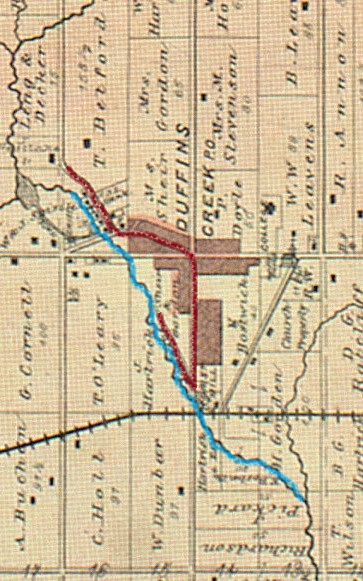
Although the mill equipment had arrived by 1799 the mills were never erected and it is likely that they were sold along with 850 acres of land to Timothy Rogers in 1807.  Kingston Road had been complete just two years earlier and a small community of Quakers began to form at Duffins Creek.  The mills started a long progression of changing hands and going in and out of business.  Stores established in the early community also kept failing.  In 1824 Francie Leys opened a store and used his house as an inn to accommodate travelers.  When he opened a post office in his store in 1829 it was called Pickering, the community continued to be known as Duffins Creek.  The 1878 atlas below still shows the community as Duffins Creek although the name was officially changed to Pickering a decade earlier.  The original village has become overgrown with development and is now referred to as Pickering Village.

Duffins Creek (2)

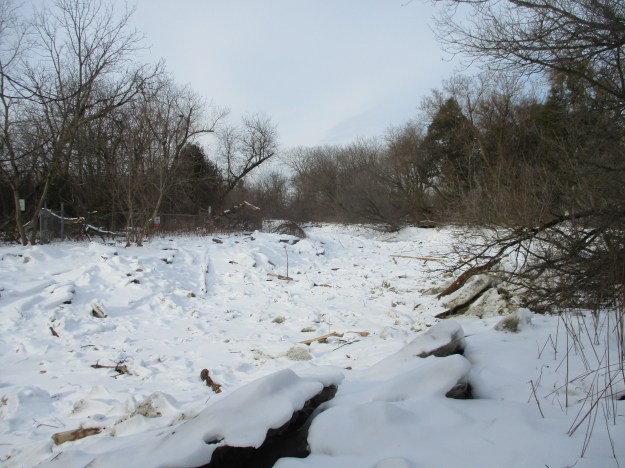
By 1846 the population was about 130 and there were four churches.  These were comprised of a Presbyterian, Weslyan, Quaker and Roman Catholic.  The usual small town professionals had also arrived including blacksmiths, tanners, tailors, shoemakers, and inn keepers.  Through the 1850s there were at least 3 grist and saw mills operating at the same time, located above and below Kingston Road.  In August of 1856 the Grand Trunk Railway gave the community access to new markets and each of the mills had a spur line.  Milling became the main industry with one grist mill surviving until 1934 and the other in 1956.  Duffins Creek has previously frozen over but the recent warm spell flooded the creek with melt water, breaking the ice and washing it onto the creek banks.  Some of these chunks are over 30 centimetres thick.

IMG_1680

As we followed the creek we came to the place where a weir has been built to prevent sea lamprey from having access to the upper reaches of the creek.  Sea lamprey are an invasive species that aggressively feed on the body fluids of fish by attaching themselves with their suction cup mouths and rows of sharp teeth.  The first weir on both Duffins Creek and the Humber River are designed with traps in them to catch the adult lamprey as they move upstream to spawn.  The lamprey weir on Duffins Creek was not visible under all the blocks of ice in the creek.

IMG_1686

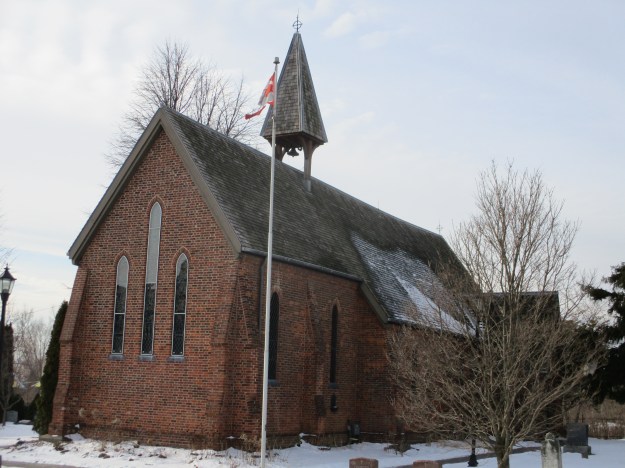
St. George’s Anglican Church was built in 1841 and is the oldest surviving church building, not only in Pickering but in all of Ajax as well.  The red bricks for the church were provided by the Grand Trunk Railway in exchange for a right of way across lands that belonged to the church.

IMG_1713

The Roman Catholic Church was built in 1871 and is the tallest building in the old village.  Built in the Gothic Revival style with pointed arches throughout and even the roof shingles have been laid with an interesting pattern to catch the eye.  Many early communities did not have a Roman Catholic church and so this is a little unusual.  The fact that the roof is cut with dormer windows is very rare in a church.

IMG_1703

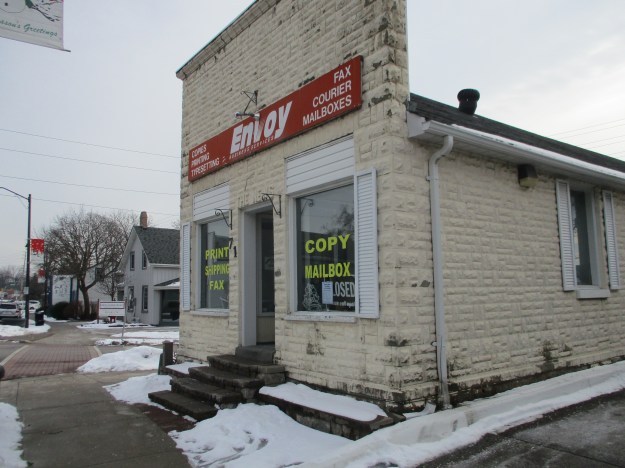
Pickering village attained a population of 1000 by 1900 and had its own newspaper called The Pickering News.  In 1890 an annual subscription was $1.00 Strictly in advance, $1.25 If not so paid.  This little building with a boomtown front still houses a print shop. Notice the words “The News” above the door, however, this was not the original building for the newspaper.  The prefabricated blocks are designed to look like cut stone and this innovation didn’t come out until around 1900.

IMG_1734

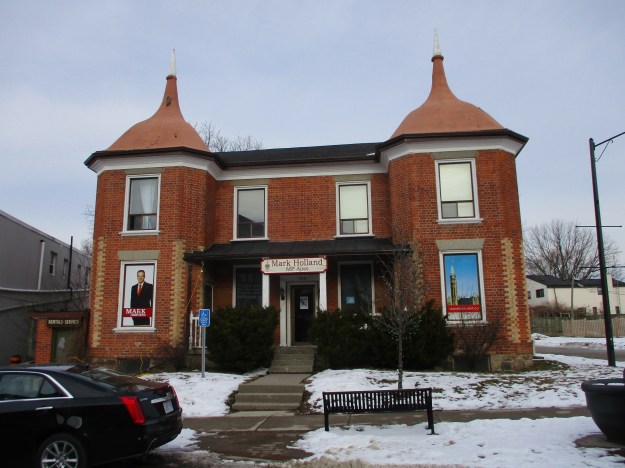
In 1850 Dr Robert Burns had this unusual home built to accommodate his family and his medical practice.  The two story extended bays with copper cupolas give the building a decorative look that stands out on the main street of the town.  In the 1860’s, two family doctors ran their practices out of this early medical building

IMG_1738

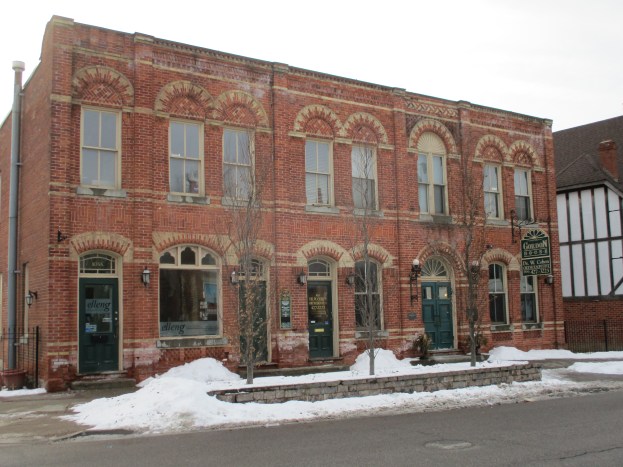
The cover photo features one of the more decorative buildings in the old town.  John Cuthbert’s Hotel features extensive dichromate brick patterns and a recessed main entrance.  The hotel was built in 1881 and was operated by the Gordon Family from 1893 until 1952.

IMG_1737

The Trans Canada Trail also follows Duffins Creek Trail and the entire area is a flood plain for the creek.  During the recent melt, this whole section of park was flooded and then the surface froze several centimetres thick.  When the water drained out from underneath it left the ice clinging to the bottom of the trees.

IMG_1690

The original village of Duffins Creek, now known as Pickering Village has many other historic buildings that can be enjoyed on a walking tour.  The historical society has produced a tour map that can be found here.

Google Maps Link: Pickering Village

Like us at http://www.facebook.com/hikingthegta

Follow us at http://www.hikingthegta.com


Massey-Goulding Estate

Saturday, January 13, 2018

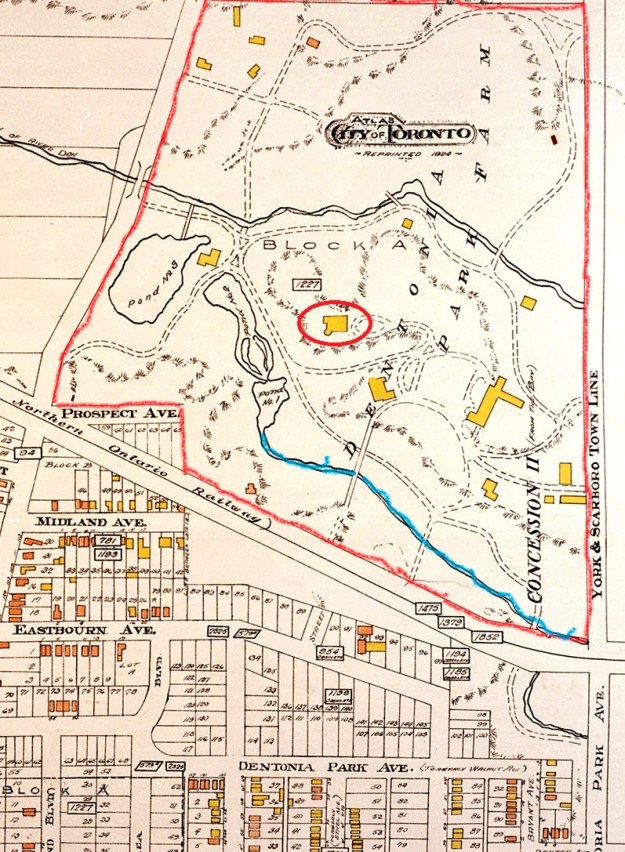
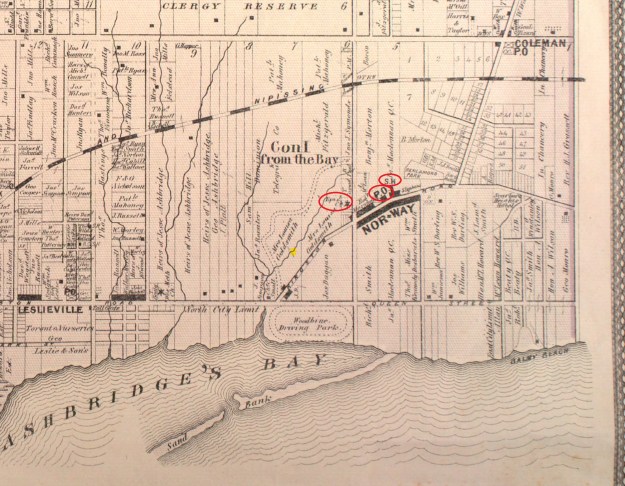
Canada’s first major industrialist was Hart Massey whose agricultural implement manufacturing eventually became Massey Ferguson.  In 1855 he moved his father’s business from Newcastle to Toronto.  His son, Walter, was born in 1864 and in 1887 he bought a 240-acre farm which he named Dentonia after his wife’s maiden name of Denton.  The historical map below shows the original extent of the farm and all of the buildings have been marked in yellow.  The one circled in red is the only remaining one and is the cover picture for this post.

sub-history-map (2)

The farm sold fresh eggs and dairy products to the public. City Dairy opened in 1900 and was the first in the city to offer pasteurized milk.  At this time it was estimated that 400 children a year died in Toronto due to contaminated dairy products.  The archive photo below shows the farm in its heyday.  All of the buildings in this picture have been demolished and replaced with Crescent Town towers.

DEntonia Dairy

Walter and Susan Massey had a daughter named Dorothy who got married in 1921 to Dr. Arthur Goulding and they built a house as a wedding gift for her.  The house was built in the arts and crafts style that was popular at the time.  Arthur and Dorothy raised their family in the house and she encouraged her own children and their friends to perform fairy tales and plays as a way of occupying their time.  This grew into the Toronto Children’s Theatre.  This may have been an influence on her nephew, Walter Massey the famous Canadian actor. The house is 5000 square feet and has highly detailed windows.

IMG_2183

Walter Massey had pioneered the sale of pasteurized milk in Toronto but ended up dying at the age of 37 due to typhoid that he contracted from unclean drinking water he got on a train.  Susan kept running the City Dairy until 1930 when it was sold to Bordens.  The 240-acre farm was then slowly sold off for development.  Susan donated 60 acres of land to the city for a public park on the condition that it be known as Dentonia Park. The Gouldings were fond of their horses and the house features an oversized porch to allow riders to get beneath it.

IMG_2185

When Dorothy died in 1972 the house became the property of the borough of East York and sat vacant until 1997 when it was restored.  Today it serves as the Children’s Peace Theatre, a use that Dorothy would have approved of.

We parked on Victoria Park Avenue, originally known as York and Scarborough Town Line.  Taylor-Massey Creek is named, in part, after the family farm that it flowed through on its way to join the Don River.  It passes under Victoria Park Avenue in a large concrete culvert that is a replacement for an earlier bridge seen on the map.

IMG_2173

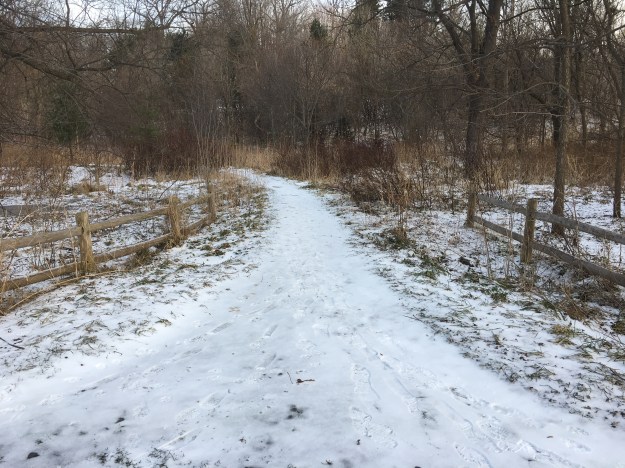
The trail through the park passes a lot of new growth trees as the farm returns to a more natural forest cover.

IMG_2174

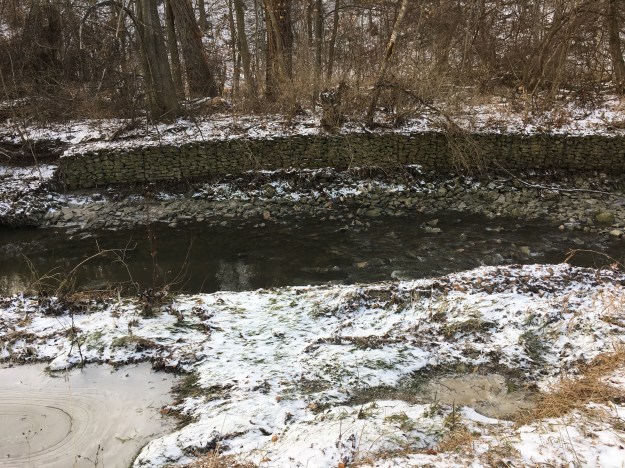
Taylor-Massey Creek is one of the most degraded watercourses in the city.  The upper reaches collect pollution off of the 401 and carry it through a long industrial section.  The city has updated its master plan for the revival of the creek and the repair of failing gabion baskets that were installed 50 or 60 years ago.  The ones through this part of the park are in fairly good condition.

IMG_2175

Winter camping, or homeless living, in Toronto’s parks must have been a very cold experience so far this winter.  We saw a Jolly Roger flag flying on the top of a small rise along the side of the ravine.  Pirates this far from the bay required investigation and so we proceeded to do so.  There were no recent footprints in the snow and, unsure if the tents were occupied or not, decided to leave them alone.

IMG_2206

We followed the trail along Taylor-Massey Creek past all three locations of the ponds seen in the historical map.  Crossing to the unmaintained trail on the other side of the creek we made our way until we could see the O’Connor Drive bridge over the ravine.  This marked the point where we had made it to during our previous hike in Taylor Creek Park.

IMG_2225

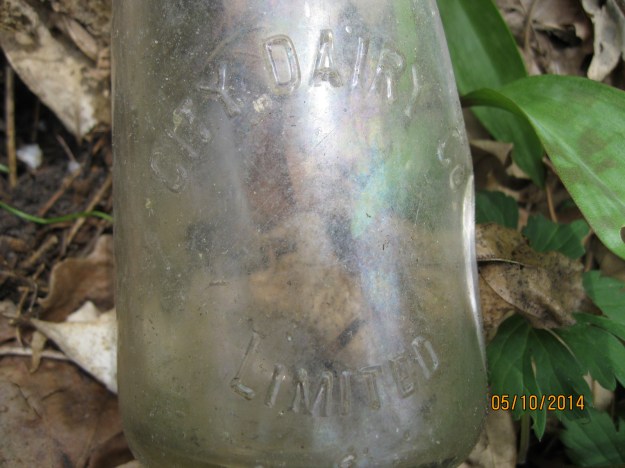
The picture below is from our investigation of some of some abandoned ovens on the back of Baby Point opposite to The Old Mill.  At that time we found a number of old bottles including this partial City Dairy milk bottle.

city dairy

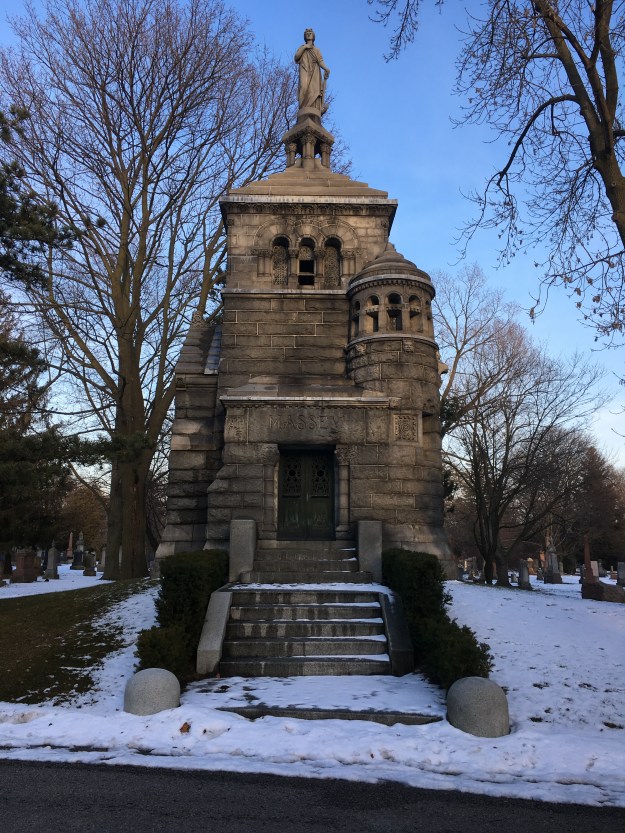
It is a fitting ending that one of the leading industrial and philanthropic families in the history of Toronto is entombed in a mausoleum designed by the most prolific architect of the late 19th century in the city.  J. E. Lennox designed the mausoleum which was built between 1890 and 1894.  All of the Masseys and their spouses that are part of this story are interred in this family mausoleum in Mount Pleasant Cemetery.  It has been repaired over the years and in 1967 the underground crypt was filled in.  In 2000 it was designated as having architectural and historical value.

IMG_2254

The Massey family is remembered in Toronto by Massey Hall and the new 60-story Massey Tower rising behind it.  Dentonia Park and Dentonia Park Golf Course are also remnants of the old farm and recall the family.  Their agricultural implements manufacturing lives on in Massey Ferguson a major brand, worldwide.

Google Maps Link: Taylor Creek Park

Like us at http://www.facebook.com/hikingthegta

Follow us at http://www.hikingthegta.com
Norway – Ghost Towns of the GTA

Sunday, January 14, 2018

The first capital of the united colonies of Upper and Lower Canada was in Kingston.  The British military was stationed at Kingston and a road was needed for rapid troop transportation in case of trouble from the newly created United States of America to the south.  A road was cut through the forest from York (Toronto) to Kingston.  Asa Danforth Jr. was contracted to build the road at a cost of $90 per mile to run from York to the mouth of the Trent River.  It was completed by December 1800 but was poorly maintained.  It served as a route for the mail coach and needed to be better maintained.  A series of toll booths were set up to collect funds for the ongoing repair of the road.  One of these toll booths was located at the intersection of the road with modern Woodbine Avenue.  This was the first area near the beaches to have a community arise and an early name for the town was Berkley.  By 1837 it is said that there were 80 people living in the community and they had a hotel, store, brewery and a steam-operated saw mill.  The mill still existed at the time of the county atlas in 1877 and is marked below as SM.  It stood east of the Post Office that had been erected at 320 Kingston Road in 1866 but which has since been removed.

Norway map (2)

A stagecoach ran every week between York and Kingston, beginning in 1817, usually taking four days to complete the journey.  Over the next 15 years, the frequency increased to a daily run that included regular delivery of mail to the village.   Tracks were laid along Kingston Road in 1874 to allow the operation of horse-drawn streetcars which were replaced in 1893 with the  Toronto and Scarboro’ Electric Railway, Light and Power Company.  This radial line was absorbed into the Toronto and York Radial Railway in 1904.

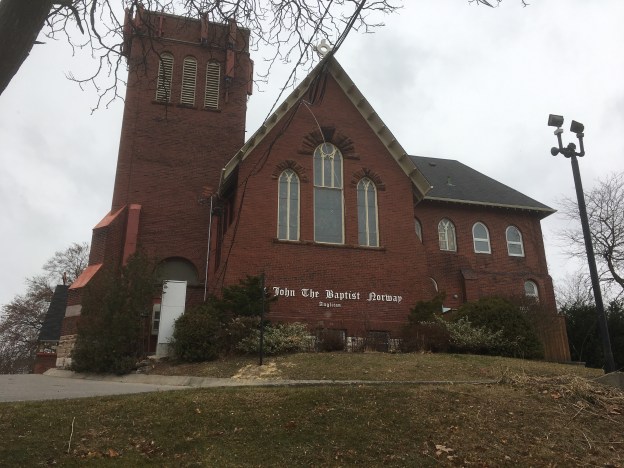
In 1853 Charles Coxwell Small donated 3 acres off his 472-acre estate to erect a church building and create a cemetery so that the local Anglican church could move their meetings out of O’Sullivan’s Tavern and into their own building.  The first building on the site was the old school house which had been purchased by the congregation and then moved by a team of oxen.  According to the terms of the land agreement the church was called St. John’s, Berkley.  The name was later changed to St. John the Baptist Norway at some point following Small’s death.  The picture below shows the original church as it appeared in the late 1920’s.  It had been replaced with the current building in 1893 which can be seen in the corner of the picture.

St. John's Anglican Norway, old church, close. - October 4, 1927

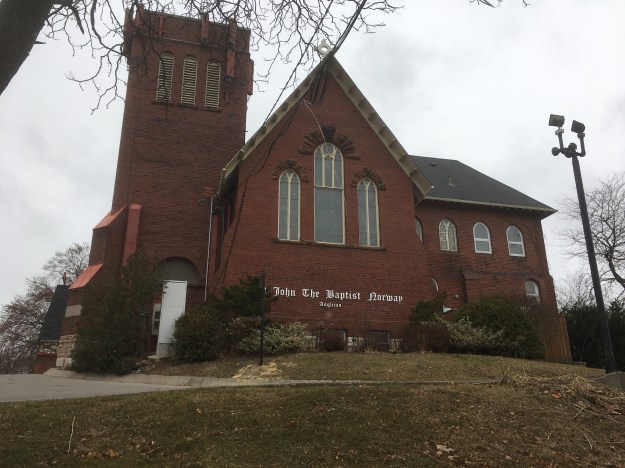
The congregation began to build their new brick church in 1892 and that is the date on the cornerstone.  The building was opened in 1893 and by 1915 an expansion was needed.

IMG_1639 (1)

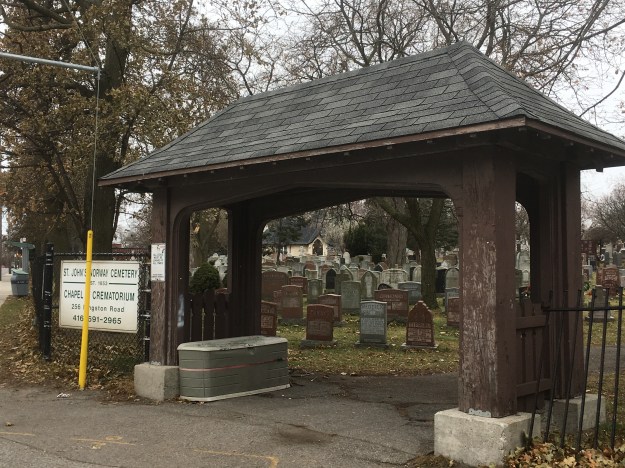
The term Lychgate comes from the ancient Saxon word for corpse.  English churches often had a lychgate where the body would lie in state until burial.  People often died at home and the body was moved to the lychgate to await burial.  Bodysnatchers forced most of these to be guarded and very often there were seats for the family to sit and mourn for the deceased.  The first part of the funeral service would often be performed under the lychgate.

IMG_1630

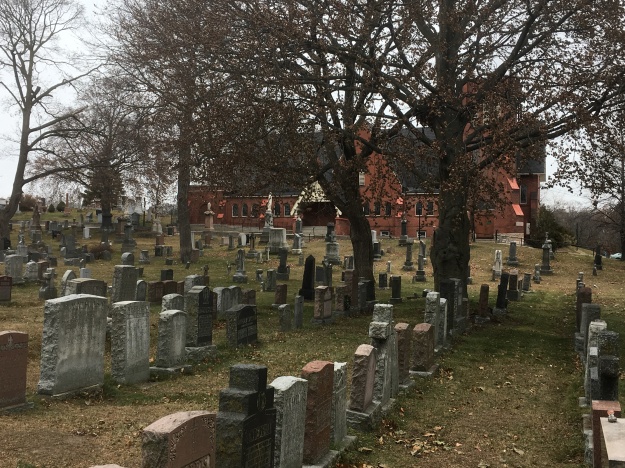
The cemetery at St. John the Baptist has been in operation since 1853 and has over 80,000 interments.  Originally the cemetery was Anglican only but has been opened up as an interfaith burial grounds.  Many of the early pioneers of the city are buried here as well as founding families of the Beaches area.  Joseph Williams who was the founder of Kew Gardens along with many members of his family is buried here.

IMG_1631

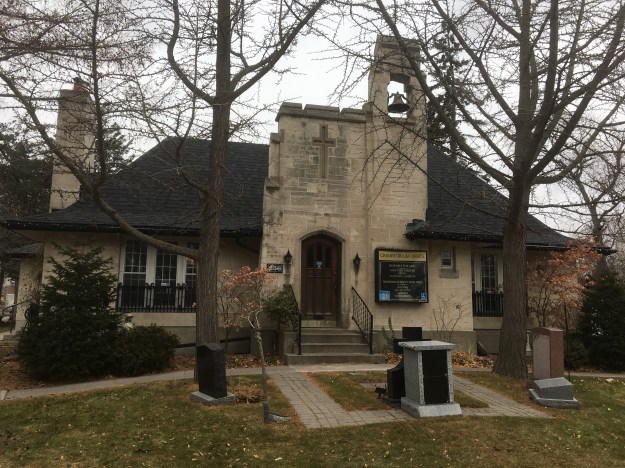
The cemetery features a crematorium in which the bell from the original school has been preserved.

IMG_1632

The current Norway public school was built in 1976 and is at least the third building to occupy the site.

IMG_1618

The building at 340 Kingston Road appears to be one of the original buildings based on the brickwork and the fact that the ground level windows have been buried over time.  Only the bricks of the lintel show at street level.

IMG_1625

This store occupies a building that has an unusual name stone at the top.  Where one might find a date or bank name we see the letters T.W.M. which is likely the initials of the person who built the block.

IMG_1616

Norway has recently acquired a lot of low rise condos along Kingston Road where the historic buildings are falling, one at a time in the name of progress.

Google Maps link: Norway

Like us at http://www.facebook.com/hikingthegtacom

Follow us at http://www.hikingthegta.com
The Castle – Glengrove Substation

Friday, December 29, 2017

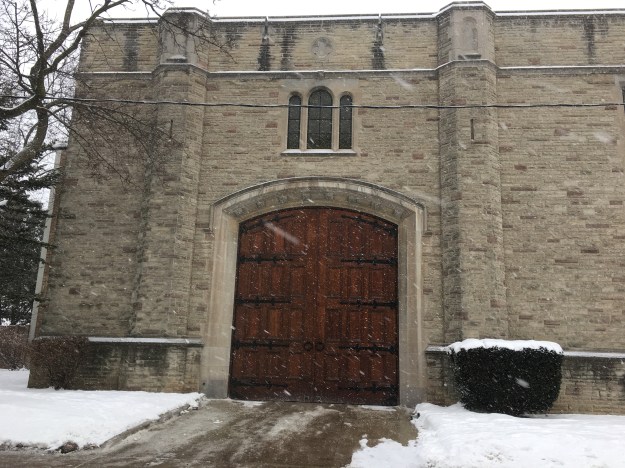
Electrical power came to Toronto in 1910 and the network for distribution was born.  Power generated at Niagara Falls was brought to the city on high tension transmission lines.  It had to be converted to currents that could be used by the average consumer but nobody wanted the large sets of transformers, wires and resistors next door for their children to play in.  Toronto Hydro decided to hide them and several designs were developed that allowed the substations to blend in.  In March 2016 we checked out the abandoned Transformer House on Bayview Avenue beside Sunnybrook Hospital.  There were over 250 of these built but perhaps the most elaborate was built in 1930 in North Toronto.  This is the front door to the Glengrove Substation that has become known as The Castle.

IMG_2011

The date plate stands on the right side of the front door.

IMG_2012

The windows and rough-cut stone architecture give the substation the appearance of a castle that could be found on the moors of England.


The windows on the building come to life at night when the interior lighting switches on.

IMG_2087


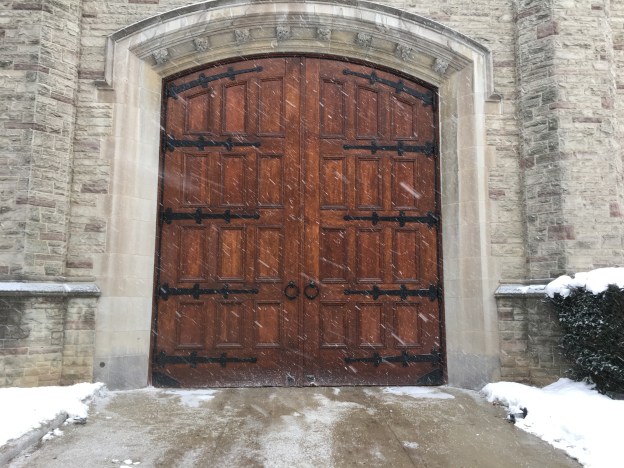
On the Glengrove side of the building, there is a very tall set of oak doors with the appearance of a drawbridge.  These doors allow the installation and repair of the large transformers inside.

IMG_2009

Two major construction projects were going on at the same time that The Castle was being built that had an obvious influence on the design and construction materials used for the sub-station.  In November 1926 a new parish was opened to serve the Catholics in the expanding area of North Toronto.  In the spring of 1929 construction began on their new church building with the first services being held on June 1, 1930.  The rough cut stone and Gothic Revival arch doorways are dominant on both buildings.

IMG_2089

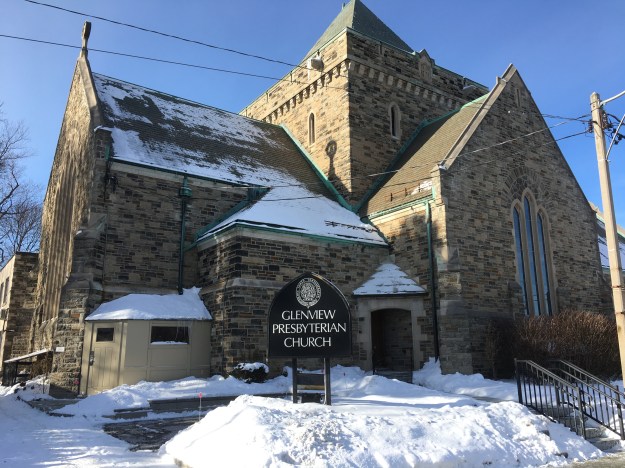
The Presbyterian church had been meeting in Eglinton, later renamed North Toronto, since 1860.  In 1929 they moved into their new building kitty-corner across Yonge Street from the sub-station.
IMG_2083

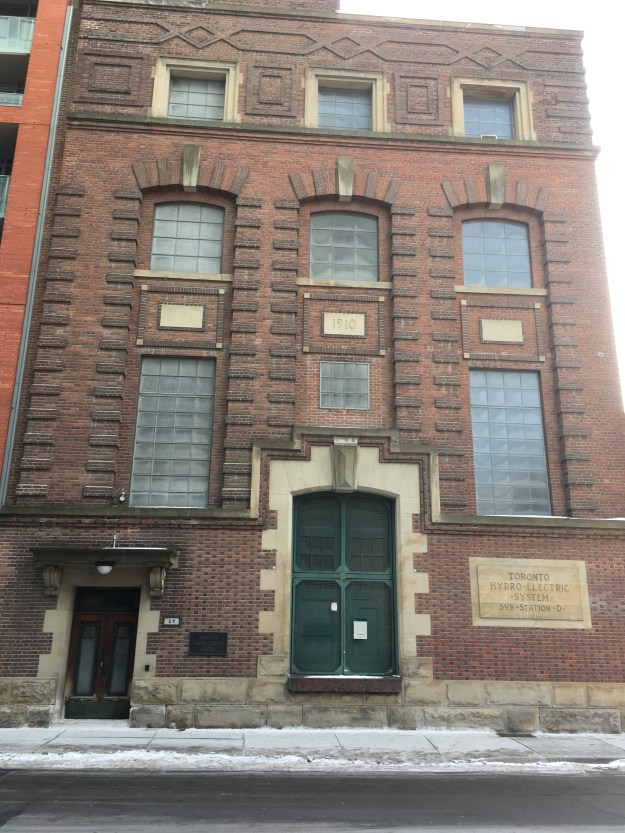
A different example of disguised transformer buildings can be seen in the Entertainment District downtown.  The corner of Duncan Street and Nelson Street was home to factories and warehouses in 1910 when the sub-station D was built.  Therefore it looks like a typical factory building of the era and is one of the original buildings in the distribution system.

IMG_2075

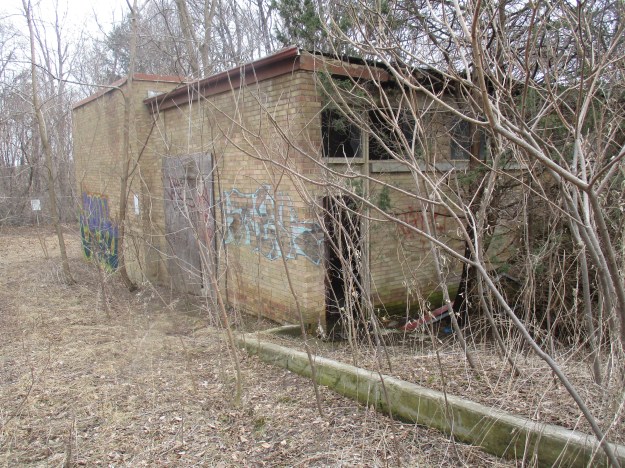
The transformer house on Bayview Avenue near Sunnybrook Hospital was designed to look like one of the hospital outbuildings.  It has now been abandoned and is in serious decay.  The story of the Bayview Transformer House can be read in greater detail with additional pictures at the link above.

transformer

Google Maps Link: Glengrove Substation

Like us at http://www.facebook.com/hikingthegta

Follow us at http://www.hikingthegta.com