Camp 30 – Bowmanville POW Camp

Wednesday, March 28, 2018

Until 1922 John H H Jury had owned a 300 acre farm north of Bowmanville which he called the Darch Farm.  He decided to donate it to the Ministry of Education for a school to house boys who were getting into trouble and considered to be “unadjusted”.  The school was to be known as the Ontario Training School for Boys.  Several buildings were constructed between then and 1927 when the site was completed and opened. Classes were started and continued at the school until April 1941 when the government announced that it was taking over the school for use as a Prisoner Of War camp.

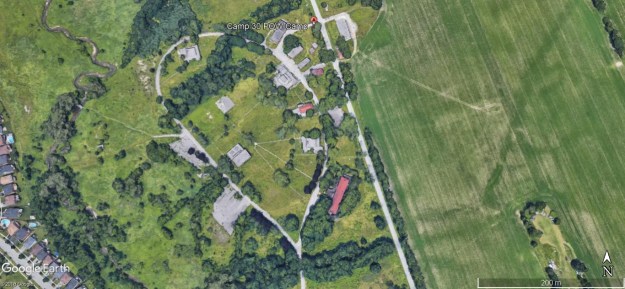
Hitler’s bombing campaign in England had raised the possibility that England could be invaded by the Nazis and the prisoners there set free to return to the battle.  The boys from the school were then sent to various homes throughout Bowmanville so that the camp could be converted.  Two rows of fences were constructed around the perimeter with 15 feet of grass in between to deter escape attempts.  Nine guard towers were built along with a set of barracks for the Canadian soldiers who would be the guards at the POW camp.  The Google Earth capture below shows the various buildings that survive today.  Several others have been demolished over the past few years.

Camp 30

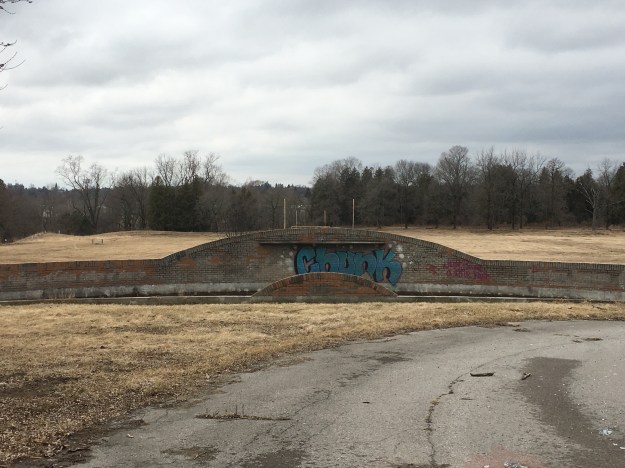
I parked up the road and walked back with the idea of scanning the property and taking pictures from the road.  There were several sports fields at the south end of the compound that were used by the school and the POW camp.  The gymnasium building also housed an indoor swimming pool but the POW’s were allowed to leave the camp for exercise.  As long as they promised not to try and escape they were allowed to go down to the lake in the summer to go swimming and for cross country ski trips in the winter.  Life in the camp was pretty good and relations with the guards were generally amicable.

IMG_3495

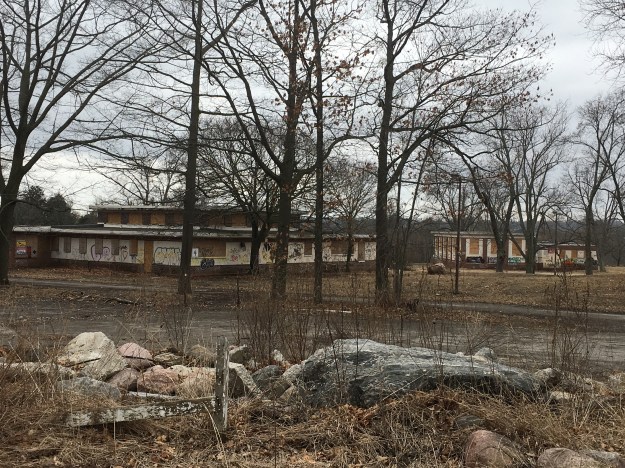
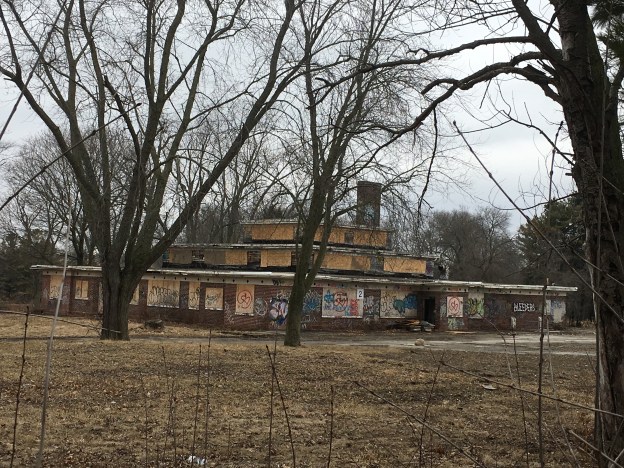
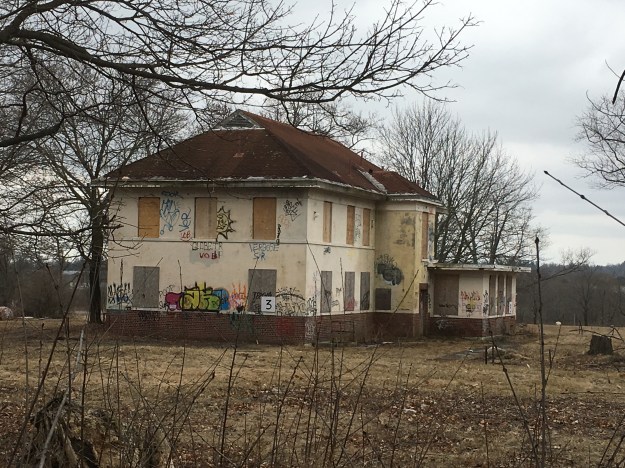
The first buildings you come to along the road are the two story dorms which were used as barracks for the POW’s.  Like all the buildings remaining on site, all the windows were broken before they were boarded up.  Graffiti covers the walls and the drywall inside is smashed up.  Most of the buildings have suffered some fire damage as people have started fires on the wooden floors during parties on the grounds.

IMG_3509

The hospital building is one of two with a peaked roof, along with the barracks above.

IMG_3518

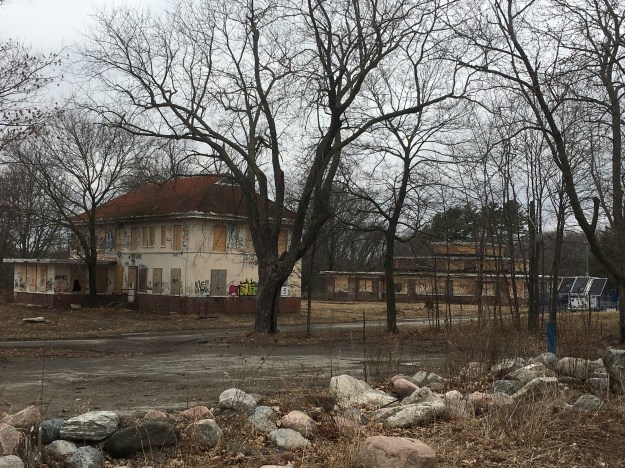
The hospital in relation to the mess hall.

IMG_3514

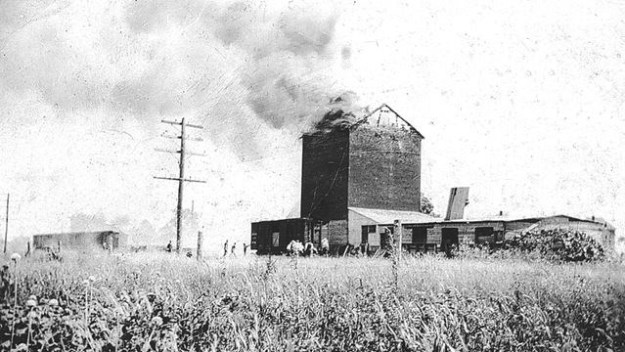
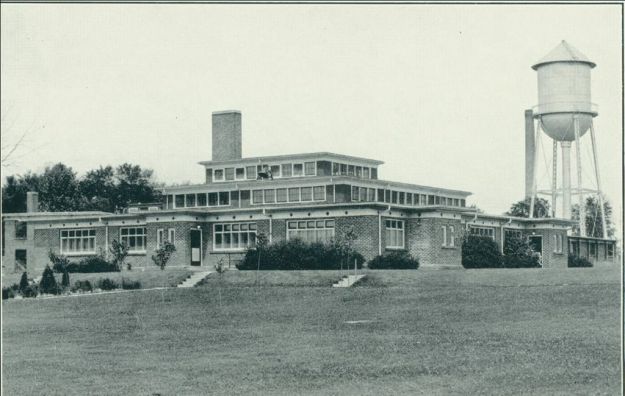
The historic photo below was taken from Wikipedia and shows the cafeteria building as it looked around 1930.

CAmp 30 cafeteria

The cafeteria building became the mess hall when the POW camp was created here.  The building became the site of the infamous Battle of Bowmanville in October 1942.  In Europe, Hitler had ordered that Canadian POW’s be placed in shackles and in retaliation German POW’s were to be shackled too.  100 officers from Camp 30 were supposed to volunteer but instead barricaded themselves in the mess hall.  They gained access to hockey sticks as weapons and so the 100 soldiers brought in from Kingston stormed the hall armed with baseball bats.  We had to keep it fair!  The most serious injury was to a Canadian soldier who was hit in the head with a jar of jam.  Later, German soldiers who were holed up in the basement of the barracks were flushed out using high pressure water hoses.  After the stand off was over, the Germans were placed in shackles until December 11, 1942.  The mess hall is one of the buildings that remains on the site.

IMG_3520

Two other buildings can be seen below, including the gymnasium in the background.

IMG_3516

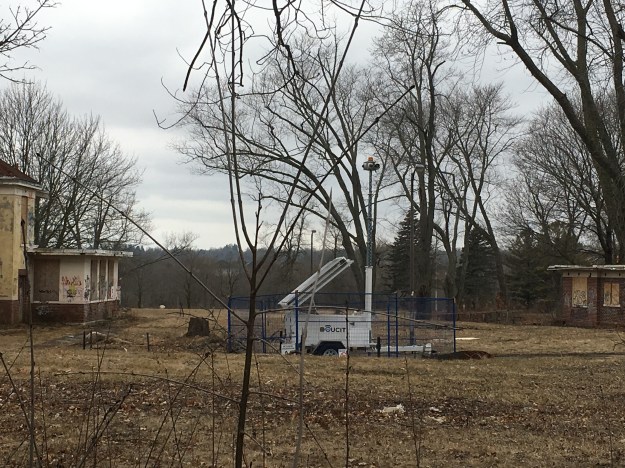
After the war was over the property was given back to the Ministry of Education and put back into use as the Pine Ridge Training School.  It operated in this capacity until 1979 when it was closed as a boys school.  It was used for various other educational uses until 2008 when it was finally closed for good.  Since that time it has deteriorated badly and has been the subject of much vandalism.  Several buildings have been lost to fire and a few were demolished in the past few months.  In 2013 the property was listed as one of the most endangered historical sites and was finally given a historical designation to attempt to preserve it.  Six buildings are to be restored and in the fall of 2017 they were boarded up again to keep the winter weather out.  Security cameras and foot patrols are in place to give trespassing tickets to those who are curious enough to enter the property.

IMG_3521

I was hoping, perhaps for the first time ever, that a security guard would show up.  I had planned to ask them if I could walk around the property with them if I didn’t leave the paved walkways.  Alas, no security guard when you really want one.  Many people have posted online about getting tickets for trespassing so beware.  There are several of these cameras set up on the site and they apparently alert the police when motion is detected.

IMG_3519

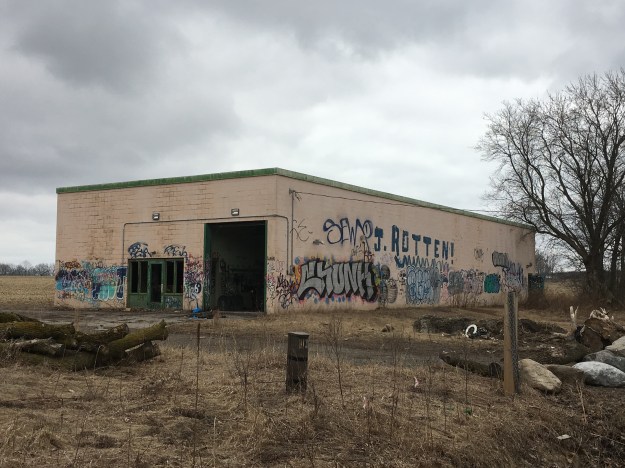
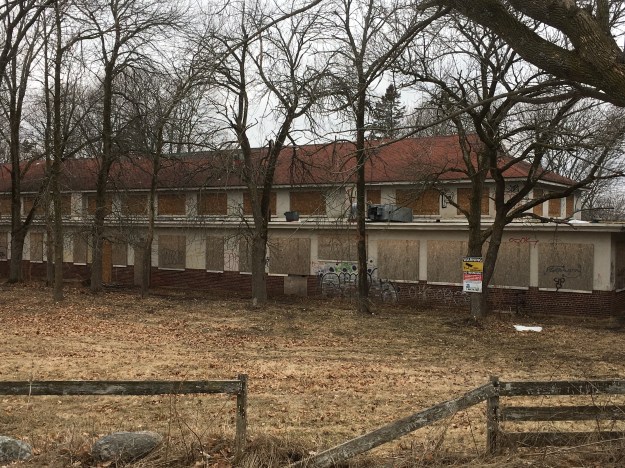
A further abandoned building can be found across Lambs Road from the camp.

IMG_3529

The original 300 acre site is planned for housing developments except for 66 acres that will form a park.  The theory is that the buildings will be restored for their historical value but the cost to repair the recent damage may be prohibitive.  We will have to wait and see what the final outcome will be.  Camp 20, known as Camp Calydor was located in Gravenhurst and a story on it can be found at this link.

Google Maps Link: Camp 30

Like us at http://www.facebook.com/hikingthegta

Follow us at http://www.hikingthegta.com
Maple Syrup Festival At Kortright

Saturday, March 24, 2018

The Kortright Centre for Conservation opened in 1979 as a 325 hectare park and education centre.  The conservation area is named after Dr. Francis Kortright who lived from 1887-1972.  He was an avid conservationist who was a member of the Toronto Sportsman’s Association and served as the president in 1948.  It was at this time that he initiated the Toronto Sportsman’s Show which raises money for conservation activities.

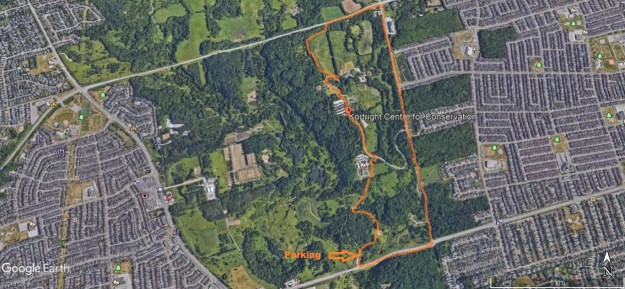
We parked in the free parking lot on Rutherford Road just west of Pine Valley Drive near the Humber River.  It is possible to hike on minor trails and arrive at Kortright Centre but you will still need to pay for entrance to the sugar festival.  Our TRCA and CVC parks pass includes entrance to the park and festival.  We roughly followed the orange trail marked on this capture from Google Earth.

Kortright

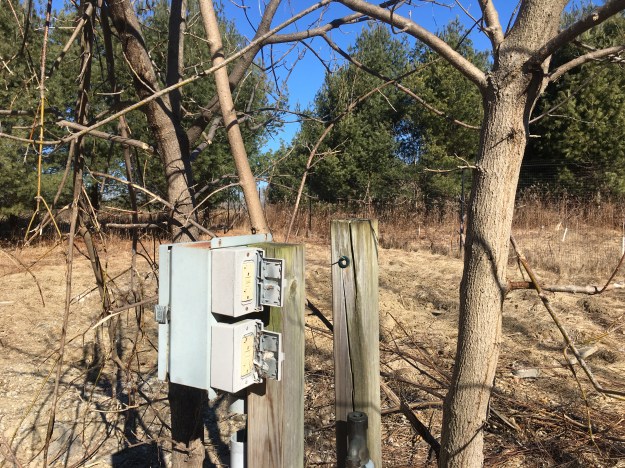
As we approached the park from the west we passed through an area that appears to have had a campground at one time.  There are several of these hook-ups for water and electricity hiding in the trees.

IMG_3407

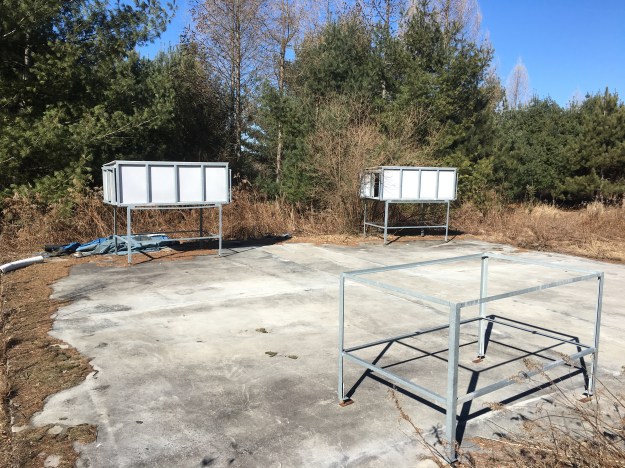
Three concrete pads are set up with the remains of a series of metal animal houses.  We followed the trail from here toward Pine Valley Drive.  Along the way you may hear the call of an owl

IMG_3409

The Earth Rangers are a Canadian group aimed at teaching conservation practices to youth.  They were founded in 2004 in Woodbridge to teach students in the GTA.  They have since expanded to a nation wide operation.  Their LEED gold certified building at Kortright Centre is home to Animal Ambassadors.  They now house over 40 animals including red foxes and ring-tailed lemurs.  Their collection of birds includes bald eagles and kestrels.

IMG_3421

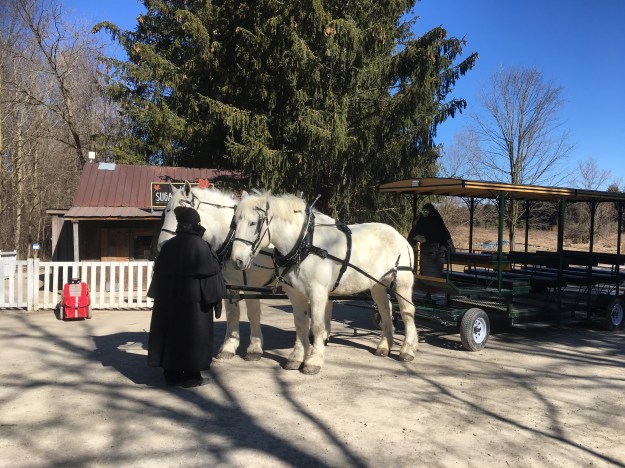
The main attraction at Kortright in March is their Maple Syrup Festival, one of several in TRCA parks across the GTA.  The park has two main forested areas with pine trees forming the north and east portions while maple trees are found in the south and west parts.  Wagon rides are available for those who would like to see the park in relative luxury.

IMG_3425

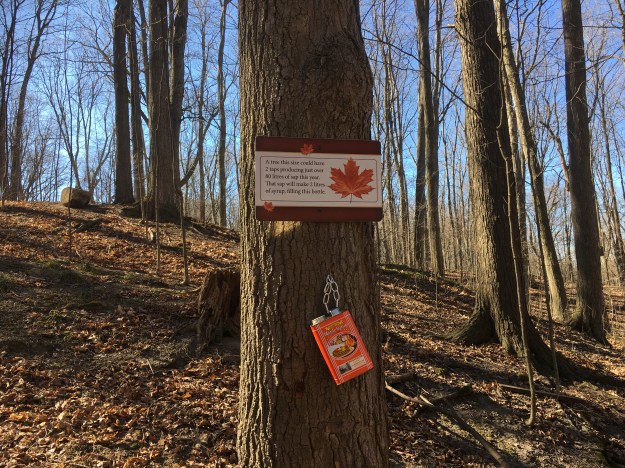
The trail from the visitor centre to the ravine floor follows an old trail that was used by the native people who had an encampment along the East Humber River.  Many artifacts have been recovered from a village that has been excavated.  The river valley provided an access route for goods travelling north and south on The Carrying Place Trail.  Today, the park has provided signage along the trail to teach the basics of maple syrup production to visitors.  The two litre tin for syrup that is attached to this tree indicates the amount of finished product that a tree this size can produce.

IMG_3432

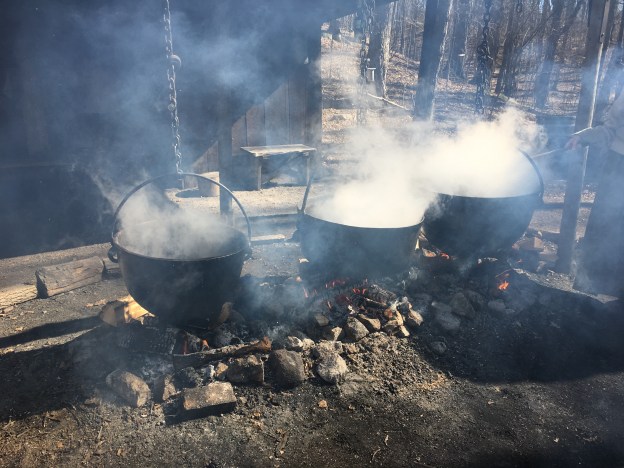
Maple syrup was being produced by the natives when the Europeans arrived in North America.  By the 1680’s collecting maple sap and boiling it into maple syrup had become a spring industry.  It was very labour intensive collecting the buckets of sap and carrying them to the sugar shack for processing.  Families would pull their children out of school for the month of March to help on the farm.

IMG_3436

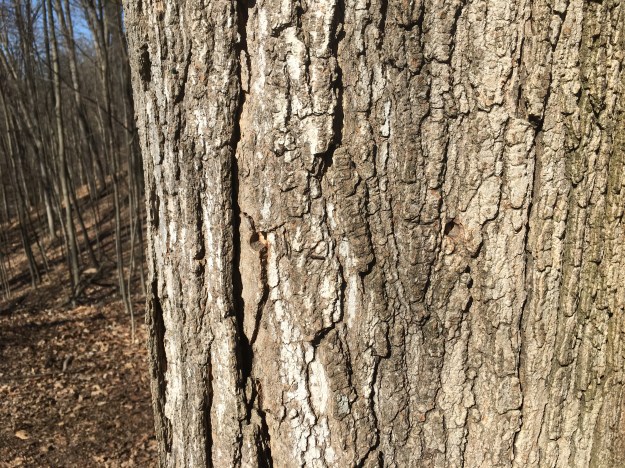
Trees would be tapped when they were around 30 to 40 years old and would continue to produce for the next 60 or 70 years.  Holes in the tree are quickly healed and can be seen for years after.

IMG_3427

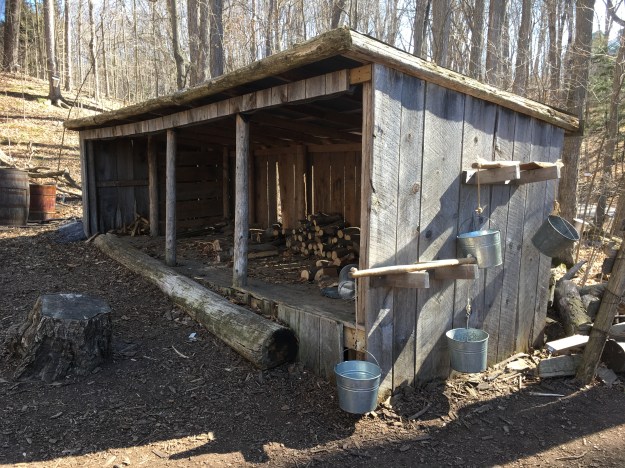
At the sugar shack wood was stock piled to keep the kettles of sap boiling.  The shacks also provided some small shelter from the weather and a place to rest during the cooking process.

IMG_3442

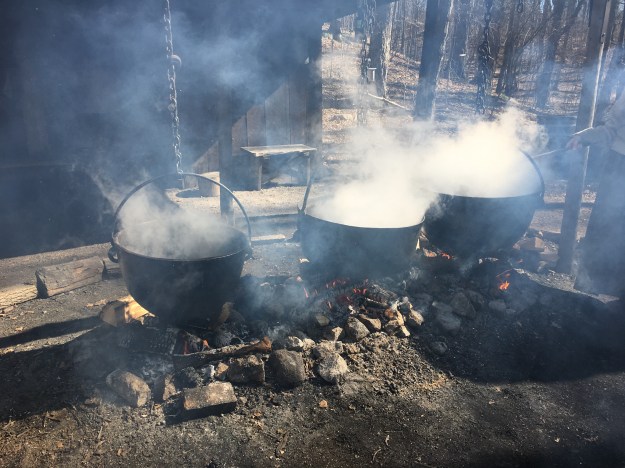
Prior to the 1850’s a series of three kettles were used.  The larger kettle contained the raw sap and it was left to boil for 8 hours.  The condensing sap was then transferred to the middle kettle for another 8 hours.  It would be finished in the third kettle after another 8 hours.  Innovations began after this time starting with larger, flat bottomed pans that increased the surface area available for evaporation.

IMG_3443

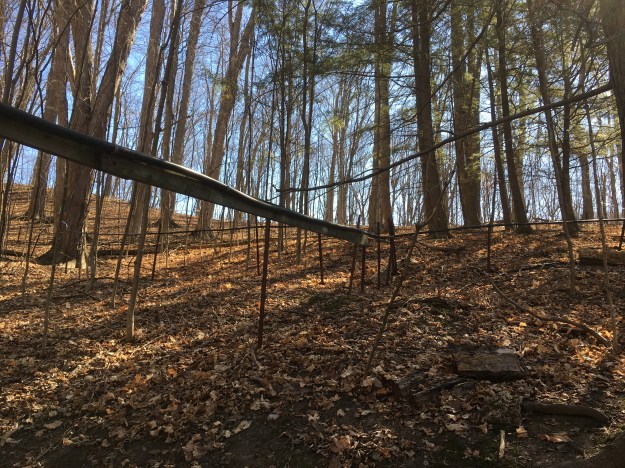
In the 1970’s a system of collecting sap using plastic tubes was developed.  It allows individual trees to  be tapped in one or more places and the slow drip of sap is fed into increasing diameter pipes until it reaches the sugar shack.  In the shack it is stored in a large vat while it waits to be evaporated into maple syrup.

IMG_3446

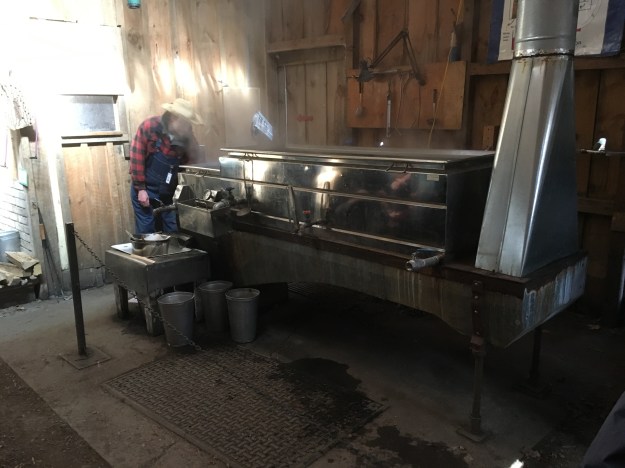
Today’s evaporators have flues in the bottom which increase the surface area of the pan that is used for boiling.  This further reduces the processing time which can be as little as 3 to 5 hours.

IMG_3447

Kortright Centre has many trails and there will need to be another expedition one day to investigate them.

Google Maps Link: Kortight Centre For Conservation

Like us at http://www.facebook.com/hikingthegta

Follow us at http://www.hikingthegta.com
Cemetery Bridge

Sunday, March 18, 2018

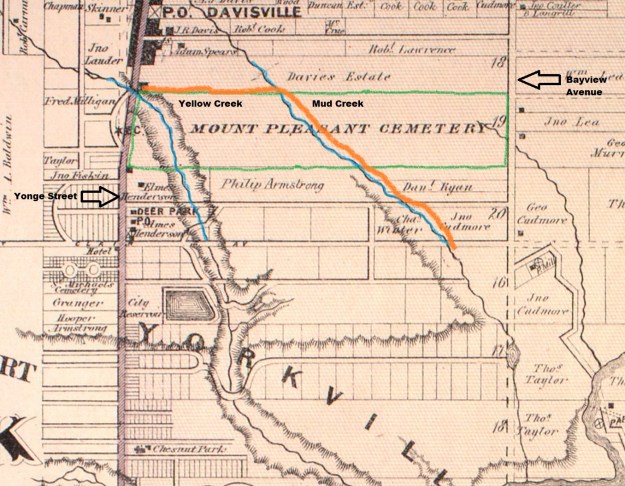
When Mount Pleasant Cemetery opened in 1876 it was comprised of the entire 200 acres of lot 19, just north of present day St. Clair Avenue.  The cemetery developed eastward from Yonge Street and we examined the history and some of the monuments and mausoleums in the earliest sections.  They can be found in our post entitled Mount Pleasant Cemetery.  The undeveloped end of the cemetery would be cut twice for transportation routes.  In 1915 The government bought the rights to a strip that would cut the cemetery in two halves.  To commemorate this, the new extension to Jarvis Street was named Mount Pleasant Road.  It had previously been severed for the right of way for a commuter railway line.  The 1877 County Atlas below does not show either the new road or railway.  Yellow Creek has been drawn in the atlas as being in a ravine as it passes through the cemetery, which is outlined in green.  Mud Creek rises out of a steep ravine and flows across the cemetery on a much shallower one.  I’ve marked the railway line in orange.  As a side note, the Davisville Post Office shown on the map still exists as a Starbucks on the corner of Yonge and Davisville.

Cemetery Map (2)

With an economic boom going on in Toronto a plan was developed to sell lands north of the developed city and service them with a commuter railway to be known as the Belt Line Railway.  When it was revealed that the proposed railway would follow Mud Creek and then pass through the cemetery the plan was opposed by the The Toronto General Burying Grounds Trustees.  Moore Park Station was proposed for just south of the cemetery at the top of the ravine and it was designed as the grand masterpiece of the railway.  The Trustees were eventually convinced that the proposal would help establish the cemetery as a Victorian country garden destination and it would gain in the end.

The housing boom didn’t happen due to an economic crash and the railway only operated for a little over two years.  The first passenger train ran on July 30, 1892 and by November 17, 1894 the service was shut down.  The former right of way for the Belt Line Railway was a prime piece of real estate and Toronto City Planning Commissioner Tracy Lemay had a plan for a high speed expressway that would link the Lakeshore with Mount Pleasant Road.  This was part of a larger plan of roadways that was never fully implemented.  Fearing that they would be cut off from the east end of their property the trustees commissioned a bridge over the railway right of way.

IMG_3464

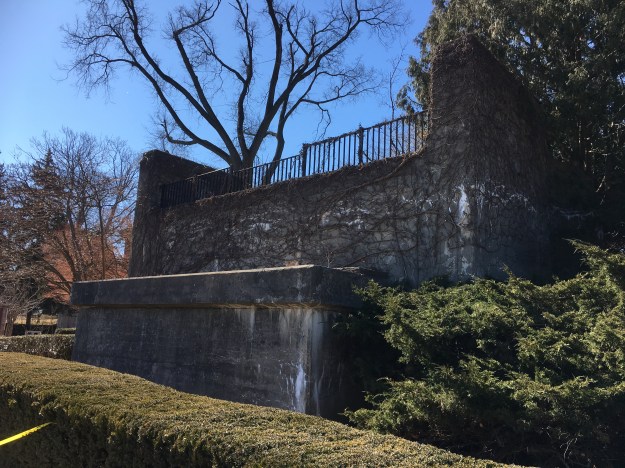
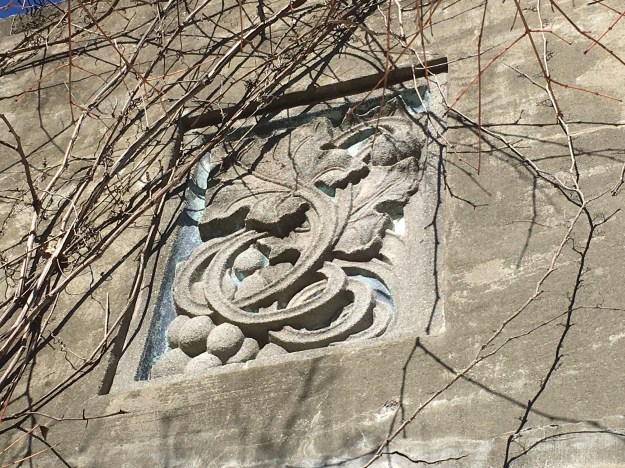
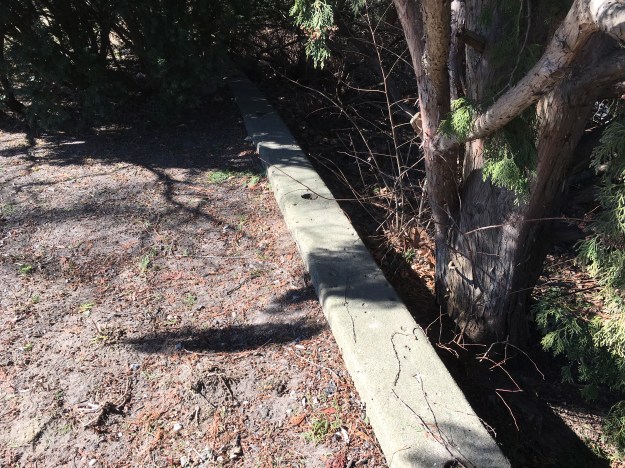
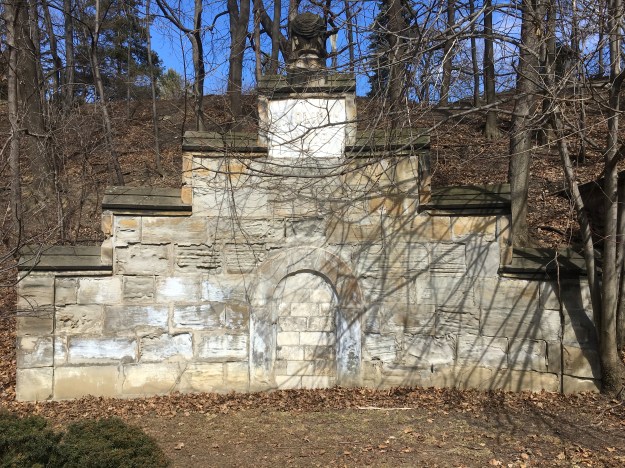
The expressway was never built and the cemetery ended up with a bridge over a shallow depression.  The bridge stood from 1929 until the early 1970’s when it was demolished because it had deteriorated.  Like everything else in the cemetery, the former bridge also has become a monument.  The west abutment has been left as a reminder of the bridge. In a way, it is a testament to a failed railway enterprise and an expressway that was never more than a dream. The concrete is adorned with a symbol of vines and grapes.  The vines represent continuity while the grapes are a Christian emblem that remembers The Last Supper.

IMG_3467

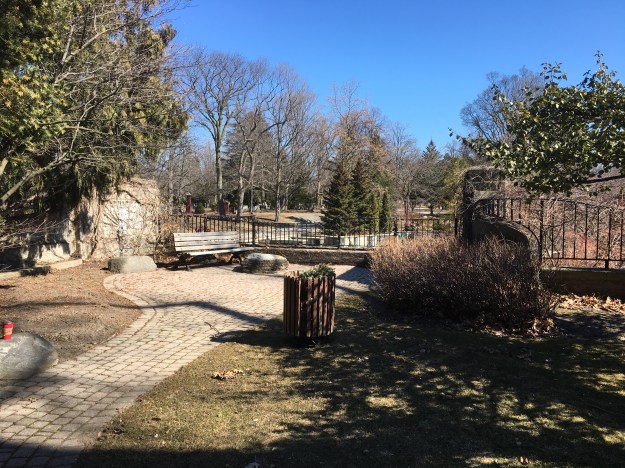
The top of the abutment has been turned into an area for quiet reflection behind the cemetery offices.

IMG_3469

The insides of the bridge are adorned with painted images of the cross.  The cemetery was started as a secular one and it seems interesting that the symbolism is Christian within about 50 years of the opening.

IMG_3472

The original guard rails on the approach to the bridge have been removed.

IMG_3473

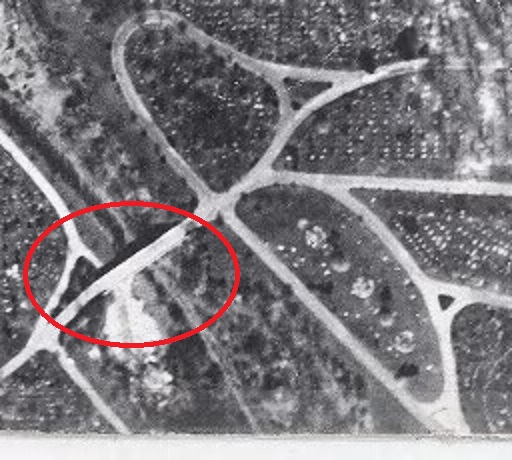
This areal photo taken in 1947 and found on The Toronto Archives shows the bridge.

bridge

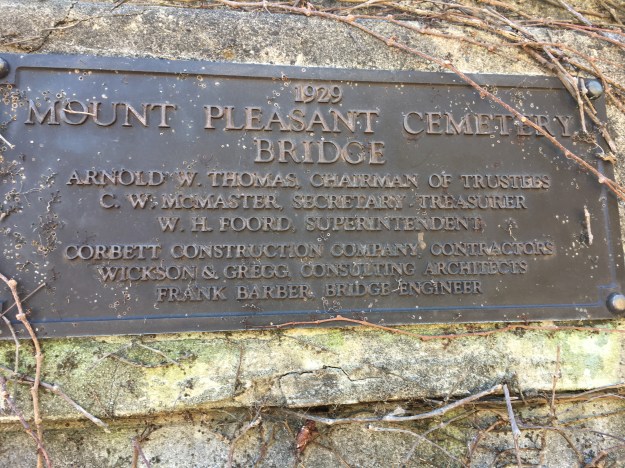
A plaque on the inside of the bridge pays respect to those who were involved in the plan to stay ahead of the city planners.

IMG_3471

Google Maps Link: Mount Pleasant Cemetery

Like us at http://www.facebook.com/hikingthegta

Follow us at http://www.hikingthegta.com
Mount Pleasant Cemetery

Sunday March 18, 2018

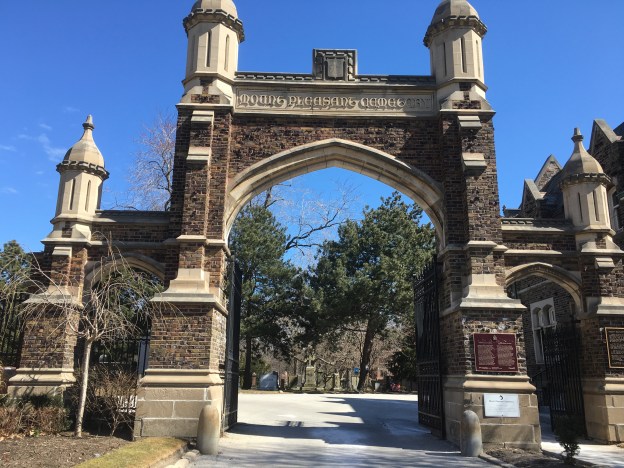
Mount Pleasant Cemetery was created to provide a burial alternative for those who didn’t belong to one of the local churches that had their own cemetery in the churchyard.  The cemetery was laid out like a country garden and has become a prime place for joggers and dog walkers but it has a unique history and some interesting architecture. To start my visit I parked on Yonge Street near the main entrance to the cemetery.  My first objective was to make a side trip to St. Michael’s Cemetery, which is just south of St. Clair Avenue.  This Catholic cemetery contains an interesting piece of architecture that has been removed from Mount Pleasant Cemetery.

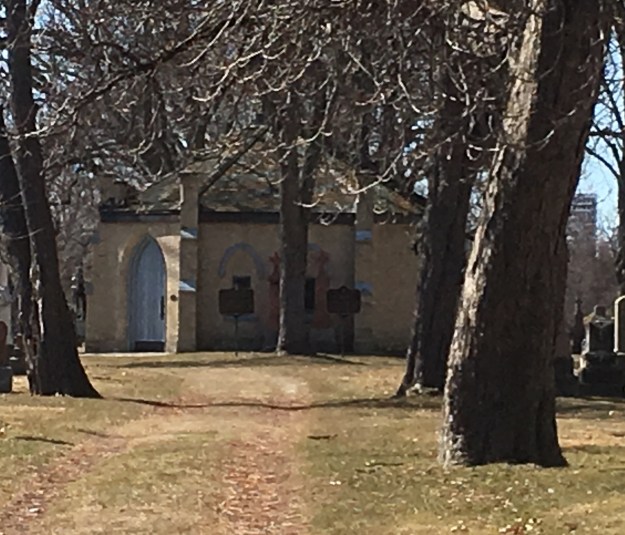
St. Micheal’s Cemetery opened in 1855 and is the oldest surviving Catholic cemetery in the city.  Until the mid-20th century graves were dug by hand and no interments were made during the winter.  Bodies were stored in a mortuary until the spring when burial could take place.  These buildings were often octagonal, this being determined the ideal shape for maximum storage, and took on the nickname “Dead House”.  The gates were locked and so I couldn’t get close to the vault which was designed by Joseph Sheard who would later serve as mayor in 1871-1872.

IMG_3304

In the first part of the 19th century, York (Toronto) had no place for secular people to be buried.  Rebel leader William Lyon MacKenzie was instrumental in persuading the government to enact legislation to create a secular burial ground.  On January 26, 1826 The York General Burying Grounds Trust was established and they bought a plot of land at Yonge and Bloor for their cemetery.  It went by several names including The Potter’s Field.  Burials took place between 1826 and 1855 when it was closed and the bodies removed over the next 25 years.

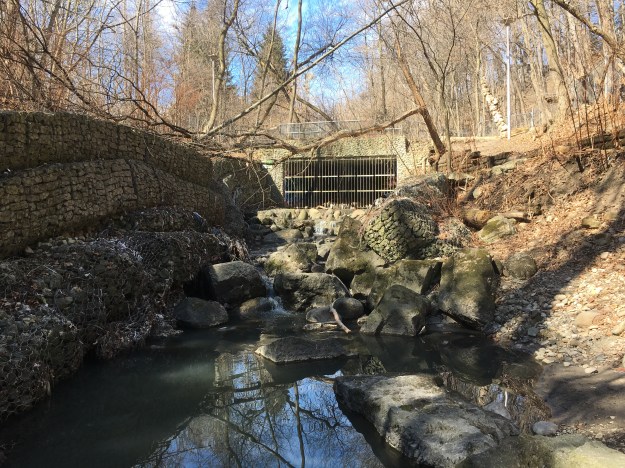
The Vale of Avoca is the name given to the bridge that crosses Yellow Creek on St. Clair Avenue, just east of Yonge Street.  It is also the name of the ravine which can be entered beside the bridge.  This is the route I chose to access Mount Pleasant Cemetery.  Walking north you’ll pass the remains of an old saw mill and follow the path through a cut in the berm that marks the old mill pond.  This is where Yellow Creek emerges from a large concrete storm pipe.  It was buried in the 1950’s under ten metres of soil excavated during construction of the Yonge Subway Line.  Although one of the oldest sections of the cemetery, the earliest burials here appear to be from the 1970’s and 1980’s.  The picture below shows the emergence of Yellow Creek from beneath Mount Pleasant Cemetery.

IMG_3307

In 1855 the re-named Toronto General Burying Grounds Trust purchased a plot of land near Riverdale to establish a new cemetery known as The Necropolis.  Many of those interred at The Potter’s Field were moved to The Necropolis.  The Necropolis stood on the ridge overlooking the Rosedale Ravine, an industrial hub of the era.  One of the businesses below was a glue factory that made visiting the cemetery a smelly affair.  The Trust sold the cemetery to the city and in 1873 went in search of a new site for their cemetery.

They bought all 200 acres of Lot 19, Concession 3 for their new cemetery, well to the north of the city at that time.  Since the 1830’s a trend toward building garden-like cemeteries outside of major cities had been in fashion.  It was decided to hire H. A. Englehardt to design the cemetery based on his work in Port Hope and Belleville.  The location was ideal because it contained both Yellow Creek and Mud Creek whose ravines created a rolling landscape.  Roads were laid in asymetrical curving patterns. The new cemetery officially opened on November 4, 1876 and now is the final resting place of over 180,000 people.

IMG_3346

Yellow Creek was dammed to create a series of ponds that had swans in them at one point.  The ponds lasted until the depression of the 1930’s made funding for their maintenance unattainable and the ponds were filled in.  Later both Yellow Creek and Mud Creek ravines filled with subway diggings.  Englehardt collected tree specimens from all over the world with the intention of creating an arboretum at the cemetery.  His desire to have the trees labeled for the education of visitors has been carried on today.

IMG_3342

One of the first Mausoleums you will come to after entering the cemetery from this angle is also one of the first ones built after the cemetery opened.  S. A. Oliver had opened his general merchant business on Queen Street West in 1852 and he built it into a major retailer of produce for the young city.  Oliver retired in 1872 and passed away in 1878.

IMG_3316

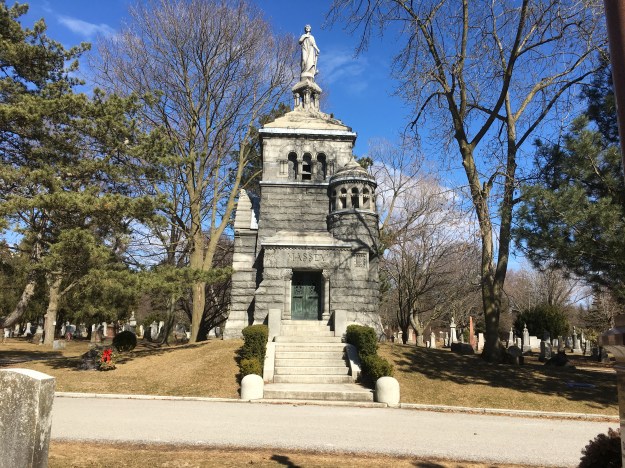
The most elegant family mausoleum in the cemetery belongs to the Massey Family.  It was completed in 1894 and houses many members of the city’s most prominent industrial family.

IMG_3345

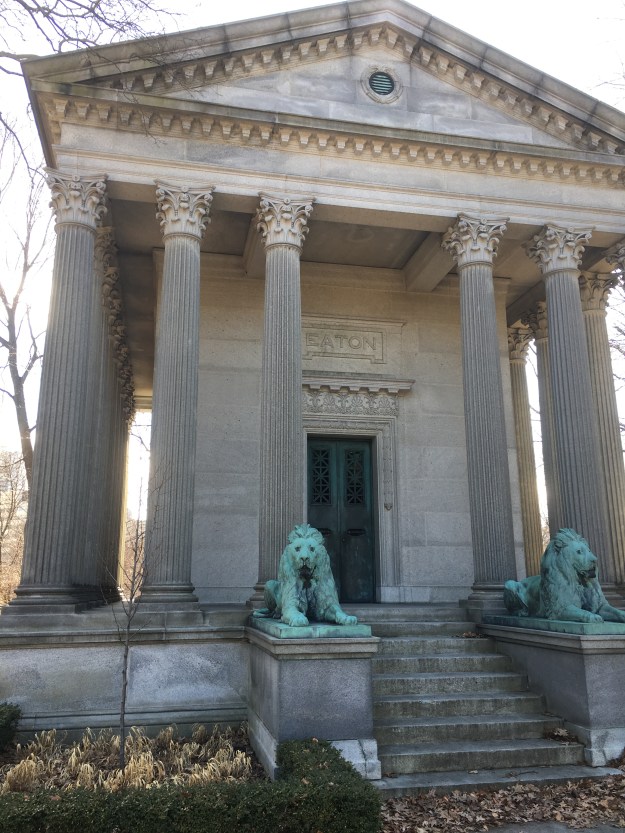
Timothy Eaton was born in Ireland in 1836 and came to Canada in 1854.  After moving around working in stores in several small communities, Eaton moved to Toronto in 1868 to open his own dry goods store.  Eaton revolutionized retail with mail order catalogues in 1884 and store owned manufacturing.  By 1907 Eaton’s was largest retailer in the Dominion.  This same year, Timothy died from pneumonia and was buried in the newly built family mausoleum in Mount Pleasant Cemetery.  17 other members of the Eaton family have been buried in this mausoleum.

IMG_3349

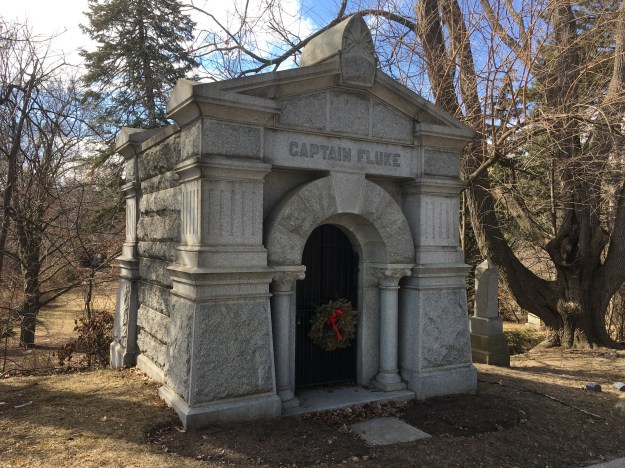
Captain James Fluke was born in Ireland in 1824 and came to Canada West in 1829. Fluke became a miller operating both grist and saw mills as well as an inn. He was a captain in the militia, 3rd Company, Cartwright Volunteers, 45th Battalion, West Durham Regiment. Fluke died in April 1894 and was buried at Mount Pleasant Cemetery. His wife, Charlotte, had this mausoleum built for him and he was later moved into it. She was buried there in 1929.

IMG_3327

William Barker was born in Manitoba in 1894.  During the First World War, Barker shot down 50 enemy planes earning him the Military Cross and Bars and the Distinguished Service Order.  He is also one of less than 100 people awarded the Victoria Cross, Canada’s highest military honour.  He died in 1930 when a test plane crashed and he is buried in the large public mausoleum at the cemetery.

IMG_3347

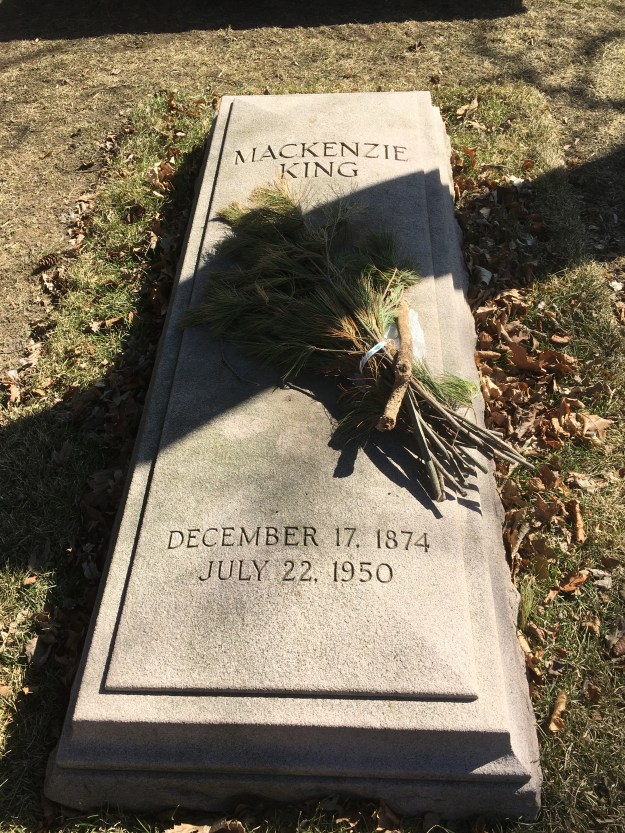
William Lyon Mackenzie King was Canada longest serving Prime Minister, holding the office for a total of 21 years.  His grandfather was William Lyon Mackenzie, the leader of the 1837 rebellion.  Both of Mackenzie King’s parents are also laid to rest in this plot as part of a total of nine people buried here.

IMG_3334

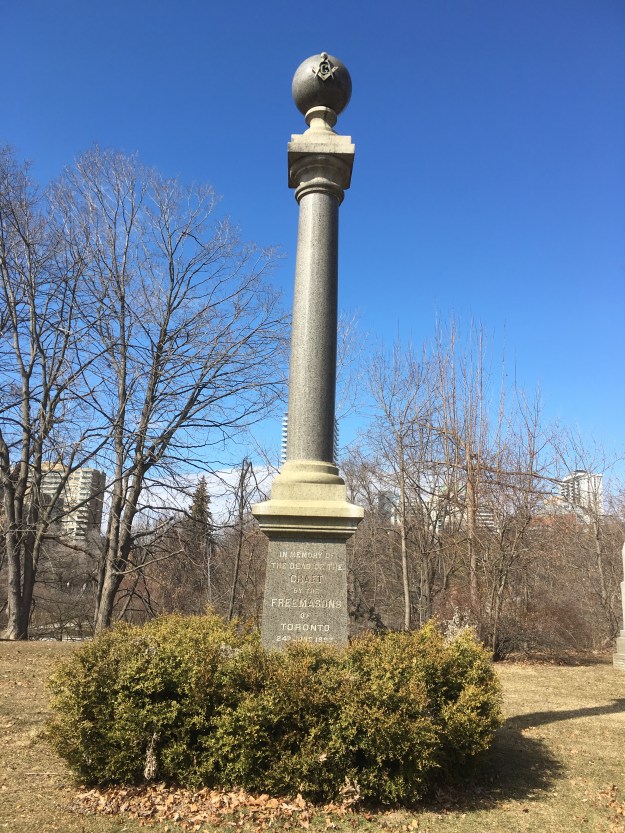
The cemetery has many monuments including this elegant one to the members of the Freemasons.  Today the area around the monument continues to be used to bury those members of the craft of Freemasons who pass away in the city.  The mason tools of square and compass adorn the ball on the top of the monument.

IMG_3329

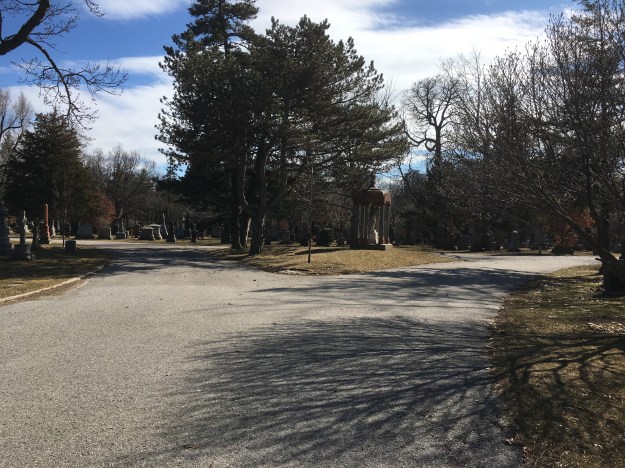
Thousands of people enjoy the solitude of the cemetery every day to jog, walk their dogs or simply take in the quiet and the grand monuments to those who have gone before.

Google Maps Link: Mount Pleasant Cemetery

Follow us at http://www.facebook.com/hikingthegta

Like us at http://www.hikingthegta.com

Credit Valley Footpath

Saturday, March 10, 2018

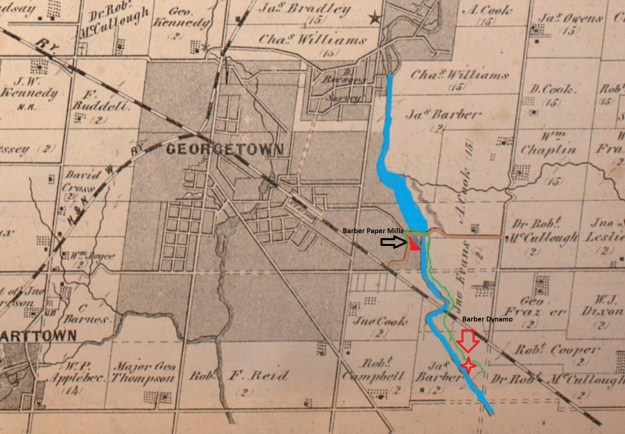
The Credit Valley Footpath is a 5.3 kilometre side trail that is part of the larger Bruce Trail system. It runs along the side of the Credit River through Georgetown providing access between two early industrial sites of the community.  At the time of the historical atlas in 1877 the paper mills existed and their mill pond was drawn into the atlas.  The mills themselves are not identified as they are part of the larger urban area of Georgetown.  The Dynamo was yet to be constructed and is shown with a red star on the map below.  We followed the green trail on the map which marks the Credit Valley Footpath.

Footpath

Parking for the trail can be found along Maple Avenue near River Street.  This will place you beside the historic Barber Paper Mills.  Their history is told in detail in an earlier blog post which can be found here.  The buildings were listed as heritage sites in 2008 but over the years there has been no real effort to preserve them.  The roofs are caving in and the walls are crumbling.  A recent proposal to restore and re-purpose the buildings has fallen through and the National Trust for Canada has listed the buildings as among the most endangered heritage sites in the country.

IMG_3078

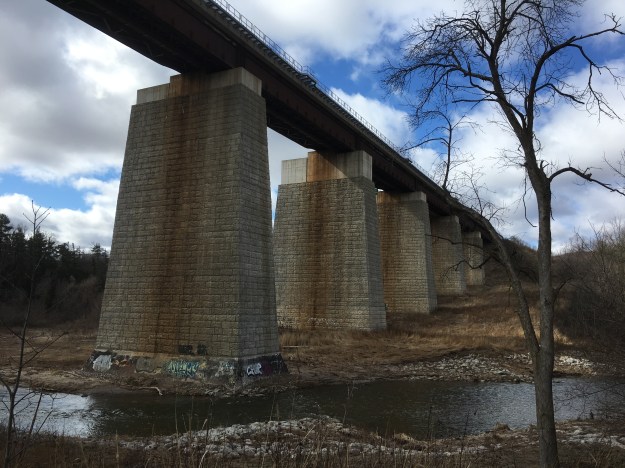
The footpath passes under a newer railway bridge about a kilometre downstream.  The original bridge was nicknamed The Iron Bridge and was built in 1855 for the Grand Trunk Railway.  The concrete piers on the modern bridge were built in 2010 and were dressed to look like cut stone blocks.  The very last pier on the west end is actually cut stone blocks and dates to the the second bridge across the valley.

IMG_3084

The Credit Valley Footpath through this section makes a couple of 40-metre climbs up the side the the Credit River Valley and fortunately, there has been a few steps put in to help.  Sections of this trail should be considered as difficult and should be walked with the assistance of a walking stick.

IMG_3093

Traveller’s Joy, also known as Old Man’s Beard, is a member of the buttercup family.  The feathered seed pods have survived the winter on the vine and will be distributed in the spring to spread the plant to new sites.  The flowers attract bees and other pollinators and are a food source for certain moths.  Traditional medicine has made use of the plant for its anti-inflammatory properties.

IMG_3089

The Barber Dynamo was built to provide electric power to the paper mills.  It is located a couple of kilometres downstream and was the first remote generation of electrical power for industrial uses in North America.  When we visited the Dynamo in 2015 there were a number of trees that had been partially chewed through by local beaver.  They were in danger of falling on the Dynamo and further demolishing it.  Hiking the GTA brought the situation to the attention of the Credit Valley Conservation Authority who sent people in to cut the trees.  All but one of them was successfully dropped away from the building.  It can be seen leaning through a second story window frame.

IMG_3094

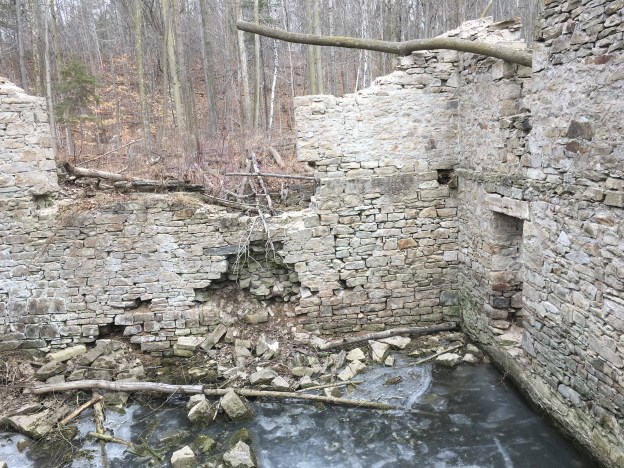
Water was fed into the Dynamo through a large pipe called a penstock.  It split in two with the water turning two turbines that were suspended from the second floor.  A line can be seen along the wall that marks the location of the former floor.  The cover photo shows the inside of the north wall which has started to crumble and is in danger of collapse.  Efforts are being made to have the site declared as historically significant which may allow the Credit Valley Conservation Authority to gain the funding needed to restore the wall to prevent further deterioration of the structure.

IMG_3104

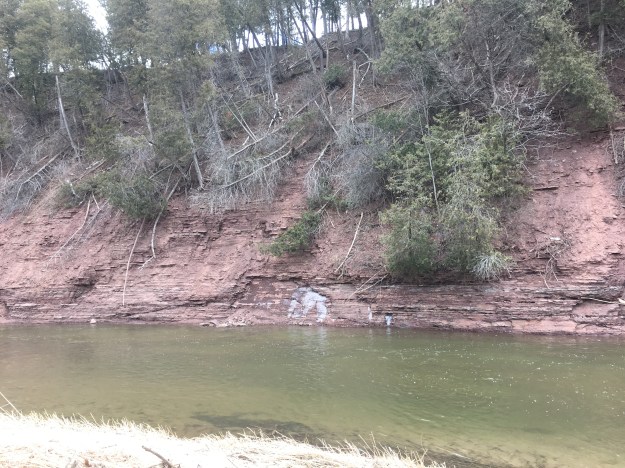
Just beyond the Dynamo the river cuts through a red shale embankment.  This Queenston Shale is the same layer that forms the base of the Niagara Escarpment.  The exposed section near Cheltenham has become a major attraction and is set to re-open with a new boardwalk in the near future.  The erosion along this section of The Credit River has brought many  of the trees tumbling down the embankment.

IMG_3107

As you walk back toward the Dynamo you can see the penstock through the ground floor window.  There are two windows just below the current water level that returned the water to the tail race after it had turned the turbines to run the generators.

IMG_3117

As you arrive back at the Barber Paper Mills you can see the roof on the building that housed the main paper rolling equipment is caving in.  The tool shop in the foreground has lost its roof a long time ago.

IMG_3118

This is a good hike for those interested in the local history as well as a few challenging climbs.

Links to the more detailed stories:  The Barber Paper Mills and The Barber Dynamo

Google Maps Link: Credit Valley Footpath

Like us at http://www.facebook.com/hikingthegta

Follow us at http://www.hikingthegta.com
The First Three Welland Canals

Tuesday, February 27, 2018

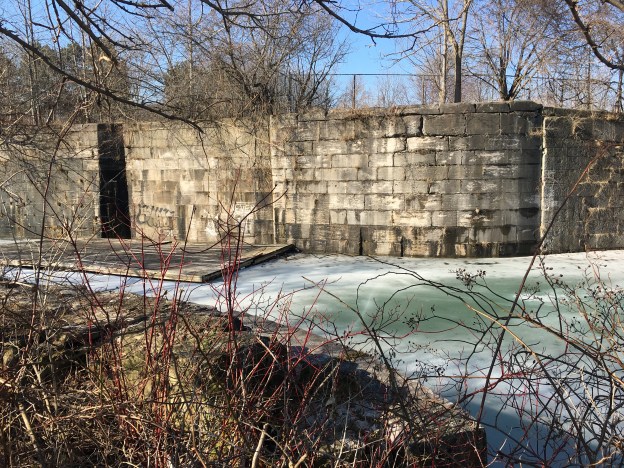
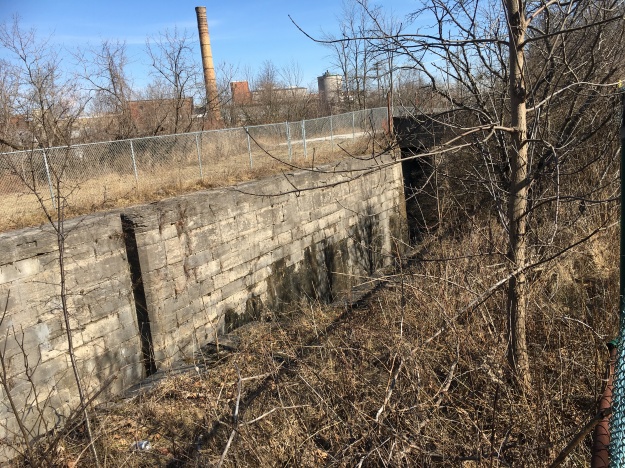
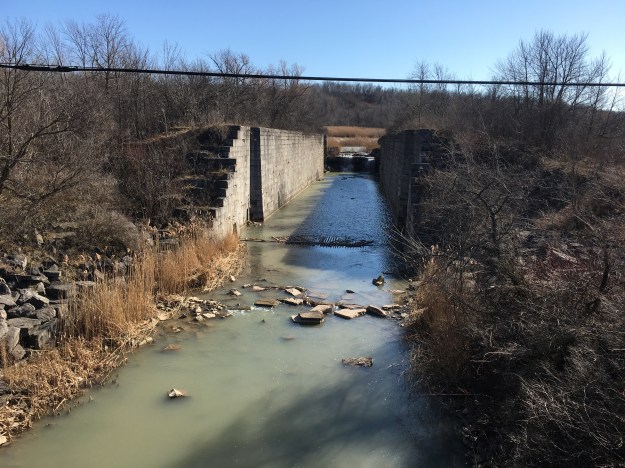
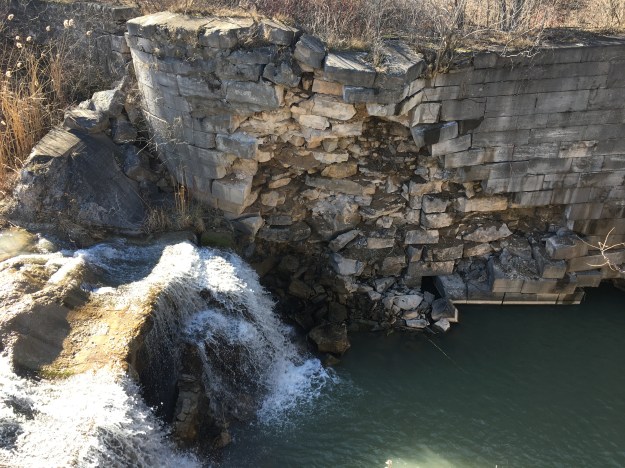
One lesson that was learned in the war of 1812-1814 was the need to move men and goods quickly and a period of road and canal building began.  The British had largely controlled the Great Lakes during the conflict but Niagara Falls prevented movement between the lakes.  In spite of this, the first canal built between the two lakes was a private enterprise.  The government would build the next three Welland Canals culminating in the current Welland Shipping Canal.  The first three canals have been abandoned but sections of each still remain, although active preservation does not appear to be happening.   This picture of lock 15 on the third canal shows the partial collapse and deterioration of everything up to the gate recesses.

IMG_2966

To look at some of the remnants, I made a day trip and planned four stops (to which links will be provided).  The first stop was in St. Catherines to see the second lock on the third canal.  Then to Welland Vale where the first and second canals diverted routes shortly, leaving evidence of both.  Mountain Locks Park along Bradley Street contains a series of second canal locks.  Finally South of Glendale Avenue is a series of third canal locks and the Merritton Tunnel.  Rather than tell this story in the sequence of the visit it is being arranged in the sequence of the three canals.

Shipping on the Great Lakes was confined to Lake Ontario because goods on the Upper Great Lakes had to be portaged around Niagara Falls.  Lake Erie was 325 feet higher than Lake Ontario.  In 1818 a mill operator named William Hamilton Merritt proposed to divert water from the Welland River past his mill in Welland Vale to supplement the water flow of 12 Mile Creek.  The idea was abandoned but just a month later he came up with the proposal that led to the building of the first Welland Canal.  The Welland Canal Company was founded in 1824 to build the 40 kilometre canal.  The channel was dug 24 feet wide and 8 feet deep and 40 wooden locks were built each capable of lifting a boat between 6 and 11 feet.  The picture below shows a section of the first canal in Welland Vale.

IMG_2926

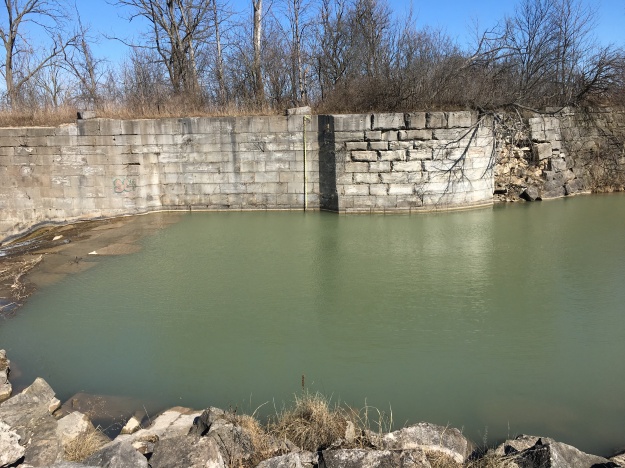
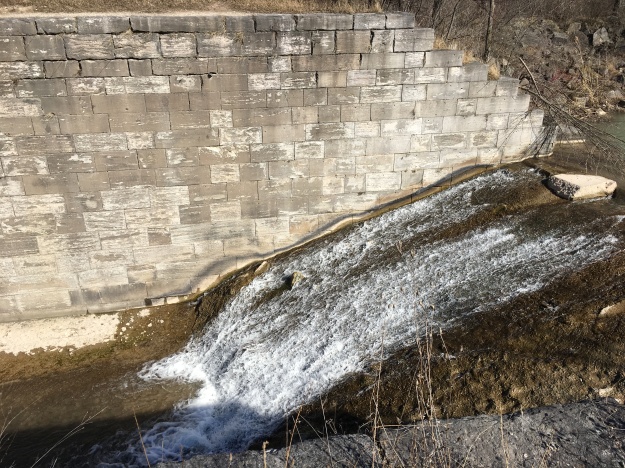
The first canal was operated between 1829 and 1844 but it was clear from the beginning that the wooden locks were too small and required too much maintenance.  In 1841 the government took over operation of the canal and started work on rebuilding it  The path of the canal followed the first one so closely that most of the first canal was lost.  There is a 1 kilometre stretch of the first canal in Mountain Locks Park that was left intact and one wooden lock, number 24, can still be found in that park.  The locks on the second canal were built of stone and to slightly larger dimensions than their wooden counterparts.  The channel was dug 36 feet wide and 9 feet deep with locks that were 150 feet long.  The picture below shows the one of the locks on the second canal at Welland Vale.  The height of the lock has been reduced and the stone work has been completely removed from one side of 12 Mile Creek to improve water flow and reduce flooding.

IMG_2930

The first and second canals climbed the escarpment in a series of locks that now form Mountain Locks Park.  Lock 19 of the second canal no longer has water flowing through it and this picture was taken from inside the lock

IMG_2941

Lock 24 of the second canal is typical of the locks that climb the escarpment as boats moved toward Thorold.  The creek flows deep in the bottom of these locks.  The second canal was used from 1845 until 1935 even though a third canal came into operation in 1932.

IMG_2943

A third, larger canal was started with a new, straighter route in 1872.  It was designed to carry the larger ships that were plying the Great Lakes by this time.  The third canal was completed in 1887.  Lock number two can be found in Jaycee Gardens Park in St. Catharines.

IMG_2911

There is a 50 foot towpath that extends out into Martindale Pond at the second lock that allowed the ships to be towed through the lock.  Towpaths allowed ships to be towed out of the lock by a team of horses until a point where they would have room to sail again. Towpaths were no longer needed when ships were equipped with engines. A concrete pole on the end, and another near the beginning of the towpath mark a later addition of electricity to power the lock.    This relieved a lot of physical labour that was involved in operating the canal gates and was an advancement made on the third canal that wasn’t available on the first two.  The gates from the lock can be seen half submerged beside the towpath.

IMG_2919

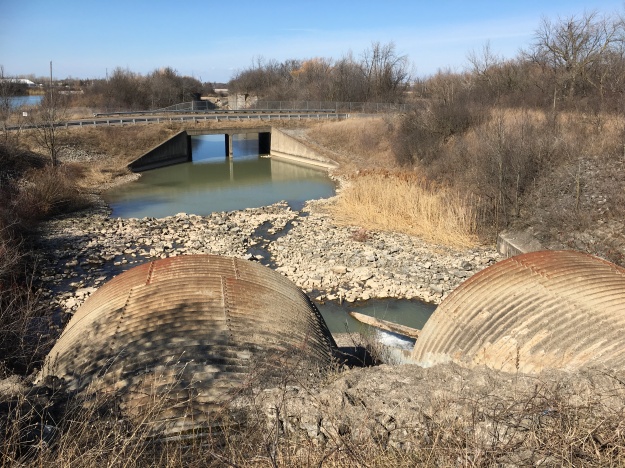
Lock 13 has had two large culverts placed in it to support Glendale Avenue.  From this vantage point, lock number 12 on the third canal can be seen.  Locks 13 through 18 can be found by following the river south.

IMG_2948

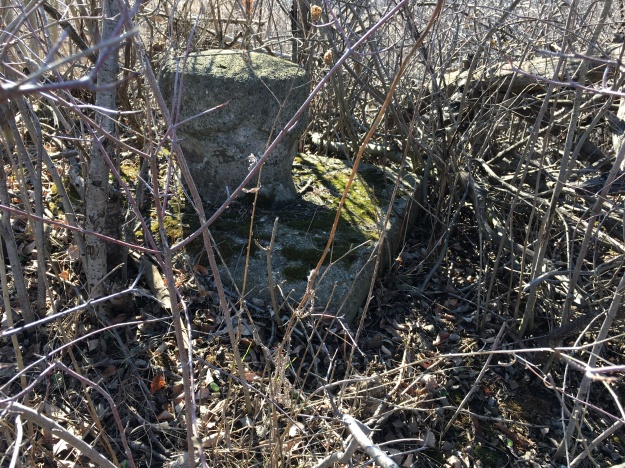
As ships were being raised or lowered in the locks they needed to tie themselves to bollards located along either side of the lock.  Many of these old concrete bollards can be found along the canals.

IMG_2956

When the third canal was abandoned in favour of the new fourth canal, the gates were left in place.  These have all fallen into the locks.  One of the improvements in the third canal was the lining of the bottom of the locks with wood to protect the bottom of the ships as they passed through.

IMG_2960

Locks on the third canal were 270 feet long and could lift a boat from 12 to 16 feet.  The locks were 45 feet wide and a minimum of 14 feet deep.  The picture below shows the lift in lock 15.

IMG_2971

One of the innovations of the third canal was the inclusion of the water control system in the lock stonework.  The walls of the locks were recessed so that the gates could swing back to allow clear passage of boats.  The small openings behind the gates allowed water to be flooded into the locks.

IMG_2975

Along the west side of each lock a series of control ponds was built that allowed the locks to be flooded when boats were passing through. Stone sluice gates were used to control the flow of water from the ponds into the locks.  The picture below is taken from inside one of the control ponds looking at the sluice gates.

IMG_2963

Between locks 16 and 17 there is an old swing bridge for the railway.  It was completed in 1915 and allowed the railway tunnel beside lock 18 to be closed to rail traffic.

IMG_2972

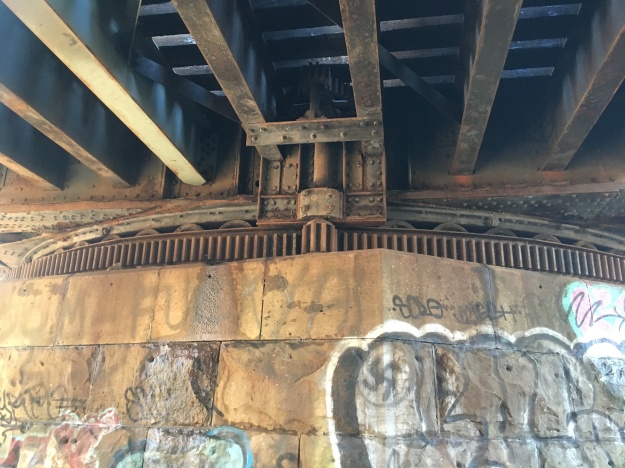
The swing bridge was designed to move out of the way of oncoming ship traffic.  It hasn’t been moved since the canal closed in 1935 and the tracks on the top side have been replaced in such a way that it couldn’t move even if those gears are not seized.

IMG_3004

The Grand Trunk Railway needed to build a tunnel to allow the train to pass under the third canal.  The Grand Trunk Tunnel was completed in 1876 and is discussed in more detail in this separate post.

IMG_2981

The Fourth Welland Canal was opened in 1932 with only 8 locks and a much straighter route.  Very quickly a fifth canal was proposed that would have had only one super-lock.  This 1950’s dream was never built.

There are many interesting places to explore along the old abandoned canals and a return trip would definitely be in order.

Google Map Links: Port Colborne, Welland Vale Road, Thorold

Like us at http://www.facebook.com/hikingthegta

Follow us at http://www.hikingthegta.com
Merritton Tunnel (Blue Ghost Tunnel)

February 27, 2018

As part of a day of exploring the old Welland Canals I decided to look for the Merritton Tunnel.  The story of the first three canals will be told in greater detail in a separate post.  To reach the tunnel you have to walk a fair distance and I parked in a small lot beside the Welland Ship Canal on Glendale Avenue, near the Good Eats Diner.  You will walk past the General Motors Plant which is clearly marked, indicating electronic surveillance and patrols.  I was unsure if this included the old canal and tunnel or not but decided to be wary just in case.

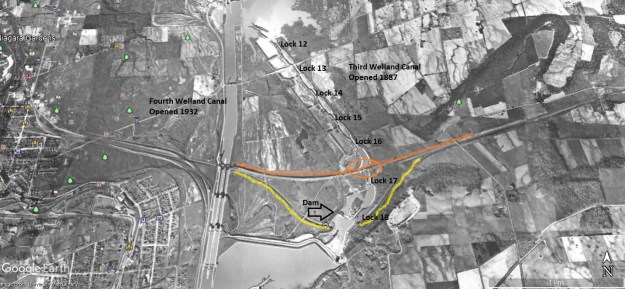
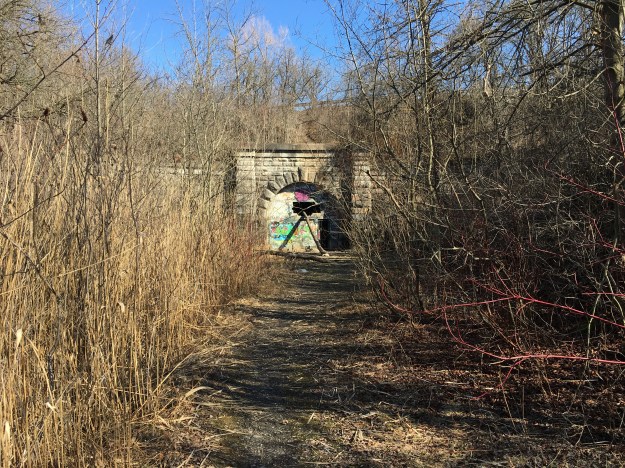
The first Welland Canal was opened in 1829 and consisted of wooden locks.  A second, larger canal was built in 1842-1845 and followed the route of the first but used stone blocks for the locks.  Very quickly it was determined that a third canal, with larger and deeper locks was needed.  It was built between 1872 and 1881 but was modified through to 1887.  It ran straighter and required shorter transit times than the second canal.  The Grand Trunk Railway would need a way to cross the new canal and so in 1876 a tunnel was built.  The Grand Trunk Railway Tunnel is 713 feet long and made of Queenston Limestone.  The tunnel has the formal name of Merritton Tunnel after William Merritt who is seen as the father of the Welland Canal system.  He first conceived the idea of joining Lake Ontario with Lake Erie by canal in 1818.  The nearby community of Merritton was named after him.  On the 1934 aerial photo below the yellow line marks the path of the GTR through the tunnel while the orange line marks the path across the swing bridge.

1934 two Tunnel

Lock 13 of the third canal is crossed by Glendale Avenue and has two large culverts installed to support the road.  The Bruce Trail runs along the east side of the canal but I was hoping to find the west end of the Merritton Tunnel and go through to the east side.  Therefore, I went up the west side leaving the Bruce Trail for the return hike.  Locks 13 through 16 are located between here and the rail bridge.  Lock 16 below shows a drop in river elevation of about 10 feet.

IMG_2970

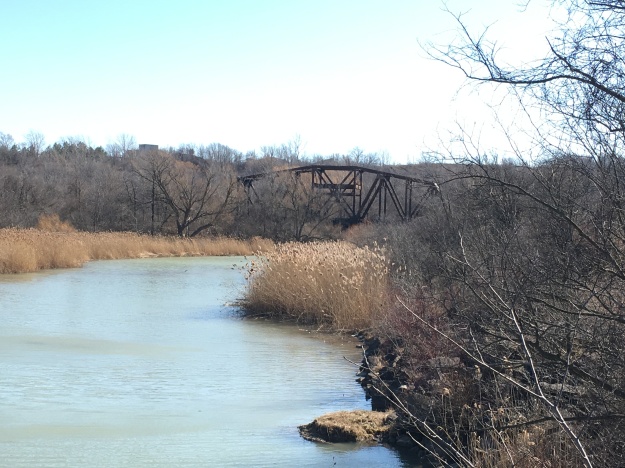
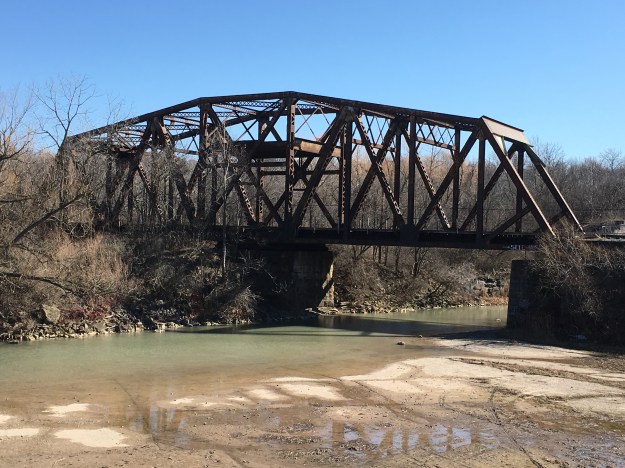
By 1915 the railway had been rerouted away from the tunnel and over a steel Howe Truss bridge.  This bridge was designed to swing out of the way of passing ships and the canal only passes under the west half of the bridge.

IMG_2973

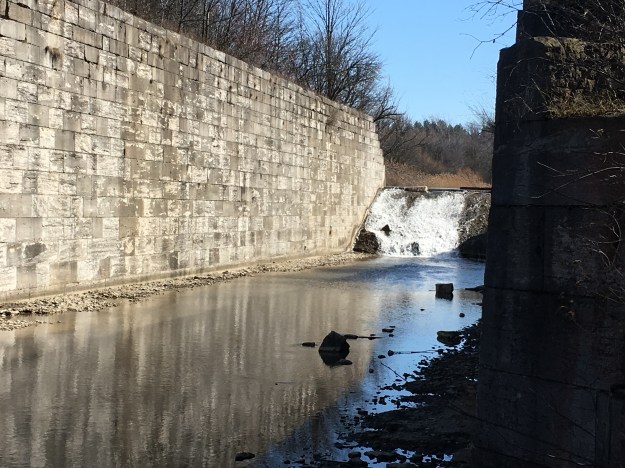
At the end of lock 18 you will be forced away from the river by an old dam that retained the water used to operate the locks.  It allowed ponds to be created behind the west side of each of the locks so that they could be flooded as ships passed through.

IMG_2978

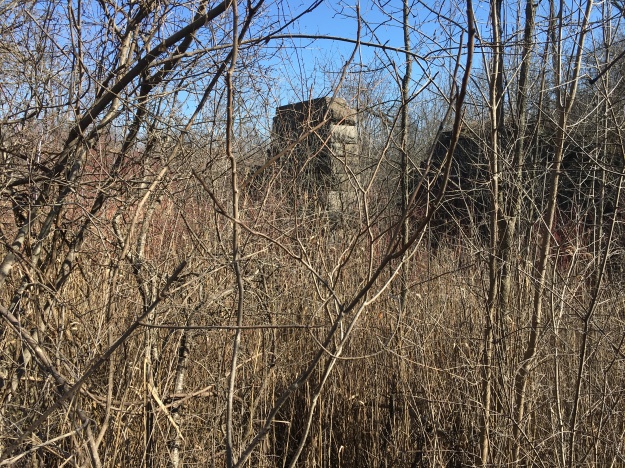
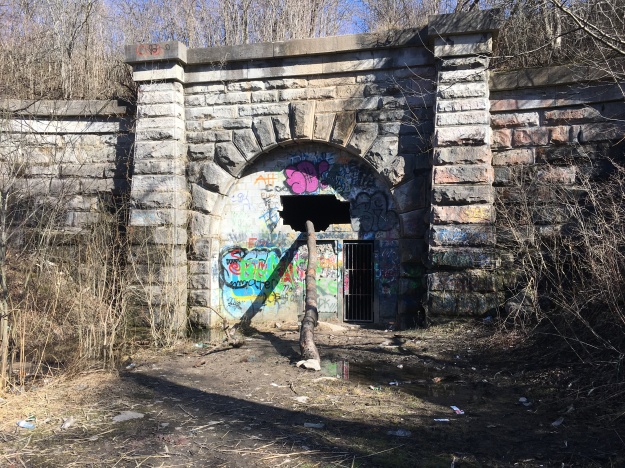
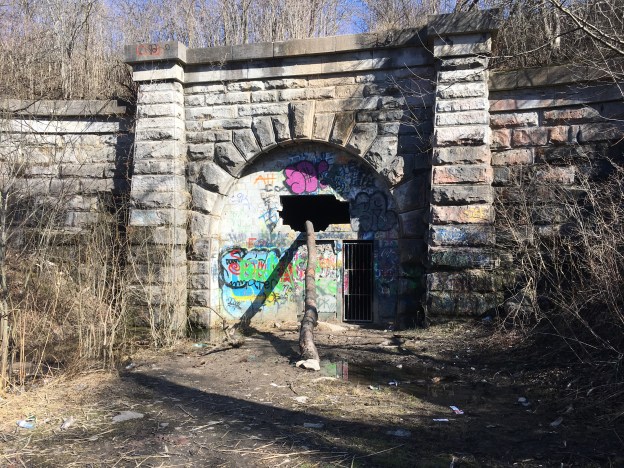
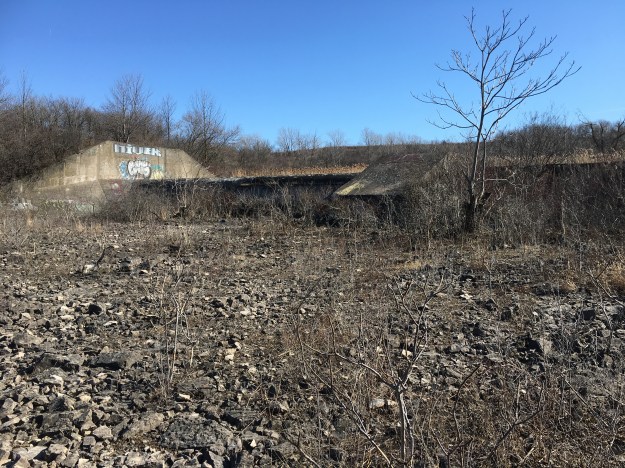
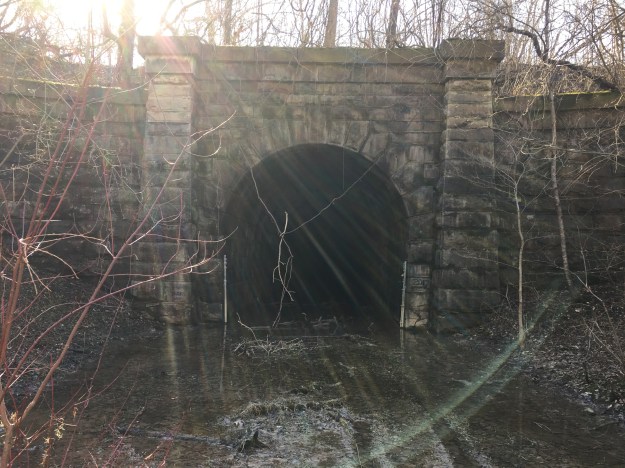
Once you pass the dam you will be forced out onto a service road that isn’t on the archive aerial photograph above.  The road passes along the side of the GM plant and had sparse traffic on it until now, but as I was unsure if I was actually trespassing I crossed it quickly and looked for a trail in the trees on the other side.  Knowing that the train had to approach the tunnel in a ravine that would be close by, I chose to follow the first one.  As you can see in the picture below, the west end of the tunnel has been closed off because it was considered unsafe.  At times, people have made several holes in the concrete blocks and a few of these have been sealed off again.  The door is currently locked but appears to be broken into regularly.  Entering from this end would require going up the log and dropping into the tunnel.  Being by myself  this wasn’t an option.

IMG_2979

The tunnel is closed but the door, apparently looted from some old jail cell, allows you to reach through the bars and take a picture of the tunnel.  Rail ties can be seen on the floor part way in.  The door can be more clearly seen in the cover photo.

IMG_2983

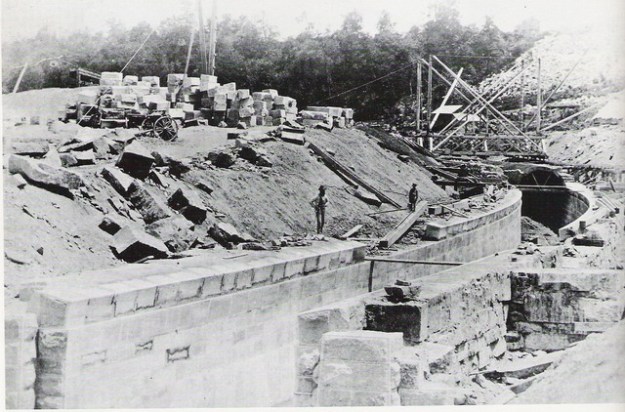
This archive photo shows the construction of the tunnel as the first row of blocks for the start of the curved roof were being laid.  A channel was cut and the tunnel constructed and then covered over.  This was done before the canal was flooded and put into service.

Building The GTR Tunnel

Unable to enter from the east end of the tunnel I determined to cross the canal on the swing bridge and look for the other end.  From the railway bridge you can look up lock 17 and see the height difference that the lock allowed ships to gain as they passed through.

IMG_2985

The canal locks have started to collapse and it is quite dangerous to get close to the edge in some places.  Most of the damage appears on the upstream ends of the locks due to flooding and annual ice flows pushing downstream.  The picture below shows the south-west end of lock 17 where the entire side is in danger of collapse.  Stepping on the wrong stone block to take a picture could result in a long drop with tons of rock crashing around you.

IMG_2986

Between lock 17 and 18 you have to go around the back of a wetland area before you cut back toward the canal.  When you find a small ravine you have reached the former rail line.  This will lead you to the east end of the tunnel.  Two metal posts indicate the original attempt to close this end of the tunnel was done using a low fence instead of concrete blocks.  I wonder why the two ends of the tunnel were treated so differently.

IMG_2991

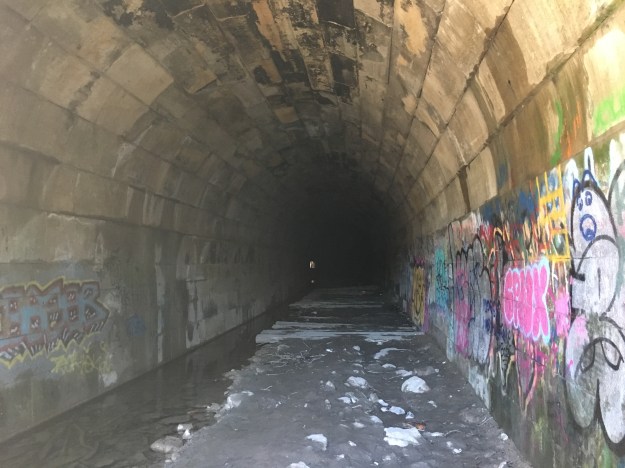
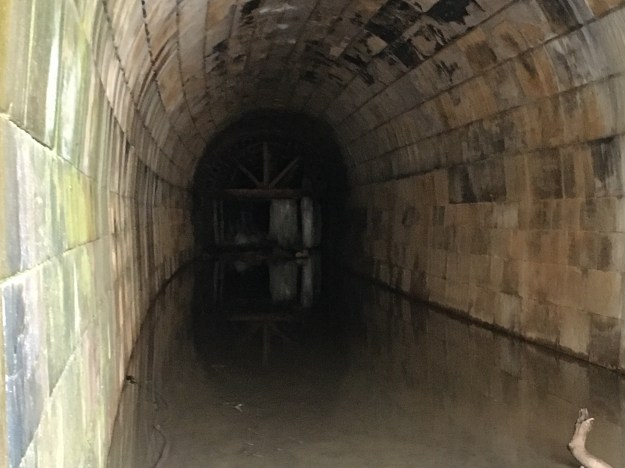
The east end of the tunnel is currently flooded.  Near the curve you can see several support beams that reinforce the tunnel where the river passes overhead.  They have been added since the tunnel was abandoned as they leave no clearance for a train to pass beneath.  Water leaks from the beams and perhaps one day the tunnel will collapse at this point, letting the river above rush in.

IMG_2993

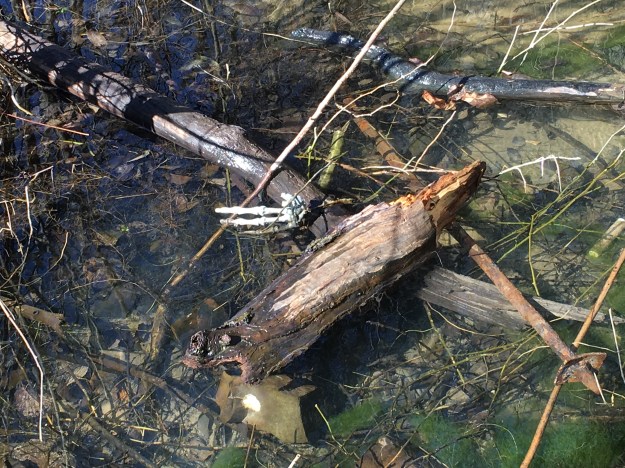
The tunnel is considered to be one of the most haunted places in the Niagara Region.  Various paranormal experiences are reported including voices, cold spots and physical pushing.  A mysterious blue ghost has given rise to the name Blue Ghost Tunnel.  Various reasons are given for this such as the 107 deaths that occurred during construction of canal, including two while building the tunnel.  A head on collision between two trains killed two people and there is also a claim that there may have been hundreds of remains left in a cemetery that was flooded by the dam at lock 18. As usual, any spirits in the area chose not to reveal themselves to me.  The closest I came was this skeletal hand which I hope is a Halloween prop.

IMG_2984

I may think about returning one day when the east end of the tunnel is dry enough to get inside without getting muddy up to the knees.  Pictures from The First Three Welland Canals can be found at the link.

Google Maps Link: Merritton Tunnel

Like us at http://www.facebook.com/hikingthegta

Follow us at http://www.hikingthegta.com
Chedoke Radial Trail

Saturday, February 17, 2018

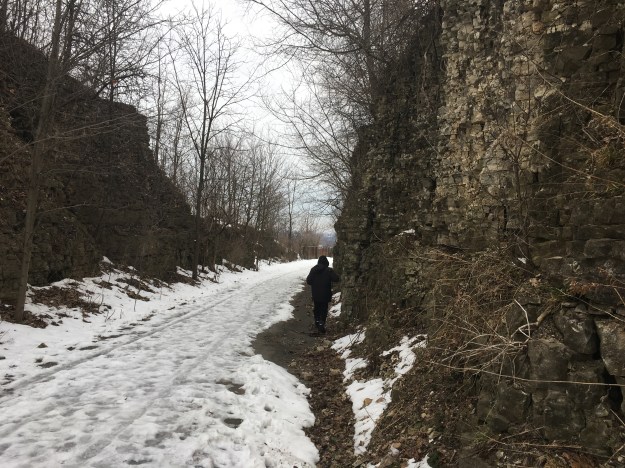
The Chedoke Radial Trail is 2.7 kilometres long, it was opened in 1995 and follows the former right of way for the Brantford and Hamilton Electric Railway.  The word “Chedoke” sounds like a native word but is actually a mispronunciation of the words Seven Oaks and refers to a patch of trees that originally stood in the area.  Several waterfalls can be seen from the trail and so we set off to view the ones between the parking lot on Scenic Drive near Chateau Court and Sanatorium Falls.

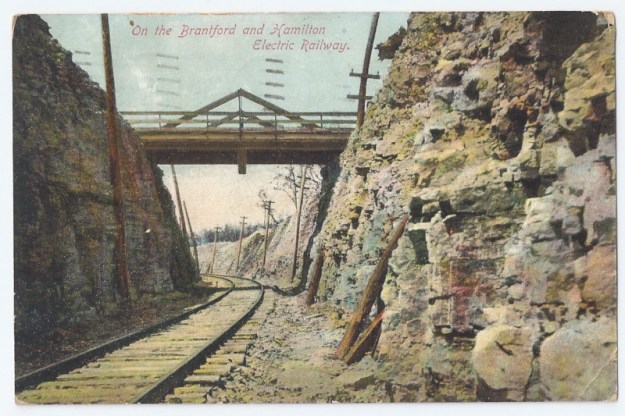
Two attempts were made to build a railway up the escarpment from Hamilton to Ancaster beginning in 1896 before an actual line was built ten years later.  The sod turning ceremony for the railway took place on August 6, 1906 but construction didn’t begin until late in the year.  Service was opened to Ancaster on December 21, 1907 and to Brantford on May 23, 1908.  The rail line runs up the escarpment at 2.5% to 5% incline.  By June 30, 1931 the line was underused and service was discontinued.  The final trip was made using the same cars as the first run up the escarpment.  Hamilton Parks Board was given the former right of way in 1938 but it would take nearly 60 years to become the Chedoke Radial Trail.  The post card below was post marked on October 16, 1909 and shows a bridge over a railway cut along the line.

BHHorning9May1911

The bridge is long gone, as are the electric poles that powered the railway cars.

IMG_2695

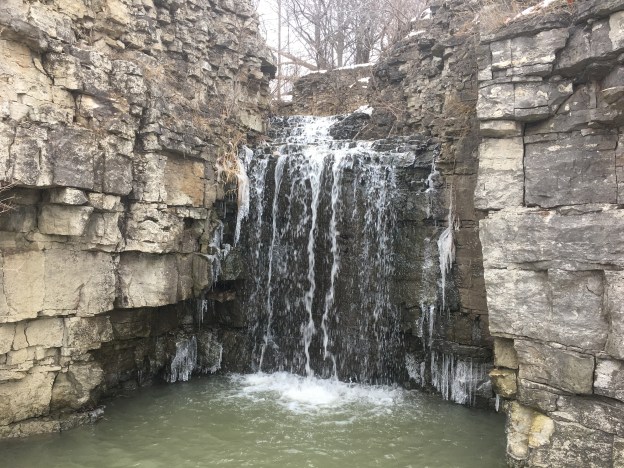
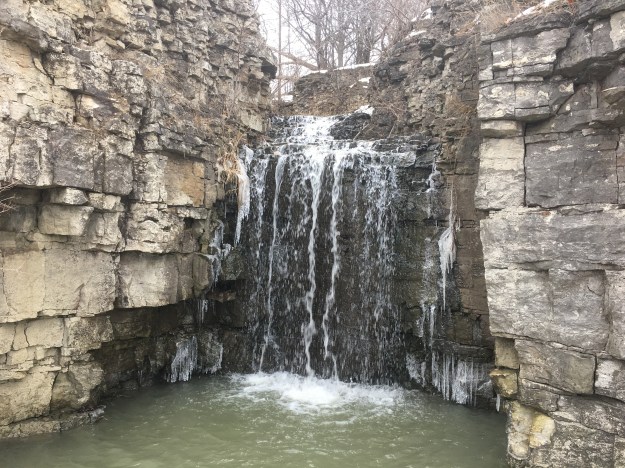
The first set of falls you come to is known as Upper Princess Falls. They are set back in a little limestone cavern and carry Lang’s Creek over a 6.7 metre drop into a deep plunge pool.

IMG_2736

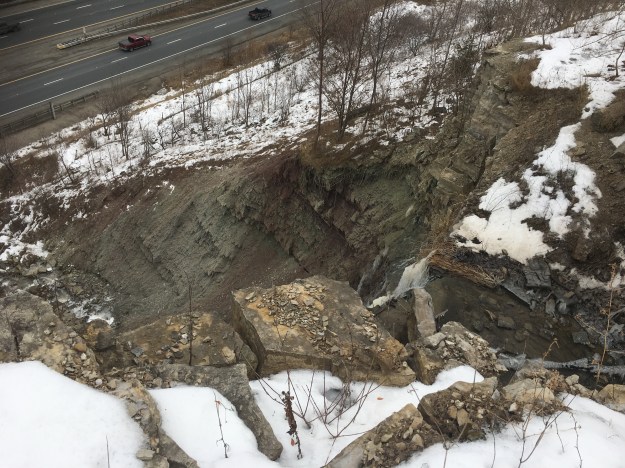
After flowing over Upper Princess Falls this tributary of Chedoke Creek is intended to pass under the trail in a culvert in the bottom of the plunge pool.  Instead, it often flows over the trail and through a fence before dropping 39.5 metres to the level of the 403.  Lower Princess Falls is quite spectacular when viewed from below.

IMG_2702

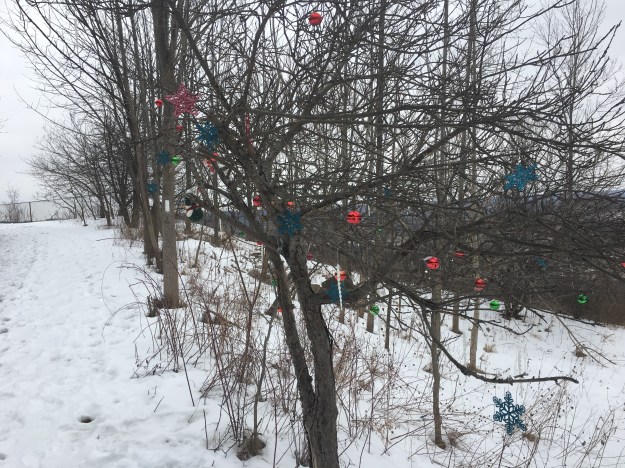
There are a few weeks in the year when Christmas ornaments look pretty on the trees in our parks.  However, after January they start to look like litter hanging in the trees.  Perhaps the people who hang them could come back and retrieve them later.

IMG_2744

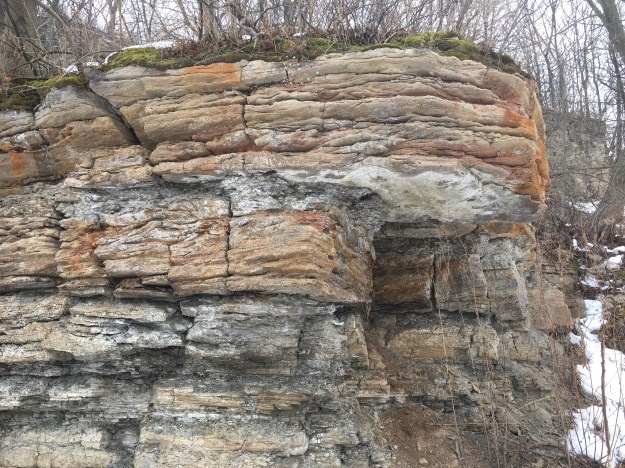
This rock formation can be seen from the trail and is included here as an example of why one must be careful how close they walk to the edge of the escarpment.  This chunk of rock is well undercut and has a large crack along the back of it.  Walking out to the edge could lead to a sudden dislodging of the rock and a nasty tumble.

IMG_2746

The Royal Hamilton Light Infantry were established in 1862 and used to have a rifle range in West Hamilton.  When the Brantford and Hamilton Electric Railway was built they extended the rock cut with a lengthy stone wall to protect the riders from stray bullets.  Rifle Range Road in Hamilton commemorates the Light Infantry and runs beside Alexander Park which can be seen from the rail line.

IMG_2747

When the Bruce Trail was opened there were three culverts installed and covered with concrete to allow pedestrians to cross Chedoke Creek.  The escarpment face was covered with patterned concrete to create a spillway for the water to flow down before entering the three culverts.  Over the years the concrete has become cracked and the water flows under it and around the culverts.  A bridge was installed in 2007 over the culverts at a cost of $60,000.   Five years later the bridge needed to be replaced and extended due to heavy erosion.  The new bridge ended up with a price tag of $950,000.

IMG_2761

Mountainview Falls is a classical complex cascade that drops 10 metres and has a width of 6 metres.  For a century this waterfall was known simply as the water fall on the mountain.  When a comprehensive listing of the Hamilton Waterfalls was made in 2002 it was given the name Mountainview after a small community that once existed here.  The entire side of the hill was given erosion control below the waterfall but this concrete is broken and being washed away.

IMG_2762

Mountainview Falls are actually quite nice when you get up close and eliminate all the man made concrete below them.

IMG_2766

Construction of Hamilton’s first reservoir began with land acquisition in 1856 and soon the hand dug reservoir had a capacity of 9 million gallons.  Some time in the 1980’s the reservoir was covered over with a concrete shell and grass was planted on top.  After becoming overgrown with hawthorn bushes it was barely discernible.  Recently the shrubs have been cleared away but the sides of the reservoir have become a target for grafitti.

IMG_2774

At the base of Sanatorium Falls is a old hub where a water wheel once rotated.  The main shaft for the wheel would have been made from a single piece of seasoned white oak.

IMG_2789

Sanatorium Falls marks the connecting point to a previous exploration of the Mountain Sanatorium.  At one time a set of stairs connected the railway with the Sanatorium so that workers could use the rail line to get to the hospital.  Every day they would have enjoyed a view of the falls as they started and finished their shift.

IMG_2786

There are several more falls that can be seen along the trail, but these will be saved for a future expedition.

Google Maps Link: Chedoke Radial Trail

Like us at http://www.facebook.com/hikingthegta

Follow us at http://www.hikingthegta.com
The Kissing Bridge

Friday, February 16, 2018

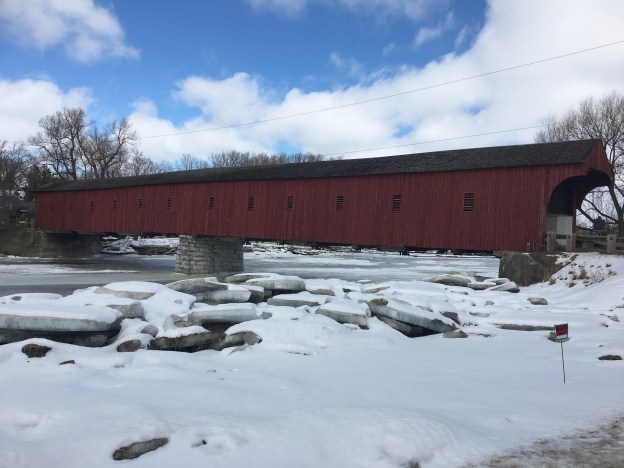
While enjoying a visit to The Shand Dam, I decided to make the side trip to see the last remaining vintage covered bridge in Ontario.

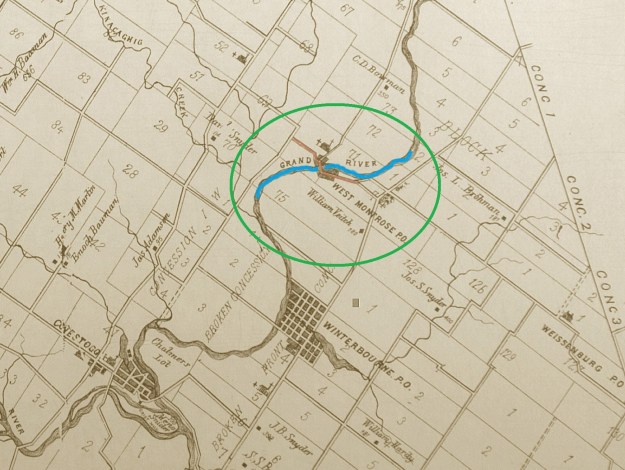
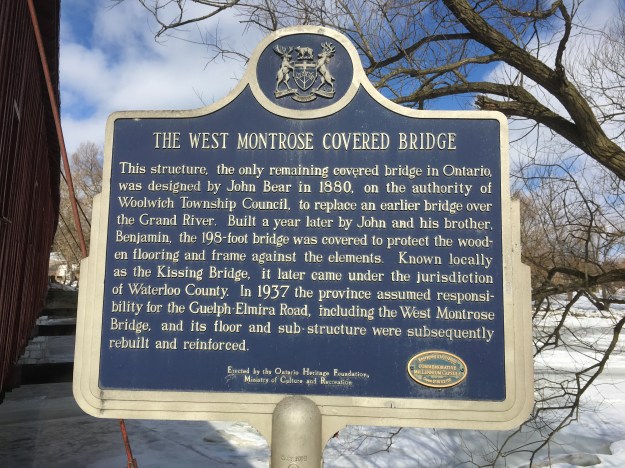
The average lifespan of a wooden bridge in the 19th century was 10 to 15 years.  The bridge marked on the county atlas in 1877 was under continual repair and by 1881 the Woolwich Council decided it was time to replace it.  They tendered the job of replacing the bridge with a covered bridge because it could be expected to last up to 80 years.

West Montrose (2)

The winning tender was from John and Benjamin Bear who agreed to $3197.50 for construction.  John Bear had built several barns but West Montrose would be his first bridge project.  Following this success he would go on to become a well-known bridge designer.

IMG_2665

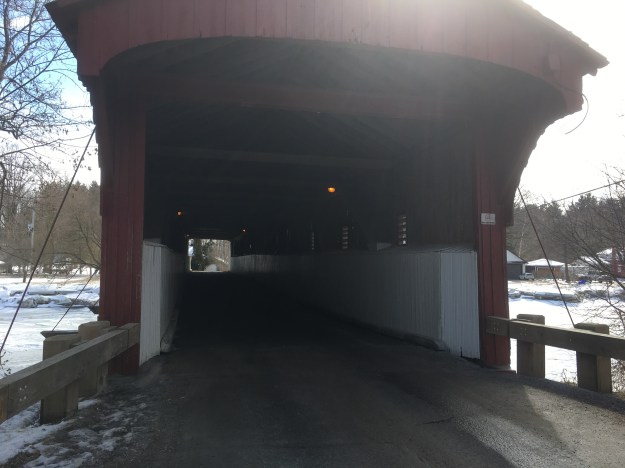
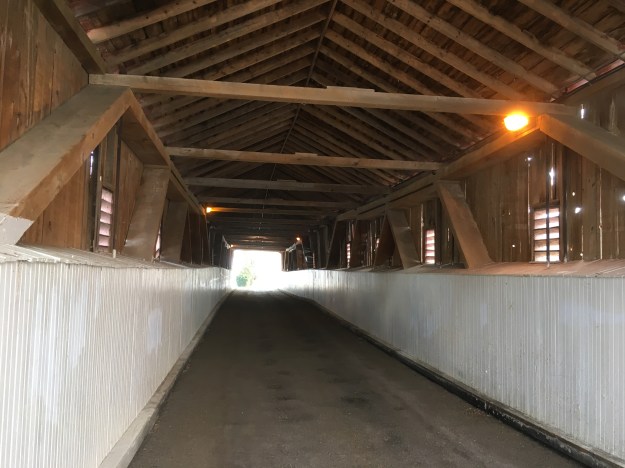
The original bridge decking was wood and the covering protected it from storms and inclement weather.  Ironically, in the winter the town had to pay someone to shovel snow onto the bridge.  Buggies switched to sleigh runners for the winter instead of wheels and the snow was needed to protect the oak planks of the decking.  A second advantage that covered bridges offered was a sense of calm for the horses who didn’t have to view the river during the crossing.  Starting in 1885 the inside of the bridge was lit by coal oil lamps during the over night hours.  Innovation came in 1950 when three electric light bulbs were hung inside the bridge.  After four years of having these smashed by tall trucks, the county paid for proper installation of electric lights.

IMG_2666

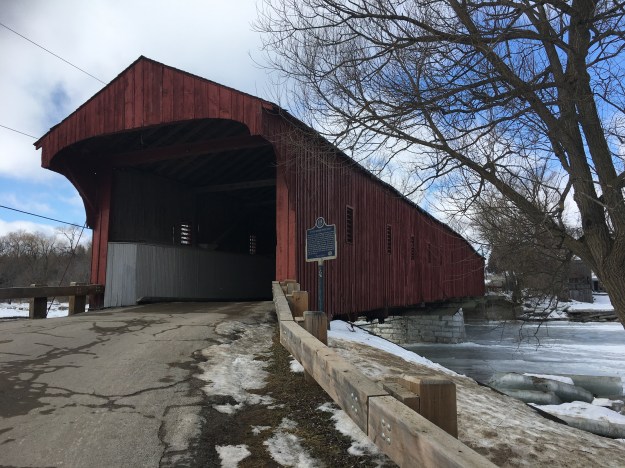
The bridge is two spans supported on a stone weir in the river.  The design is a Howe truss bridge but with the addition of needle beams (elongated floor beams) to laterally stabilize the frame.  It is 205 feet long and 17 feet wide.  It has been restored several times and steel Bailey trusses were added in 1959.

IMG_2685

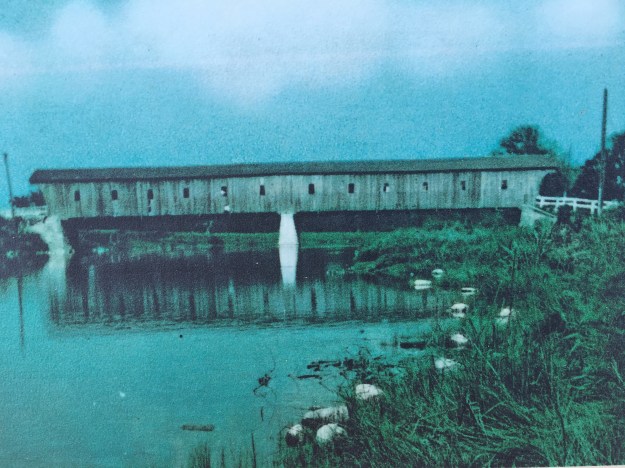
One on-line database lists 35 covered bridges in Ontario, along with pictures.  Only one of these was in existence when this postcard picture was taken in the 1930’s.  At that time there was a 30 foot long pagoda style bridge in Peterborough, among others in the province.  Only the Peterborough bridge survives from this era and it was restored in 1989 and so has an extended future.  Most other covered bridges in the province were built since 1980.  The West Montrose covered bridge is the only Victorian era vehicle bridge still in use in Ontario.  The more famous Hartland Covered Bridge in New Brunswick is much longer at 1282 feet but 20 years newer, having opened in 1901.  It is only one year shy of being the oldest in that province.  Notice how the West Montrose Covered Bridge pictured below had not been painted up until the time of this historic photograph.

IMG_2676

The length of the bridge varies from report to report with 205, 200 and 198 feet being cited.  Perhaps the floor deck is 198 while the roof is 205.  There is a small park near the bridge where you are allowed to park but property on both sides of the river is marked as no trespassing.  I can imagine it garners a fair bit of attention from tourists at certain times of the year.   Especially with a nick-name like The Kissing Bridge.

IMG_2669

As a bonus, Lost Acre Variety at the north end of the bridge has some very tasty home cooked breads and sweets.

Google Maps Link: West Montrose

Like us at http://www.facebook.com/hikingthegta

Follow us at http://www.hikingthegta.com

The Shand Dam

Friday, February 16, 2018

The Grand River Conservation Commission was formed in 1934 and one of their first major projects was the commissioning of the Shand Dam.  A vacation day from work was a good excuse for a road trip and I wanted to go and see the dam.  Rather than park at the Belwood Conservation area adjacent to the dam I decided to hike for 2 kilometres to the dam.  I parked on the Second Line, just west of the conservation area where the old railway line crossed and there are a couple of free parking spots.  This is in the former community of Spier, or Spires, where not much remains except for the  school house.  Forbes Moir had arrived from Scotland in 1858 and bought 250 acres of land and a small settlement was started.  It never grew but became a whistle stop on the Credit Valley Railroad when it passed through Moir’s property in 1879.  He operated a post office from 1882 until 1913.  The school date stone reads School Section No. 1 1872.
IMG_2660

The railway was operated under several names before it was closed by the Canadian Pacific in 1988.  It is now a 47-kilometre multi-use trail known as the Elora-Cataract Trailway.  I entered the trail near the 8 kilometre marker and quickly saw the remains of an old windmill.  A concrete trough stands at the base of the structure where it once contained water for the livestock that grazed in the field.  The wheel is missing most of the vanes and it appears that it will soon be on the ground.  Steel windmills began appearing in the 1870’s but didn’t gain popularity for another 20 years due to the difficulty the farmer faced in repairing them compared to wooden mills. The ladder is still visible on the tower of this mill and one of the most hated jobs of early windmills was the need to climb the tower to lubricate the mill.  By 1912 the self-oiling windmill had been developed and this chore was greatly reduced.  This windmill is a reminder that this plot of land was generating energy long before the arrival of the dam.

IMG_2625

The trail was crossed with several coyote tracks of various sizes. There were several places where there were obvious signs of successful hunting, including this rabbit who didn’t escape becoming a coyote dinner.

IMG_2630

Snowmobiles use the trails during the winter months and there is an intersection of a couple of trails. On this day I didn’t encounter anyone, either on a snowmobile or on foot.  I expect that the trail is considerably busier in the summer months.

IMG_2632

After a two-kilometre hike you will come to the Shand Dam.  The dam cost two million dollars and funding was provided in part by the eight municipalities that made up the conservation commission.  Brantford, Galt, Fergus, Elora, Paris, Kitchener, Waterloo and
Preston each got work for some of the unemployed in their communities.  The federal and provincial governments kicked in the balance in stimulus spending to help ease the effects of the Great Depression that was lingering.

IMG_2638

Part of the price of building the dam included the acquisition of 2,000 acres of land that would be flooded by the 12 mile lake that would be formed.  This was the first dam that the conservation commission constructed and remains the largest reservoir they control with a capacity of almost 64 million cubic metres of water.  It was the first dam built in Canada for the purpose of flood control and the provision of drinking water.  Several ice huts can be seen on the lake as people take advantage of the great ice fishing.

IMG_2644

The dam was rushed to completion with the outbreak of the second world war and all Canadian records for construction were broken as the 22.5-metre tall dam was raised throughout 1940.  Crews of men lived on-site as record volumes of concrete were poured and tons of earth were moved in a rush of construction activity.  The dams steel gates were installed in January 1942 bringing construction nearly to a completion.  The CPR had been diverted while the dam was being built and the first train to cross the dam was on March 9, 1942.  The official opening took place on August 7th with 3,500 people in attendance for the ceremony.  The dam was originally called The Grand Valley Dam but tourists looking for the dam and park often ended up in the town of Grand Valley, some 18 kilometres upstream.  As a result, the dam was soon renamed after a local pioneer family named Shand whose land was consumed under the new reservoir.  This picture looks over the side of the dam to the dissipation weir at the bottom.

IMG_2639

One hundred and twenty stairs lead from the top of the dam to the bottom.  This dam proved its value when Hurricane Hazel hit Ontario in 1954 and killed 81 people in the GTA.  No lives were lost in the Grand River watershed.

IMG_2642

Water levels in the river used to fluctuate from raging highs during spring melting to summer lows when the water was little more than a polluted stream.  Today, the water level below the dam is maintained at a safe and constant level.

IMG_2643

The Roman numerals for 1942 adorn the old conservation commission crest on the control room of the dam.

IMG_2653

Seen from the south, the difference in elevation of the water in the dam is obvious.

IMG_2651

The Elora-Cataract Trailway also serves as part of the Trans-Canada Trail which spans the country and runs to 24,000 kilometres.  The longest connected series of recreational trails in the world.

IMG_2658

Belwood Lake Conservation Area looks like a place to check out again in the summer months.

Google Maps Link: The Shand Dam

Like us at http://www.facebook.com/hikingthegta

Follow us at http://www.hikingthegta.com