Author Archives: hikingthegta

Spirit Rock Conservation Area

July 13, 2024

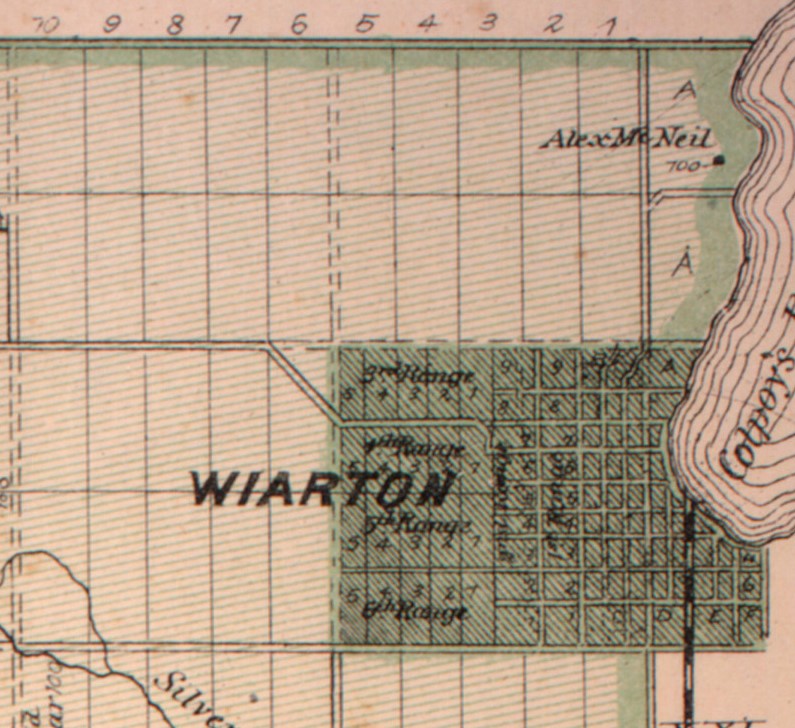
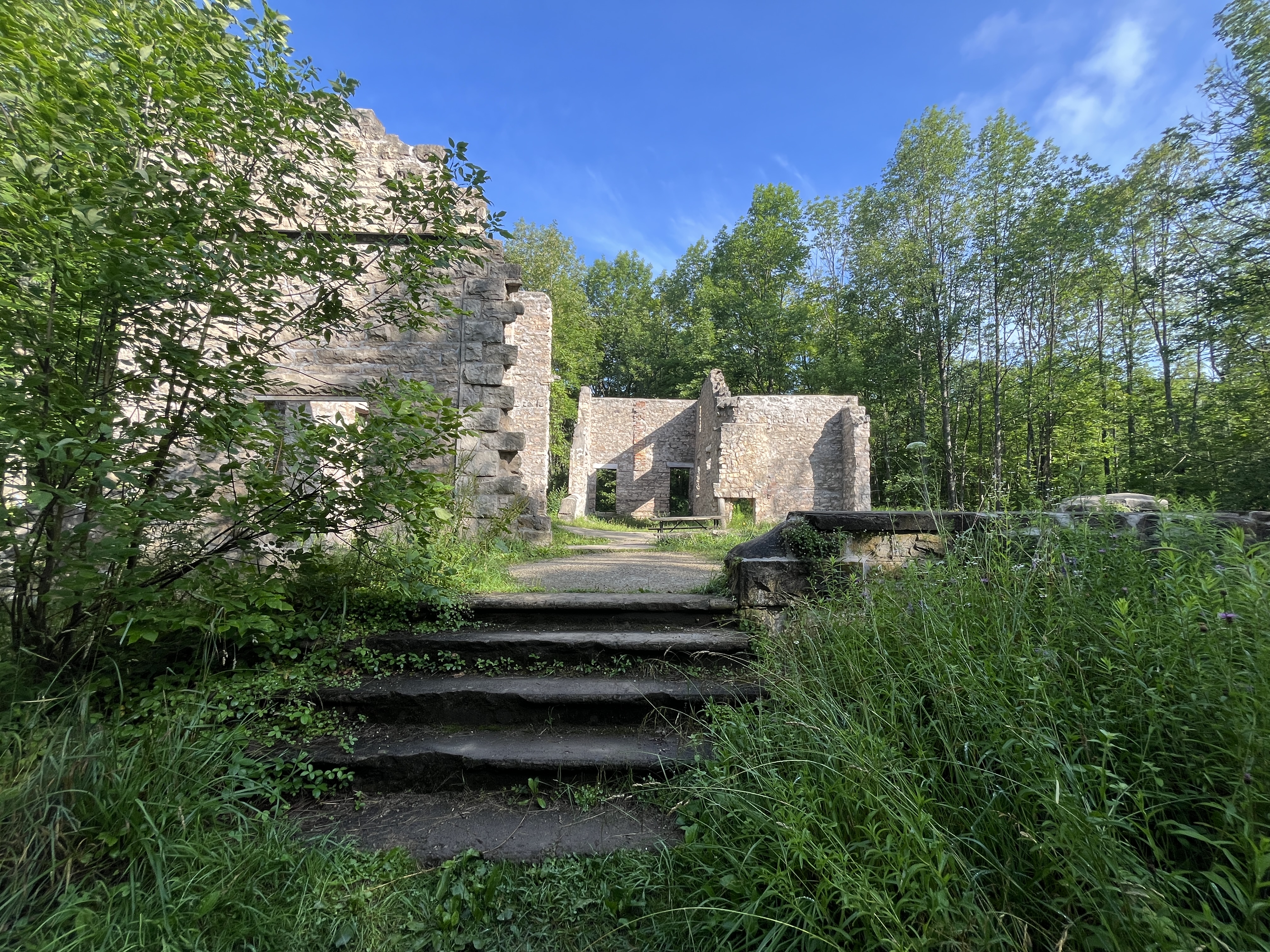
Alexander McNeill was born in The Corran, County Antrim, Ireland on May 10, 1842. When he was 30 he married his second cousin Hester who was recently widowed. That same year of 1872 they emigrated to Canada and settled on his brother-in laws farm in Elderslie Township. Hester and Alexander lived there until 1881 when he bought a 300 acre property just north of Wiarton. Alexander was a member of the Liberal-Conservative party and was elected to the House of Commons for the riding of Bruce North in 1882. He held this seat through the next 4 elections but his victory in the 1900 election was overturned the following year and he was never re-elected. The map below is from the 1882 county atlas and shows the McNeill property just north of Wiarton on Colpoy’s Bay.

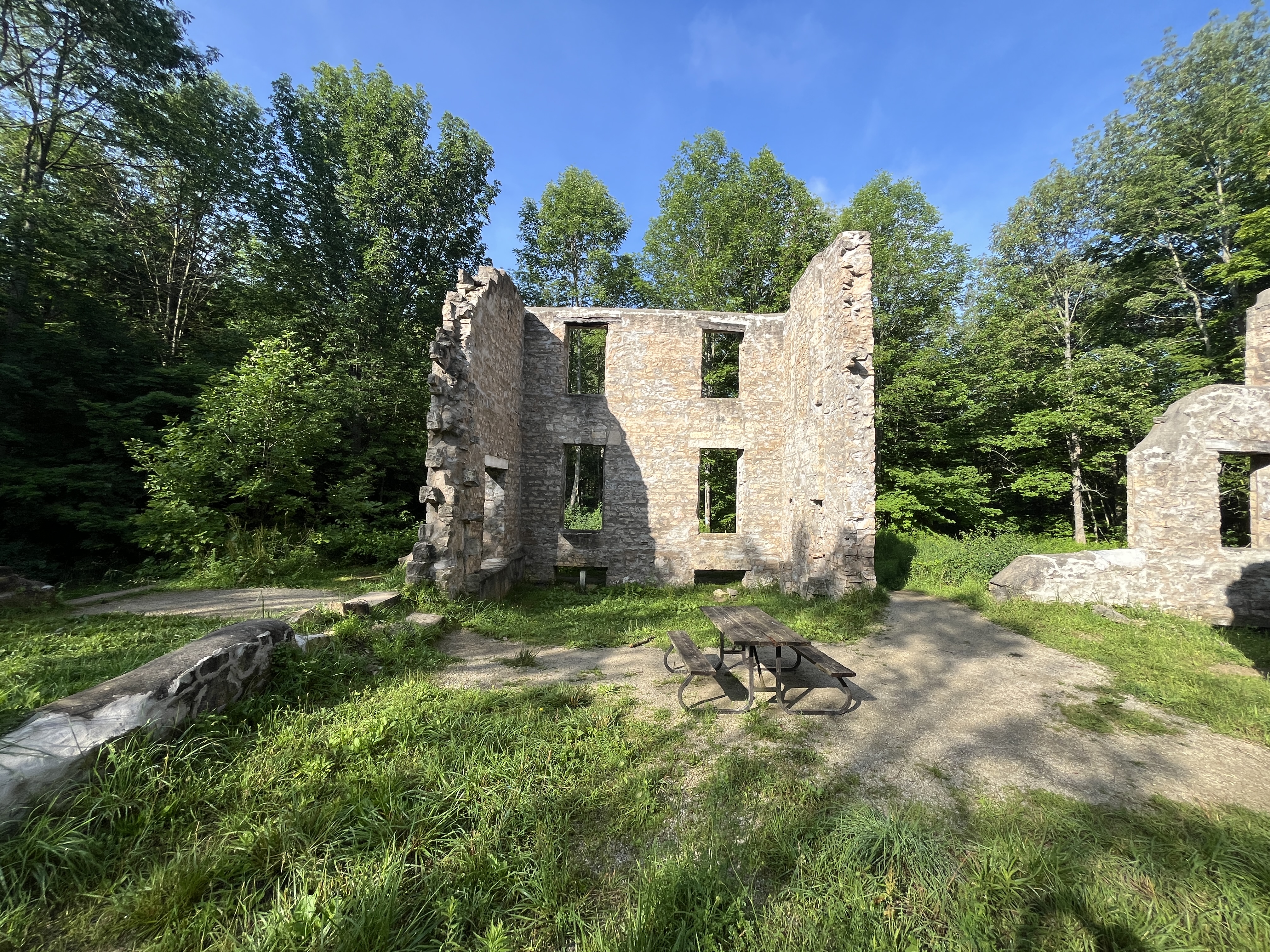
In 1882 McNeill commissioned a mansion for himself and Hester which was designed to have 17 rooms. It was the first estate mansion to be built in Bruce County. He called the 300 acre estate and the mansion The Corran after his birthplace in Ireland. It took several years to build and Hester died in 1890 before it was complete. Alexander was left with his 16 year-old son Malcom whom he willed the estate to when he passed away.

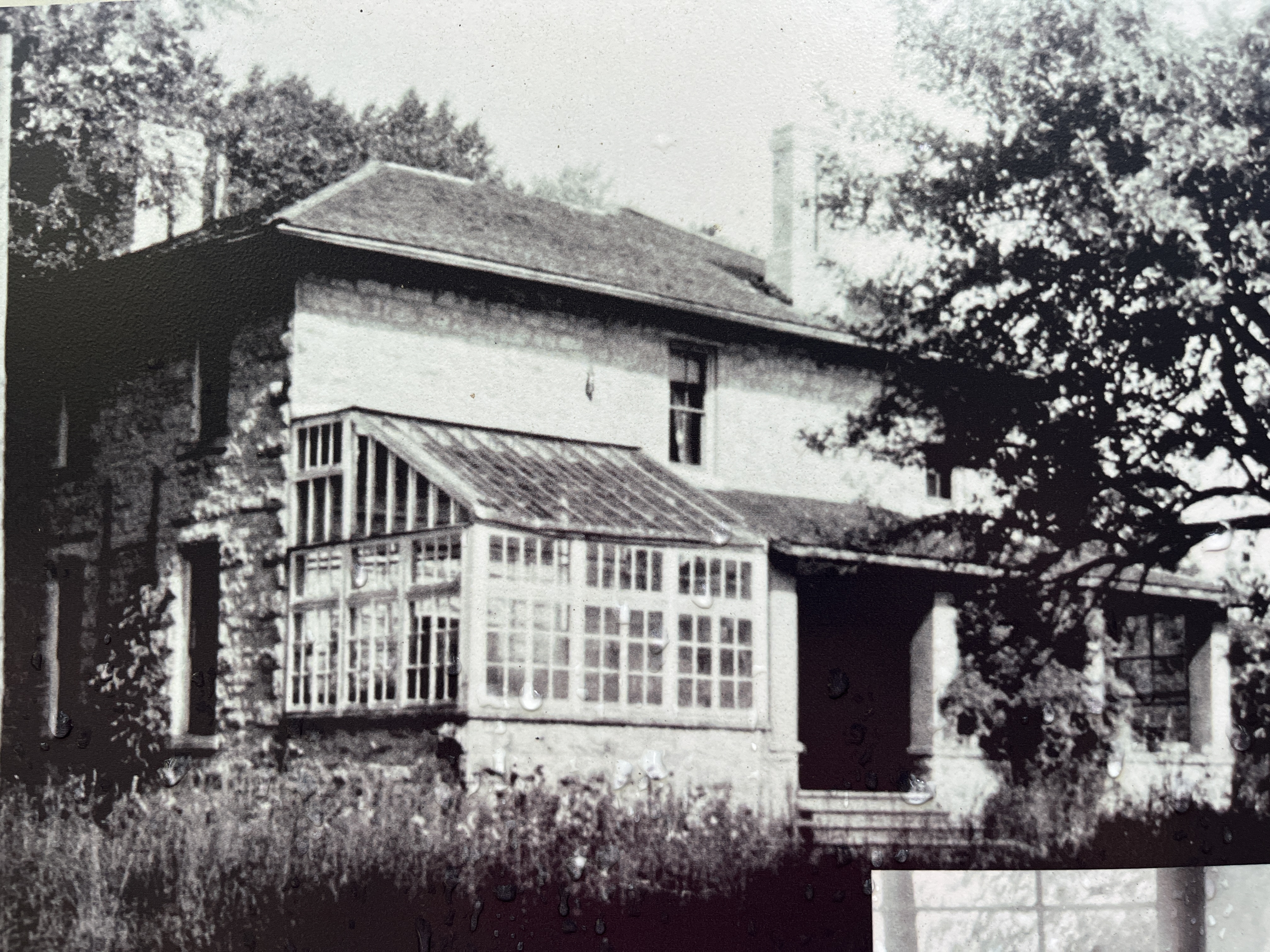
There were three acres of gardens which included over 500 rose bushes. Alexander couldn’t maintain it and serve as an Member of Parliament in Ottawa at the same time. So, he asked an old friend Alfred Lewis to move from England with his family and become the estate manager. The historical image below shows the estate in its prime. The front entrance and steps were crossed by many famous politicians and prominent citizens over the years.

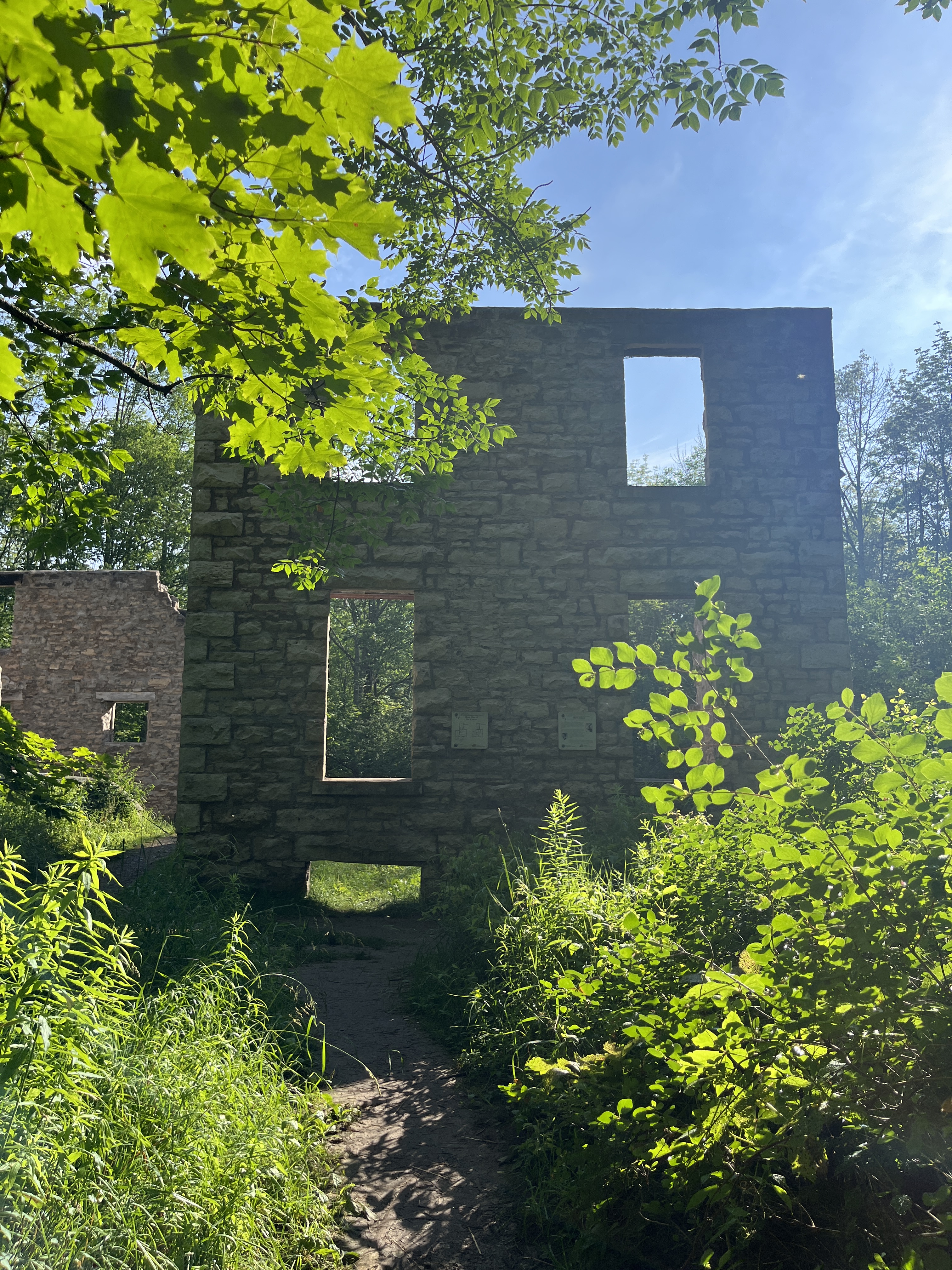
The same front steps can be seen in the image below. Lavish parties were hosted in the gardens and amongst the roses and peonies. Over 500 fruit trees were also planted on the grounds. One such party was held on July 1, 1901 when guests enjoyed violin music in the gardens.

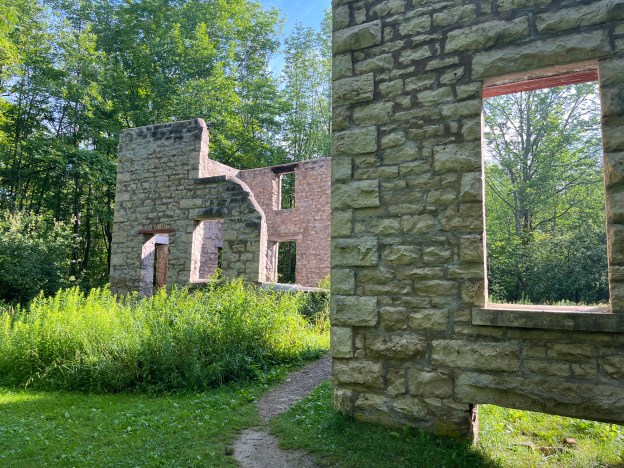
Alfred Lewis was killed in 1931 when he was hit by a car. This was the very first hit and run accident causing a fatality to occur in the Bruce Peninsula. Alexander McNeill died on April 18, 1932 and left the property to his son Malcom, who had never married. Malcom was too generous with his newfound fortune and soon it was disappearing on him. He eventually had to sell off 20 acres of the estate to pay back taxes. When Malcom passed away in 1956 he left the house to his longtime housekeeper Sally Simmons. By the time the estate debts were settled, there was little money left and Sally closed up most of the house and lived in the kitchen. She sold the house to a man from Willowdale in 1960. Since he didn’t live in the house it was easy for vandals to access because of its secluded location. By 1964 the house was in bad shape with all the windows broken and most of the interior stripped away. Grey Sauble Conservation bought the property in 1971 but the break-ins continued until 1976 when the house burned down in a final act of vandalism.

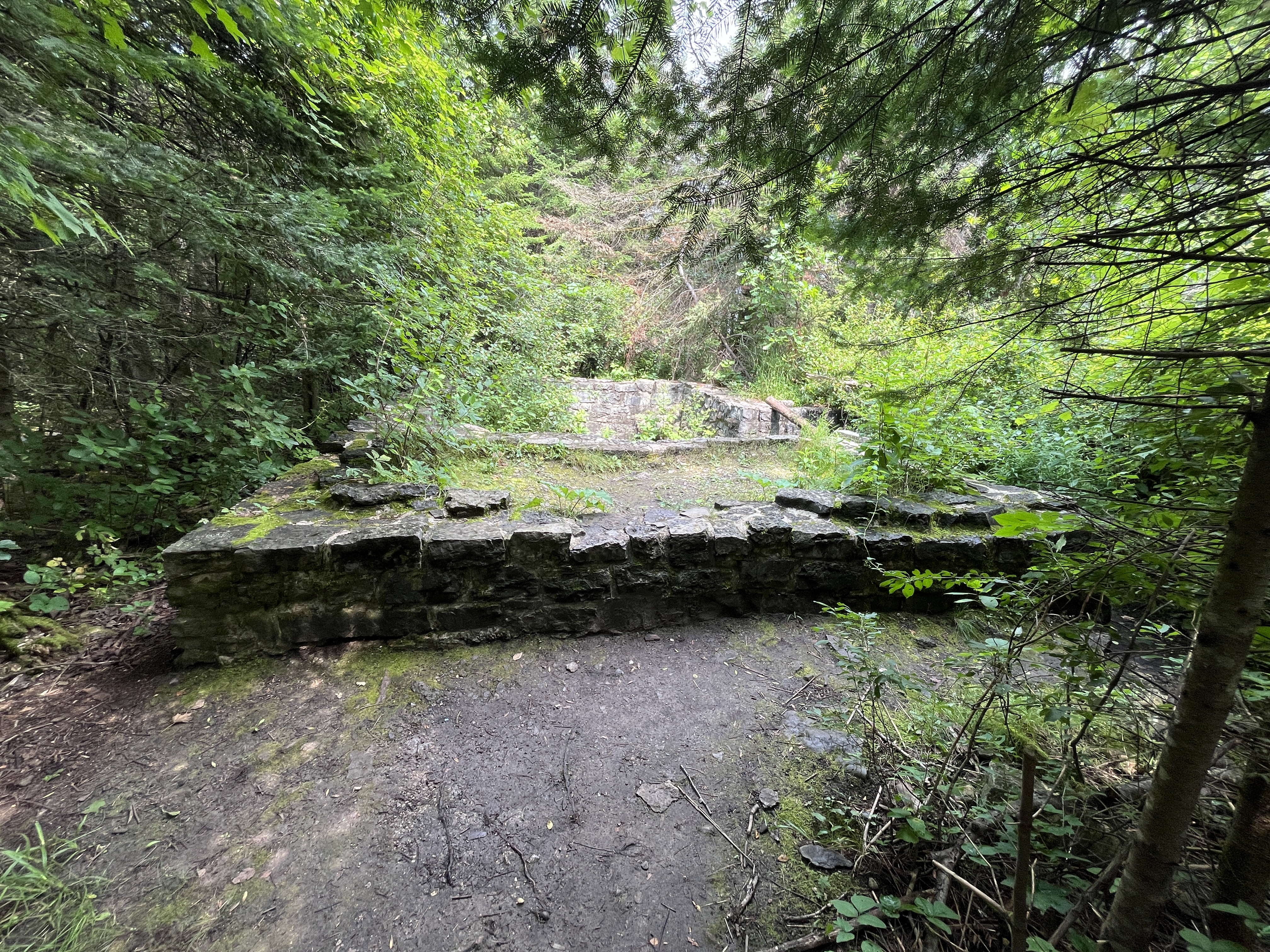
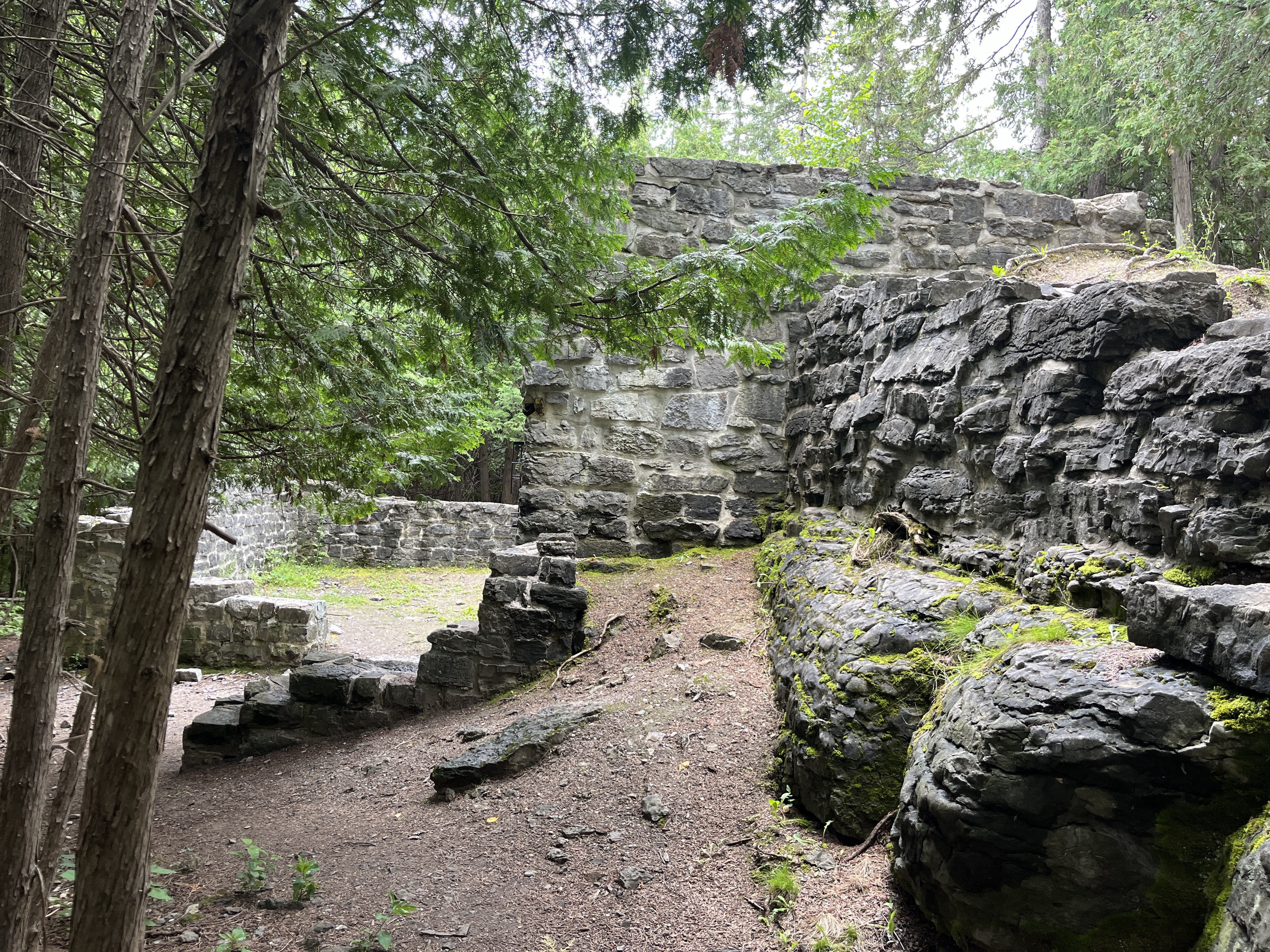
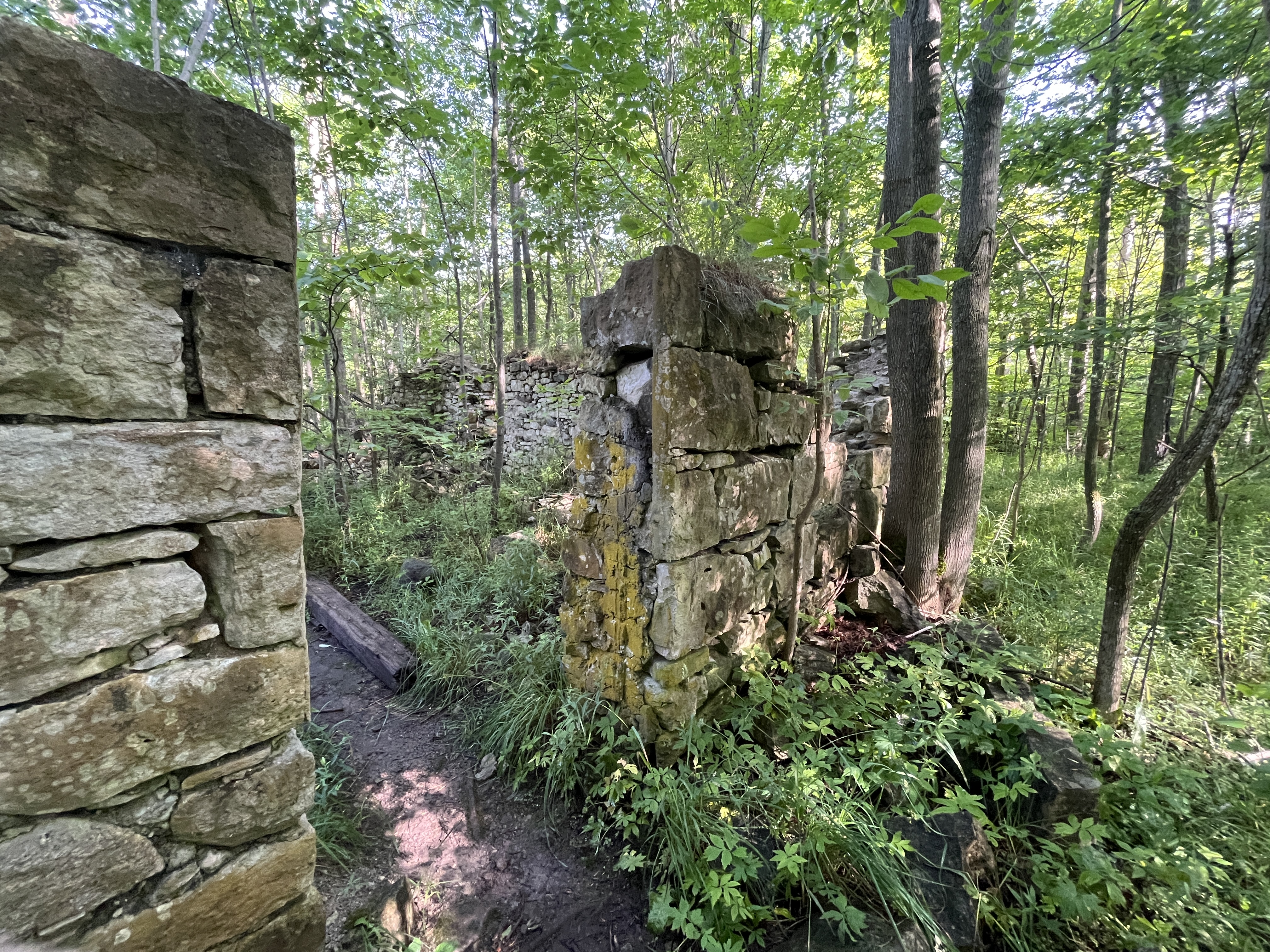
Alexander ran a successful cattle breeding farm which raised Durham Shorthorns from England. The cattle barn is gone but the stone foundations remain a short distance from the house.

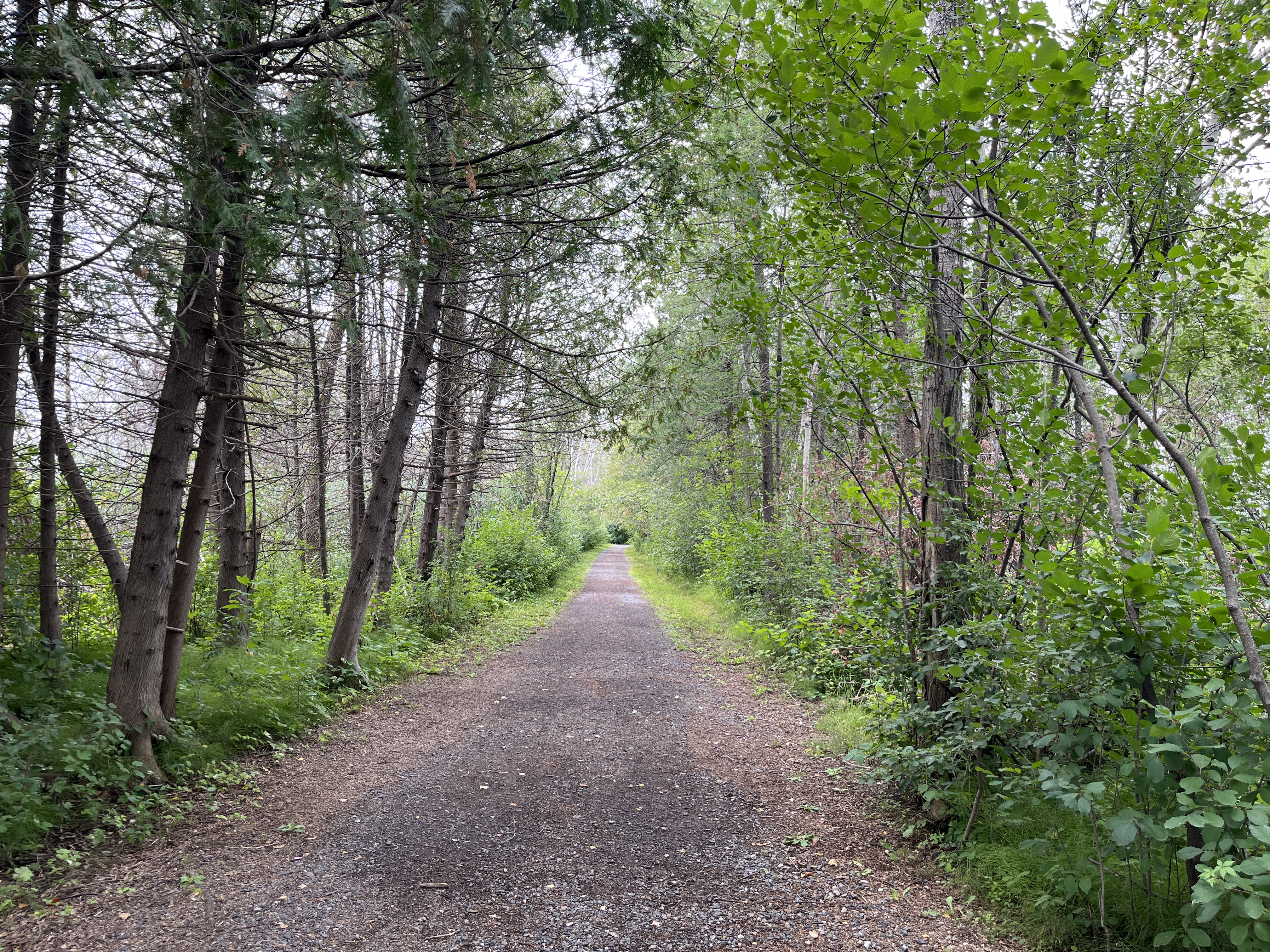
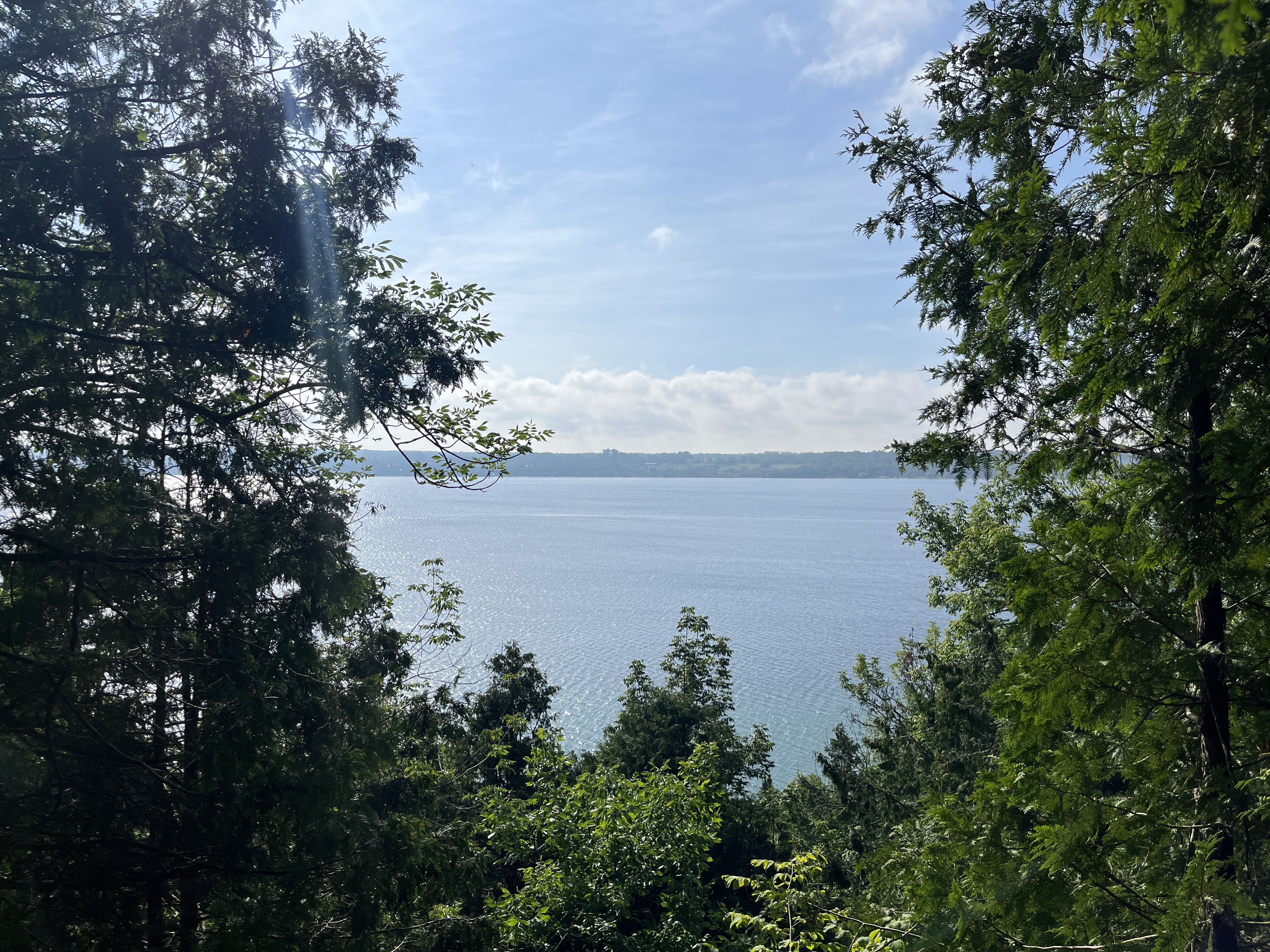
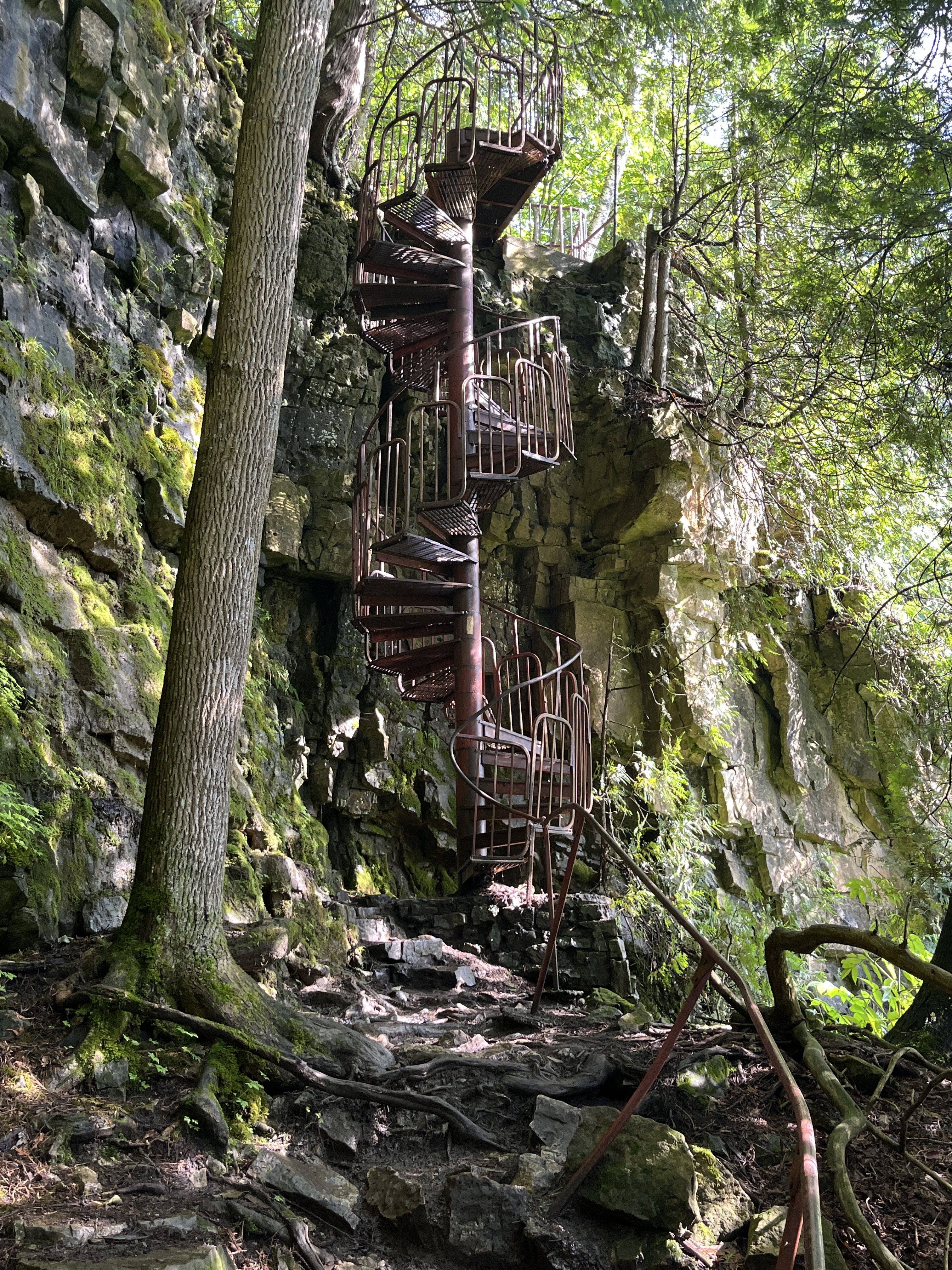
The estate was built with a beautiful view of Colpoy’s Bay and there are over 5 kilometres of trails that wind through the park, which has become known as Spirit Rock Conservation Area. The Bruce Trail passes through the estate as well as the Spirit Rock Trail. There are several great places to look out over the bay including the Spirit Rock Lookout. Because I was visiting the park for a short time before I had to go to a nearby inspection I didn’t have time to get to the lookout. Instead I headed for the spiral staircase where I was rewarded with the view in the image below.

The Spiral Staircase makes 3 turns and used 30 steps to bring you down the first steep section of the escarpment.

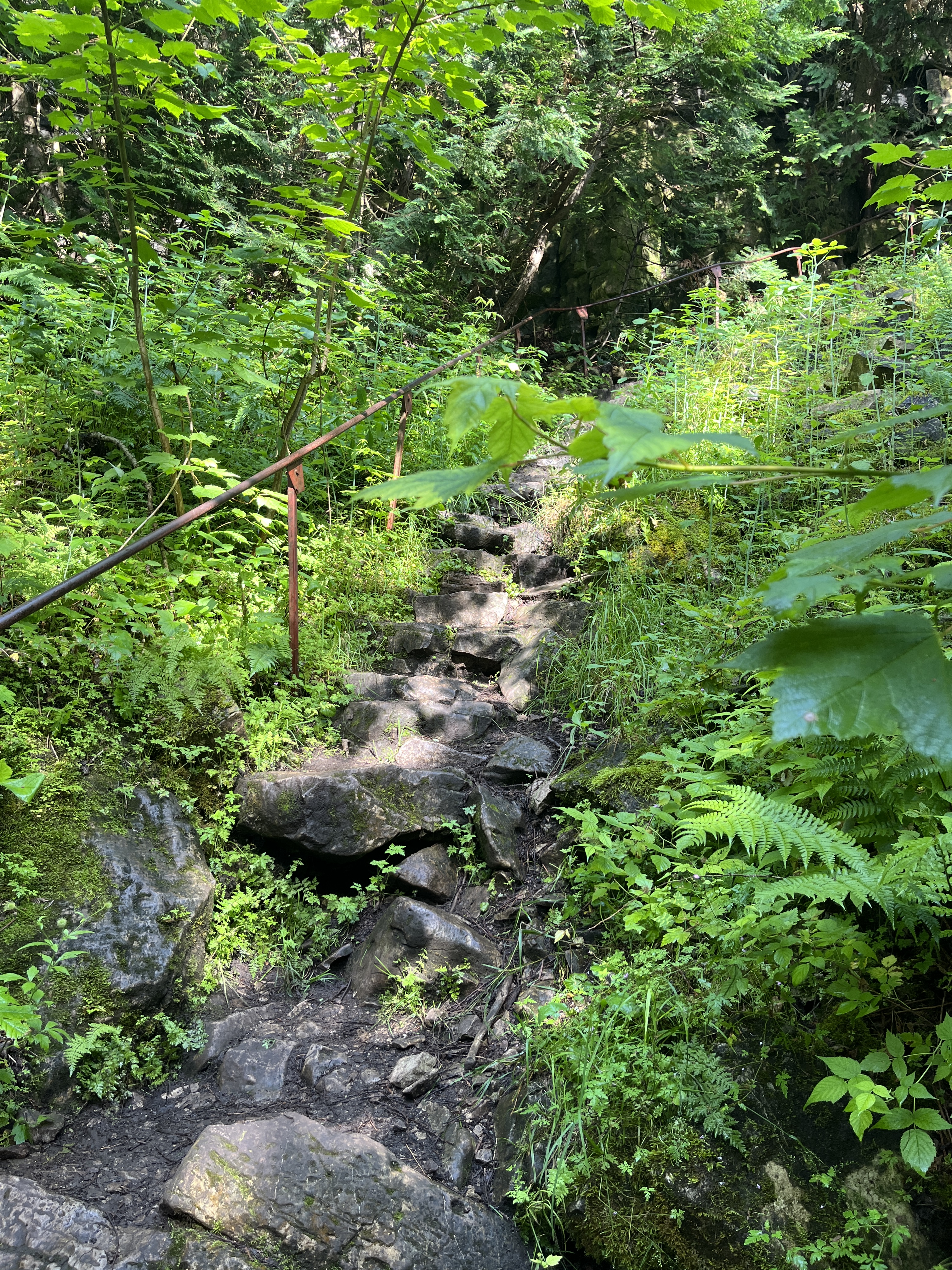
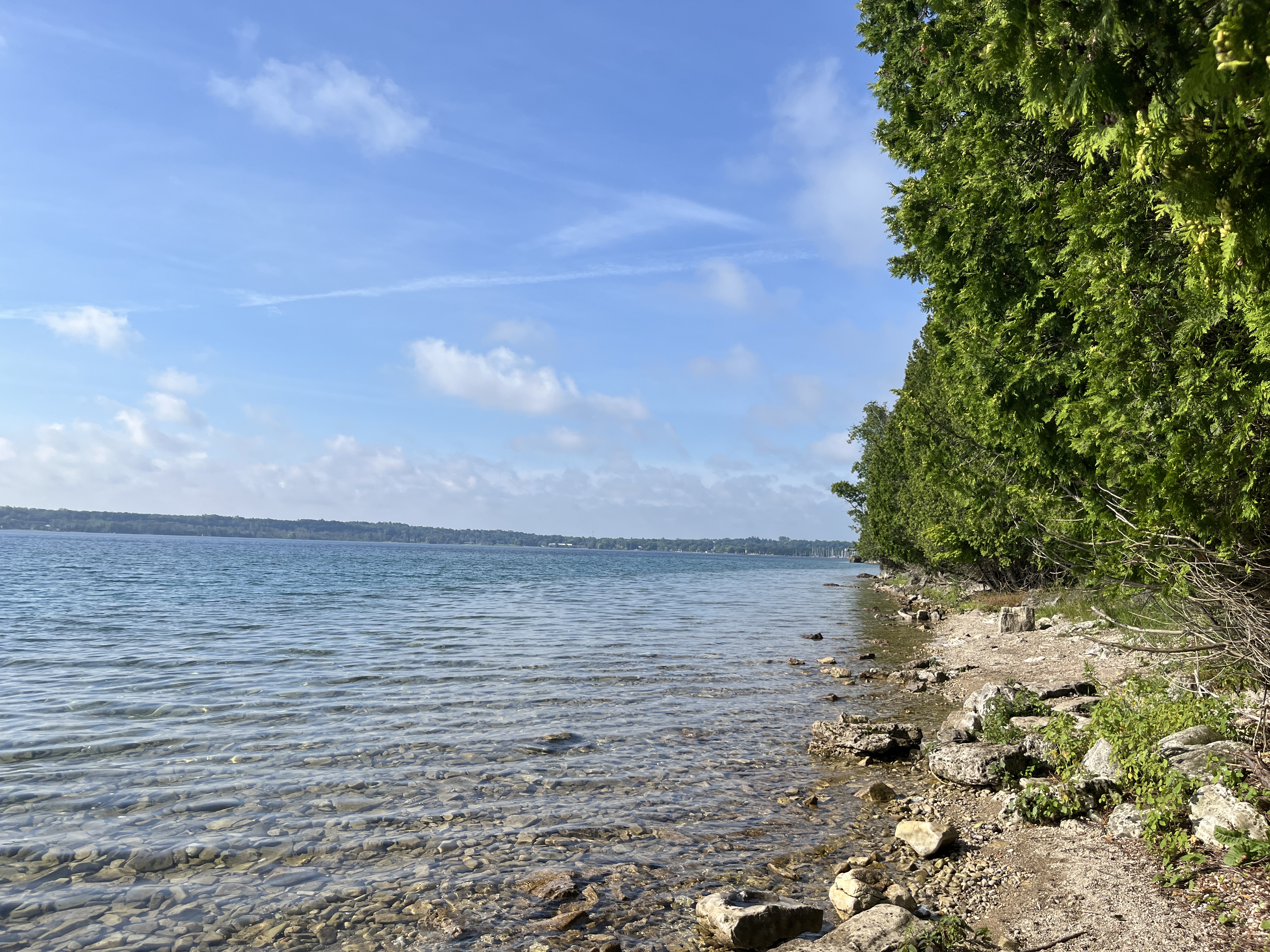
You are left with a mildly challenging section of trail that leads down to the Lake Huron shore. Fortunately, there is a handrail here. The footing was slippery on the morning that I visited and I was glad for the handrail. The mosquitos were famished and I was bitten about 30 times in 30 minutes.

The trail continues along the lakeshore but a lack of time and excess of mosquitos led me to decide to go back to the car. I previously hiked through this section of the Bruce Trail on a short vacation to the Bruce Peninsula in the early 1990s and enjoyed it then.

Spirit Rock Conservation Area has a $10 per day parking fee but the trails and history are well worth exploring.

Google Maps Link: Spirit Rock Conservation Area

Like us at http://www.facebook.com/hikingthegta

Follow us at http://www.hikingthegta.com
Also, look for us on Instagram

Fort Henry

July 6, 2024

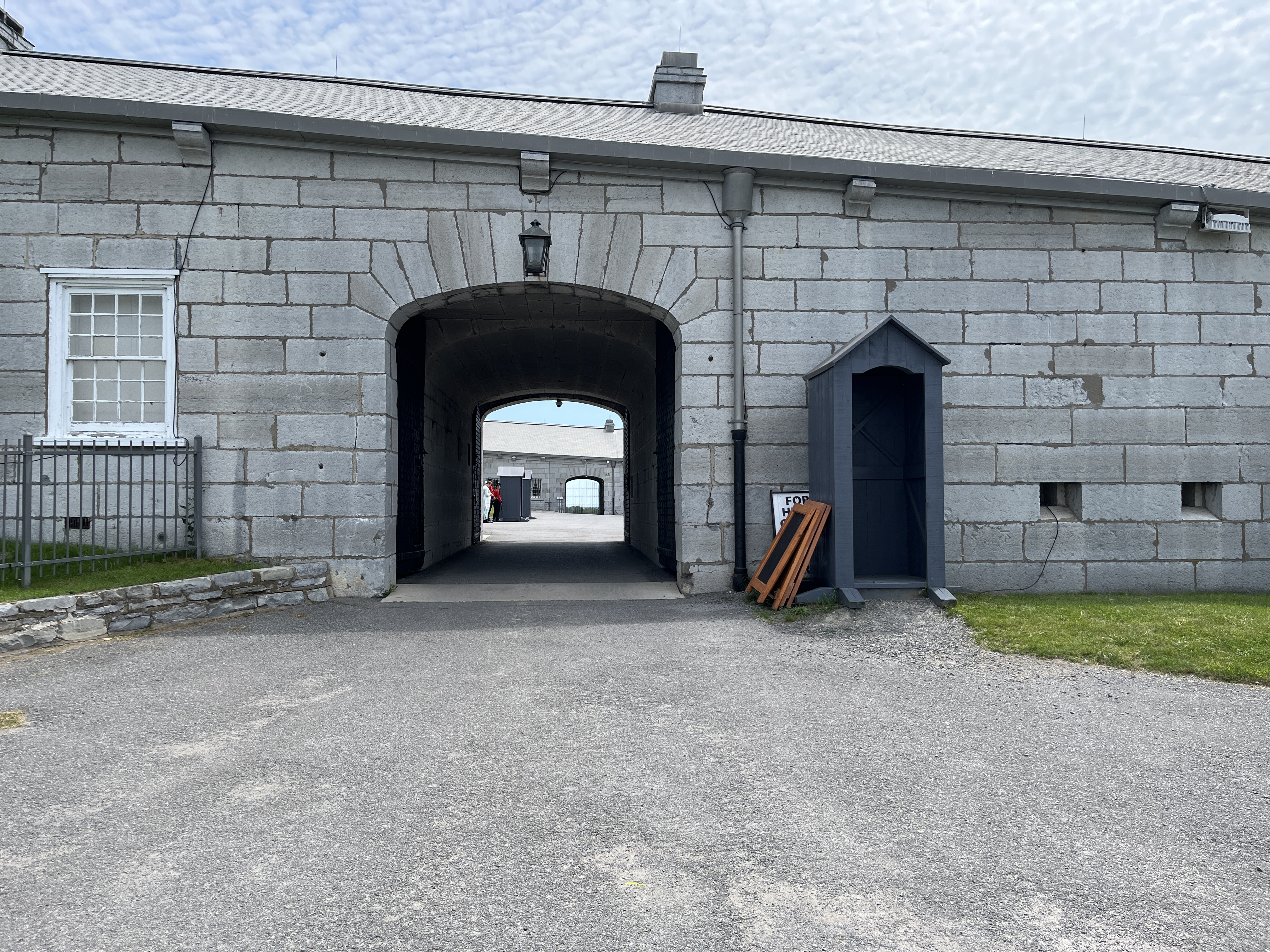
During the War of 1812 the British built a fort on Point Henry in Kingston with the purpose of defending the naval shipyards located near the mouth of the Cataraqui River. When this war finished in 1814 a period of infrastructure building was undertaken in response to possible future threats. One of these projects was the Rideau Canal. Due to the need to defend the canal, a new fort was built between 1832 and 1837 on the site of the earlier Fort Henry. This new fort was occupied by the British until 1870 when responsibility for self defense was passed on to the newly created Dominion of Canada. The Canadian military garrisoned here until 1891 and then the fort was abandoned for several decades during which time it fell into disrepair. In 1936 it was restored and then opened as a military museum. Fort Henry was the largest fortification west of Quebec city and cost the equivalent of $35 million dollars to complete. The image below shows the main gates, which could be closed with a set of double doors.

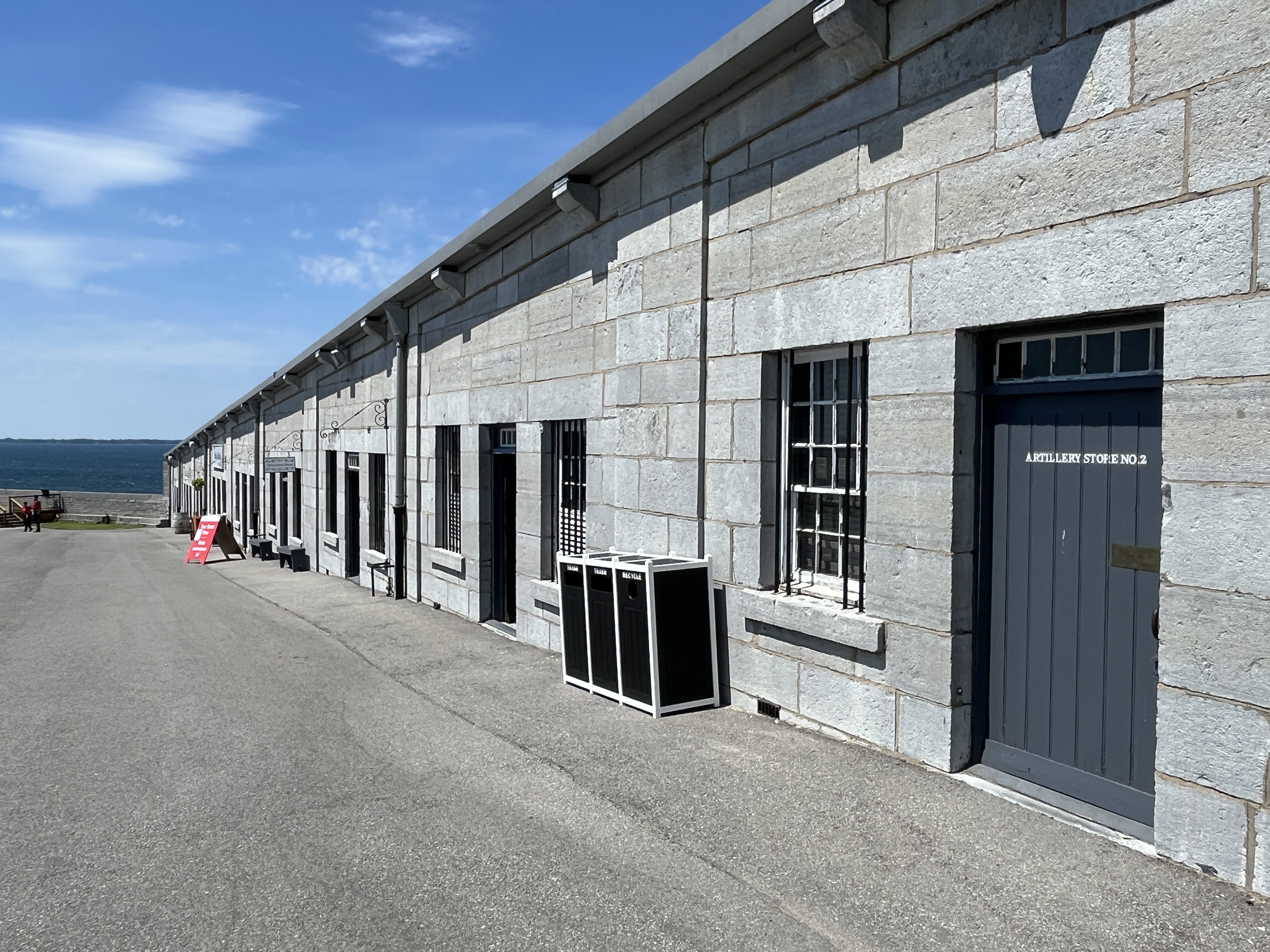
The upper fort, or advance battery, was initially separate from the main redoubt. It had 32-pounder guns that protected the entrance to the naval dockyards as well as Kingston Harbour. It had two lengthy buildings, one of which can be seen below, which held the Commissariat Stores. These rooms held various functions that were not required to be in the main redoubt. Today they house a restaurant and a few shops including the souvenir stand. Each room has an arched ceiling that was called a casement. These were deigned to protect the occupants from the effects of explosive cannonballs.

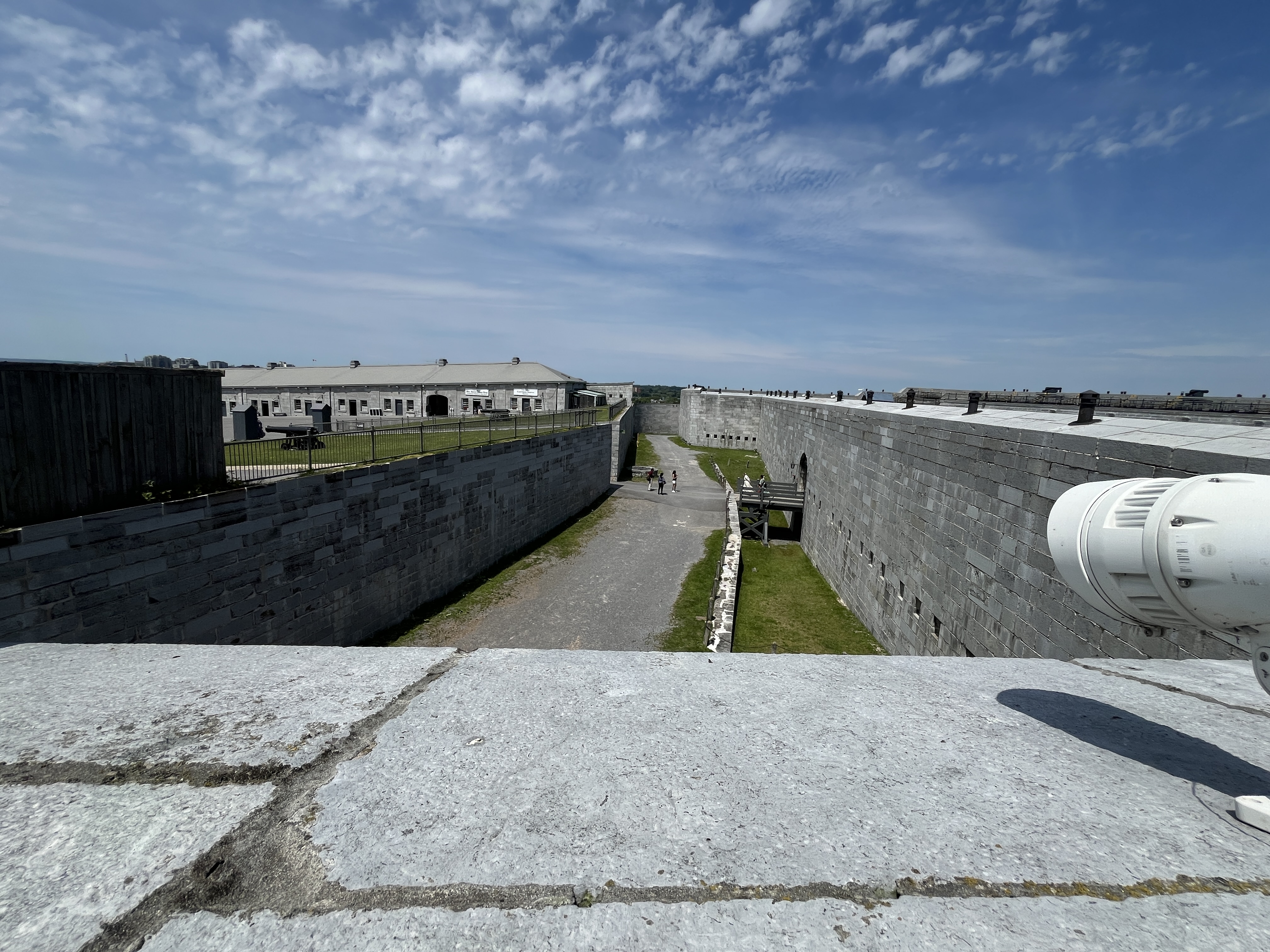
A dry ditch surrounds the entire fort and separated the upper and lower parts. It was designed to be difficult to cross. It was 12 metres wide and 9 metres deep with the facing made of cut stone blocks. If attackers got into the ditch they would face rifle fire from the little loopholes that lined the walls.

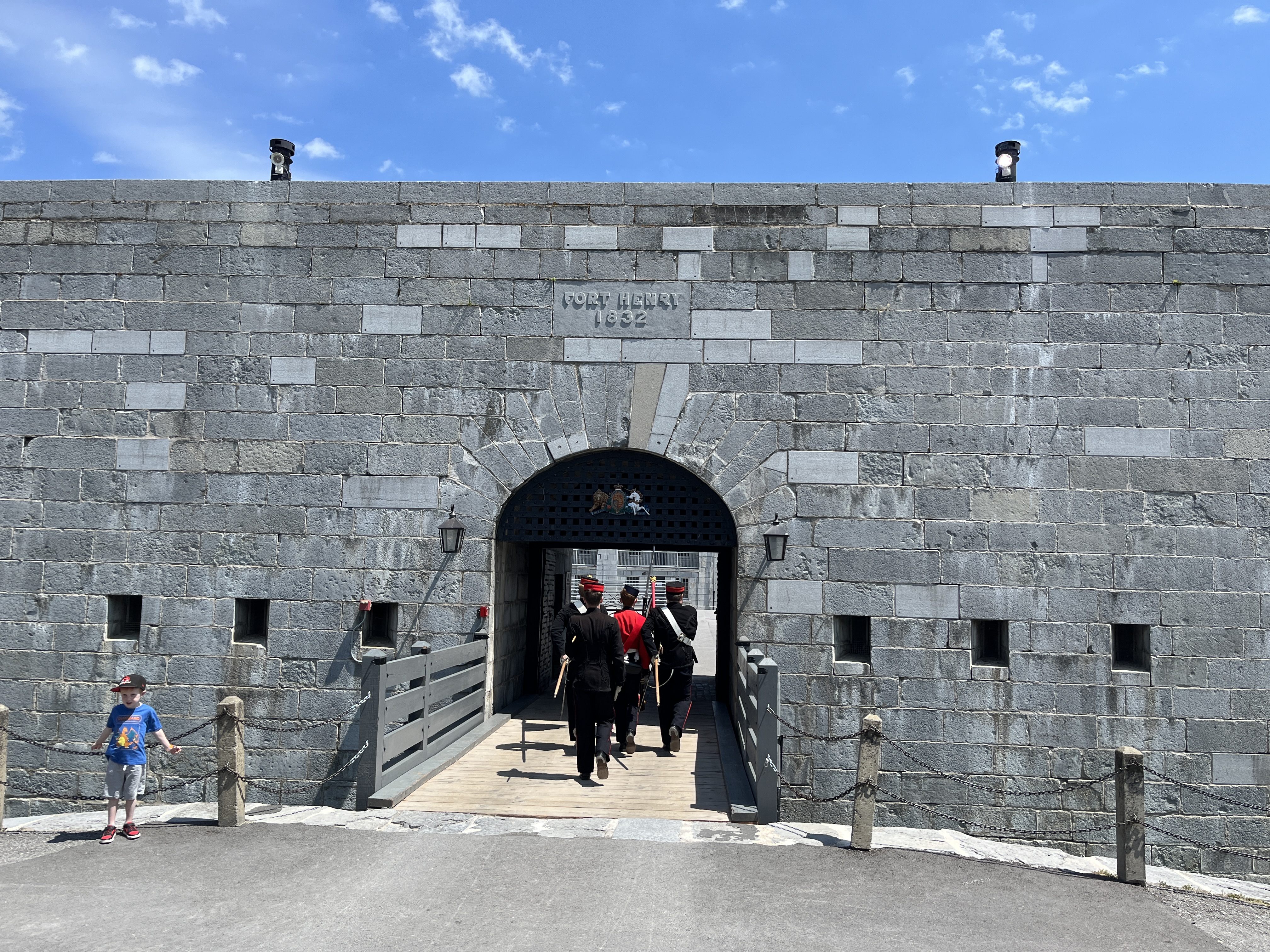
The main redoubt, or lower fort has only one entrance from the upper fort. It is protected by a drawbridge that could be closed if the upper fort was compromised. A date stone above the door reads “Fort Henry 1832”.

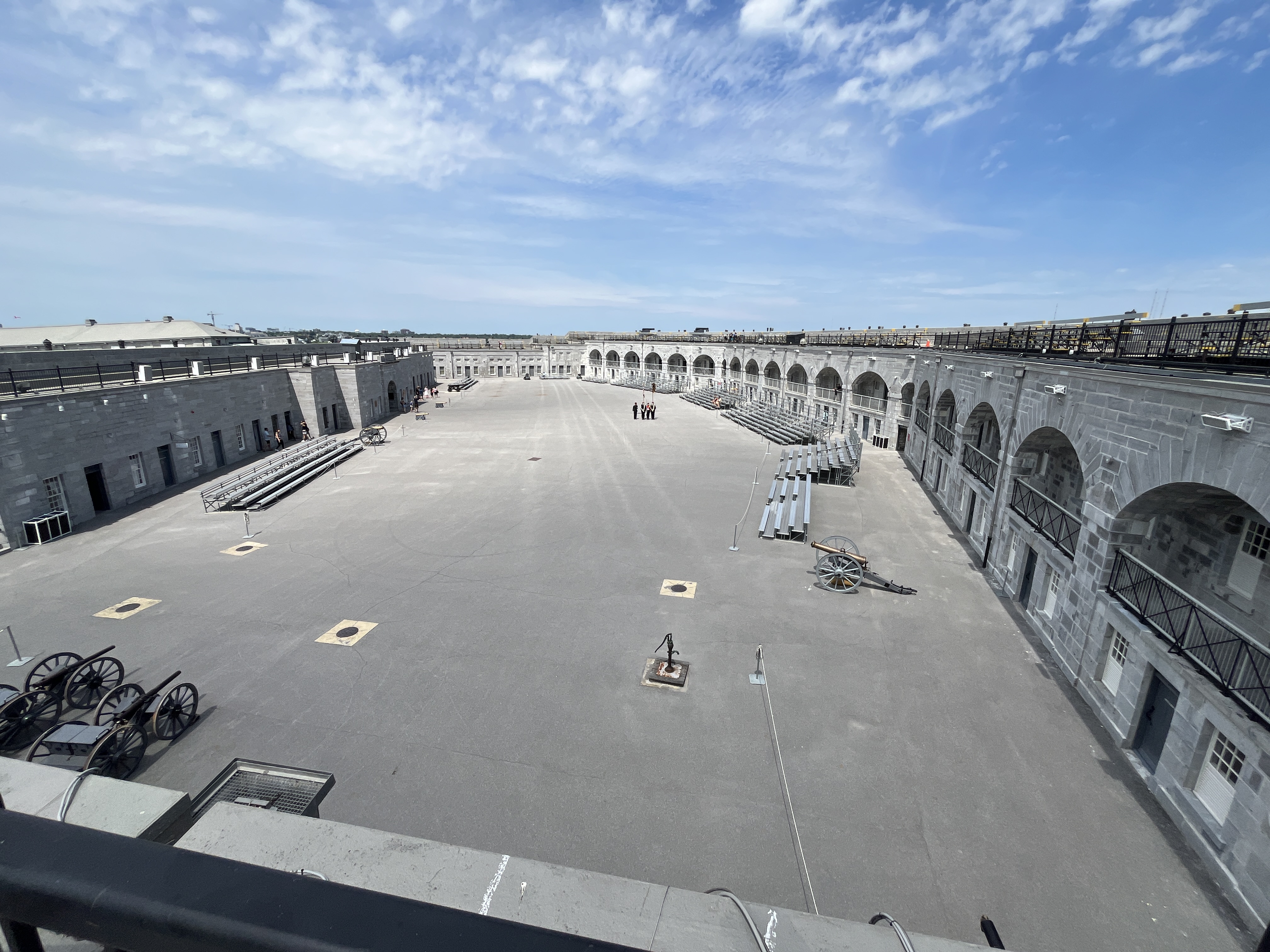
The central part of the lower fort was known as the parade square. This is where the infantry soldiers drilled and also where special events took place. The upward firing mortars were located here as well. Under the parade square were five large cisterns which held the forts water supply. This water served all the needs of the fort including a supply that was held behind a sluice gate. Occasionally the gate would be opened and water would rush through the men’s and women’s privies. This would flush the waste through a tunnel and into the Navy Bay.

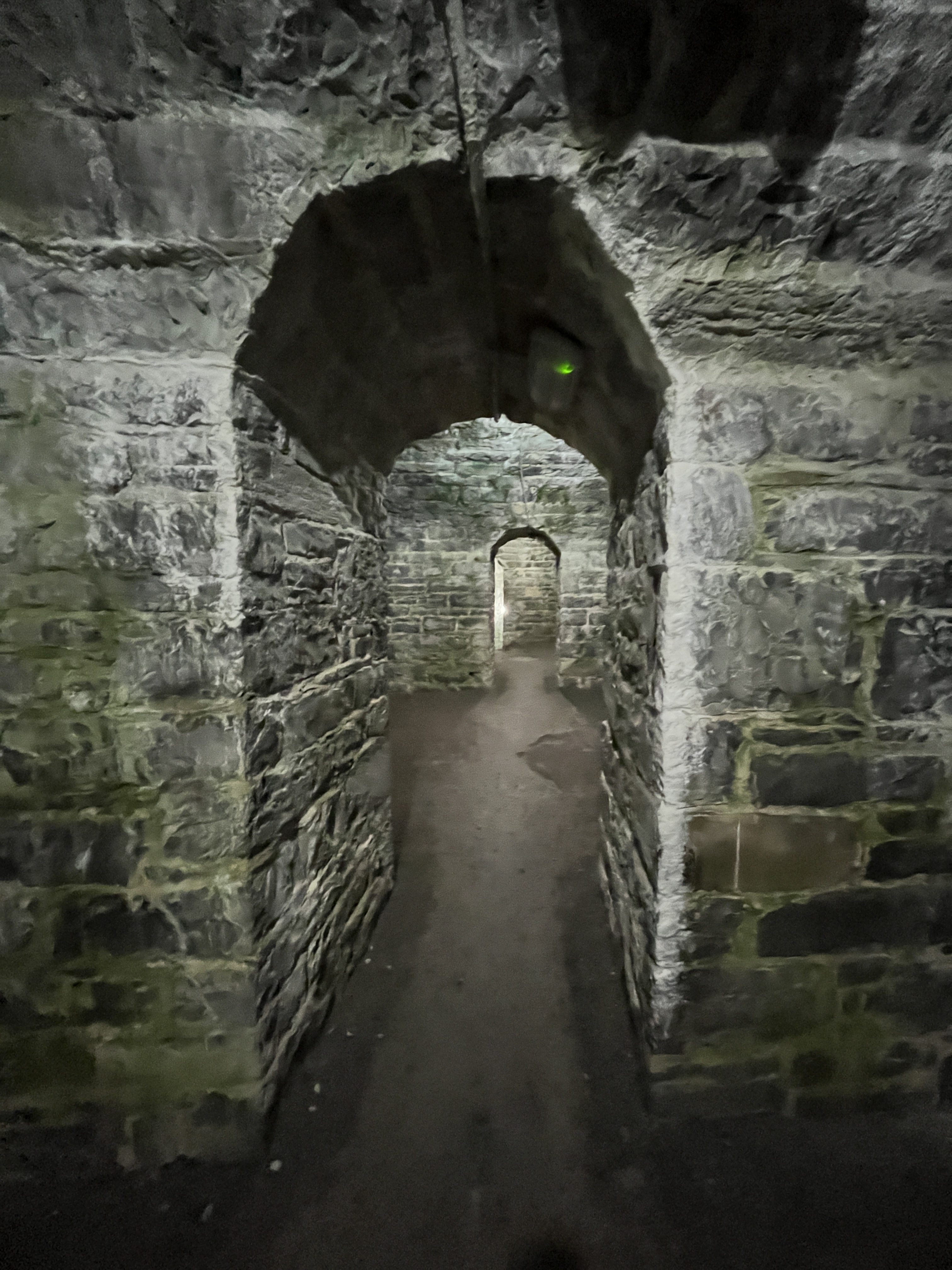
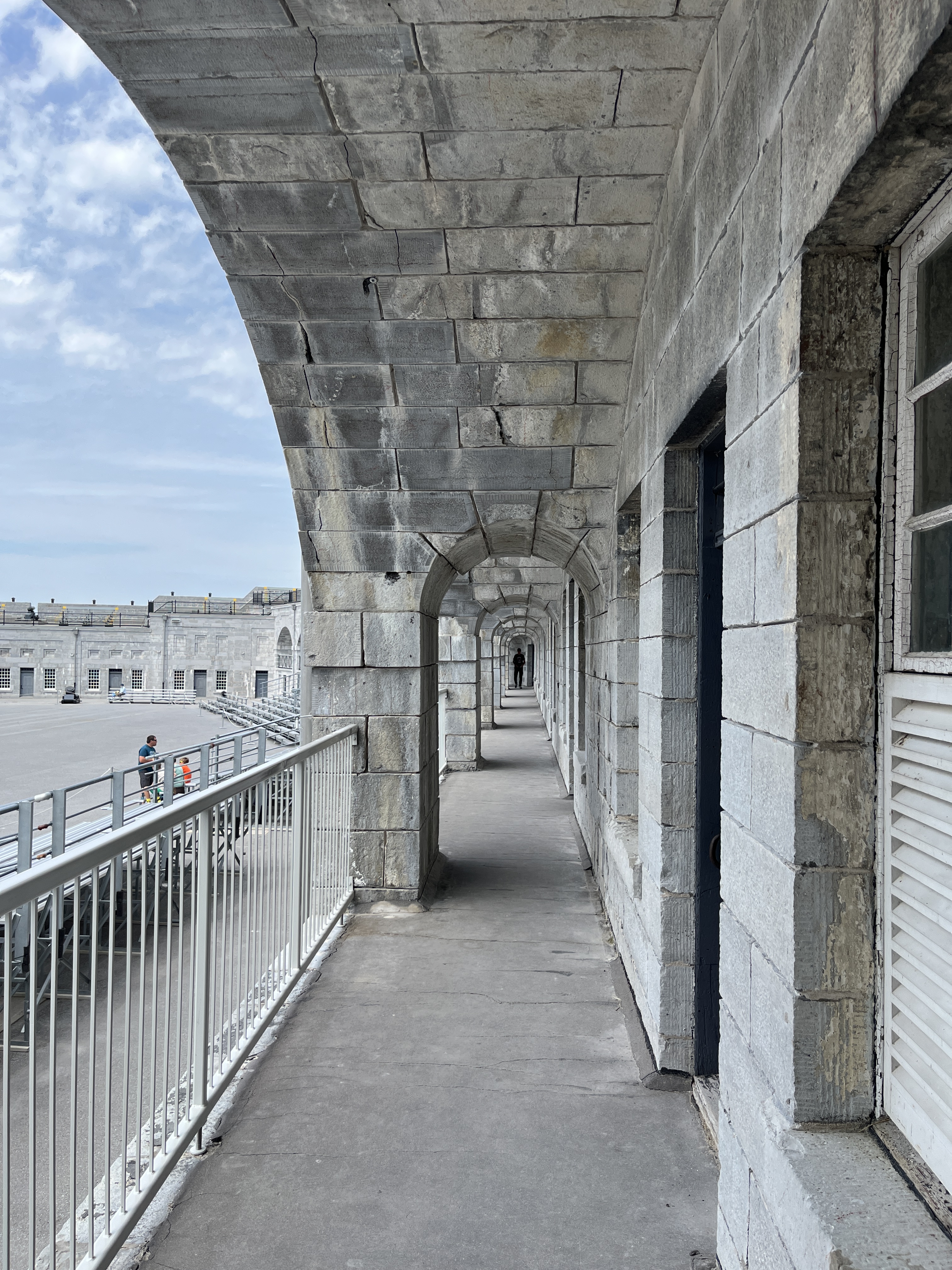
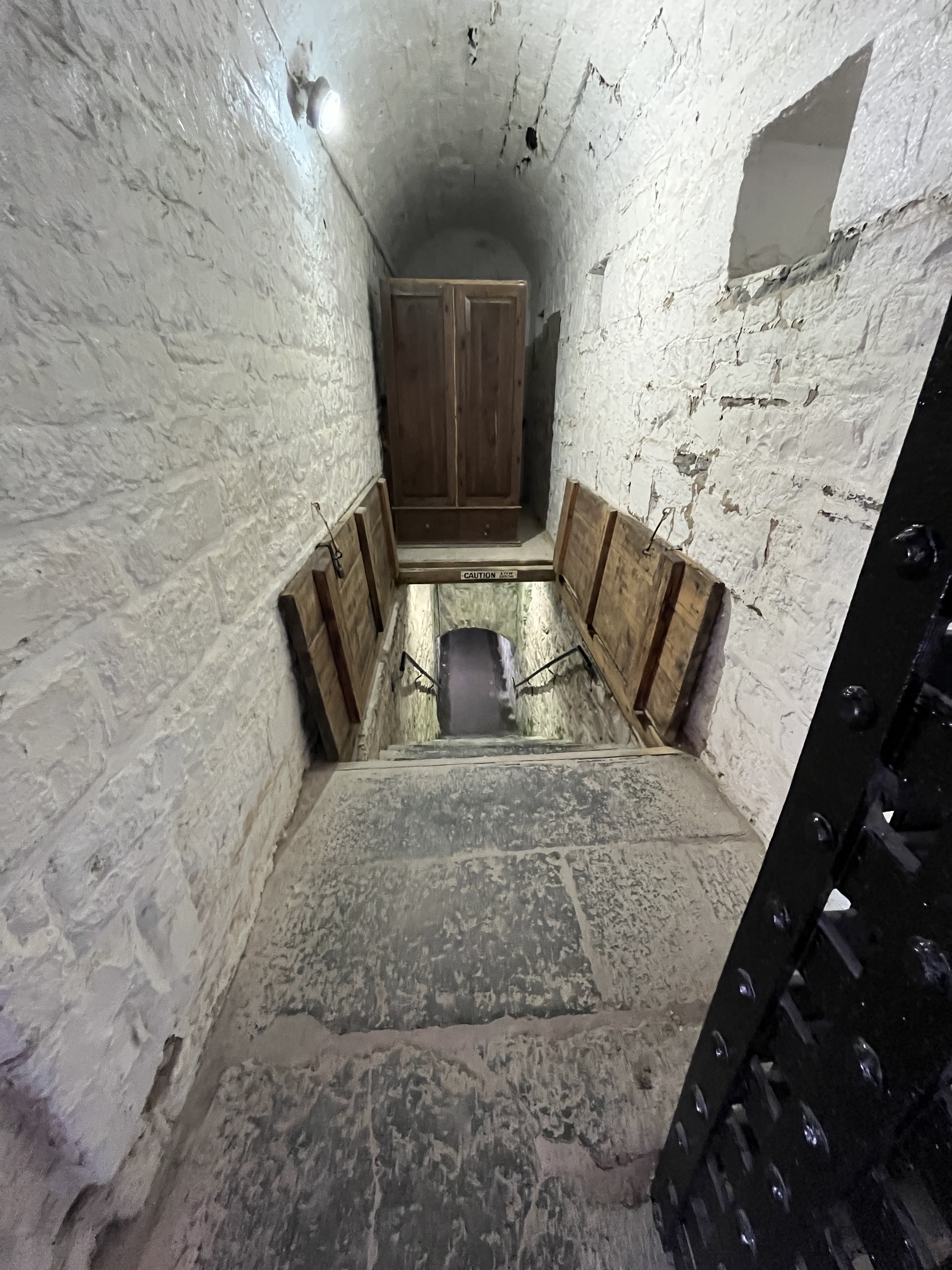
There are a series of tunnels through the walls which connect the guns on the roof to the soldiers quarters which were located on the second floor. They also connected the reverse fire chambers to the rest of the fort. The lower floor of the main building contained things like the officer’s quarters, cookhouse, schoolroom and bakery.

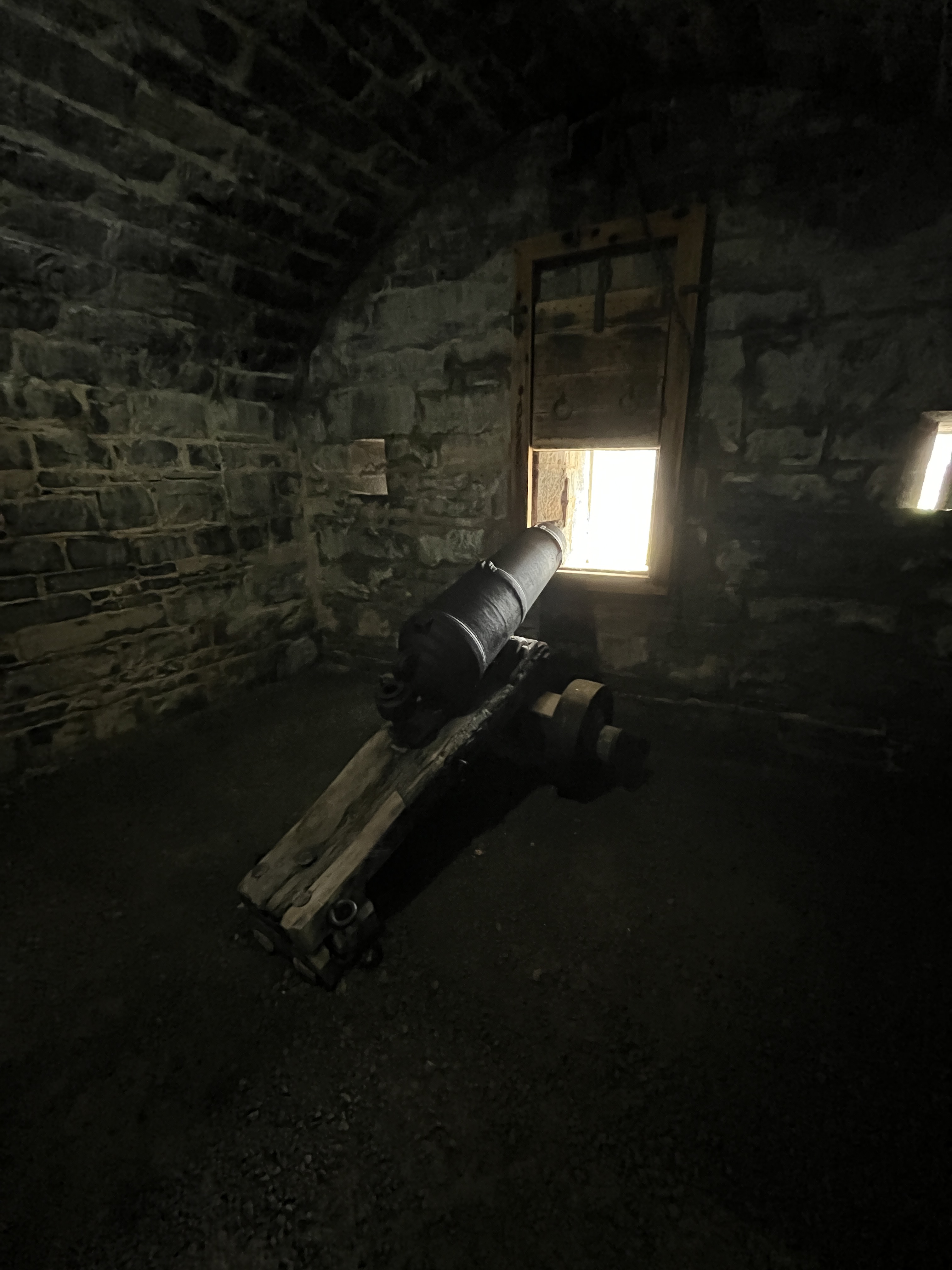
Hidden inside the north-west and north-east walls were reverse fire chambers. Each side had three gun ports that faced the redoubt’s walls. This meant that any attacker who tried to cross the dry ditch or scale the walls would face fire from 18-pounder cannonades.

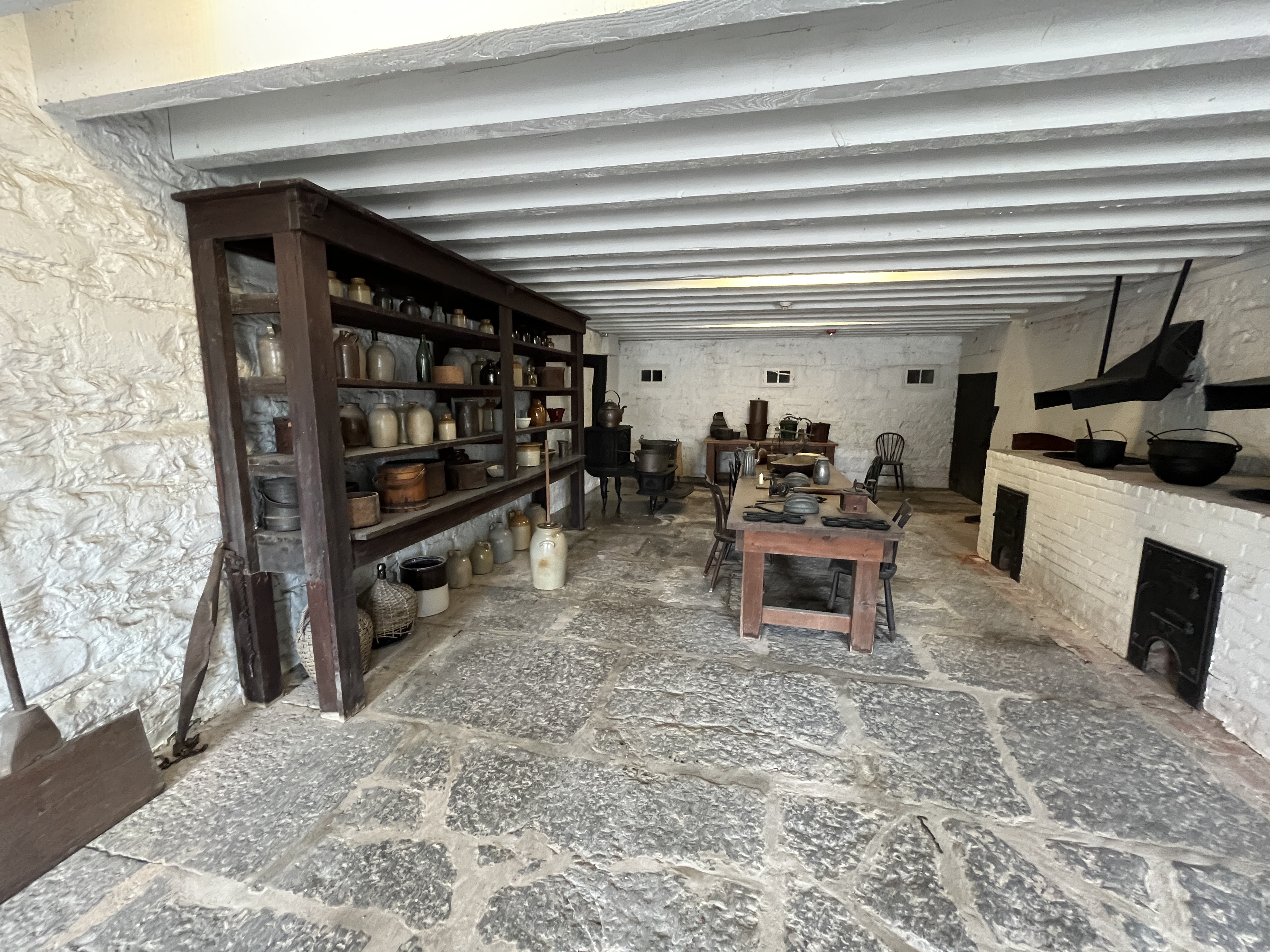
The cookhouse, along with the bakery, was set up to ensure that the soldiers could continue to be fed in the case of a siege. Each solder had a daily ration of about 1.5 pounds of bread, 1 pound of potatoes and 3/4 pound of meat. They also got rations of coffee, tea, sugar and beer or wine. A beef stew was the main meal that was prepared and unmarried soldiers took turns being the company’s cook. They took on a week’s duty but were often lacking in cooking skills and didn’t prepare the best of meals.

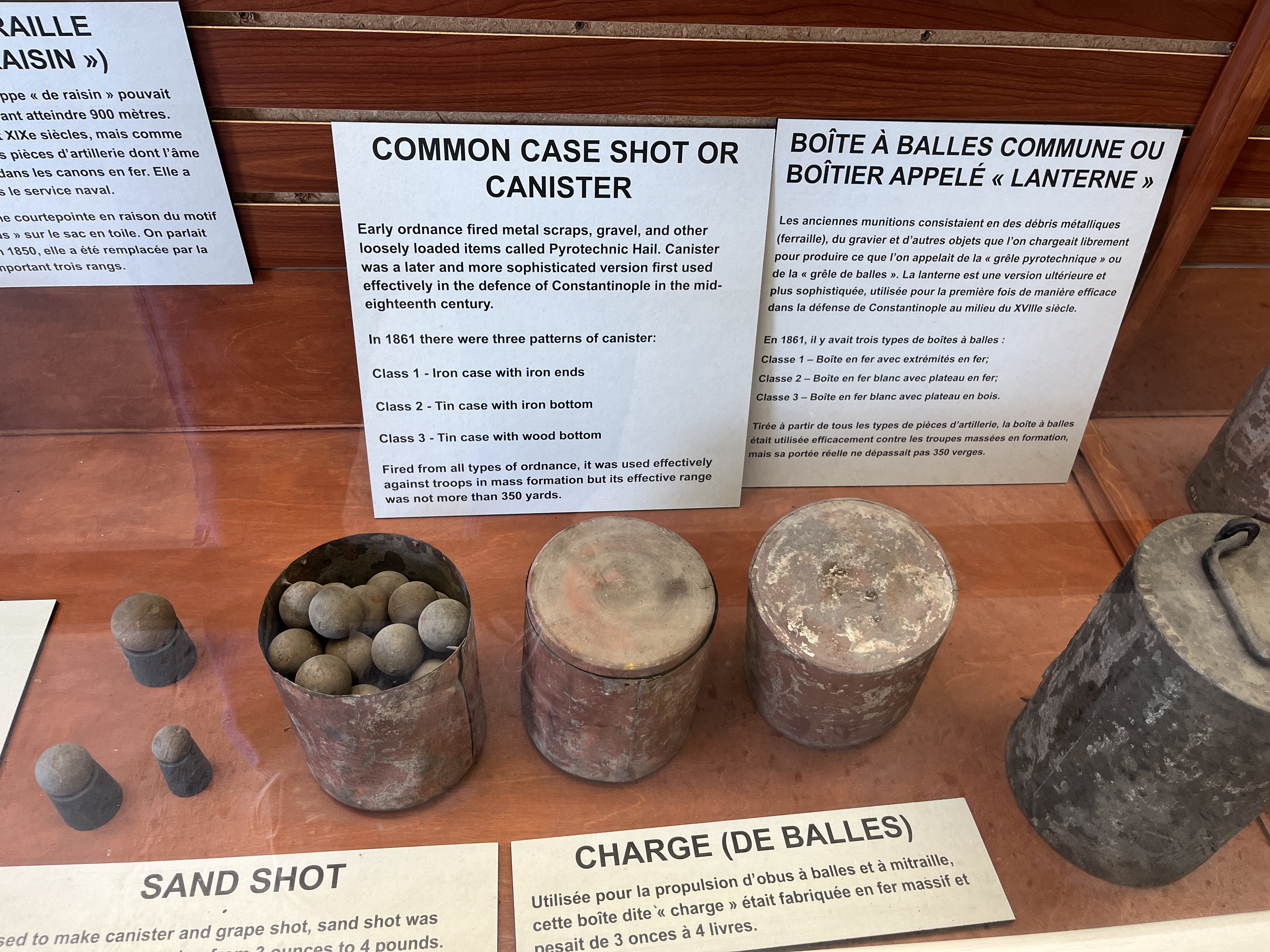
The balcony rooms on the second floor of the north wall originally housed the soldiers quarters but have been converted to display museum exhibits. These detail various parts of Fort Henry’s history including weapons that were typical of the British military of the period.

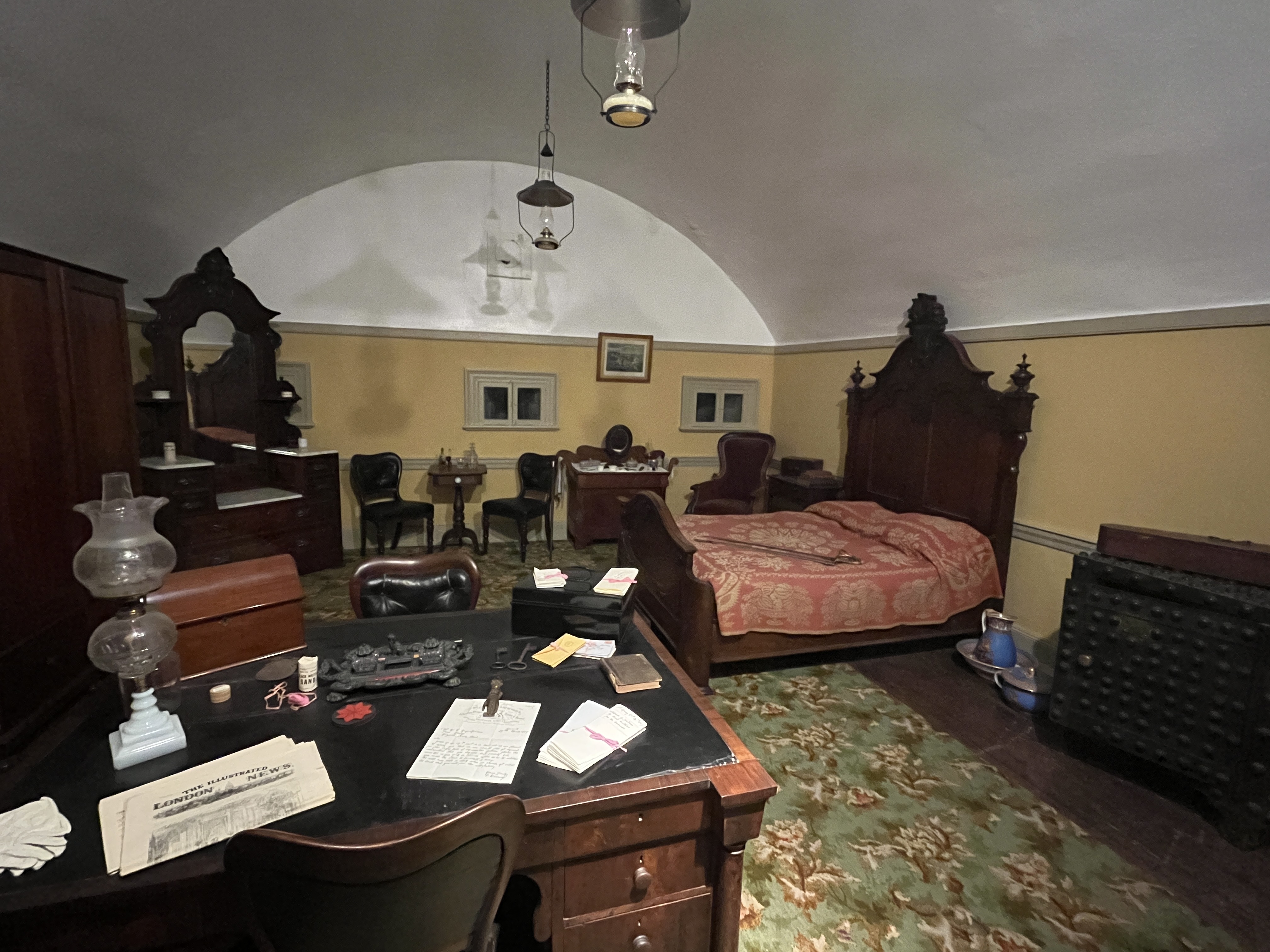
The Commandant’s quarters have been furnished to illustrate how the Captain who was responsible for running the daily operations of the fort lived. Their quarters also served as their office and a lot of paperwork was required. Important documents were tied in “red tape” and sent by military courier to headquarters in Quebec or on to England.

The museum exhibit that shows the weapons used over the decades is particularly interesting for anyone who is interested in the evolution of the methods of killing opposing soldiers.

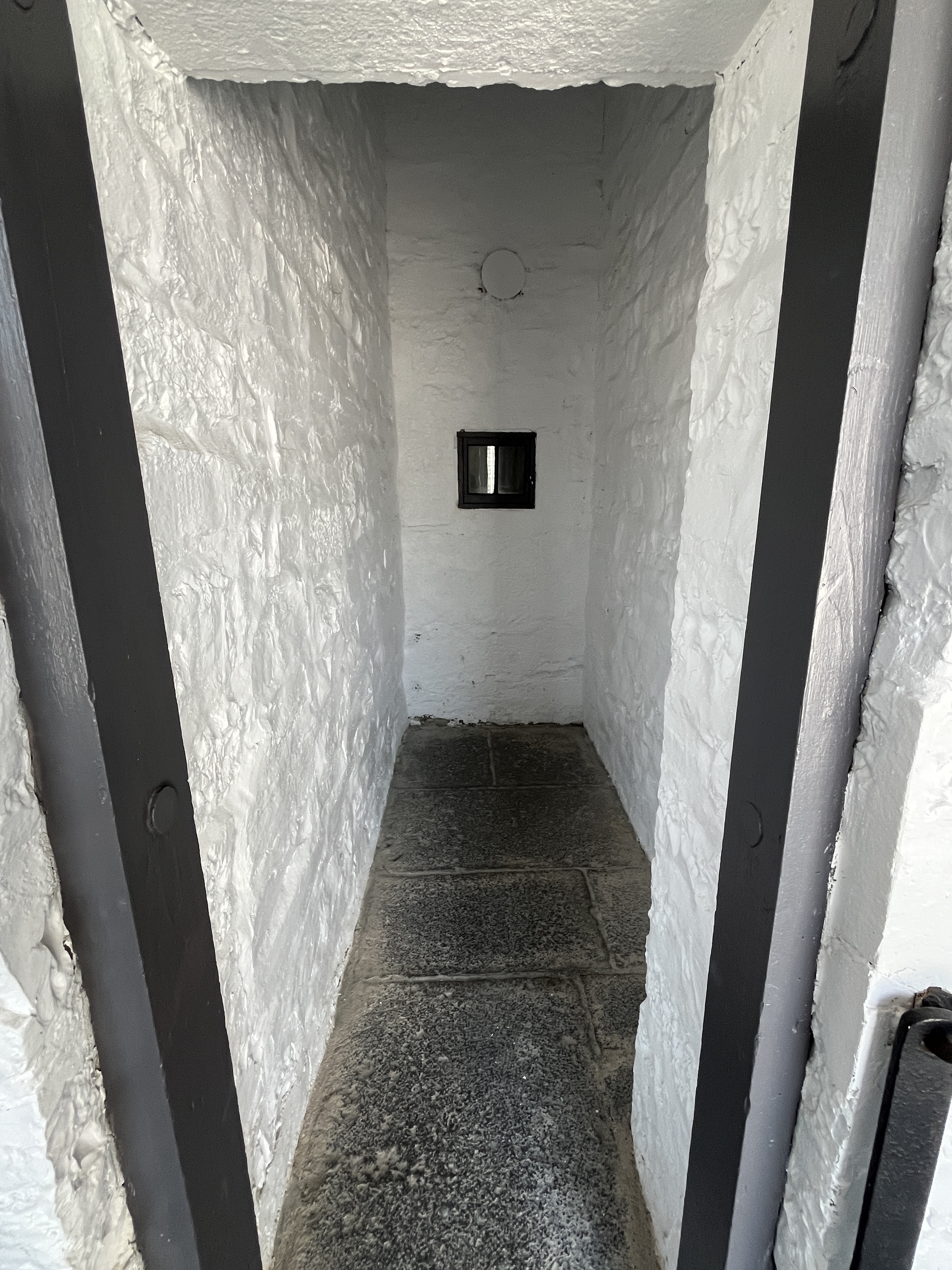
There are four sets of garrison cells that were used for punishment of soldiers. The most common offence was drunkenness. Soldiers could be locked up in these tiny cells which barely had enough room for them to lay down. Punishment might simply be confinement with short breaks for fresh air or it might also include hard labour. This would entail extra cleaning duties or possibly breaking rocks.

Fort Henry never saw active fighting during a war but was used as an internment camp during the rebellions of 1837-1838 as well as both World Wars. Shortly after the building was completed rebellions happened in both Upper and Lower Canada. A number of rebels in Upper Canada, including John Montgomery who owned the tavern where they met, were arrested and found guilty of treason. They were sent to Fort Henry to await their sentencing, either death or exile. Montgomery and 14 others were made aware by a sympathizer of the tunnels that led through the walls to the reverse fire chambers. After removing the mortar between some of the stones in a sealed up doorway, the 15 men made their escape on the night of July 29, 1838. In the darkness Montgomery fell into the drop ditch and broke his leg but was able to get away. Two prisoners were recaptured but the other 13 made their way along the river toward Gananoque and stole boats with which they rowed across the river to the United States. When amnesty was declared in 1843 Montgomery and several others returned to Upper Canada. You can read more about the rebellions in our story on William Lyon Mackenzie.

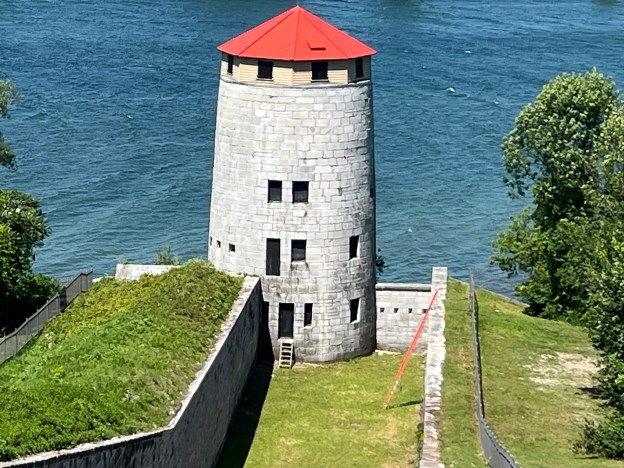
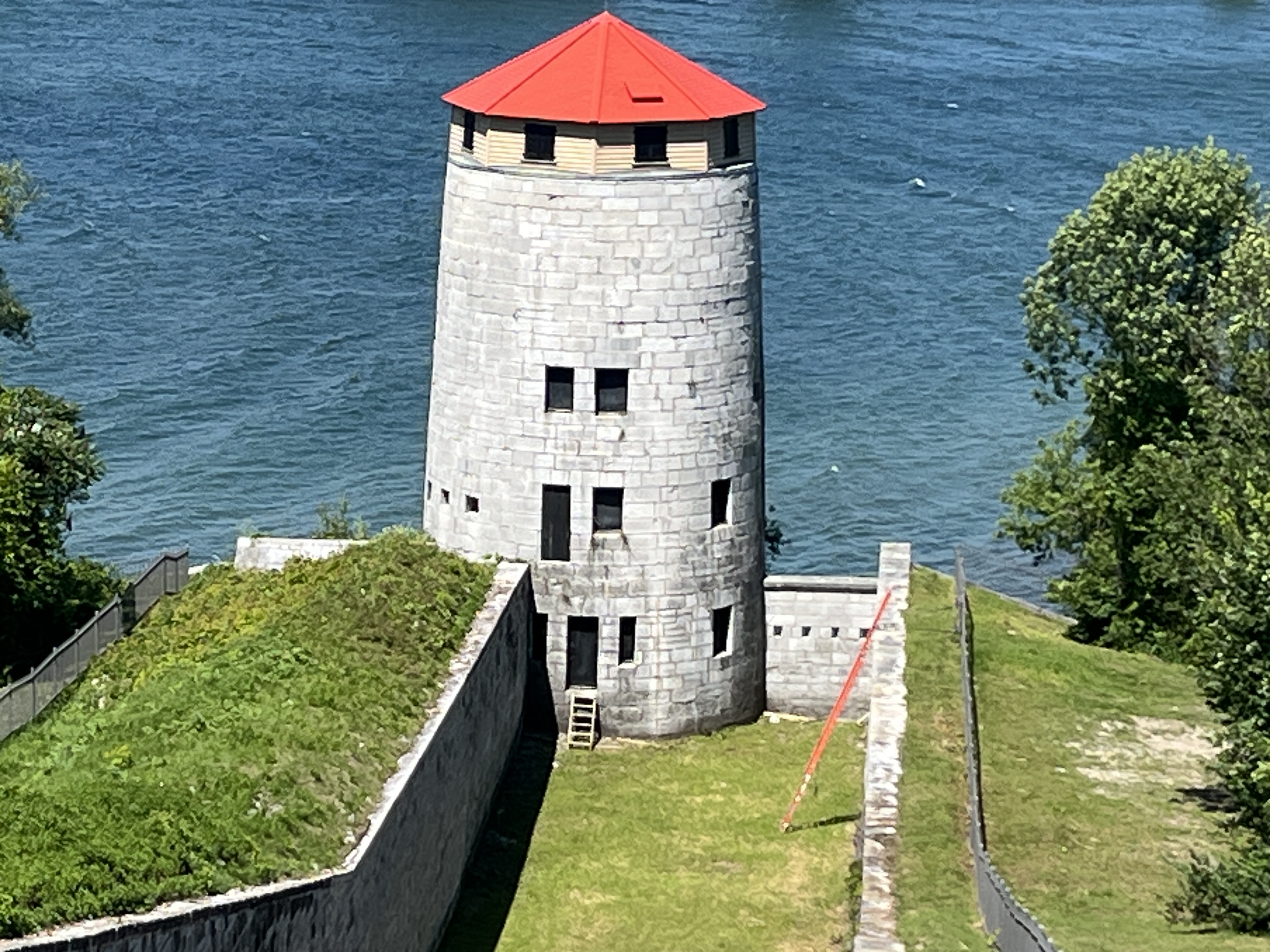
Four Martello Towers were built in Kingston, two of which can be seen from Fort Henry. In addition, two tall, thin towers were built on the ends of the dry ditches. These towers were added between 1842 and 1848. The towers were built within sight of each other so that they could pass signals between them. The pointed roof could be removed quickly providing access to a cannon that could swivel giving it a 360 degree range. The image below shows the dry ditch tower on the Navy Bay side of the fort.

Fort Henry is a National Historic Site and has served as a museum since August 1, 1938. It is well worth a visit if you are in the Kingston area.

Related Stories: Fort York, William Lyon Mackenzie

Google Maps Link: Fort Henry

Like us at: http://www.facebook.com/hikingthegta

Follow us at http://www.hikingthegta.com
Kincardine Lighthouse

June 29, 2024

It was the spring of 1848 when Captain Alexander M MacGregor took shelter at the mouth of the Penetangor River in his schooner named The Fly. It wasn’t a very sheltered spot but it soon became settled and the population grew. A thriving fishing industry developed and soon local salt was being shipped out of the harbour as well. A pier was built and in 1874 a square lighthouse was constructed on the end of it. The image below is taken from online and shows the original lighthouse on the pier. I spent two nights in Kincardine while doing some work in Tiverton and had the chance to explore the harbour area after enjoying a nice meal at The Bruce.

In 1880 a new lighthouse was built into the embankment a little further inland. A two-storey home was built as a base and this is where the lighthouse keeper lived. The octagonal tower that rose above the base stands 24.4 metres (74 feet) tall.

The job of the lighthouse keeper was to ensure that the lantern was kept lit. He had to climb up the 69 steps carrying kerosene and wind the mechanism to keep it running. In 1910 a twelve sided, Fourth Order Fresnel lense was installed which was visible for 30 kilometres. Then, in 1922 the kerosene lantern and foghorn were replaced with electric power. This made the job of the lighthouse keeper much easier. Finally, it was automated in 1970. Today the lighthouse serves as a marine museum.

The salt industry in Kincardine was a significant in the late 18th century and a driving force for the building of the lighthouse. The image below from the Bruce County Museum shows Rightmeyer’s Salt Block on the left with the lighthouse showing in the background. Levi Rightmeyer built his salt industry in 1871 and it was the third in the community. He evaporated brine to make salt which he sold to pork packing industries in Chicago and Milwaukee. The salt blocks slowly closed with Rightmeyer’s being the last one. It closed around 1900 and the buildings were later destroyed by fire. The site is now home to the tennis courts and children’s playground.

As the fishing and salt industries declined the harbour shifted from industry to recreation and is now used as a marina for personal pleasure craft. There are slips for 150 boats in the marina.

The piers in Kincardine are over 150 years old and have recently undergone restoration. The south pier is used for swimming from with people jumping in the water as I was walking around taking pictures for this post.

Some people will be asking themselves what Kincardine has to do with the GTA. Well, the trail that runs along the shore of Lake Huron is part of the Great Lakes Waterfront Trail and you can walk here from Toronto. The trail is over 3600 kilometres long and runs along four Great Lakes. It connects 170 communities, villages and First Nations and passes through 520 waterfront parks. One of which is in Kincardine. As you can see from the trail map below, it would take quite some time to complete the walk from Toronto to Kincardine.

The trail along the waterfront has been planted with many gardens and flowers. There’s an extensive area of milkweed which was attracting many Monarch Butterflies. They were a little shy and wouldn’t sit still to get their picture taken.

The boardwalk has been engraved with many names, some of whom are listed in memory of those who have passed before us.

There are sandy beaches on both sides of the marina but I was only able to explore the north beach because it rained on the second night of my visit. The south beach has historic plaques and attractions which will have to wait for another visit.

Kincardine has an extensive and growing network of trails. After visiting the lighthouse, marina and northern beach I took the trail that follows the river and ended up at Queens Lookout Park on Queen Street.

For those wishing to explore Kincardine there are many historic buildings and museums to visit. There is also a set of trail maps that can be found at www.kincardinetrails.net

Google Maps link: Kincardine Lighthouse

Like us at http://www.facebook.com/hikingthegta

Follow us at http://www.hikingthegta.com
Also, look for us on Instagram.

Mississauga’s First Gas Station

June 22. 2024

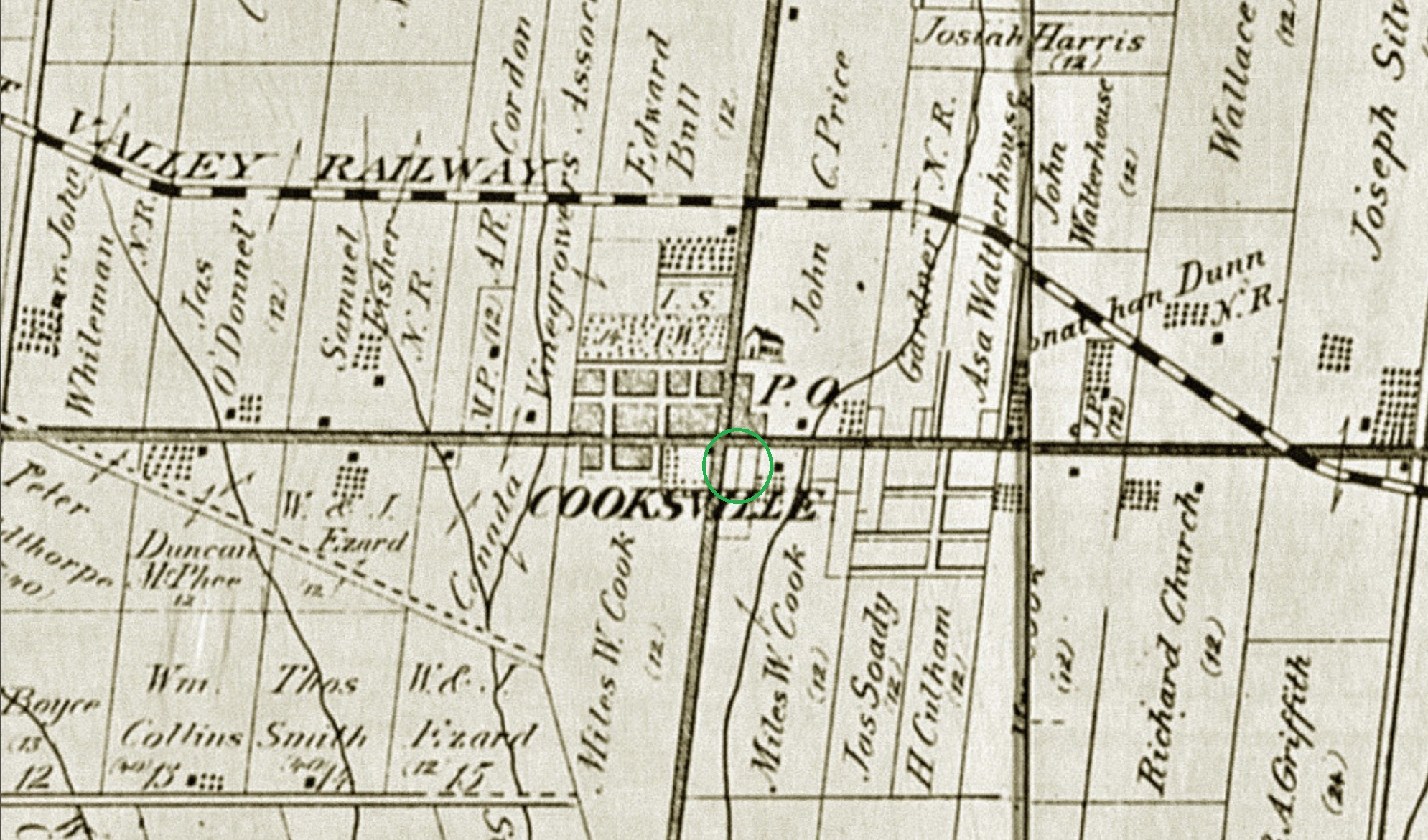
The original town of Cooksville is basically history and exists in name only. It has been absorbed and overrun by the city of Mississauga. It started when Daniel Harris arrived in 1807 and the community was originally named Harrisville. It was a stagecoach stop on the Dundas highway which had been carved out of the forest based on a 1798 road survey. A store was located on the south east corner of the modern intersection of Dundas Street and Hurontario street as early as 1809. The town grew around the intersection and had a hotel as well as a blacksmith shop and a few dozen residents.

The map below was taken from the County Atlas of 1877 and shows how small Cooksville was at the time. The site of the store is shown circled in green on the south east corner of the main intersection in town.

The name of the town was changed to Cooksville in 1836 after prominent resident and landowner Jacob Cook. On May 26, 1852 a fire broke out in Belcher’s Blacksmith Shop. By the time it was finished, 35 houses and businesses, 16 barns and 4 stables had been destroyed. Including the original store on the corner.

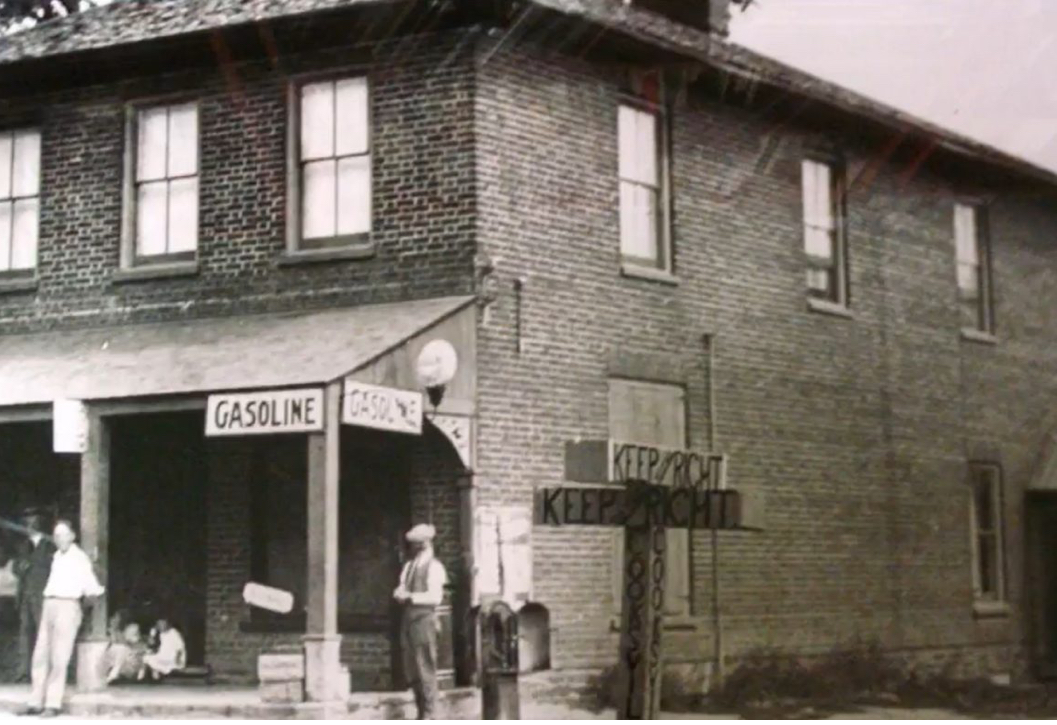
The archive photo below was taken from InSauga News and shows the store as it appeared during its days as a gas station. The sign on the post reads “Keep Right” and “Cooks”.

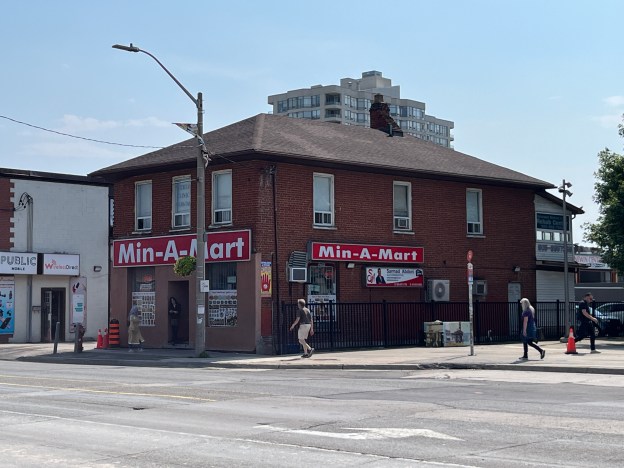
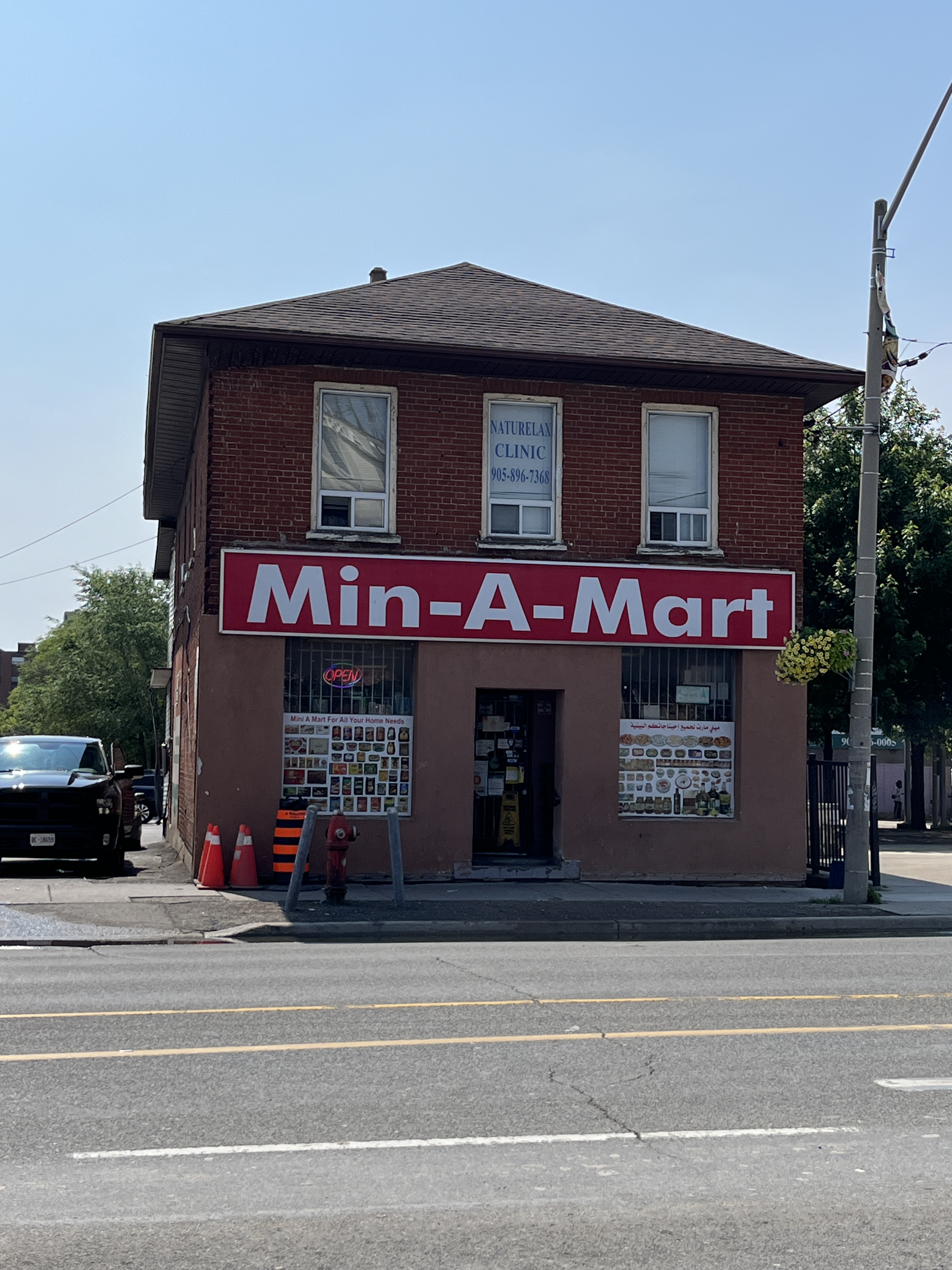
The store was rebuilt of red brick and has survived as a business building ever since making it one of the oldest commercial buildings in Mississauga. Jacob Cook ran the store, and several other enterprises, until he passed away in 1873. His son, Miles Washington Cook, rented the store to George and John McClelland who operated it. After George married Jacob Cooks great niece Anna Langdon he bought the store and the couple lived in the apartment above it. In 1910 they sold it to Alfred Scott and it became Scott’s Grocery. It was Scott who had a gas pump installed in 1911 to service the growing need for petroleum for the automobile industry. This was the first gas pump in the area that has become Mississauga. This was just three years after the Model T was invented by Henry Ford.

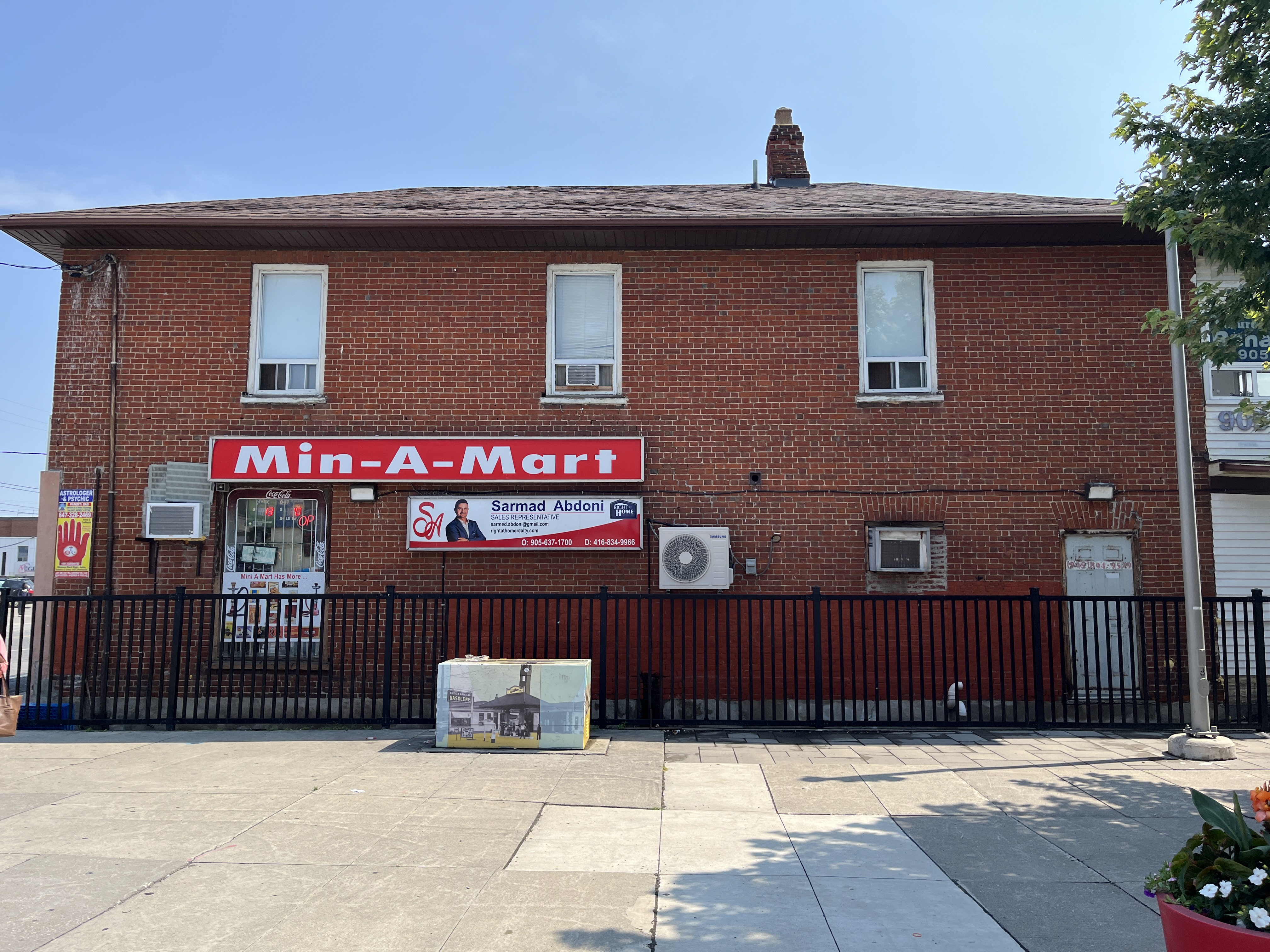
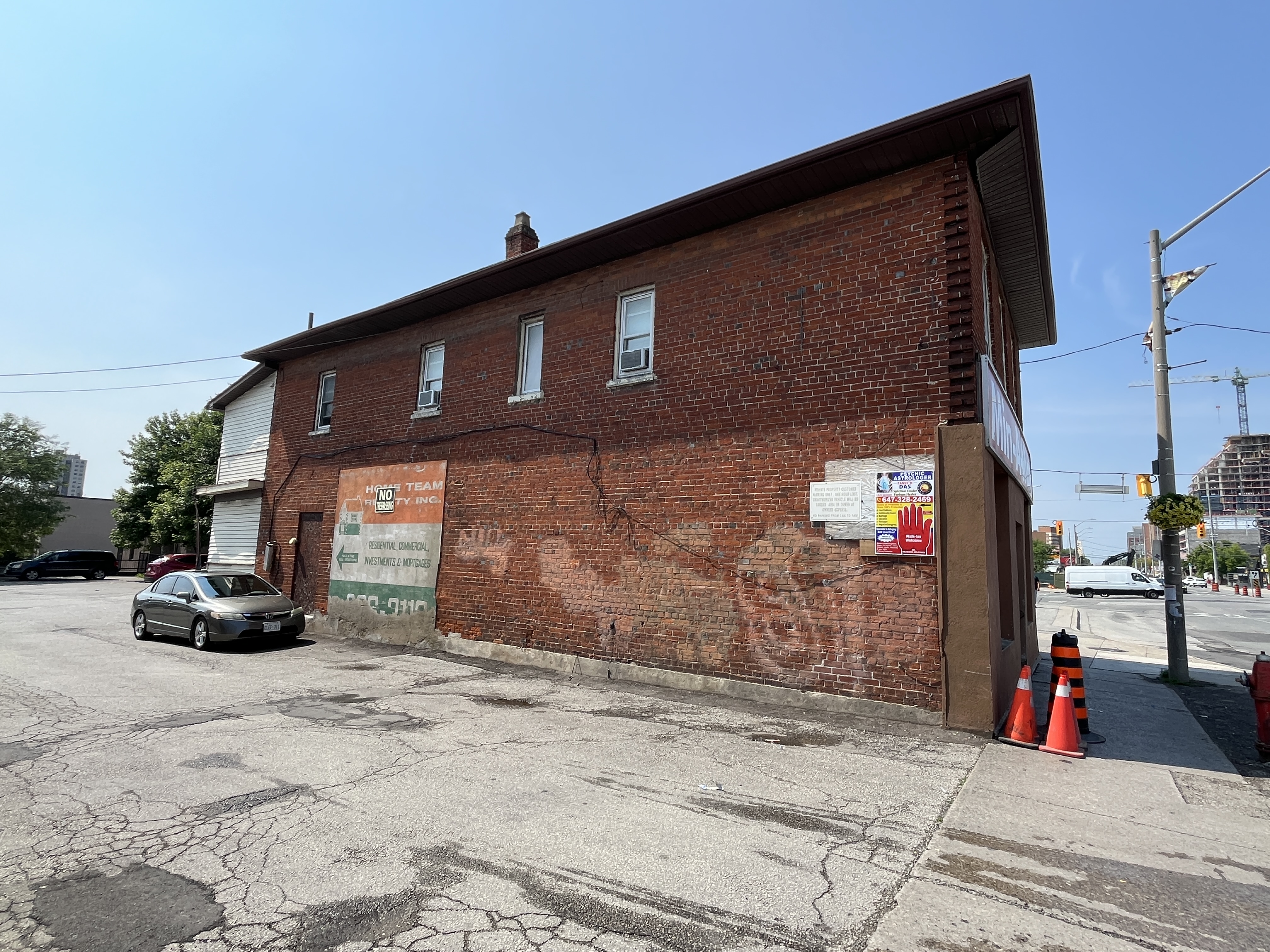
The store was sold to William Copeland in 1912 and renamed Copeland’s General Store and he operated this business until 1922 when he sold the gas station to the British American Oil Company. The store was moved 80 feet to the east by sliding rails under it and pulling it with horses and the grocery business was continued in the new location. When William died in 1948 the business was taken over by his son Charles who ran it along with his sisters.

The oldest building in Cooksville continues its existence in use as a variety store which is appropriate considering the variety of commercial uses it has had over the years.

Related Stories: Toronto’s Model T Factory

Google Maps Link: Cooksville

Like us at http://www.facebook.com/hikingthegta

Follow us at http://www.hikingthegta.com
Also, look for us on Instagram

Eyer Homestead

June 15, 2024

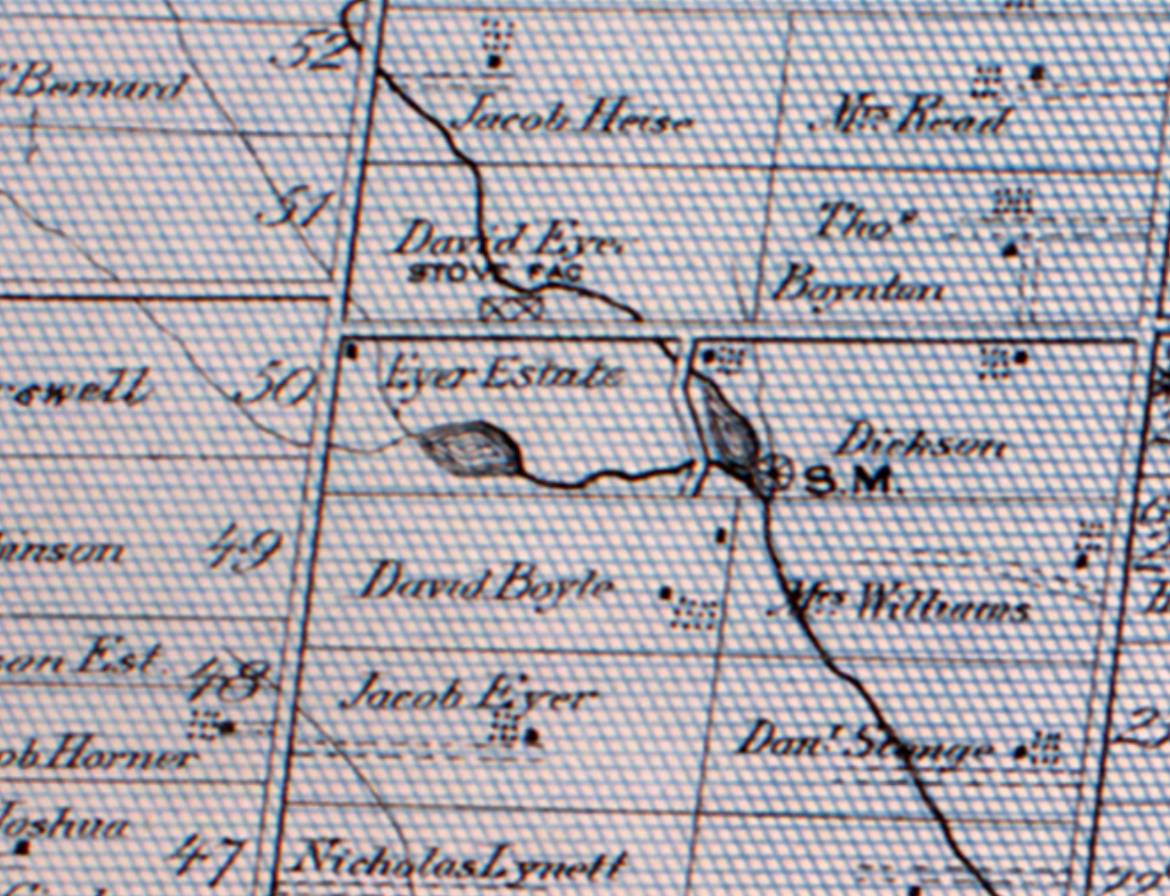
John Eyer moved from Pennsylvania to Richmond Hill in 1803 and bought a parcel of land that had two branches of the headwaters of the Rouge River flowing through it. It had the ideal location for a sawmill and so his son David Eyer opened one in 1825. He added a foundry and a farm implement factory in 1868. Tragedy struck in 1881 when a fire destroyed the foundry and the agricultural implements factory. The image below is from the 1878 County Atlas and shows the Eyer Estate as well as David Eyer’s property. A stove factory is shown on David’s property while the sawmill is located at the bottom of the mill pond on the estate.

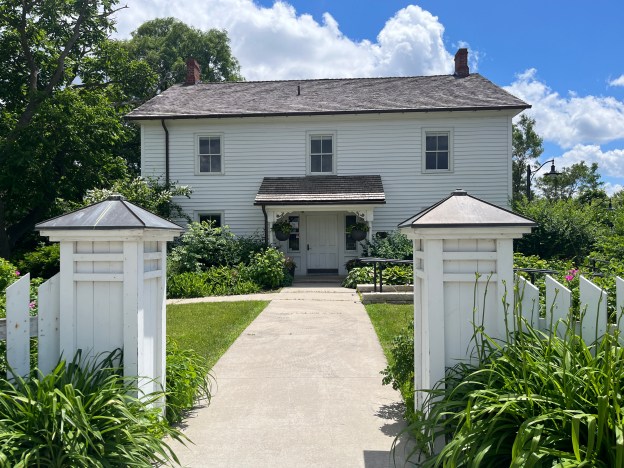
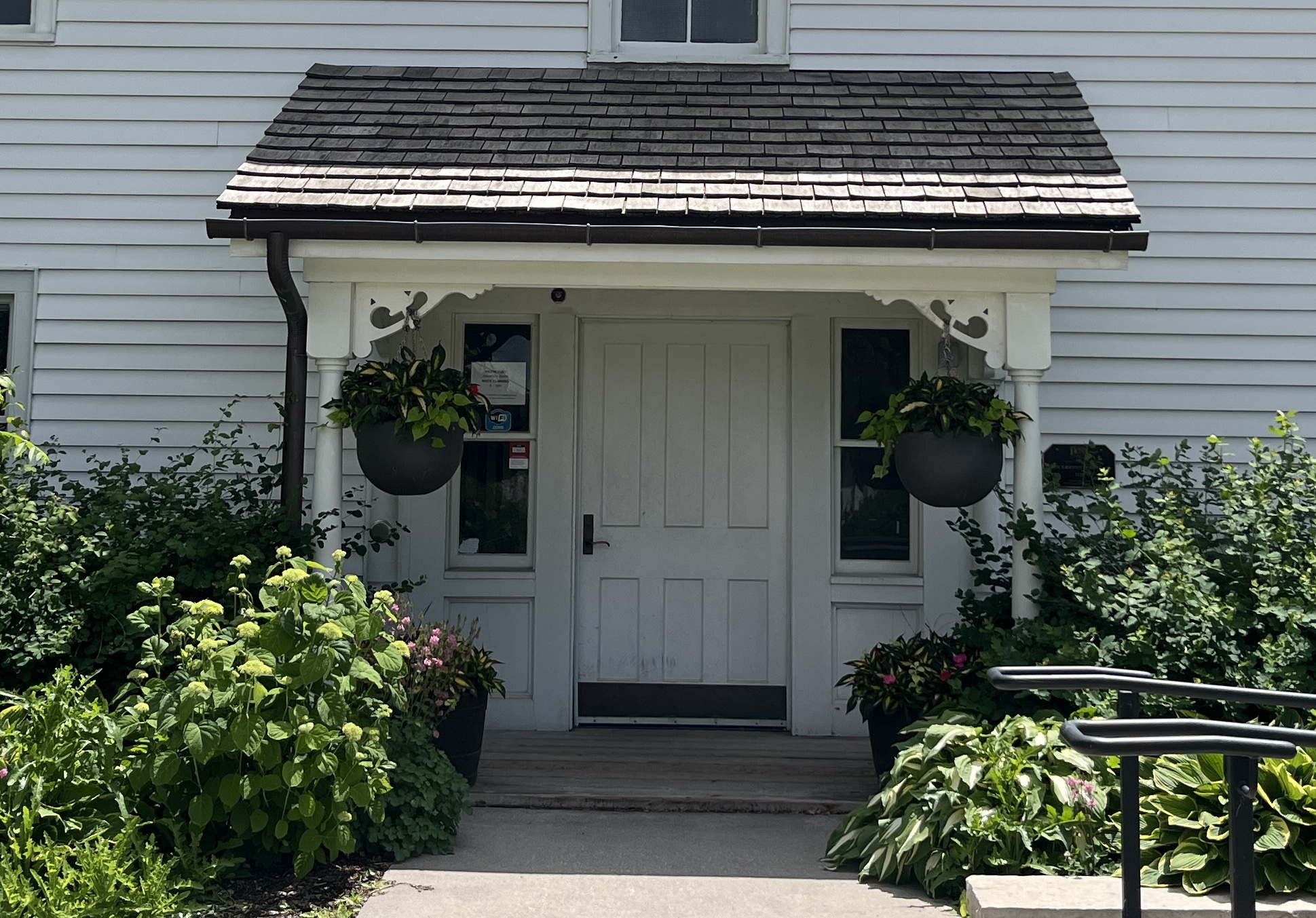
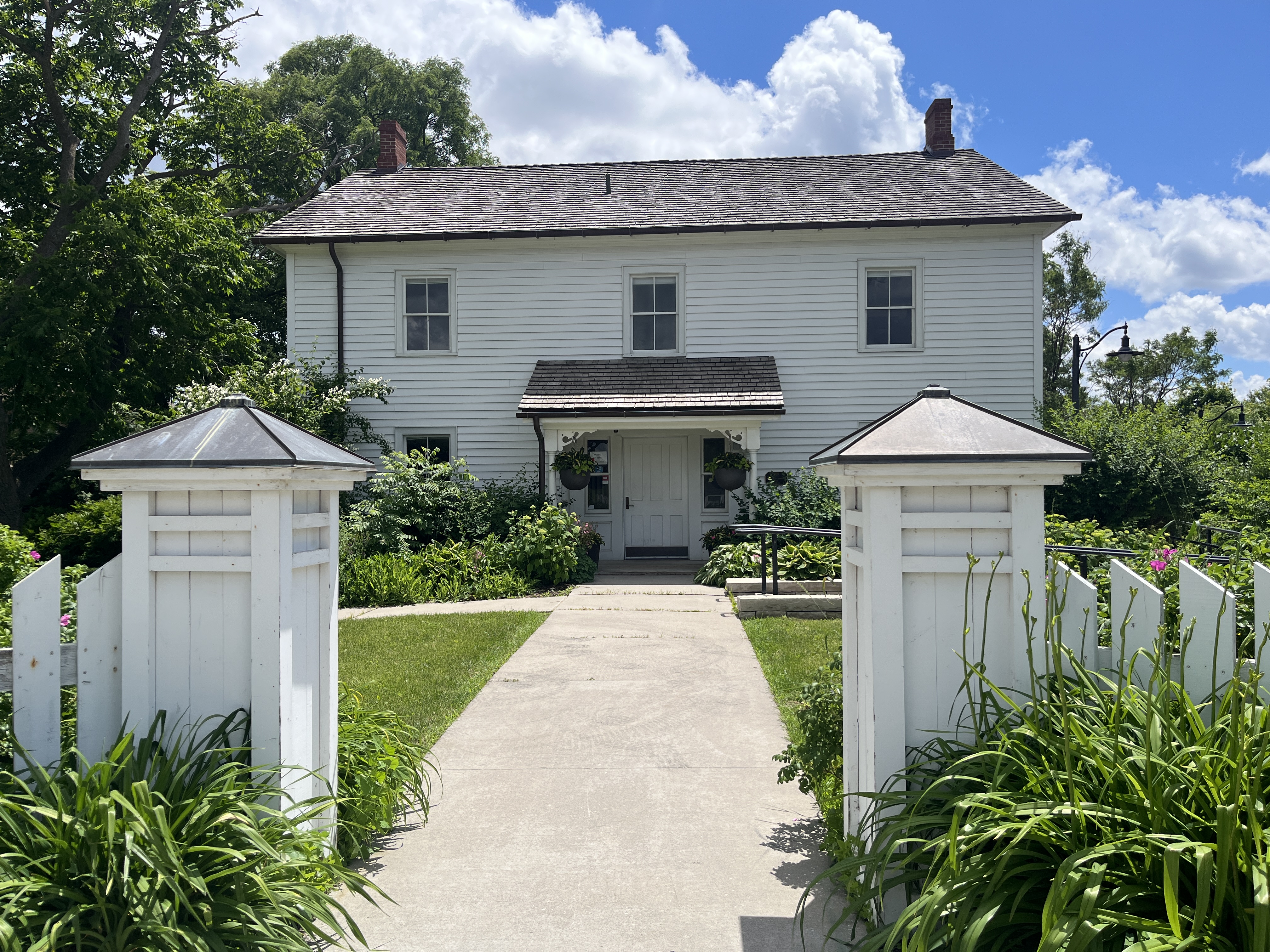
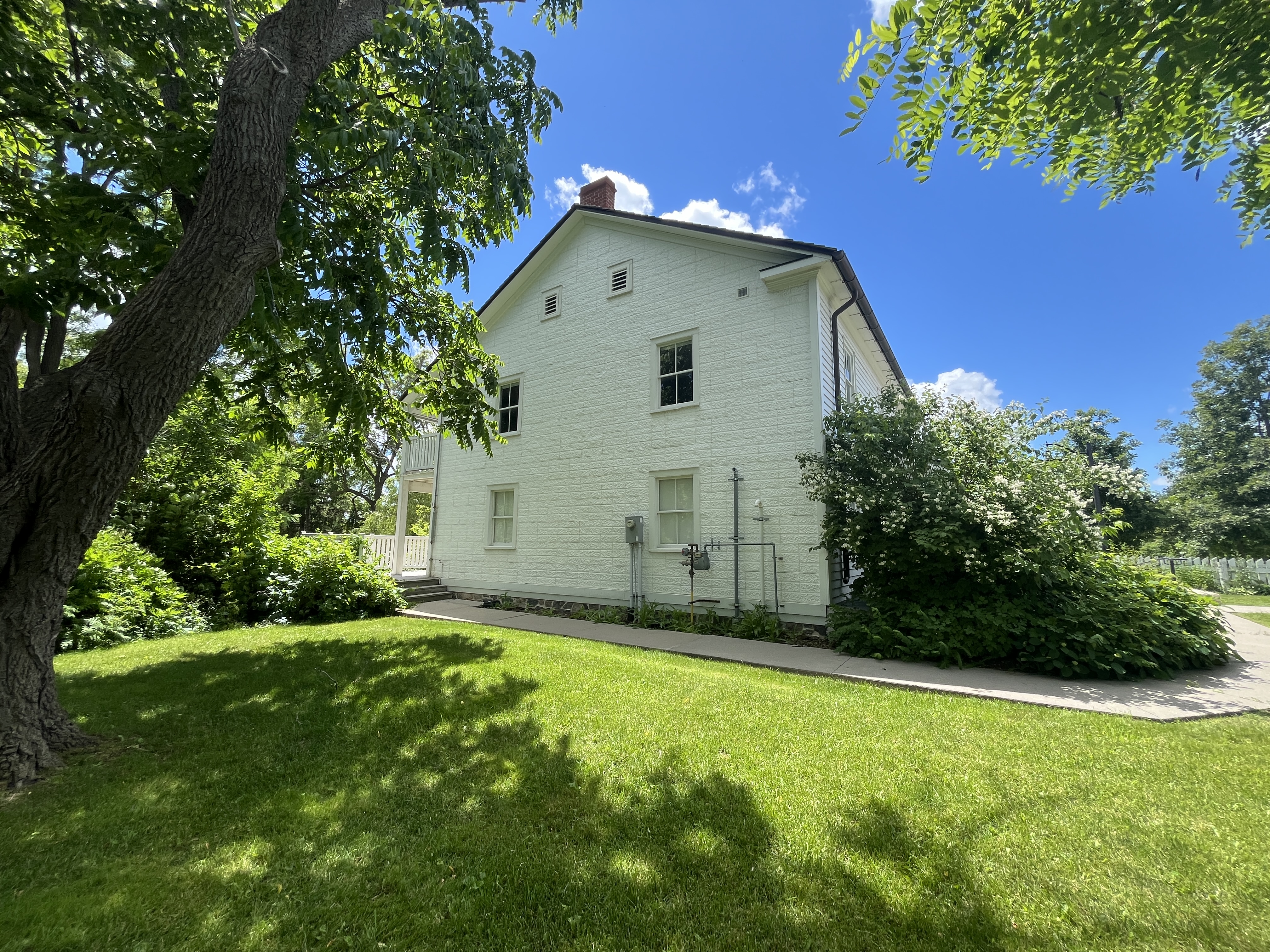
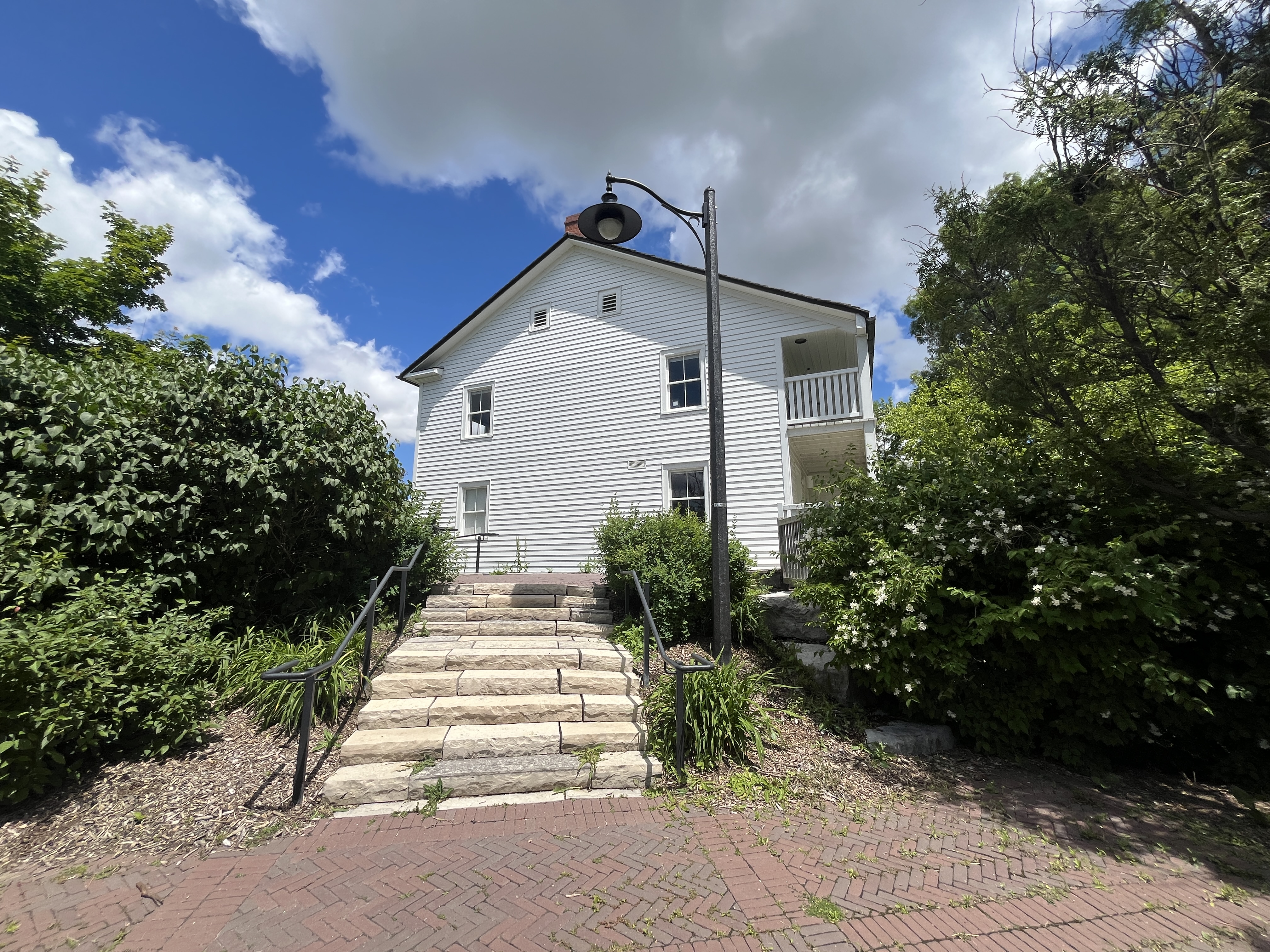
The house was built in 1828 according to the date carved in beam in the attic. The records indicate that David built the house for his parents. There is a large front door with six panels and side lights.

There are two kitchens in the basement which suggests that David and his family lived here along with his parents. The Mennonite tradition would have the two families living together in one house in separate quarters. There is no house shown David’s property on the map above.

The exterior of the house is designed in the Georgian style. This was likely borrowed from the English neighbours they had in Pennsylvania. The fireplaces have an angular design which would have been borrowed from the Swedish settlers in Pennsylvania.

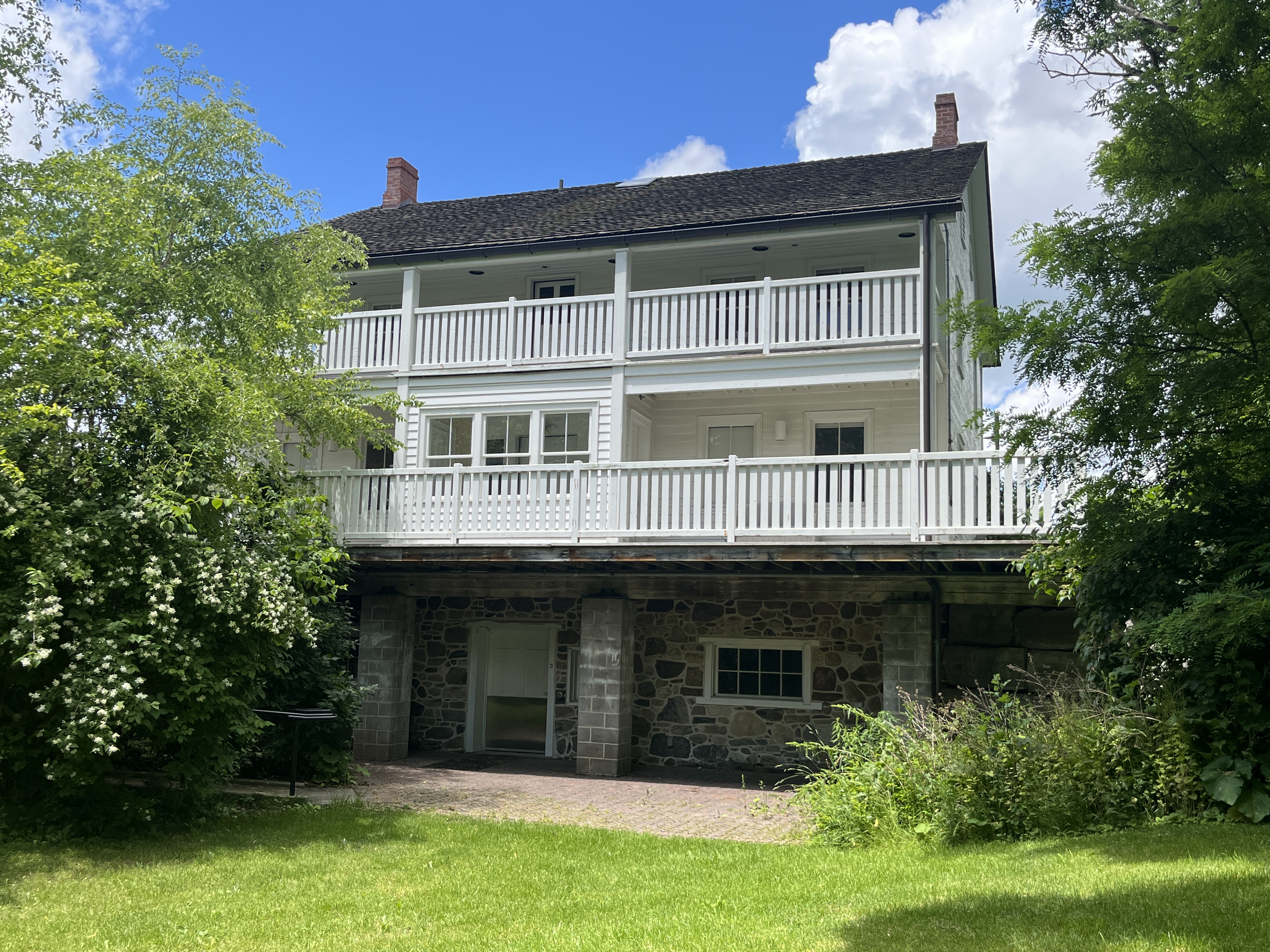
The rear elevation of the house shows two levels of verandas as well as the walkout from the basement.

The Eyer family lived in the house until 1907 when it was sold to the Wideman family. Three generations of Widemans lived in the home until 1965. All the other buildings that used to exist on the property have been lost but the house remains. It is the oldest example of a Mennonite home in Richmond Hill.

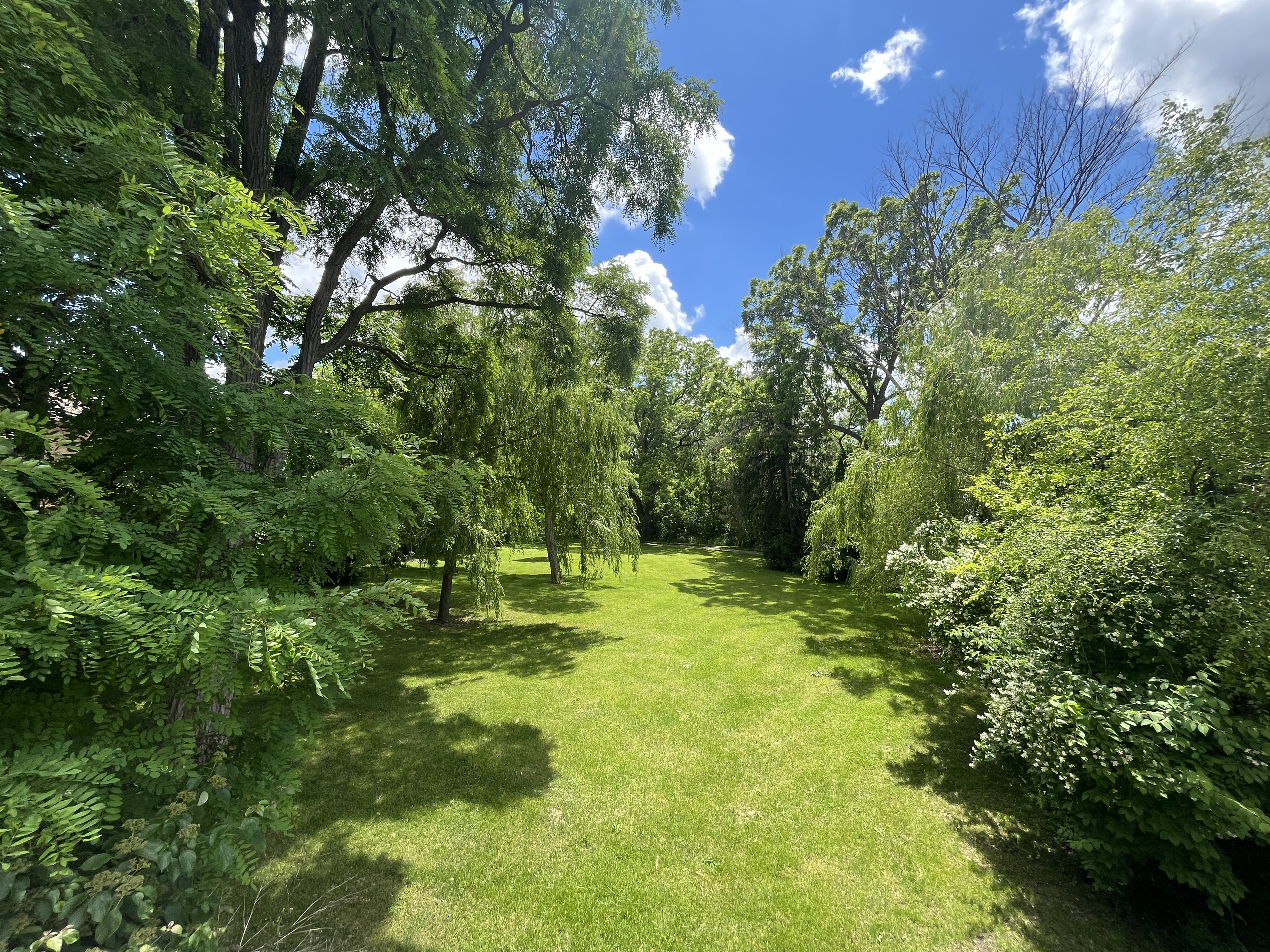
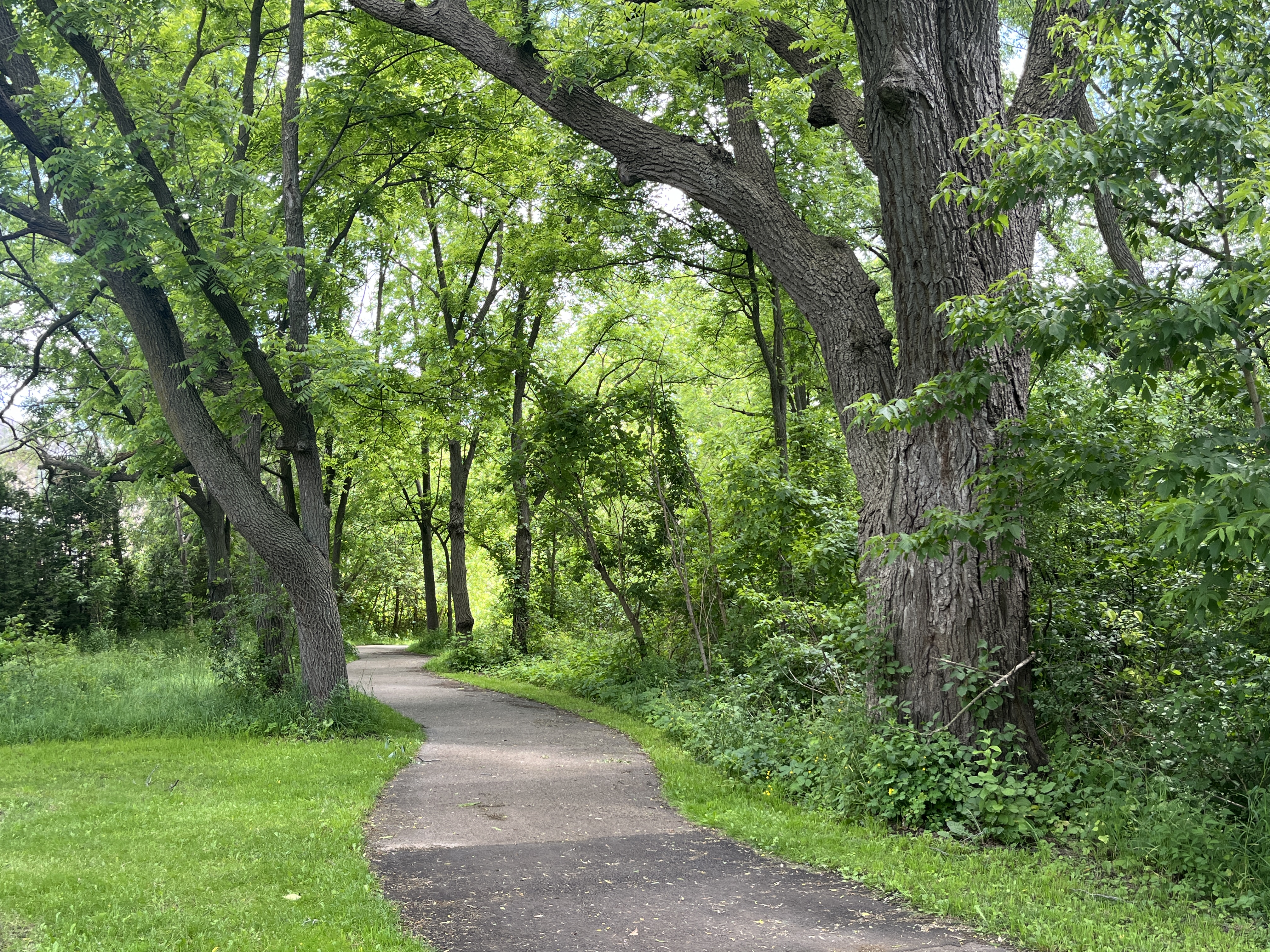
The back yard has been turned into a 1.75 acre park. It is nicely landscaped with mature trees.

A series of paved trails makes its way along the side of the river.

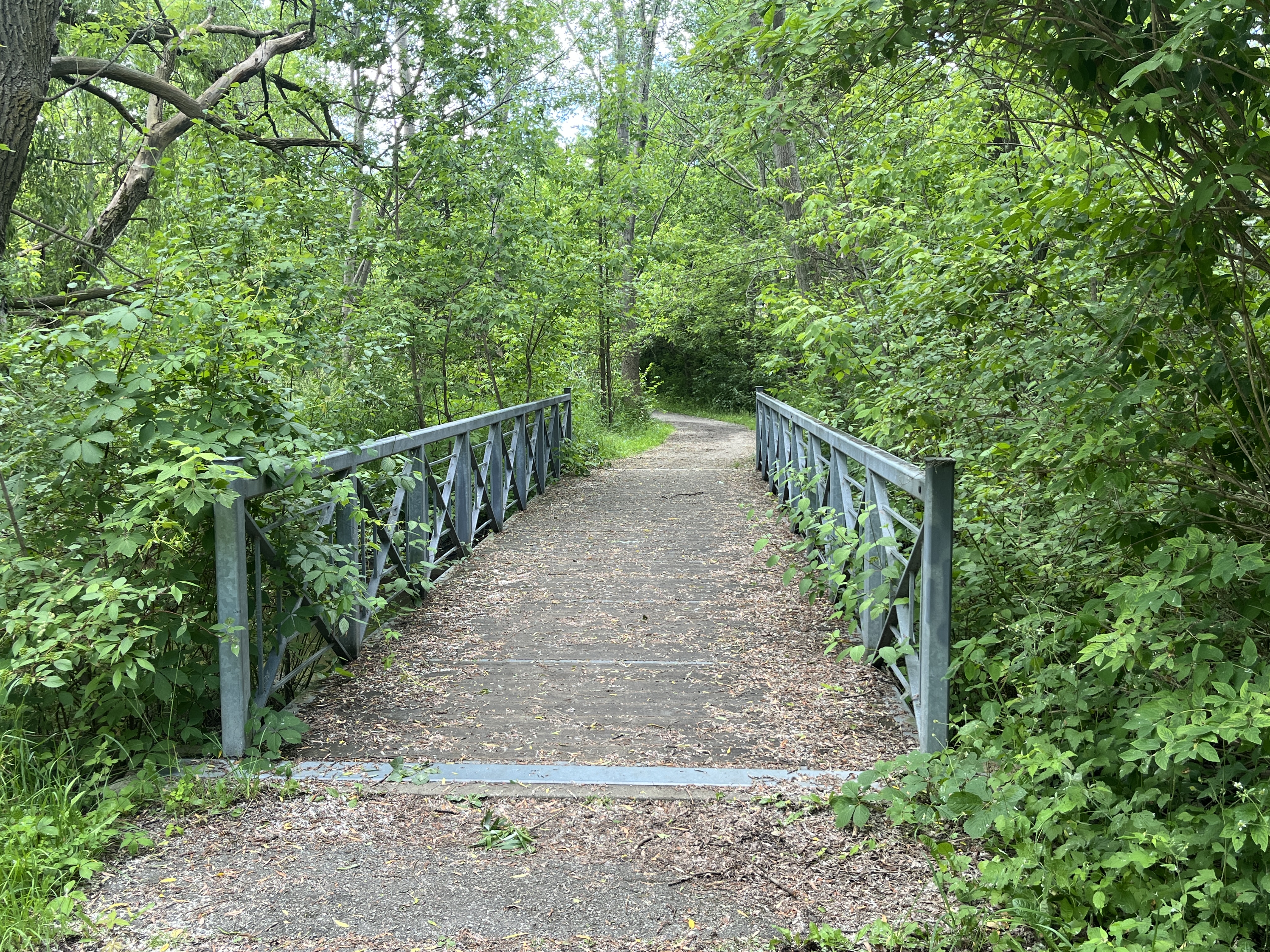
A footbridge lets you cross over the river but only leads to a subdivision.

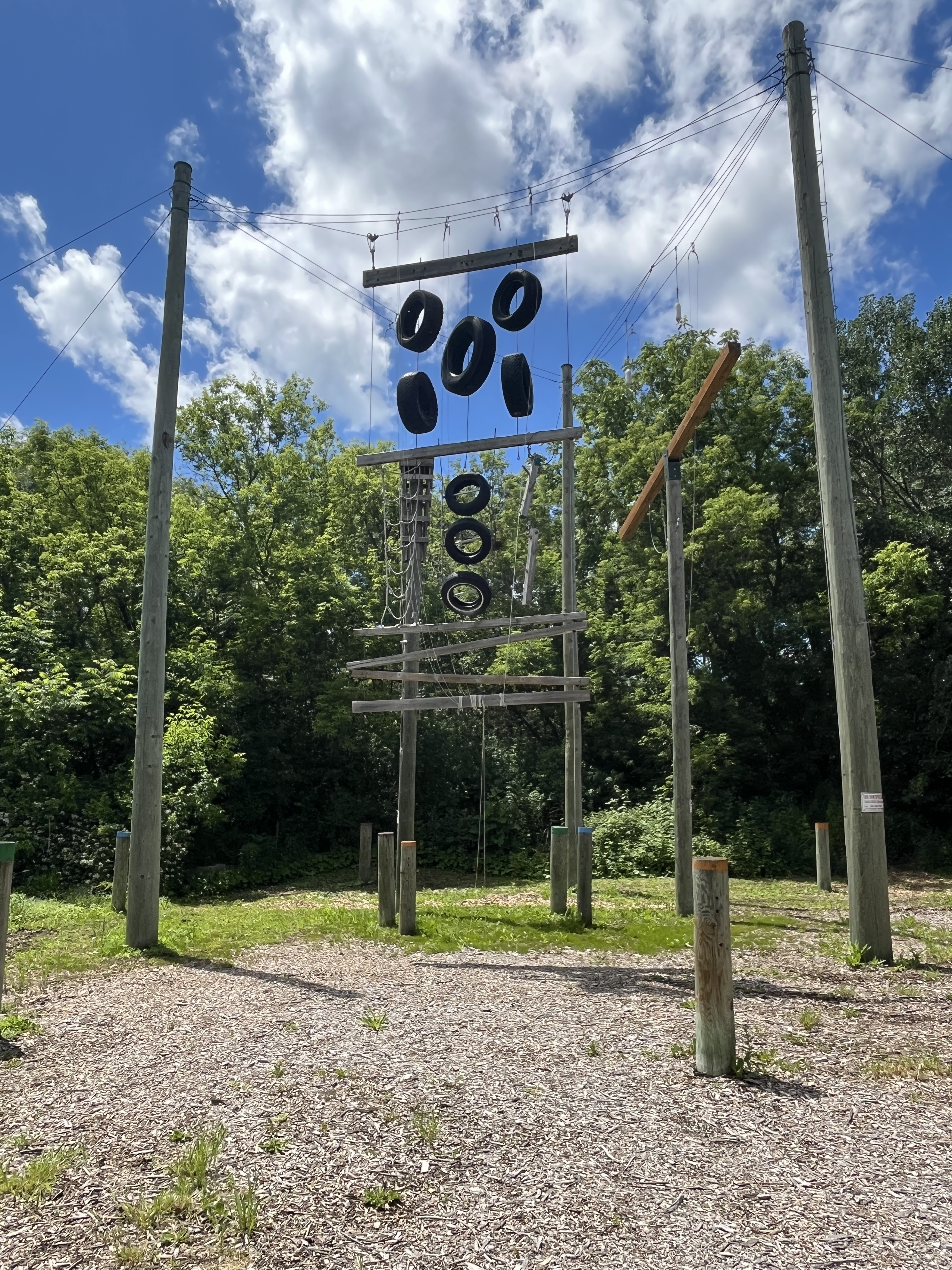
One of the features is the Eyers Homestead Ropes Challenge Course. Access is limited to people who sign up through Richmond Hill’s Community Services Department. People participate in groups and the program is ideal for team building activities. There are five high rope elements and a number of low ones as well.

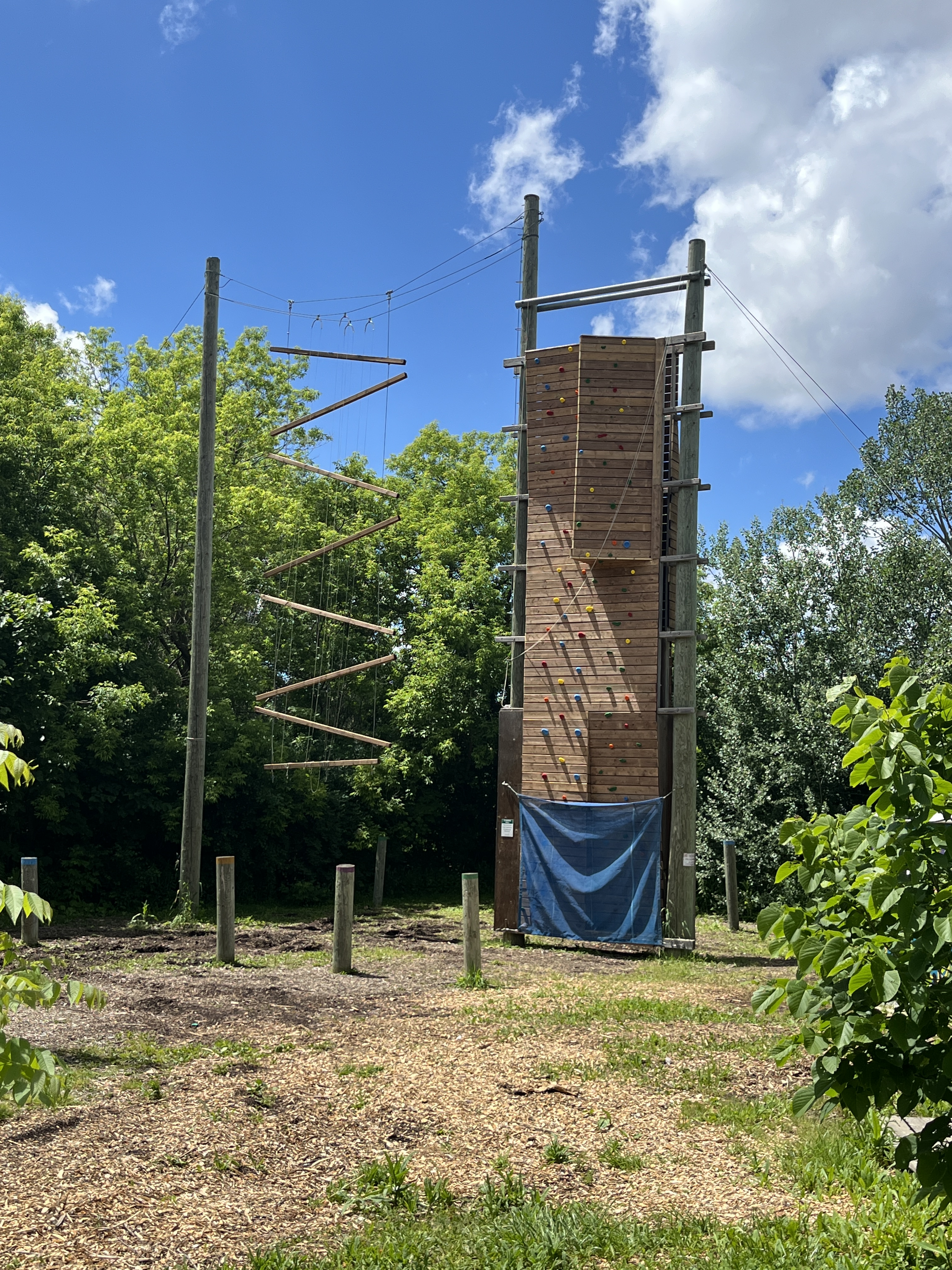
There’s also a climbing wall. Trained staff lead the groups through a series of challenges based on the goals set by the group. Naturally, there’s a waiver that has to be signed before you can begin.

There wasn’t time to explore the trail going south but there’s always another day to check them out.

Google Maps Link: Eyer Homestead

Like us at http://www.facebook.com/hikingthegta

Follow us at http://www.hikingthegta.com

Also, look for us on Instagram

Sault Ste Marie Canal

Saturday, June 1, 2024

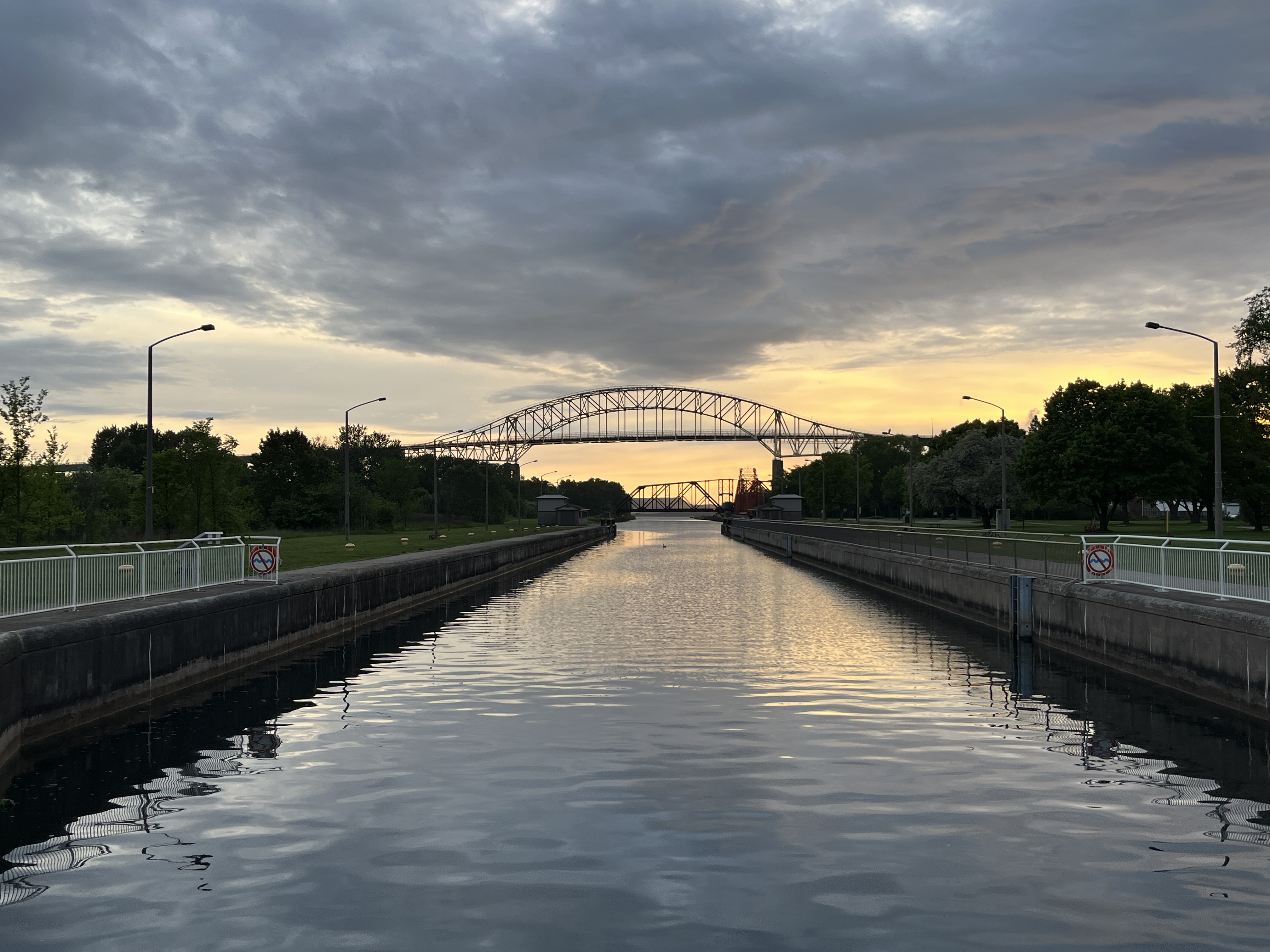
Another business trip took me back to Sault Ste Marie and since I had some time in the evening I decided to visit a Canadian National Heritage site. The Sault Ste Marie Canal. The city is located on the St. Mary River where water flows from Lake Superior to Lake Huron. The St. Marys Rapids were the site of the most significant change in elevation between the two Great Lakes. These rapids made an impediment for the fur trade and the first lock was built here in 1798 by the North West Fur company. This lock was destroyed by the Americans during the War of 1812 in an effort to disrupt the British control of the Great Lakes. A replacement lock was opened in 1895 and included the first electric operating system that was run by power created on site in a powerhouse. The image below shows the lower end of the single lock on the canal.

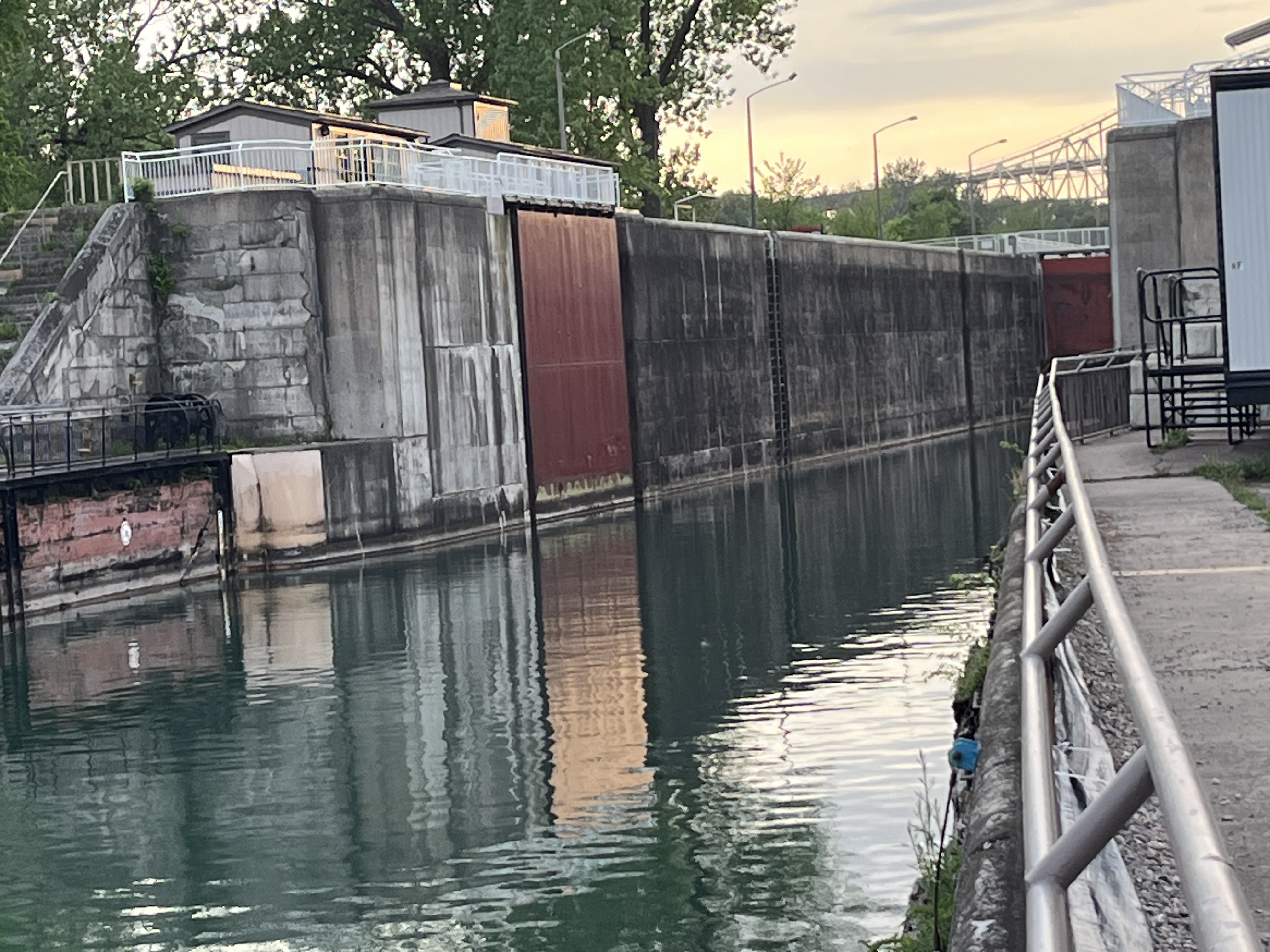
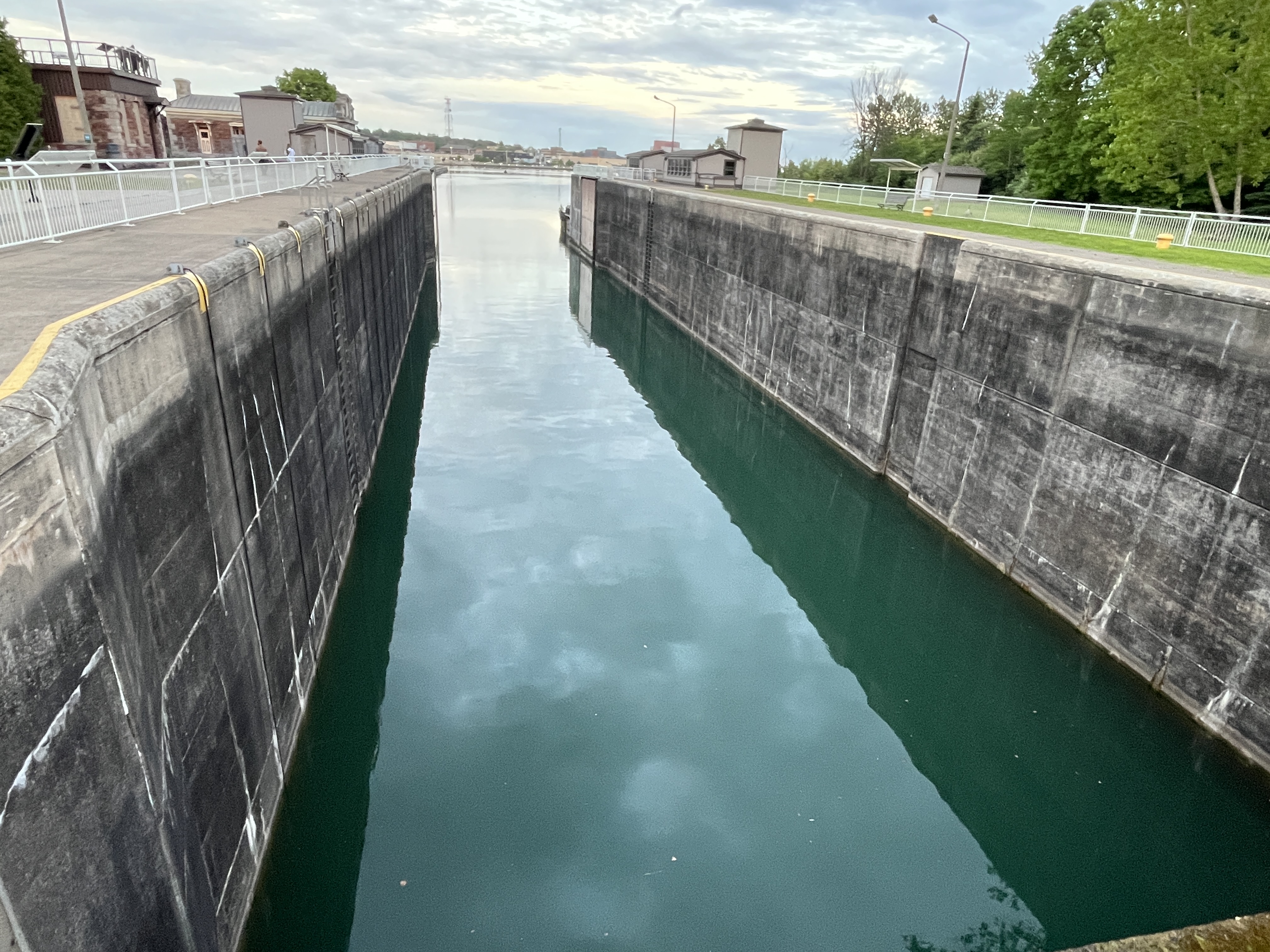
Lake Superior is about 23 feet in elevation higher than Lake Huron. The St. Mary’s River that connects the two lakes accommodates the elevation change through a series of rapids. The St. Mary’s Rapids were the site of a portage for centuries before Etienne Brule arrived there in 1621 as the first European to arrive at what would become Sault Ste. Marie. The St. Mary’s Falls Ship Canal Company started operating the first modern style lock in 1855. The image below shows the lock which is 253 feet long (77m), 51 feet wide (15.4m) and 44 feet deep (13.5m). It is normally at the water level of Lake Huron.

The other side of the gates shows the water level of Lake Superior.

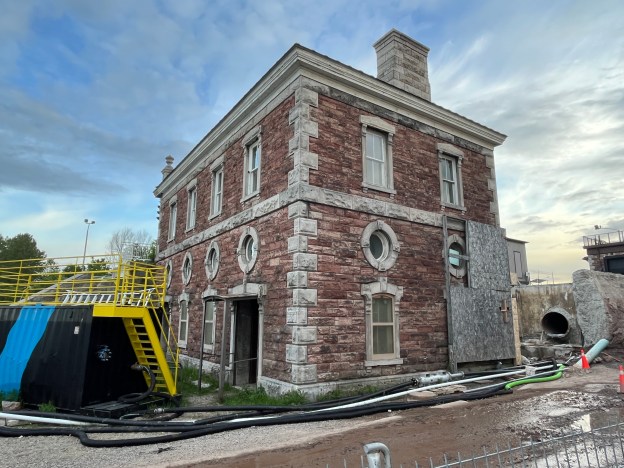
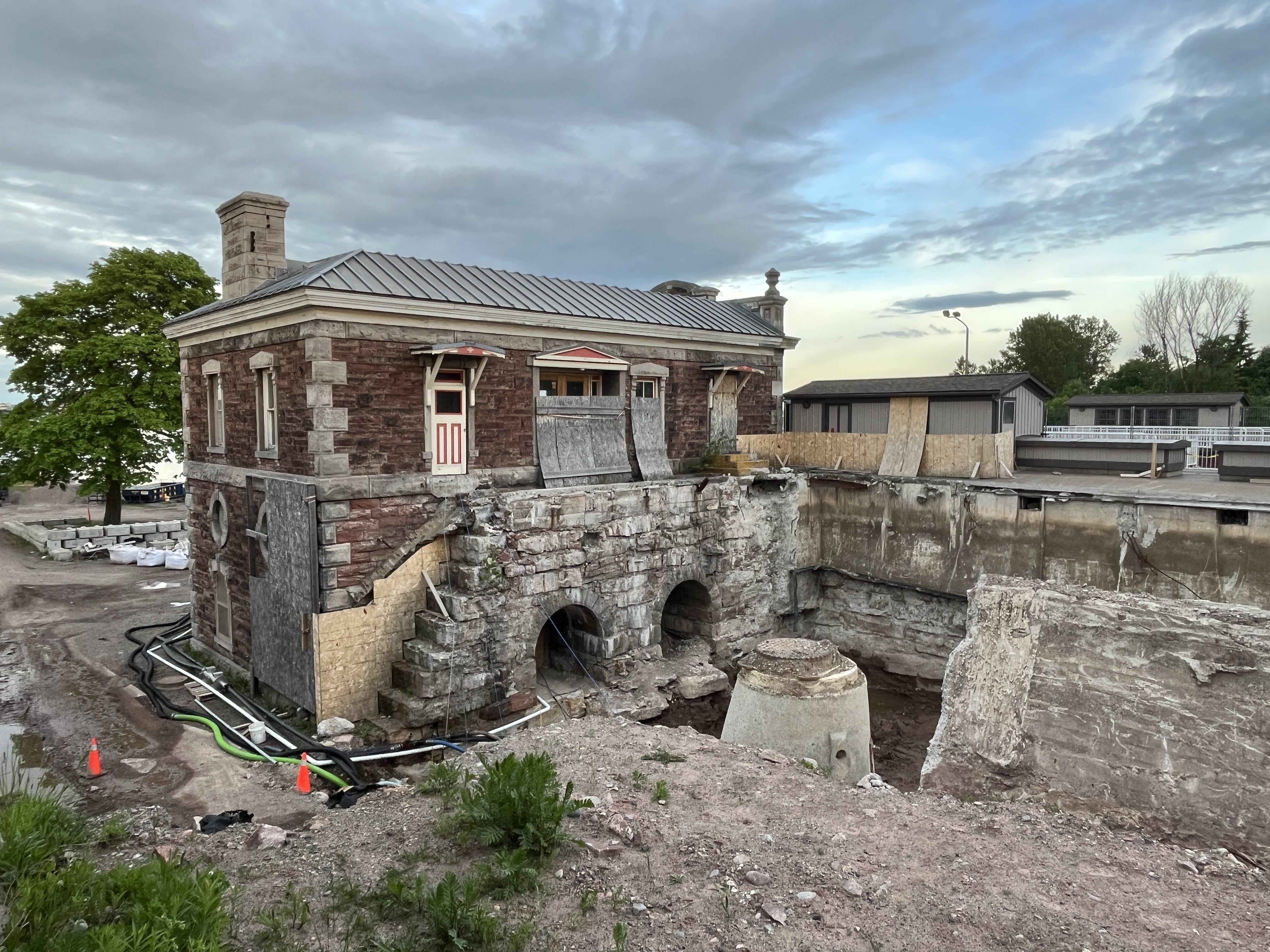
A powerhouse was constructed to supply power for the canal and to light the area. The building is currently under restoration and will be open to the public when completed. The original design from 1893 called for hydraulic power to operate the canal. A decision was made to convert it to electrical power making it the first electrically powered canal in the world.

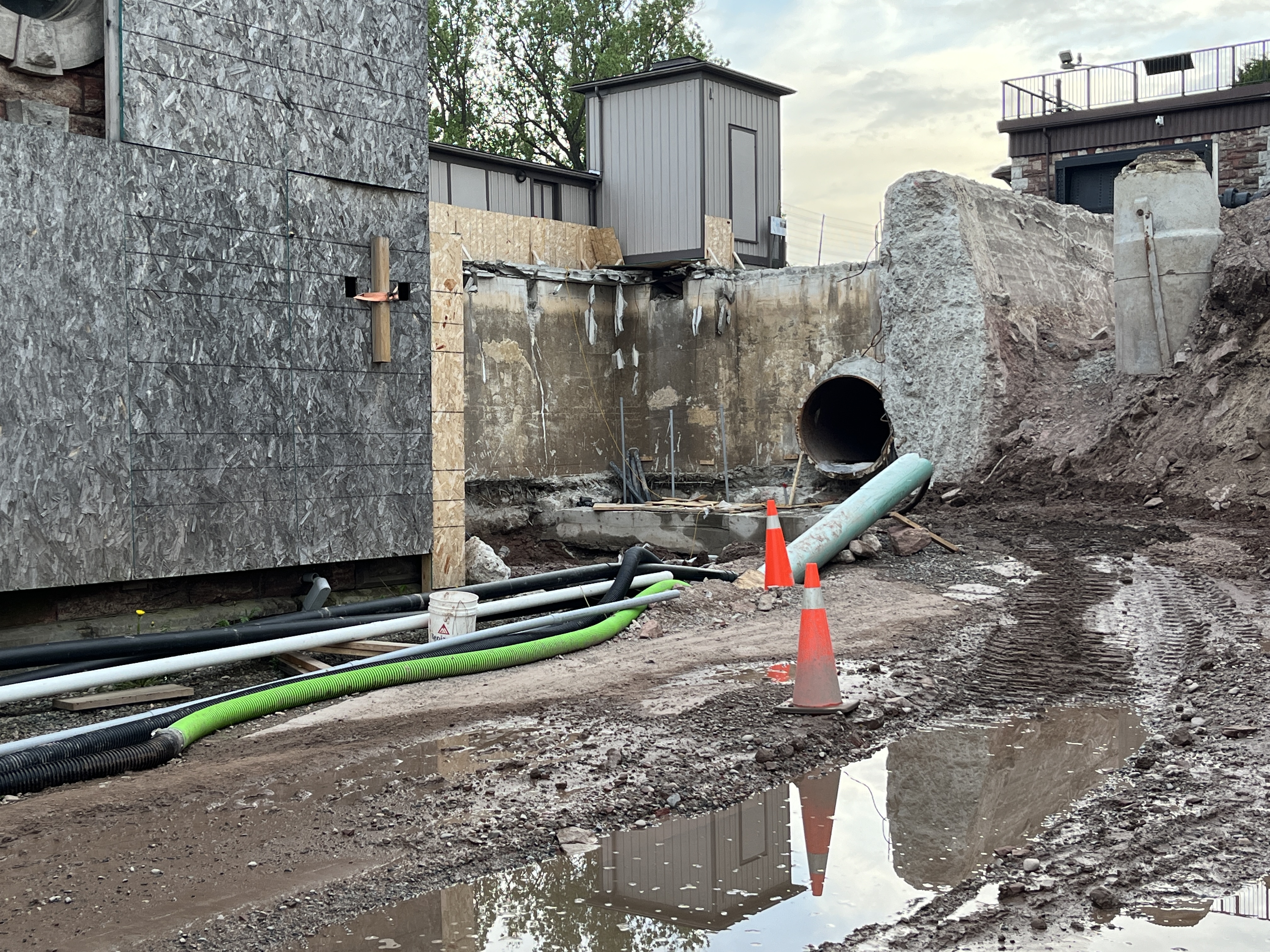
The power mill was operated using water from the canal. A 1,000 foot intake pipe was run from the top end of the canal to the back of the powerhouse. The excavations for repair show the size of the pipe that supplied the water to the powerhouse.

The water was gravity fed to the powerhouse and split into two smaller penstocks before entering the back of the building. There were two water turbines on the first floor and the force of the water entering them caused them to spin. A series of belts and pulleys turned the generators on the second floor where electricity was generated.

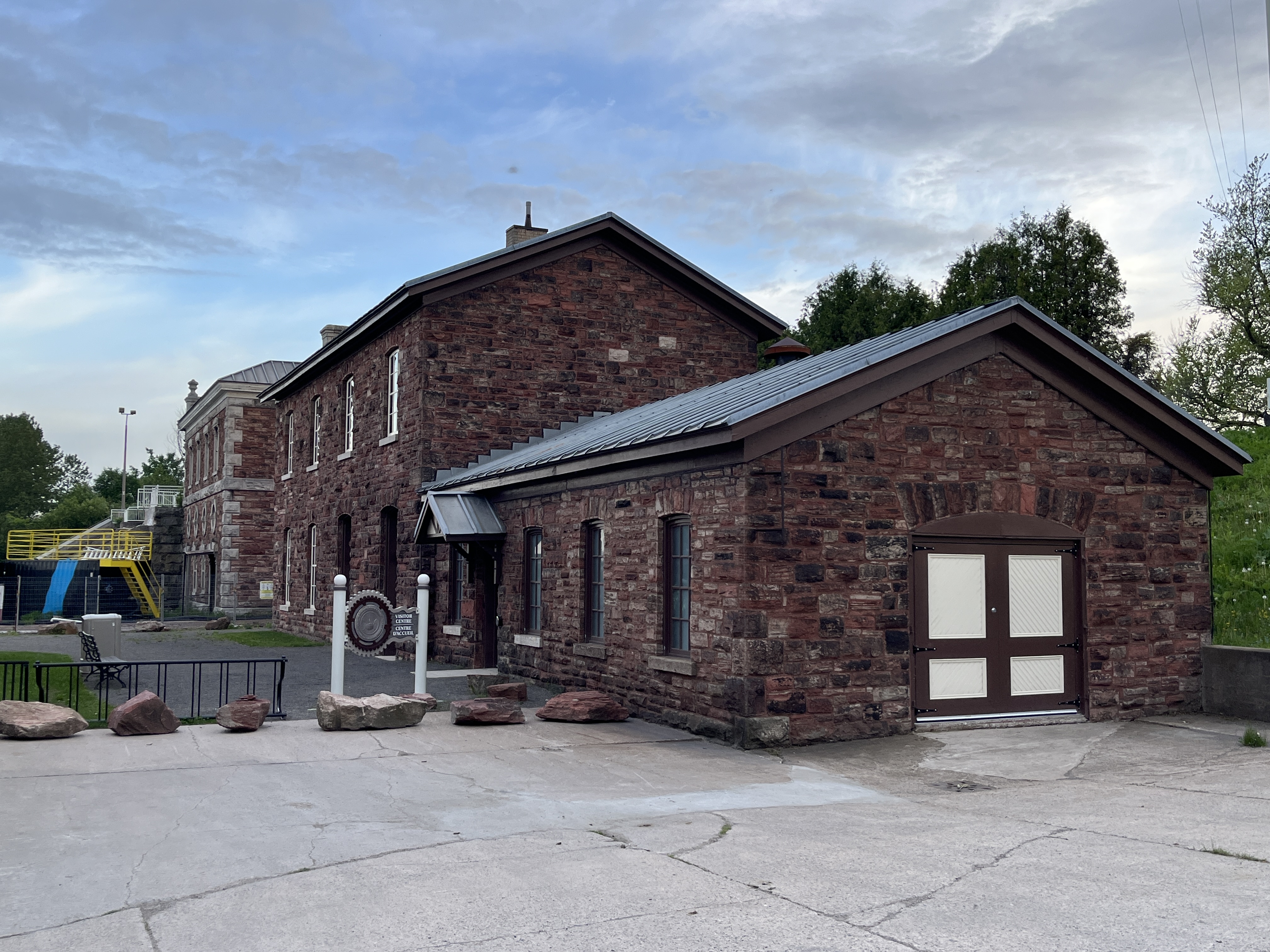
Another building was added in 1896 to act as the Stores building and Blacksmith Shop. The main building was used to store everything that was needed for the operation and maintenance of the canal. The single story portion on the end served as a blacksmith shop where metal parts were forged or repaired. The building was in terrible shape by 2010 and the foundation was collapsing. A major restoration has been completed and it now serves as the visitor centre.

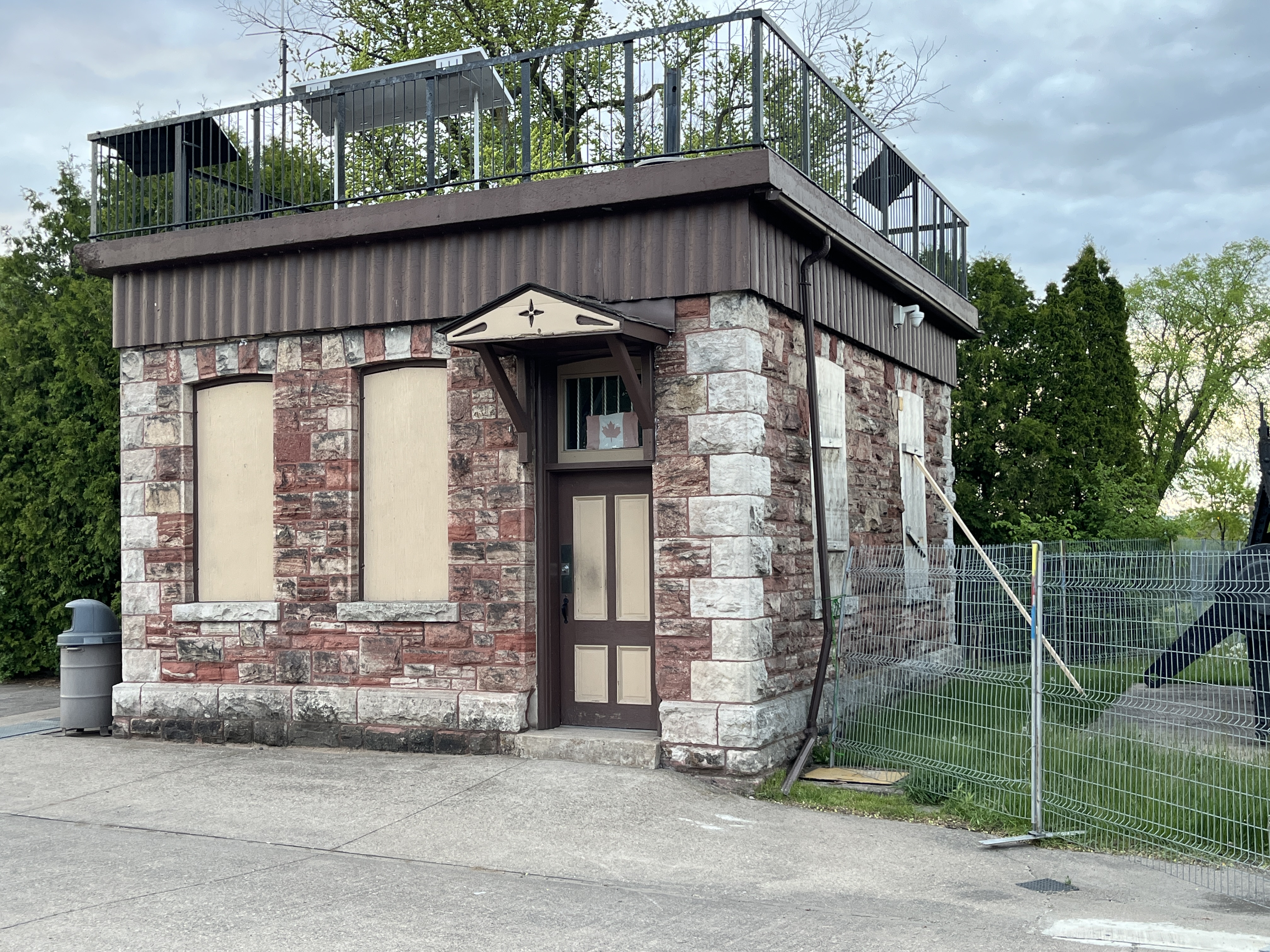
There’s a small building which was used for shelter for the canalmen. An observation platform has been constructed on the top of the building from which you can see the whole canal area.

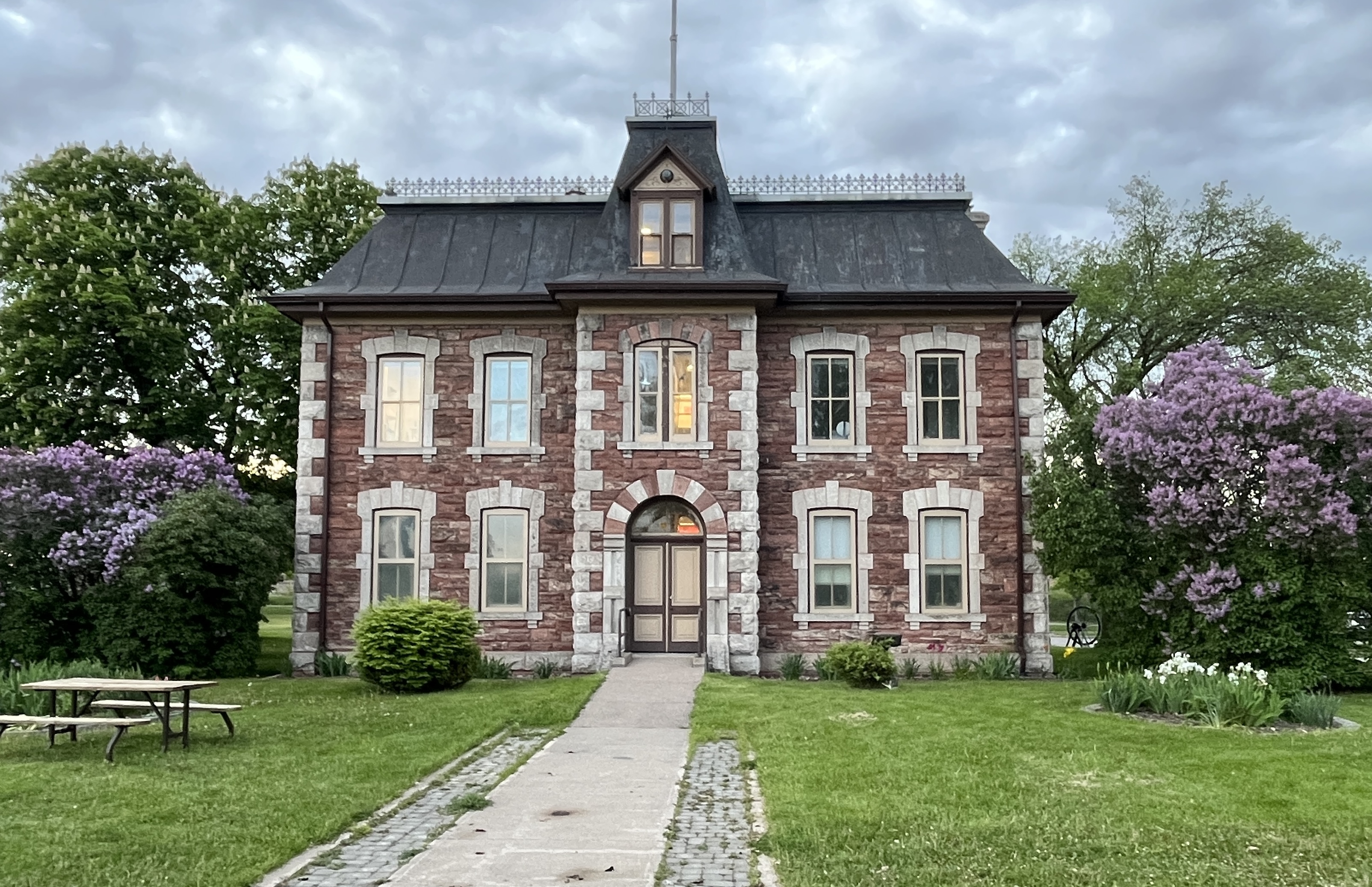
One of the most beautiful buildings in the area is the Administration Building. This Second Empire structure boasts a mansard roof and plenty of decorative stone work.

The Superintendent’s home is still located just a few feet from the canal and boasts Late-Victorian architecture.

The canal has the last remaining Emergency Swing Dam which is designed to prevent disaster in case of a failure of the canal retention system. On June 9, 1909 it was put into use when the gates were rammed from the top, allowing a torrent of water to enter the lock as two ships were preparing to transition the lock. The swing dam was put into action and the flow of water slowed down so that the auxiliary gates could be closed. It took 12 days to reopen the canal. In 1987 there was a lock wall failure and the canal was closed. When it reopened in 1998 it was made available to recreational craft who are the users of the canal up until now.

There are many interpretive signs to aid your exploration and a guided tour is also available, making this an interesting historical site to visit.

Related Stories: Burlington Canal, The First Three Welland Canals, Newmarket Ghost Canal, Peterborough Lift Lock

Google Maps Link: Sault Ste Marie Canal

Like us at http://www.facebook/com/hikingthegta

Follow us at http://www.hikingthegta.com

Also, look for us on Instagram

Scarborough Railpath Trail

May 11, 2024

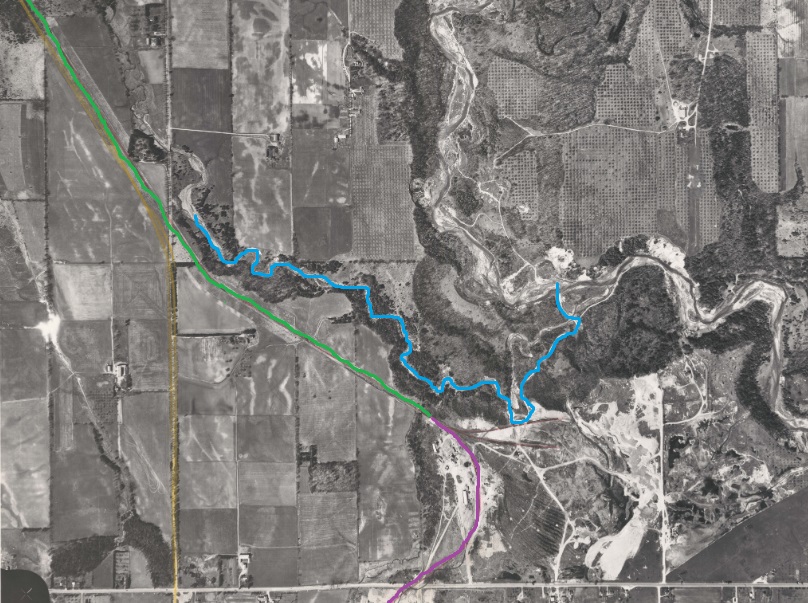
The Scarborough Railpath, also known as the Upper Rouge Trail, is a 2.3 kilometer trail that runs from Upper Rouge Trail to Sewels Road. It follows the right of way for a short rail line that used to run through Scarborough. There is little about this rail line on-line but it is likely a spur line and appears in aerial photography dating back to the 1940s. The image below is from the 1961 aerial photographs on the Toronto’s Archives website and shows the part of the right of way that is in use as a railpath marked in green. The section marked in purple has been lost beneath urban development. Morningside Creek has been marked in blue as it makes its way to the Rouge River.

The trail has been paved and, as an old railway, it is relatively flat. It is suitable for use by everyone and is commonly used for cycling, jogging and dog walking. I had the opportunity after visiting a client in the area to take a walk on the trail on a Monday morning.

There were several Six Spotted Green Tiger Beetles that kept flying and landing a few feet in front of me. They love to sit in the sunshine on trails or logs and wait for their prey to come along. They don’t generally bite humans unless they are handled but have a huge appetite for spiders, ants and caterpillars. These beetles have a lifespan of up to three years but when you include the time they spend as larvae they can live for almost 5 years.

There were several species of butterflies to be seen along the walk. I saw a Mourning Cloak, Clouded Sulfur, Cabbage White, Eastern Tailed Blue and several Red Admirals. The Red Admiral, pictured below, is a relatively calm butterfly that is easy to photograph because they will allow you to get pretty close before they fly away.

Animals can generally be split into two groups. Endothermic and Ectothermic. Endothermic animals are the ones we call “warm blooded” and are capable of generating internal body heat. Ectothermic animals are “cold blooded” and must rely on external sources of heat such as basking in the sunshine. Reptiles are ectothermic and can be found sitting in sunny places absorbing the heat. I saw two different species of snakes enjoying the sunny morning but wasn’t fast enough with the camera to get a picture of the Dekays Brown Snake. The Garter Snake got off the pathway pretty quickly but stayed in the grass along the side long enough to pose for a picture.

There was a small patch of Trilliums growing in the woods just beside the berm for the former rail bridge. These plants are often considered to have three leaves and a three petal flower. However, the green parts are actually bracts and are part of the flower.

A tall berm covers the culvert that carries a small tributary of Morningside Creek. A small bridge used to carry the railway over the creek but has been replaced with the culvert and filled in with earth. The rail berm at this point is at its tallest along the length of the railpath. The cover photo shows the rail berm that runs along the end of Casebridge Court, which is another entry point to the railpath.

There are three Major League Baseball teams that are named after birds and I saw all of their namesakes on this walk. Cardinals and Blue Jays are a fairly common sight in Southern Ontario but I don’t see Baltimore Orioles nearly as often. Blue Jays and Cardinals overwinter in Ontario while the Baltimore Oriole is migratory. They get their name from their colouring which resembles the Coat of Arms for Lord Baltimore.

As I was walking along the path near Morningview Trail I noticed a white flash in the trees beside the path. It was a White-tailed Deer. It disappeared into the trees before I had a chance to get a clear picture of it. So, I decided to follow its trail for a few minutes in the hopes of getting a clear shot of it. I wasn’t quick enough and it managed to elude me through the underbrush. I followed its footprints for a ways before finding a small dirt foot trail that runs near Morningside Creek. All I ended up with was a picture of the hoofprints.

Morningside Creek is one of 11 tributaries of the Rouge River. It rises in the area of Dennison Avenue and Markham Road and runs along the west side of the Toronto Zoo. Some sections of the Upper Rouge Trail run along the border of the zoo and are posted as No Trespassing to keep people out of the zoo property.

Mayapples were growing in a large patch along the forest floor but have not gone to flower yet. Mayapples with one leaf will not flower while those with two leaves will develop a single flower between the two leaves.

The trail was lightly used on this sunny Monday morning which probably helped increase the amount of wildlife that was available to be seen.

Although this pathway runs along the edge of residential and industrial areas before running parallel to Morningside Drive, it provides a surprising number of opportunities to see wildlife.

Related stories about former Toronto railways that are now hiking trails: West Toronto Railpath, Leaside Spur Trail, Beltline Railway, Moore Park, York Beltline Trail

Google Maps link: Upper Rouge Trail

Like us at http://www.facebook.com/hikingthegta

Follow us at http://www.hikingthegta.com
Also, look for us on Instsagram

Toogood Pond Park

May 4, 2024

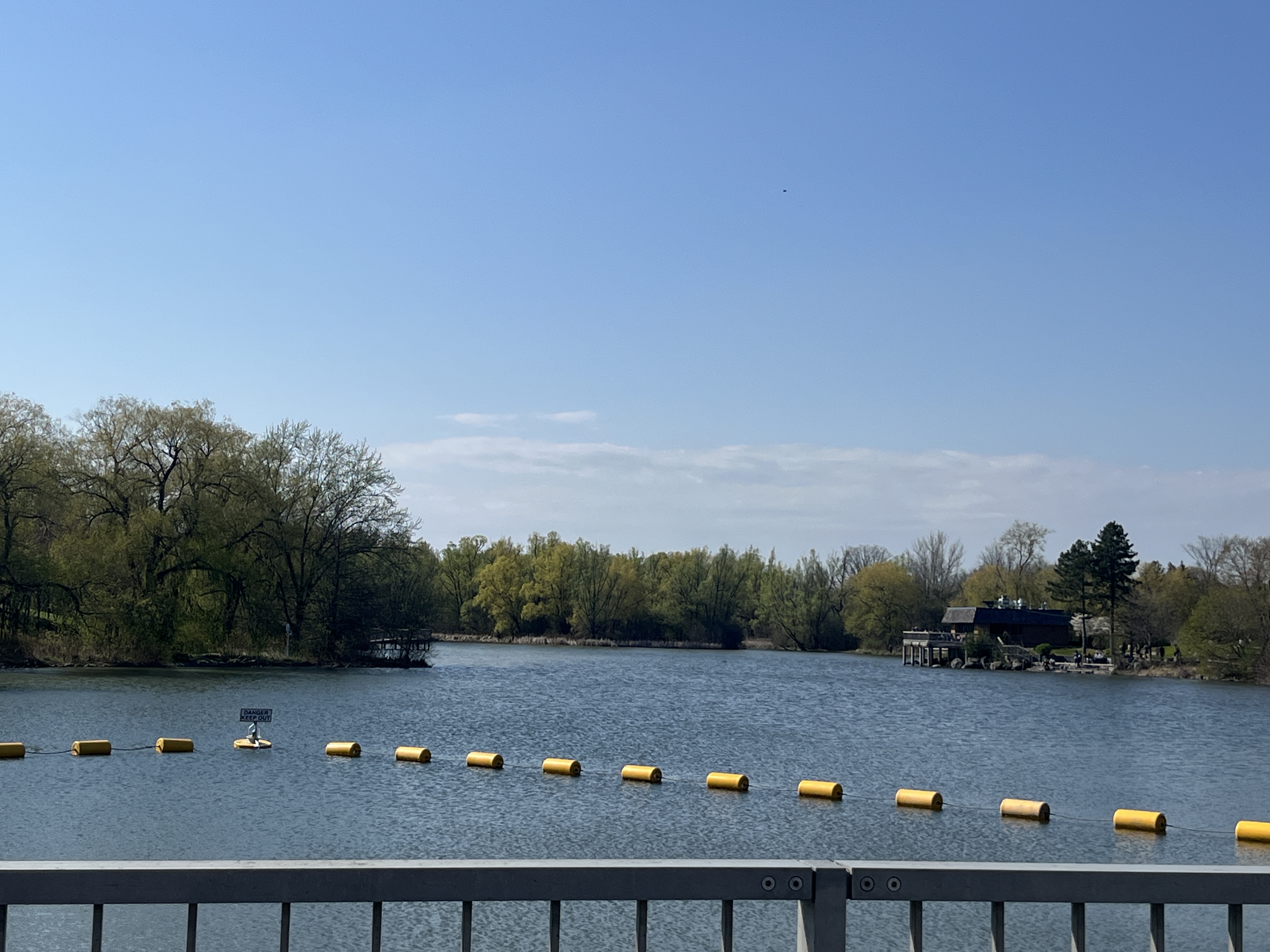
When millwright Ira White arrived at the north end of what would become Unionville in 1839 he recognized the east half of lot 13 in the 5th concession to be an ideal site to harness the water power of Bruce Creek.  He built a sawmill first and then set about cutting the wood for the grist mill he built where the creek crosses Main Street in Unionville. He built a dam across the creek to create a mill pond to provide consistent water flow to power the wheels that operated his grist and saw mills. Originally it was known as The Pond and later as Willow Lake. The mill continued to operate under water power from the pond until the dam was washed away in a flood in 1930. The mill stood for another four years until it was destroyed by a fire in 1934. The image below shows Willow Lake as it appeared in the 1877 County Atlas.

The mill was never rebuilt and the property that the mill pond stood on was sold in 1939 to a family named Toogood who had just moved from Alberta. The pond was used as a swimming hole for the local children and in 1953 the Unionville Swimming Club was established to provide supervised swimming for the children to increase safety. The Red Cross also started to provide swimming lessons. Today, you can no longer swim in the pond.

The 33.3 hectare site was acquired by the City of Markham in 1980 and became known as Toogood Park. The park is a common place to go fishing in the hopes of catching largemouth bass, carp, pumpkinseed, brown, black or yellow bullhead and creek chub.

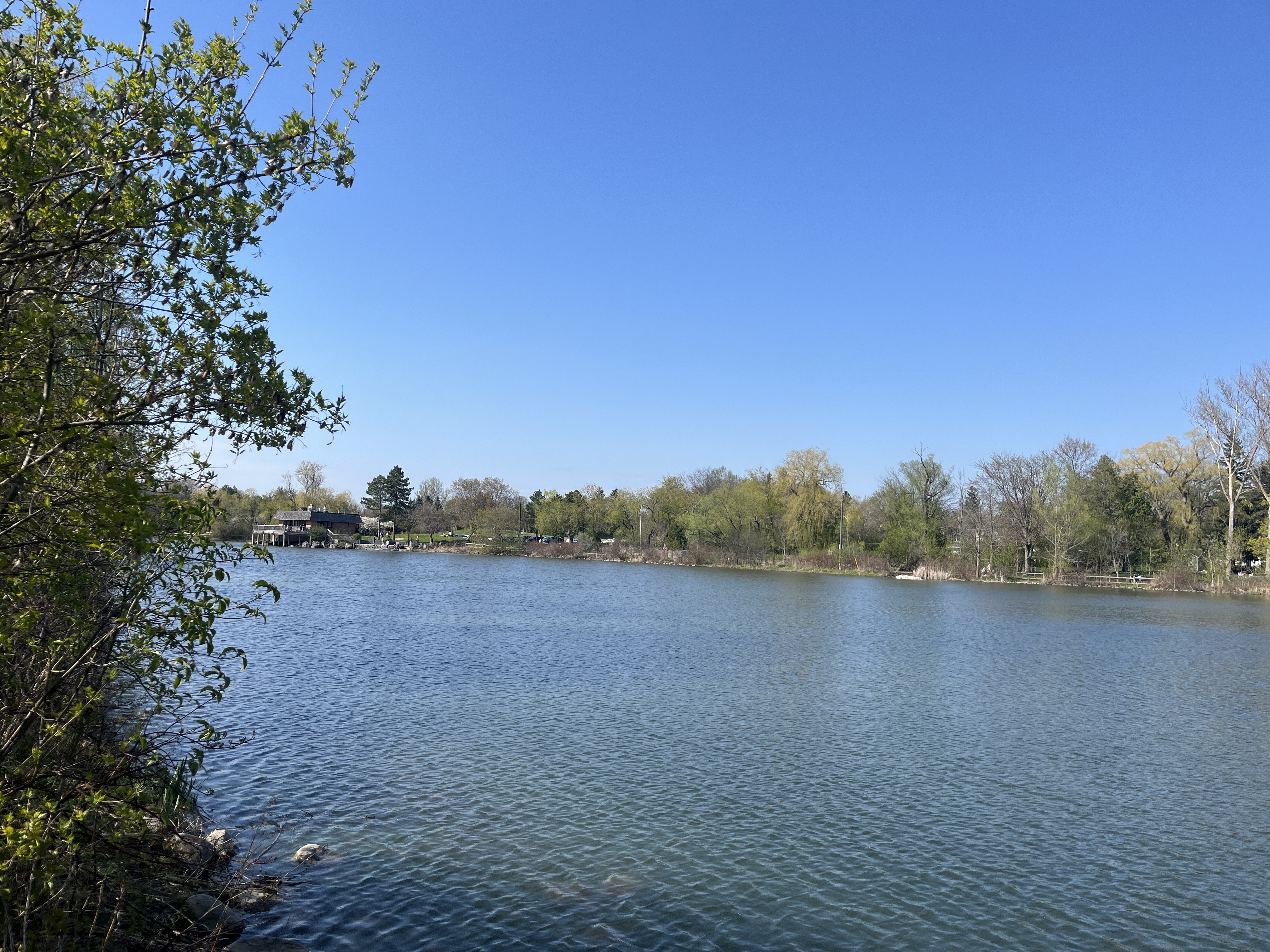
Water flows over the spillway on the dam as well as through a small channel on the side which acts as a fish ladder allowing fish to navigate around the dam. The image below shows Bruce Creek as it flows away from the dam and into the former village of Unionville.

For many years it was common practice to go skating on the pond in the winter. In 2015 the city banned this for safety reasons. By November of 2016 it was announced that users could skate on the pond at their own risk.

A boardwalk carries the trail along the northern end of the pond through a wetland of bullrushes.

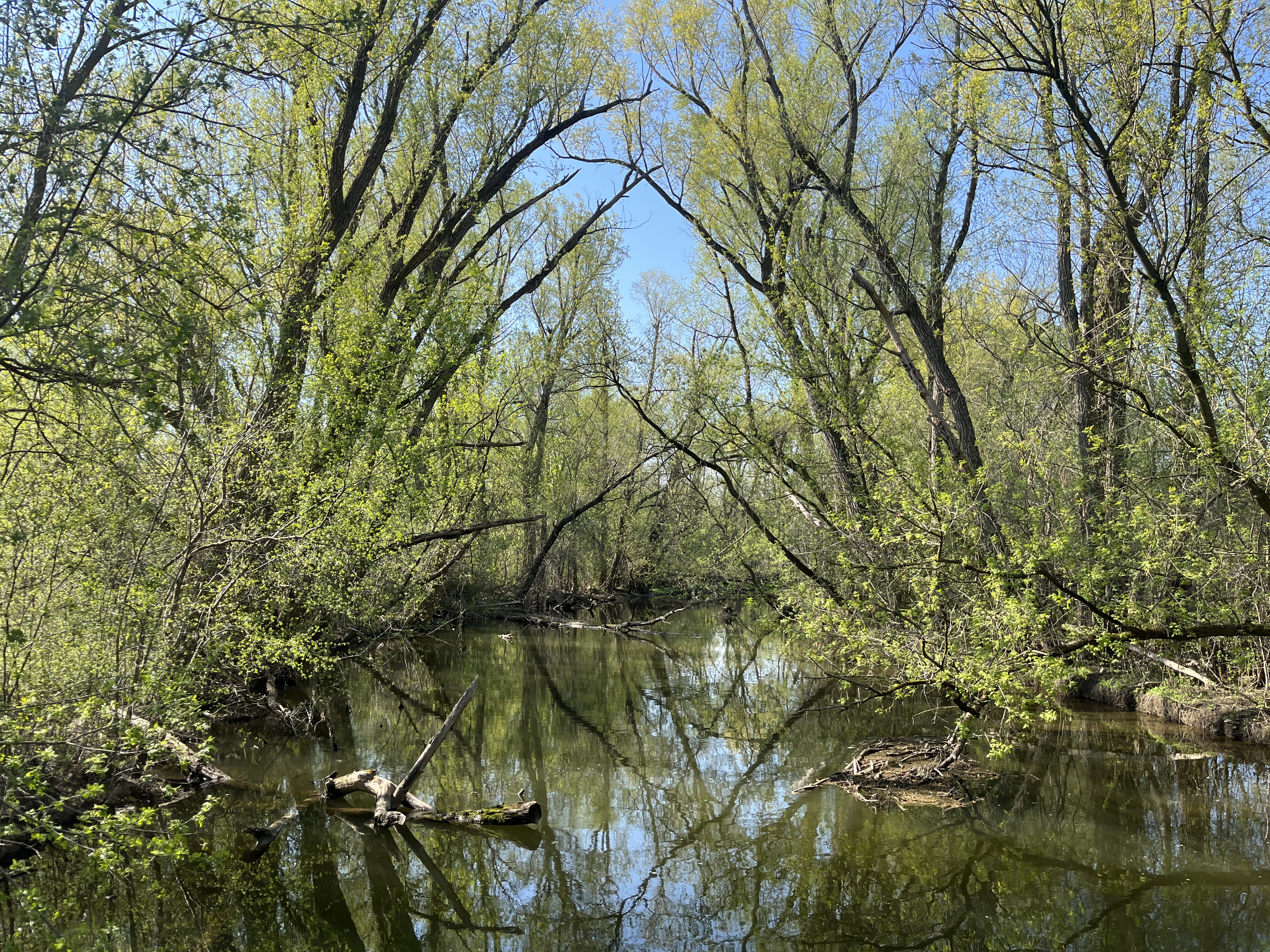
Bruce’s Creek flows south from Bruce’s Mill and makes its way towards Unionville. This image shows the watercourse on the south side of the boardwalk as it makes its way into Toogood Pond.

Looking upstream from the boardwalk the scenery is very beautiful on this sunny spring afternoon with the leaves really starting to come out.

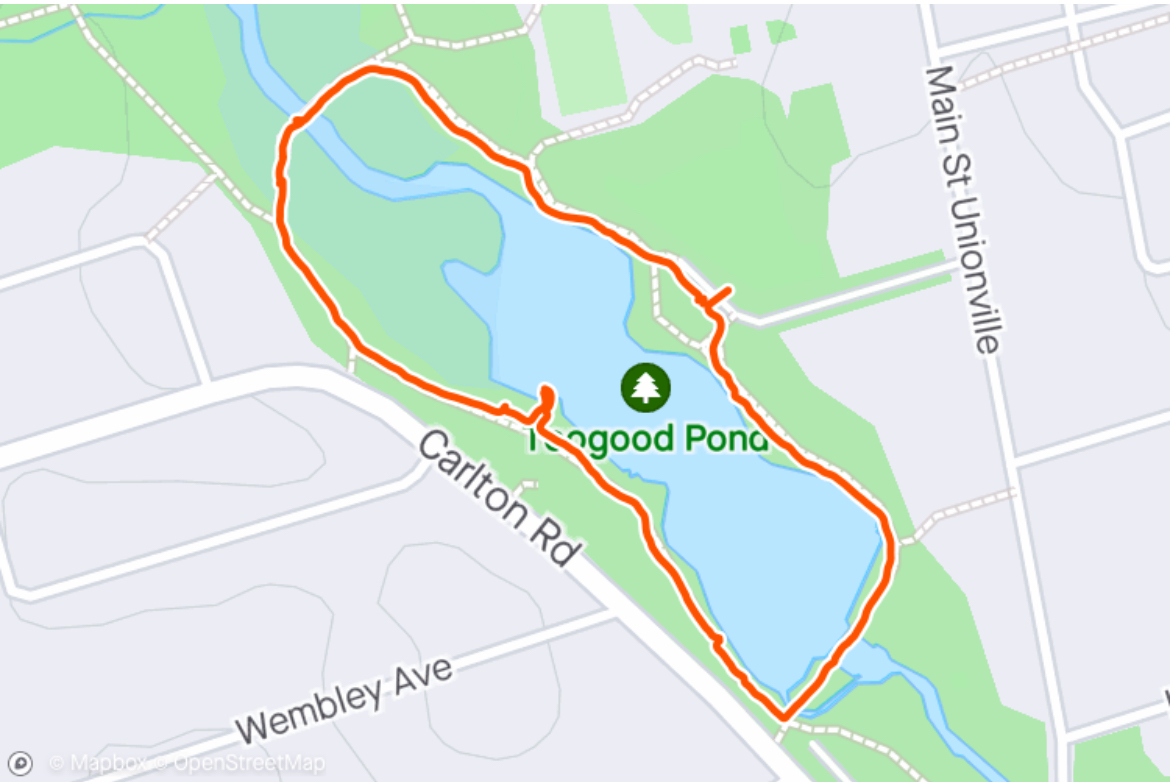
The trail around Toogood Pond is less that 1.5 kilometers and can be done in under half an hour at a leisurely pace. If you’re lucky you might spot some turtles sunning themselves on partially submerged logs in the pond.

Toogood Pond Park is a great place to for a walk, try you luck at fishing or just to relax and unwind. Free parking can be found off main street in Unionville at Toogood Pond Park road and also on Carlton Road at Pomander Road.


Associated Blogs: Unionville, Bruce’s Mill

Google Maps link: Toogood Pond

Like us at http://www.facebook.com/hikingthegta.com

Follow us at http://www.hikingthegta.com
Also, look for us on Instagram

Our Favourite Hikes

April 27, 2024

We started our blog with our initial post on April 27, 2014, Since then we’ve done a few “greatest hits” type posts where we featured the stories that have had the most reads. To celebrate our tenth anniversary we’re looking at some of the hikes that were the most fun for us. The places that were the most enjoyable and had the most interesting artifacts or histories. With over 600 posts its hard to choose the most enjoyable ones but the fifteen listed below represent some of our most loved ones. These are presented in no particular order. Click on the title of the article in each box and it will take you to the story. Links to the locations will be at the end of each story.

Riverwood

This large park in Mississauga had so much history from the estate and farms that we ended up splitting it into three posts.

The Bell Fountain – Belfountain

The park in Belfountain was created as one man’s dream and has a man made waterfall, swing bridge and many other interesting artifacts to explore.

The Caledon Aerial Tramway – Cox Property

This exploration was based on looking for evidence of an aerial tramway that used to carry quarried rock across the ravine.

Kelso’s Kilns

While looking for two old lime kilns near Kelso we also found the remains of another kiln location.

UTM Nature Trail

This nature trail explores the old estate that now forms the campus for the University of Toronto Mississauga Campus and includes a man made pond and stone bridge.

Milton Mill Pond

There’s lots of interesting things to find as you loop around the old mill pond in Milton.

Scotsdale Farm

This park in Halton includes a Bruce Trail side trail as well as several other trails and historic buildings.

Elora Gorge

The scenic gorge in Elora is also home to the refurbished Elora Mill and makes for a great hike.

The Hole In The Wall

Near Limehouse the Bruce Trail passes through this karst formation and makes for an interesting and mildly challenging hike.

Limehouse

The history of the lime industry is on display in the conservation area in Limehouse.

Felker’s Falls

One of several waterfalls that we have explored in the Hamilton Area. They say that Hamilton has 100 waterfalls as all of the rainwater that falls on top of the escarpment makes its way to Lake Ontario.

The Devil’s Punch Bowl

Exploring the upper and lower Punch Bowl Falls makes for an interesting and challenging hike.

Albion Falls

This exploration was done when it was still possible to get to the bottom of the falls. It has now been closed to the public due to the large number of rescues that had to be made of people who got injured down there.

The Barber Dynamo – Georgetown

This is a challenging trail that leads to one of the truly unique places in the GTA where electricity was generated to run the Georgetown Paper Mills.

Abandoned Passmore Avenue

Passmore Avenue runs just south of Steeles Avenue through Scarborough and has several sections that have been closed to traffic.

There are many other places that we thoroughly enjoyed exploring but there’s no room to list them all. By going to our main page at http://www.hikingthegta.com you can use the search feature to look for specific topics such as waterfalls, the Bruce Trail or ghost towns. You can also look for places in a specific town or area near you. Enjoy, and thanks for this first decade of reading our posts.

Like us at http://www.facebook.com/hikingthegta

Follow us at http://www.hikingthegta.com
Also, look for us on Instagram

Mullet Creek’s Secret Waterfalls

Monday October 12, 2015

Mullet Creek contained a couple of surprise waterfalls and an old dam in the short section we hiked.  It originates in Meadowvale north of the 407  and empties into the Credit River on the University of Toronto Mississauga campus.  It was a gorgeous long weekend and Thanksgiving Monday was a beautiful day for a brief hike before getting the turkey in the oven.  We parked on O’Neil Court and entered the woods through the community walkway.

Reginald Watkins bought 150 acres of land in 1928 north of the now abandoned Erindale Power Dam.  He tore down one house on the property and enlarged the other which was named Lislehurst.  In 1965 The University of Toronto bought the property and founded Erindale College which is now called University of Toronto Mississauga.  The section of park backs onto the university campus and contains the remains of an old out building at the crest of the hill overlooking the ravine.  It appears that a series of trial excavation holes have been dug to investigate the ruins.

IMG_0664

A long thin promontory of land provides access to the creek level.  We followed it down to where Mullet Creek winds it’s way through the ravine and on to the Credit River nearby. The creek splits into sections in the ravine and we crossed each in turn as we made our way north along the valley floor.

IMG_0667

There are over 30 varieties of periwinkle.  As an invasive species they grow aggressively, often choking out native plant life.  They are frequently recommended for partially shaded areas or places where growing plants is difficult.  Care must be taken because they can escape and take hold in the wild.  One plant can spread to an area 8 feet across.  They normally bloom in late April to early May but we found a stray splash of periwinkle blue in the undergrowth.

IMG_0670

An old steam boiler lies rusting away at the side of Mullet Creek.  It would have originally stood on four metal feet on the bottom.  The lower half contained the fire box and was open on the opposite side to this picture.  The front flue sheet contains the holes that the flues passed through and is matched by a second flue sheet on the back.

IMG_0679

Mullet Creek is crossed by the double span of Burnhamthorpe Road.  A recent assessment was done for this bridge as well as sister bridges over the Credit River just east of here.  Original construction had created bridges where the sidewalks were too small to be properly functional. The study was completed to address several concerns.  At just .838 metres high, the guard rail on the river edge of the sidewalk was considered too low for safety.  The proposal was to increase this rail to 1.4 m.  There was also no rail between the sidewalk and road and so a second rail was proposed on the curb side.  The sidewalk was to be increased from 1.7 to 3 metres wide to allow cyclists and pedestrians to safely pass.  Look-out platforms were also created. This was accomplished by widening the road deck on the outside of the bridge.  The west bound span is seen from the creek level in the picture below.
IMG_0693

Just beyond the Burnhamthorpe bridge lie the remains of an old dam.  Original wooden sections remain submerged in the water behind later concrete forms while the pre-cast concrete blocks on the top were added later still.

IMG_0699

Prior to the arrival of Europeans, Atlantic Salmon were common in Lake Ontario and spawned in the Credit River every fall.  Due to pollution, dams, over-fishing and deforestation they were basically eliminated by the 1890’s.  In the 1960’s and 1970’s Chinook and Coho Salmon were introduced from the Pacific coast.  Chinook Solmon make their only spawning run when they are 4 years old and then die afterward.  This male Chinook has developed the characteristic hooked jaw called a kype and the darker colour of his one and only run upstream.  They can usually grow to lengths of 3 feet and weights of 25 pounds.  This specimen was caught by a young fellow named Jack who was fishing with his family.

IMG_0702

As you walk up Mullet Creek toward Mississauga Road you come to several shelves of shale where the water cascades over the edge.  The picture below was taken just one bend in the creek prior to the cover photo which has a larger drop.  These two little water falls make an oasis in the heart of the city.

IMG_0707

At one time a parkette stood at the corner of the creek and Mississauga Road.  The remains of the old parking area are starting to grow over but the old rail ties that outline the side and protect the trees in the middle will be around for many years to come.

IMG_0717

Mullet Creek extends from here to north of the 407 and must contain other interesting places. Time will tell.

Like us at http://www.facebook.com/hikingthegta