Yearly Archives: 2015

Hiking The GTA – A 2015 Monthly Review

January 1, 2016

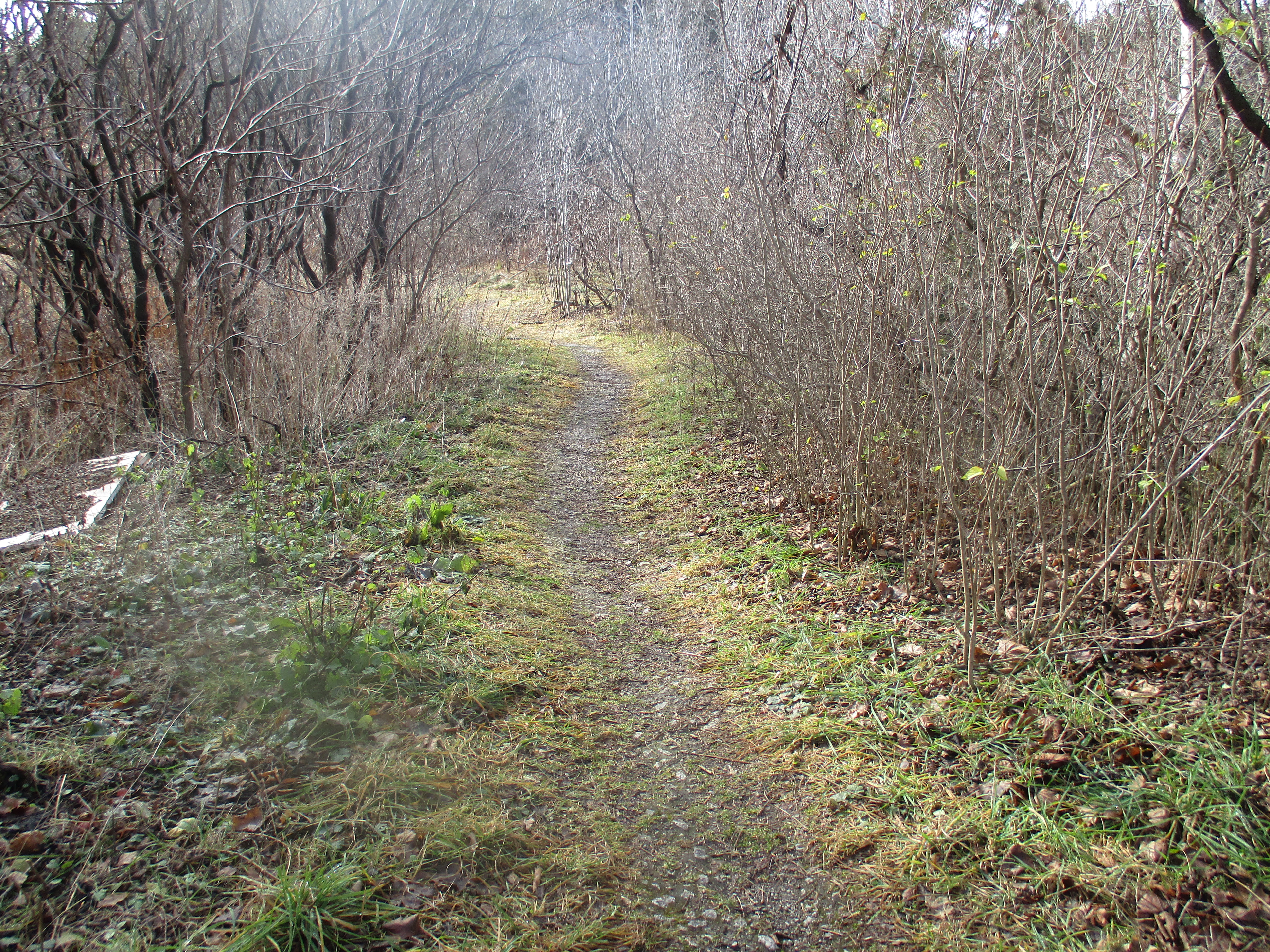
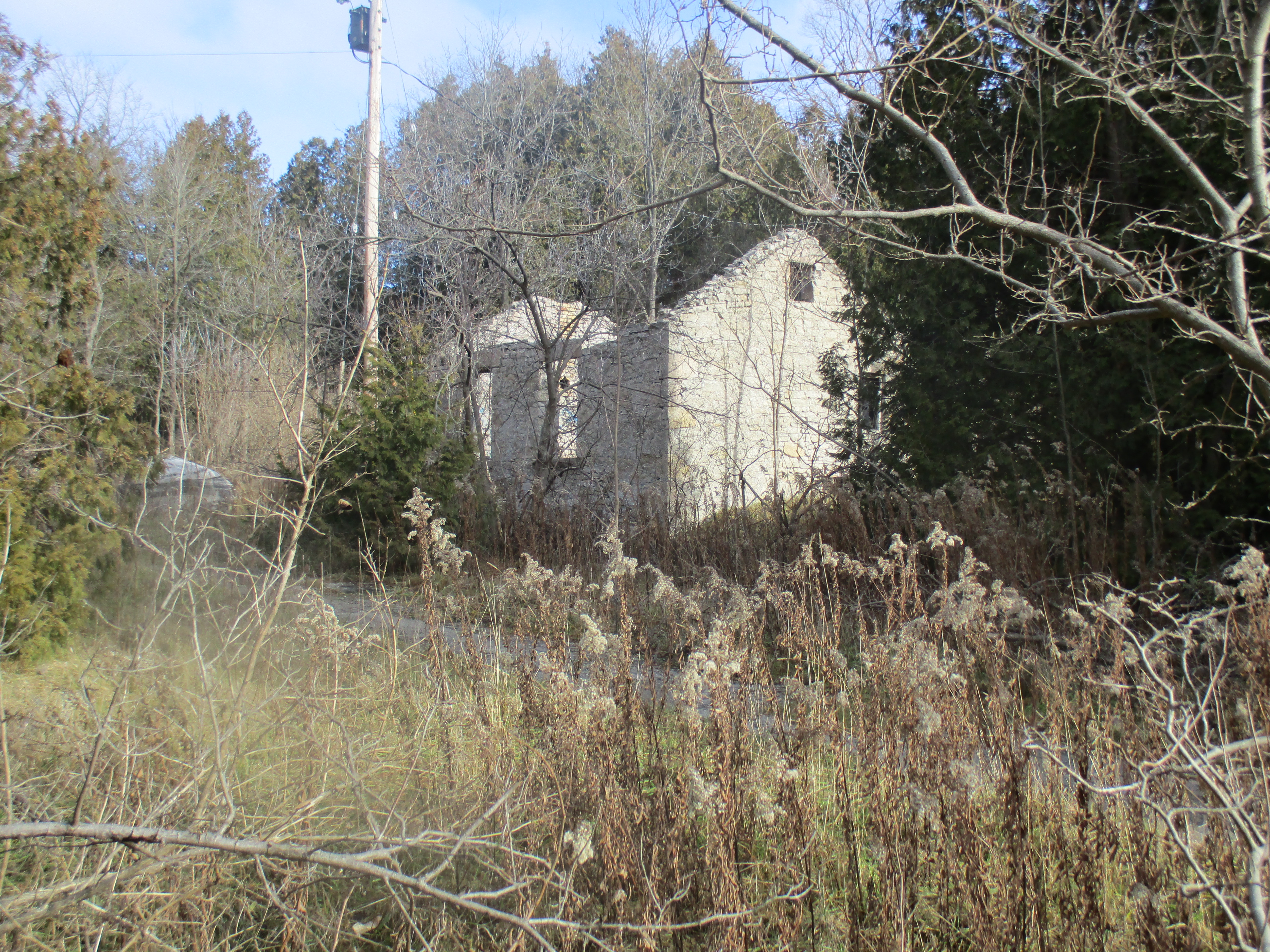
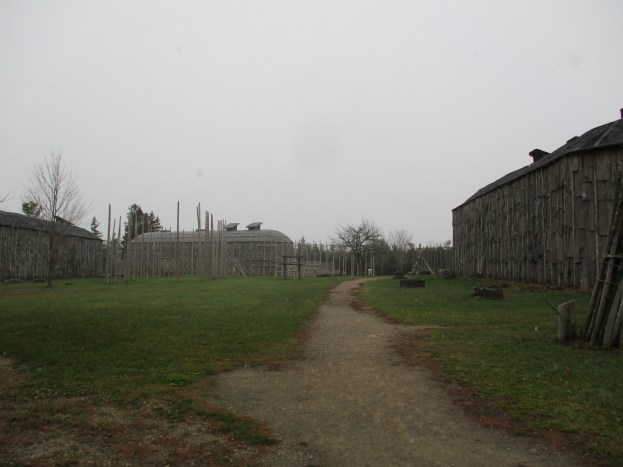
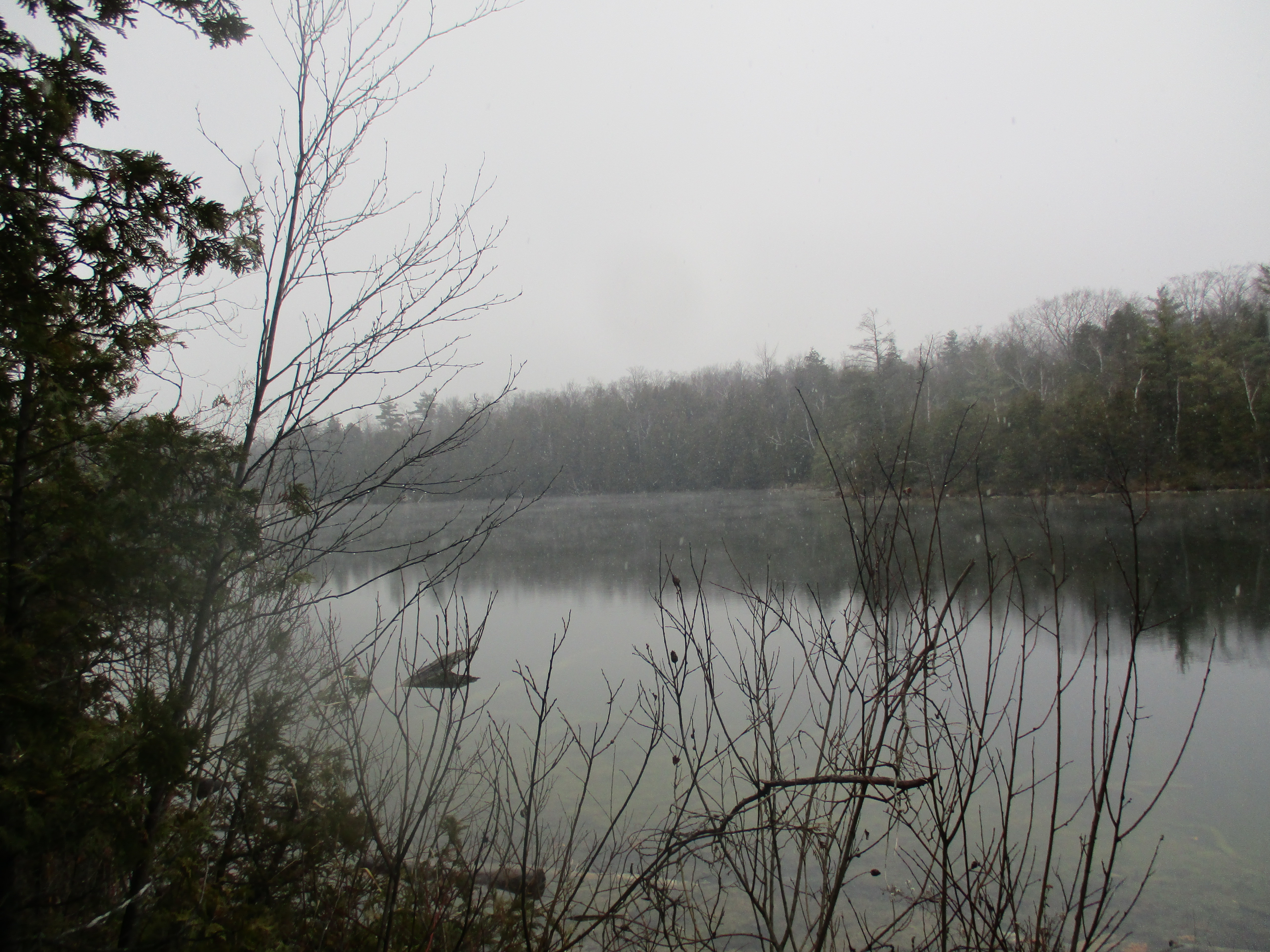
Hiking the GTA was able to visit 86 different places in 2015 where we were able to see some truly amazing things.  Each season has it’s own beauty and there are always things to be discovered. Over the course of the year more people became aware of the stories we were publishing and readership increased dramatically.  Therefore a David Letterman “Top Ten” list would really only focus on the more recent stories.  For that reason we present a review of the year 2015 by looking at the most popular post from each month.  A brief outline of the story, a picture from it and a link are provided below.  Thanks to everyone who read one of our stories this past year.  I hope some of you were able to get out and enjoy some of these sites yourself because they are all interesting in their own way.  Plus, you never know what wild life you’ll encounter.

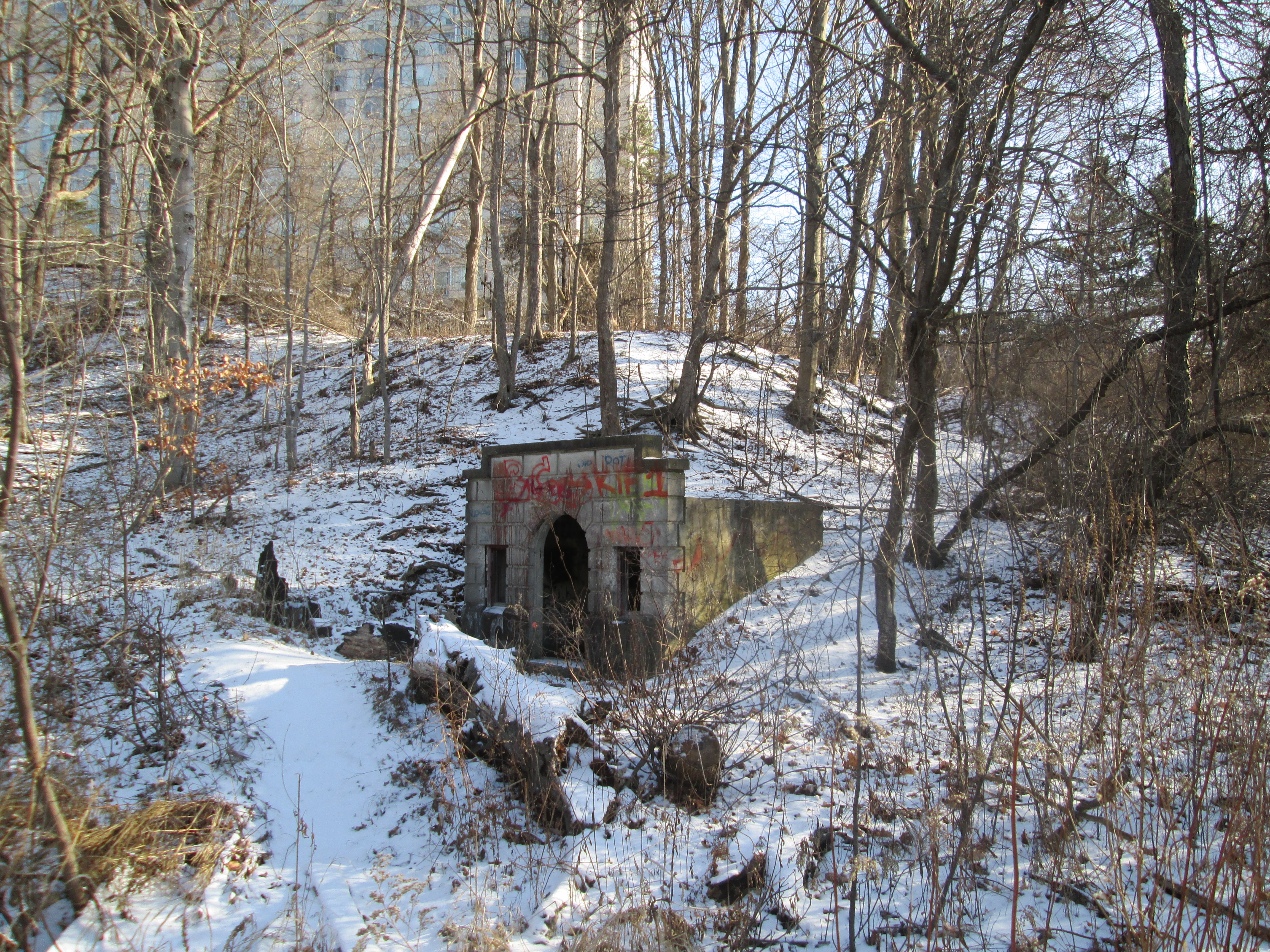
Graydon Hall was released on January 10th.  It visits a former millionaire’s estate finding plenty of evidence of it’s past usage.  The abandoned pump houses featured below are part of the former irrigation system.
IMG_1977

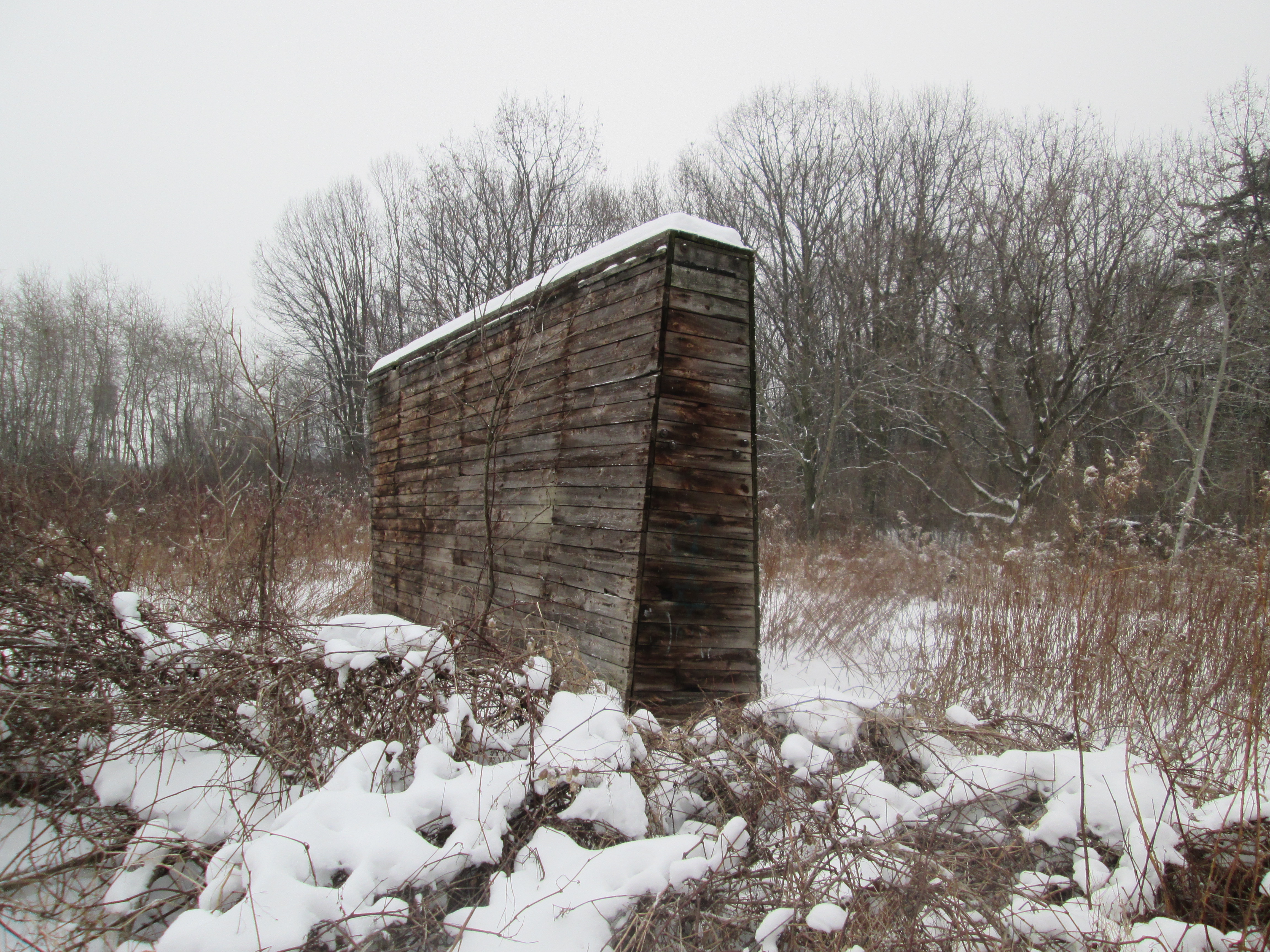
The Arsenal Lands was released on Feb. 7th.  The abandoned water tower and rifle inspection building along with the former rifle range made this an interesting hike.  One of the baffles from the rifle range is featured below.
IMG_2300

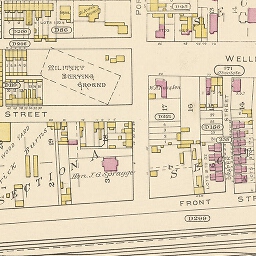
Military Burying Grounds was published on March 22 and re-posted for Remembrance Day. This hike visits the two nearly forgotten places where our early military dead are buried in downtown Toronto.
Military

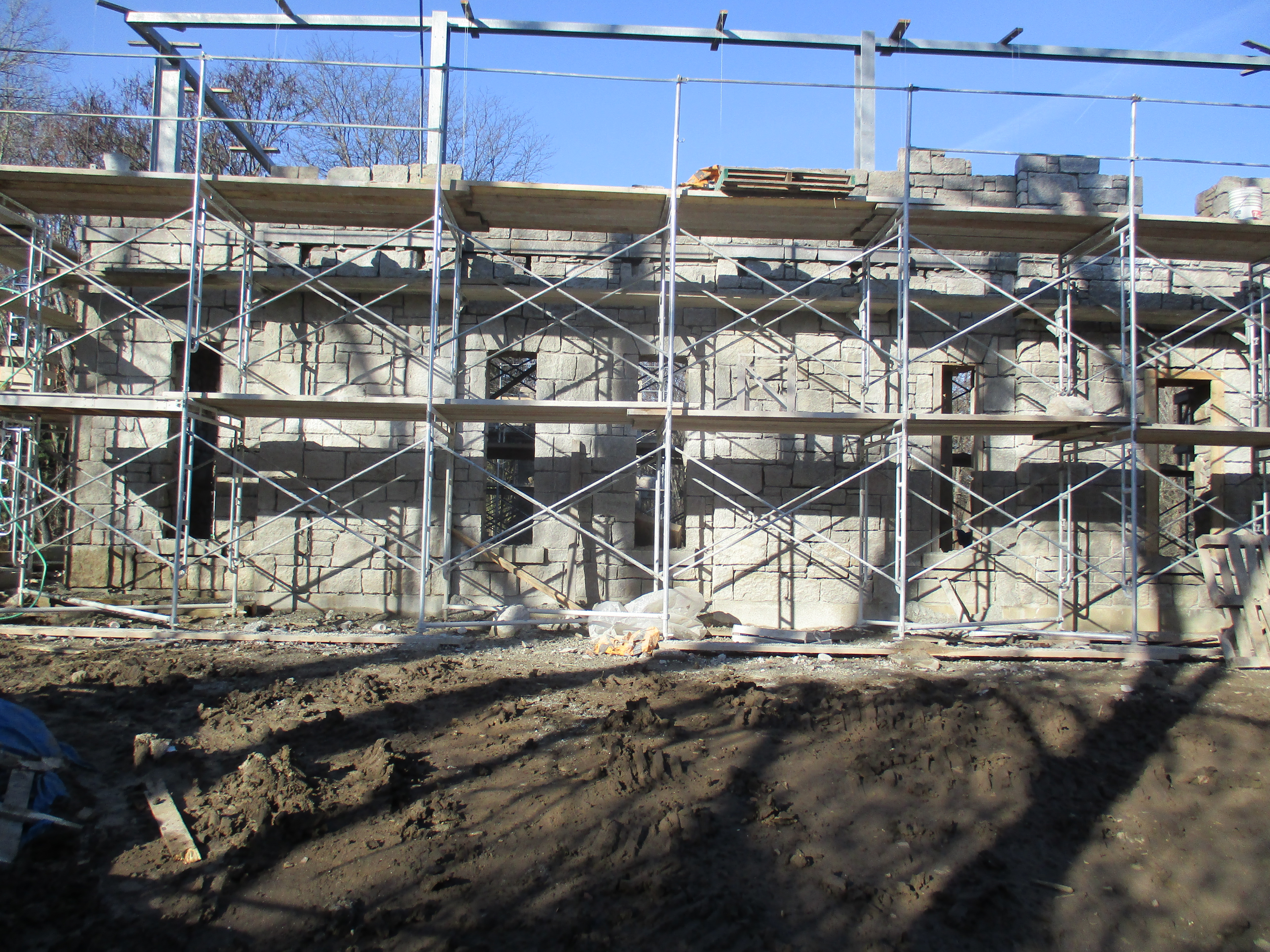
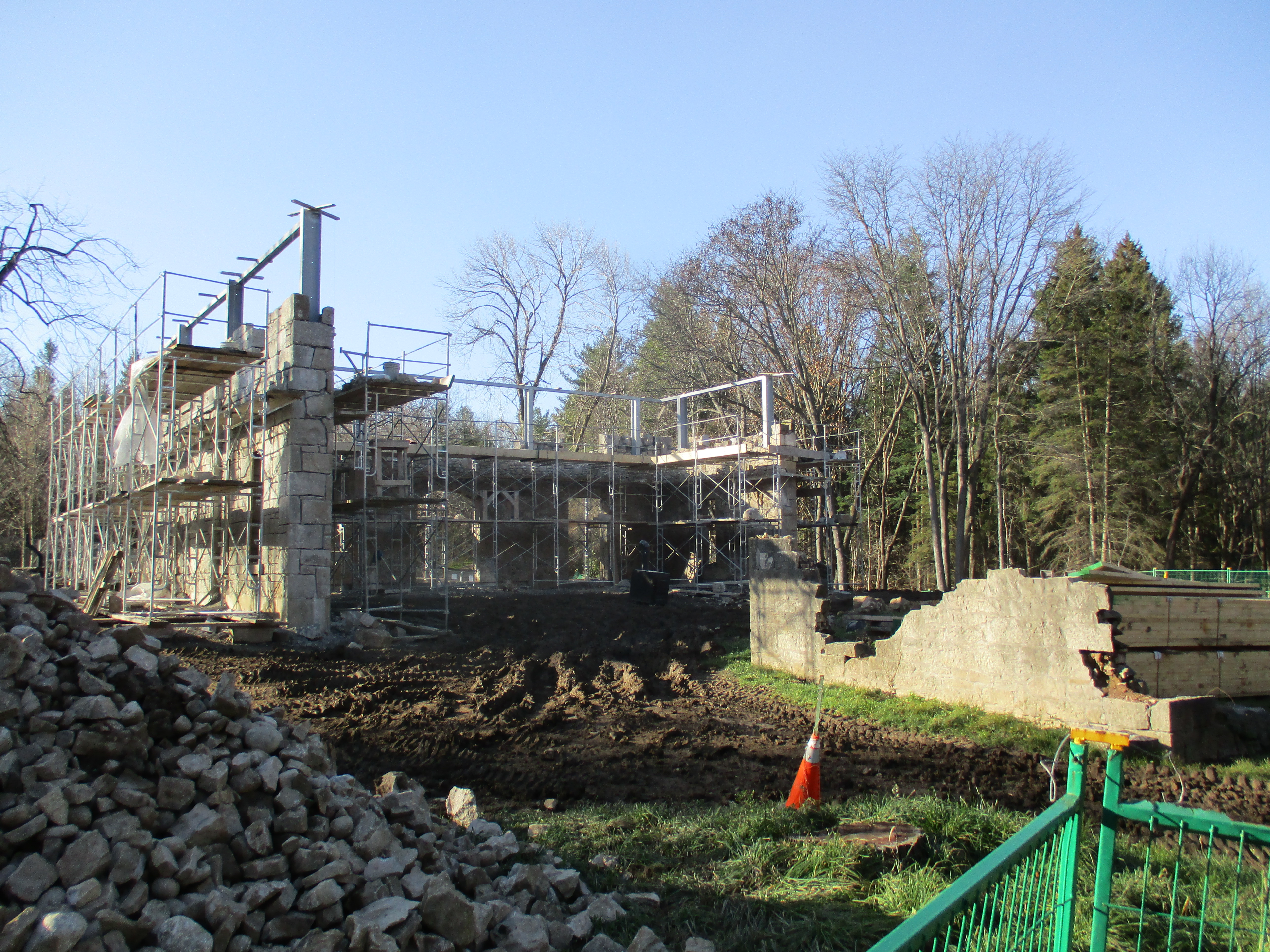
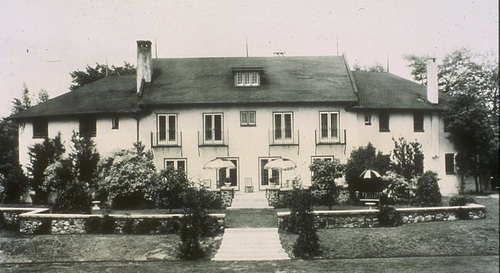
Originally published on April 19th and recently given a Throwback Thursday release Guildwood Park where the inn is currently being restored.  The post looks at the Guild Inn and it’s history along with several preserved pieces of early Toronto architecture.
Guildwood Inn original

May saw the release of Dufferin Creek which featured the remains of a 150 year old plank road that ran up Dufferin Street near Finch Avenue.  It is related to Garbage Park which was a post featured in The Toronto Star.  The spikes in the planks from the old road are 2 inches thick and 3 feet long.

IMG_3603

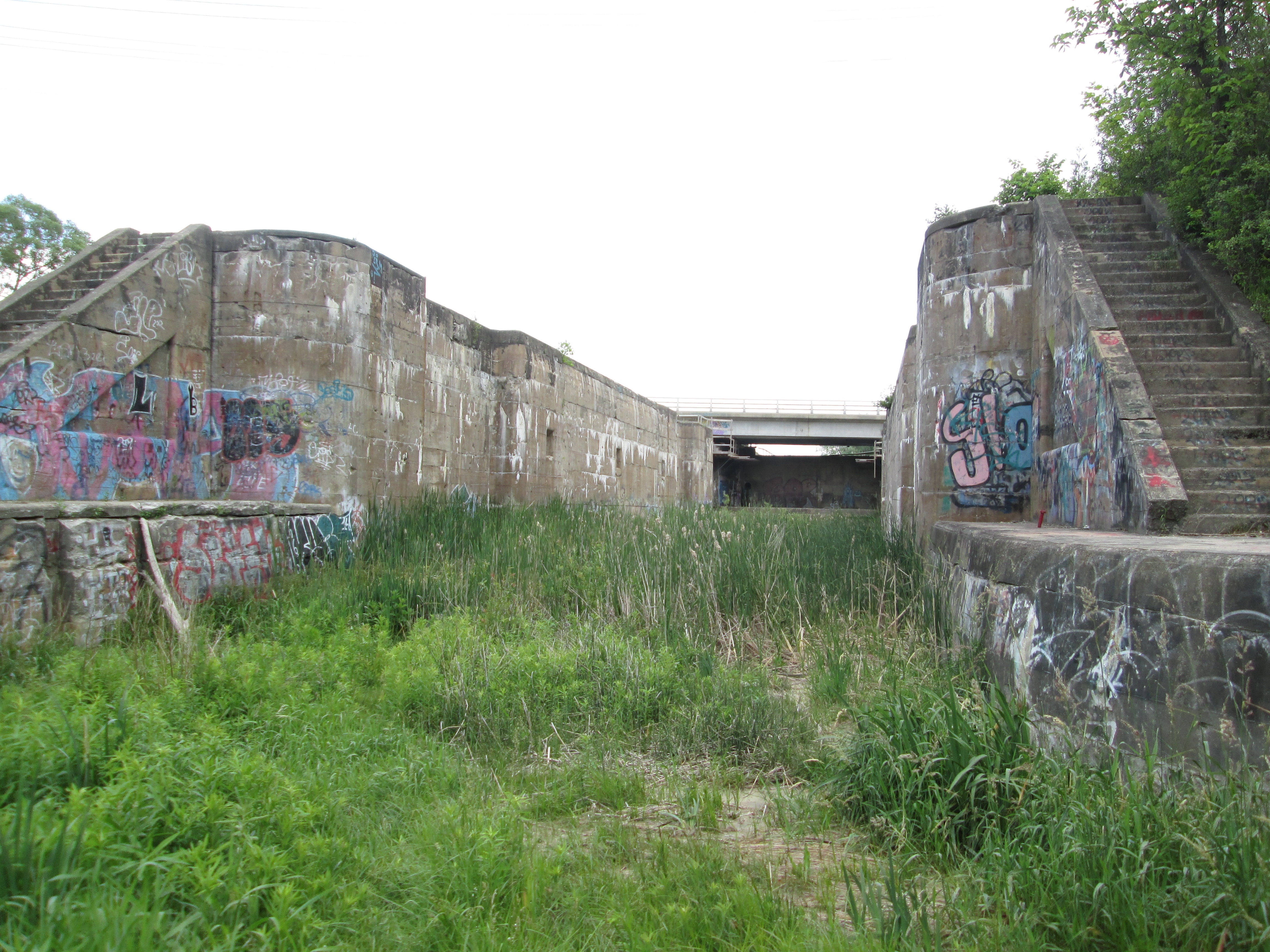
The first day of summer saw the release of our most popular post of all time.  The Newmarket Ghost Canal features the remains of the nearly completed but long abandoned attempt to link Newmarket to Lake Simcoe by a canal.
IMG_5850

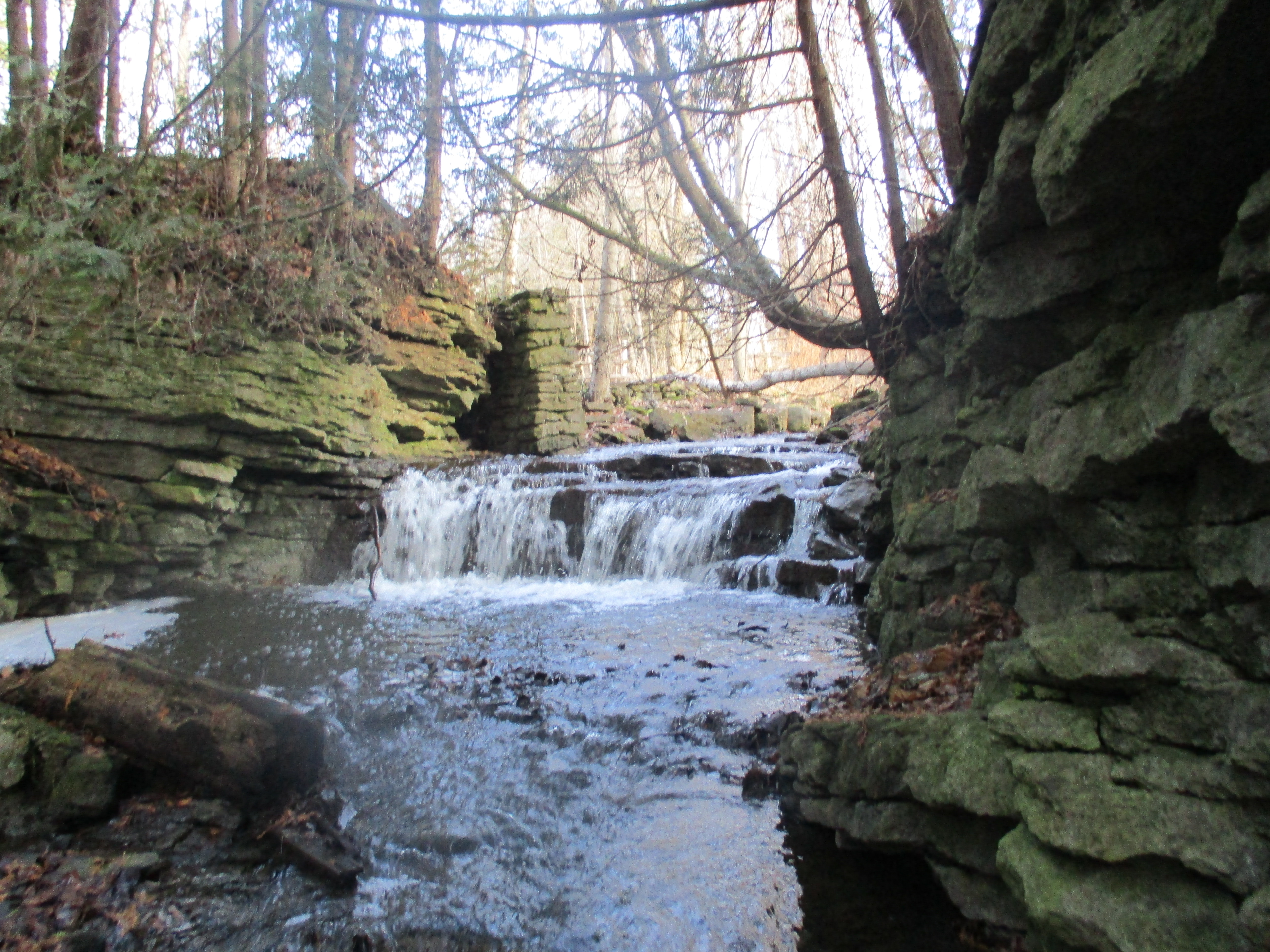
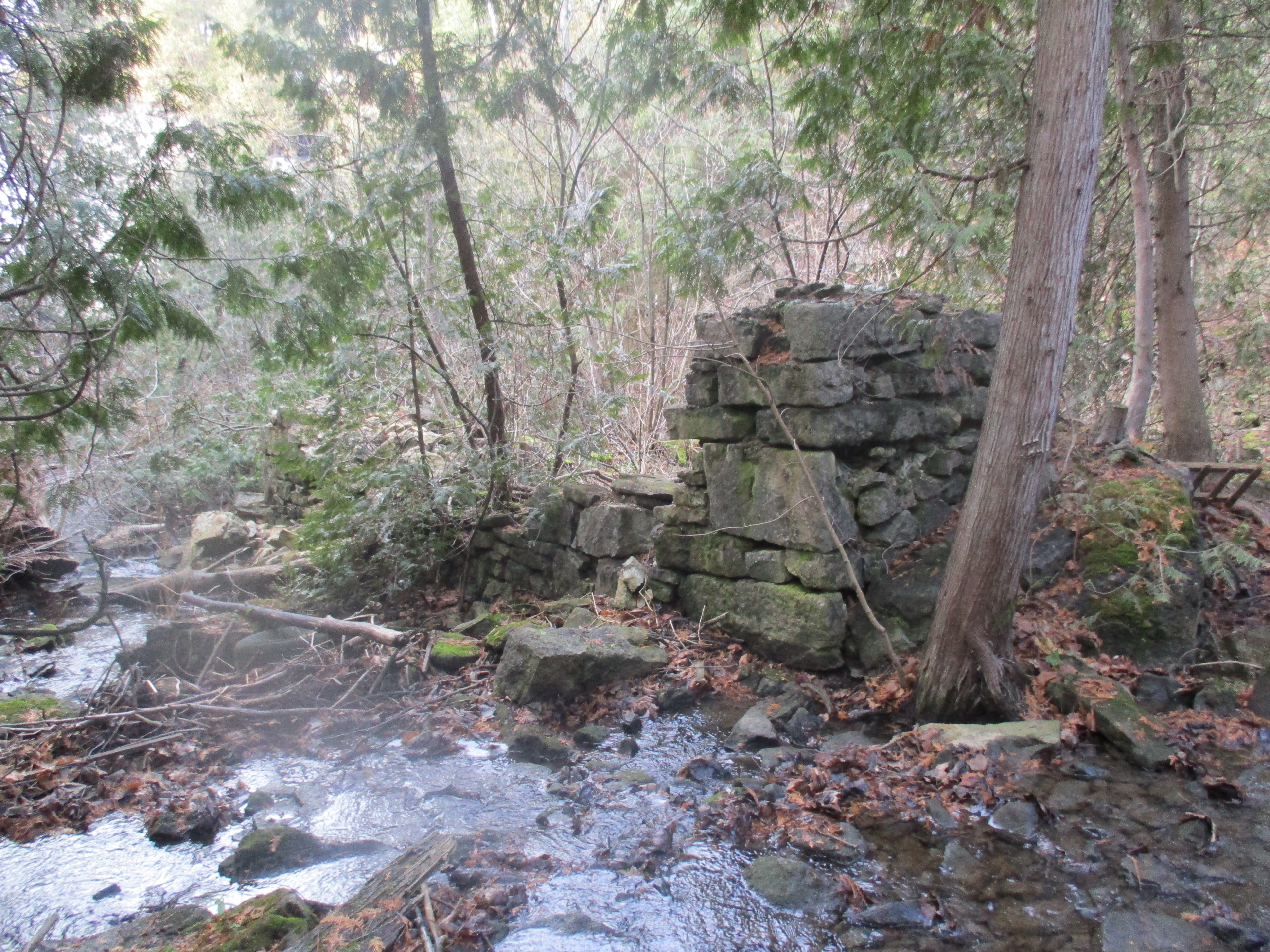
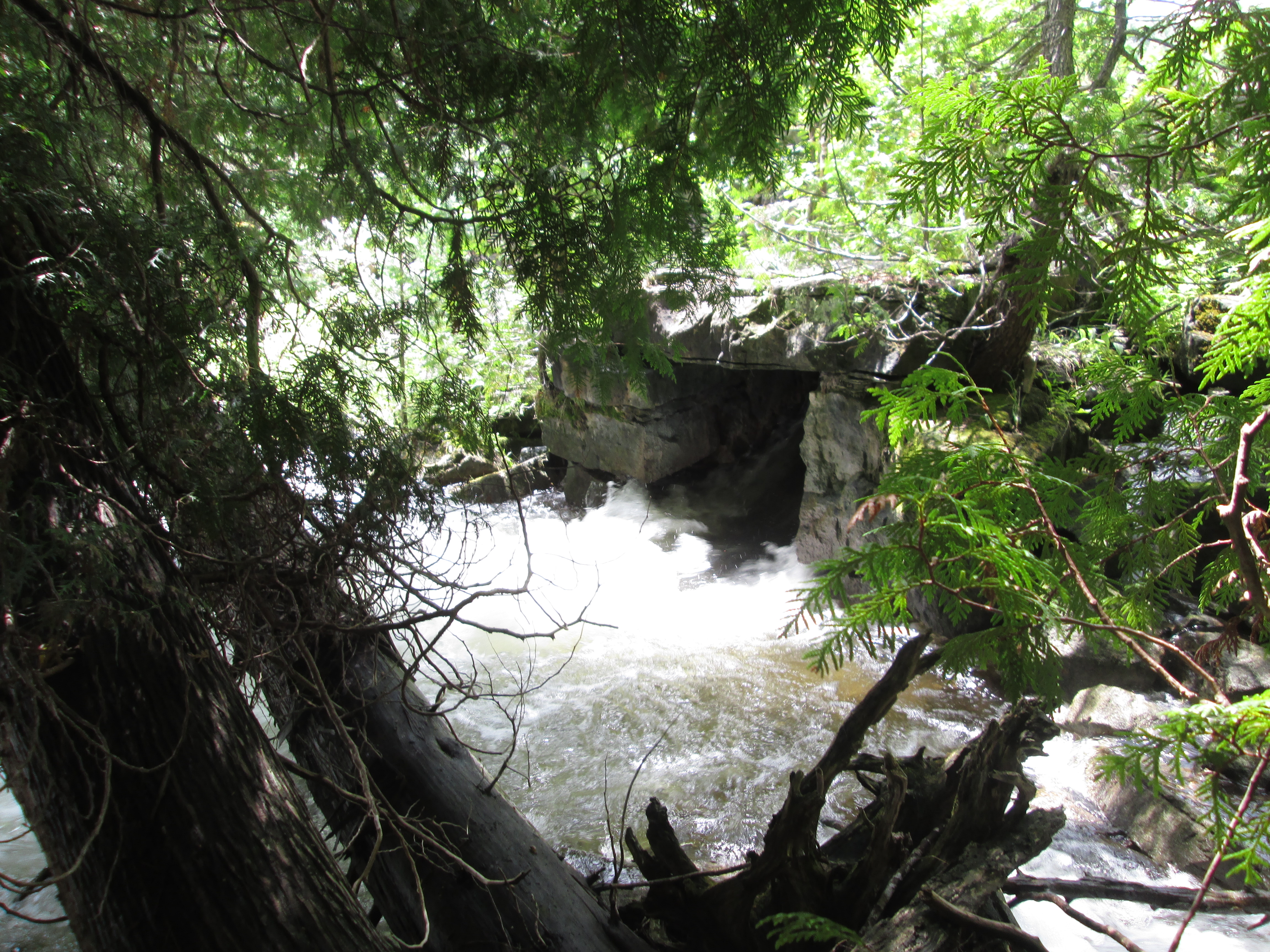
In July we completed our first 100 posts on Hiking the GTA and issued a review called Greatest Treks.  One of the most interesting hikes of the month was The Stonecutter’s Dam.  We visited an old dam near the Forks of the Credit which is made of blocks of cut stone.  It also sports a rare stone penstock as seen below.
IMG_6710

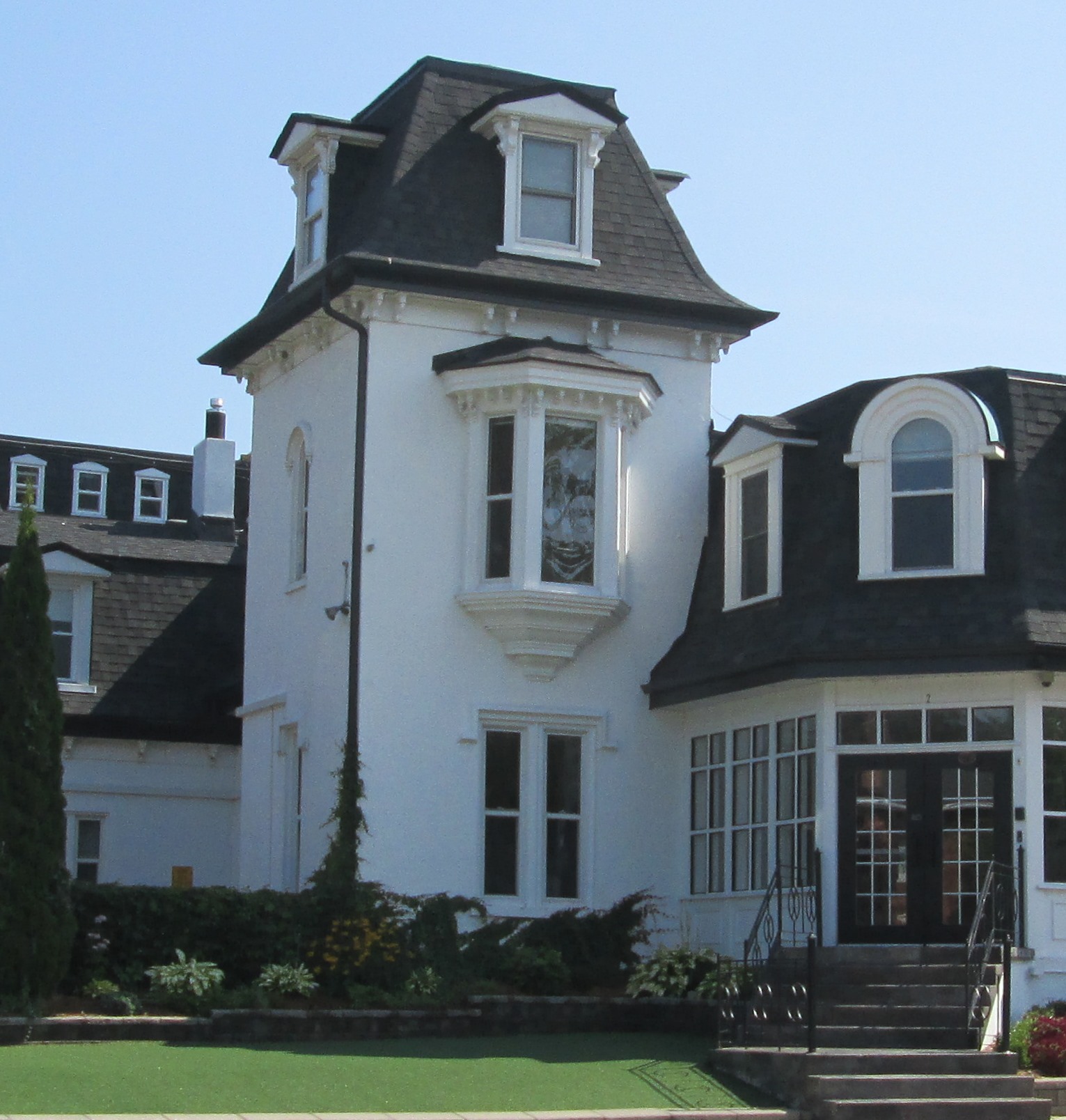
On August 15th we checked out Kerosene Castle in Oakville.  The castle was built by Richard Shaw who was refining coal into kerosene in a factory across the street on Sixteen Mile Creek. Until it blew up, that is!  When we got looking at the pictures we saw that one of them appears to have a large face in the oriel window.  It doesn’t show up in any other pictures we took that day.
IMG_7400 face

September 12th we visited the Ghost Town of Sixteen Hollow to see what remains of the formerly thriving mill village on Sixteen Mile Creek.  There is plenty of history here but all that remains of the original village is the church and the some newer bridge structures.

Sixteen Hollow 2

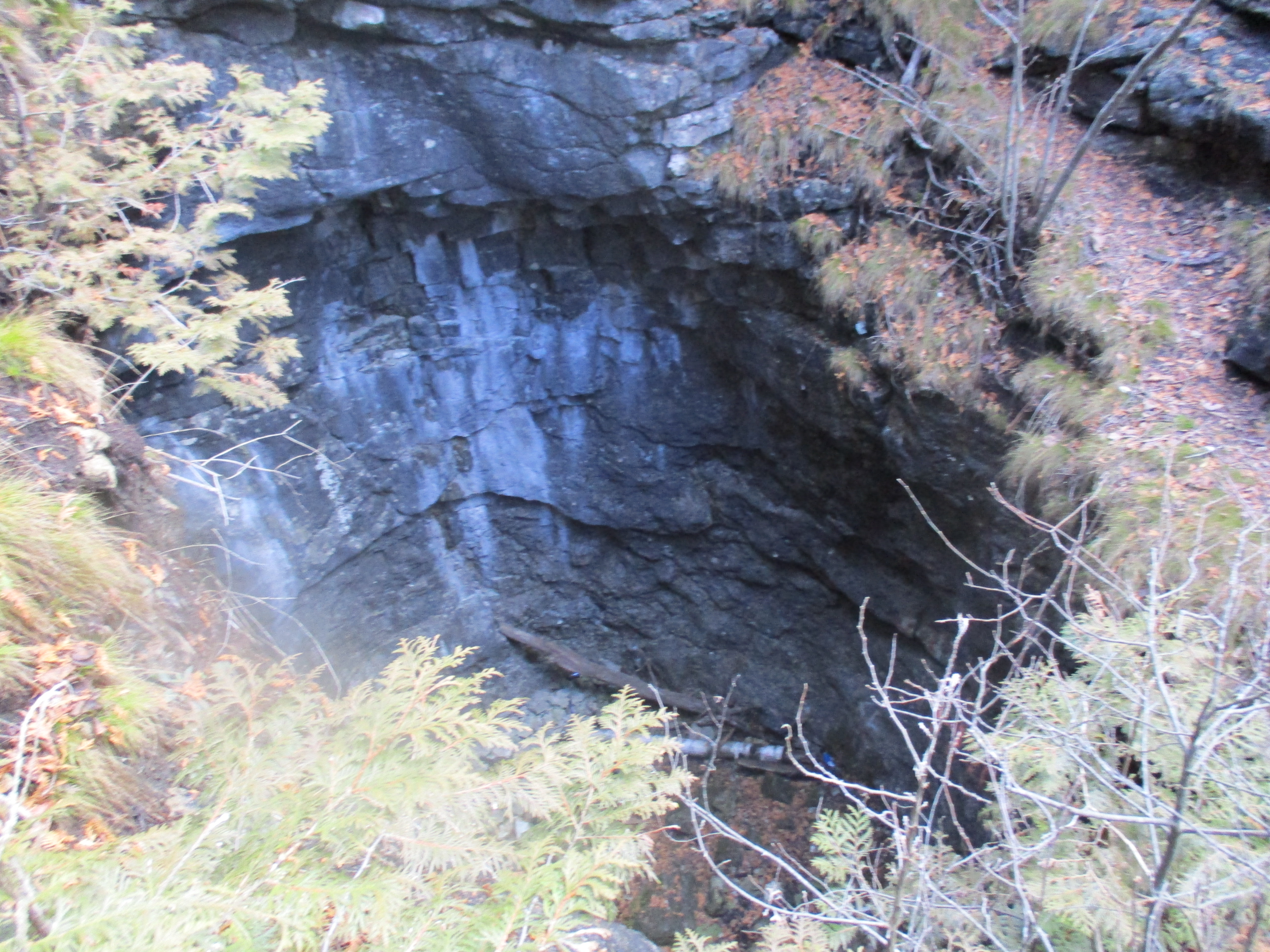
October featured a discovery related to the Caledon Aerial Tramway which made for an interesting hike.  On the 24th we found the 2 inch steel cable on The Cox Property. The underground chamber for the cable is seen below.

IMG_0897

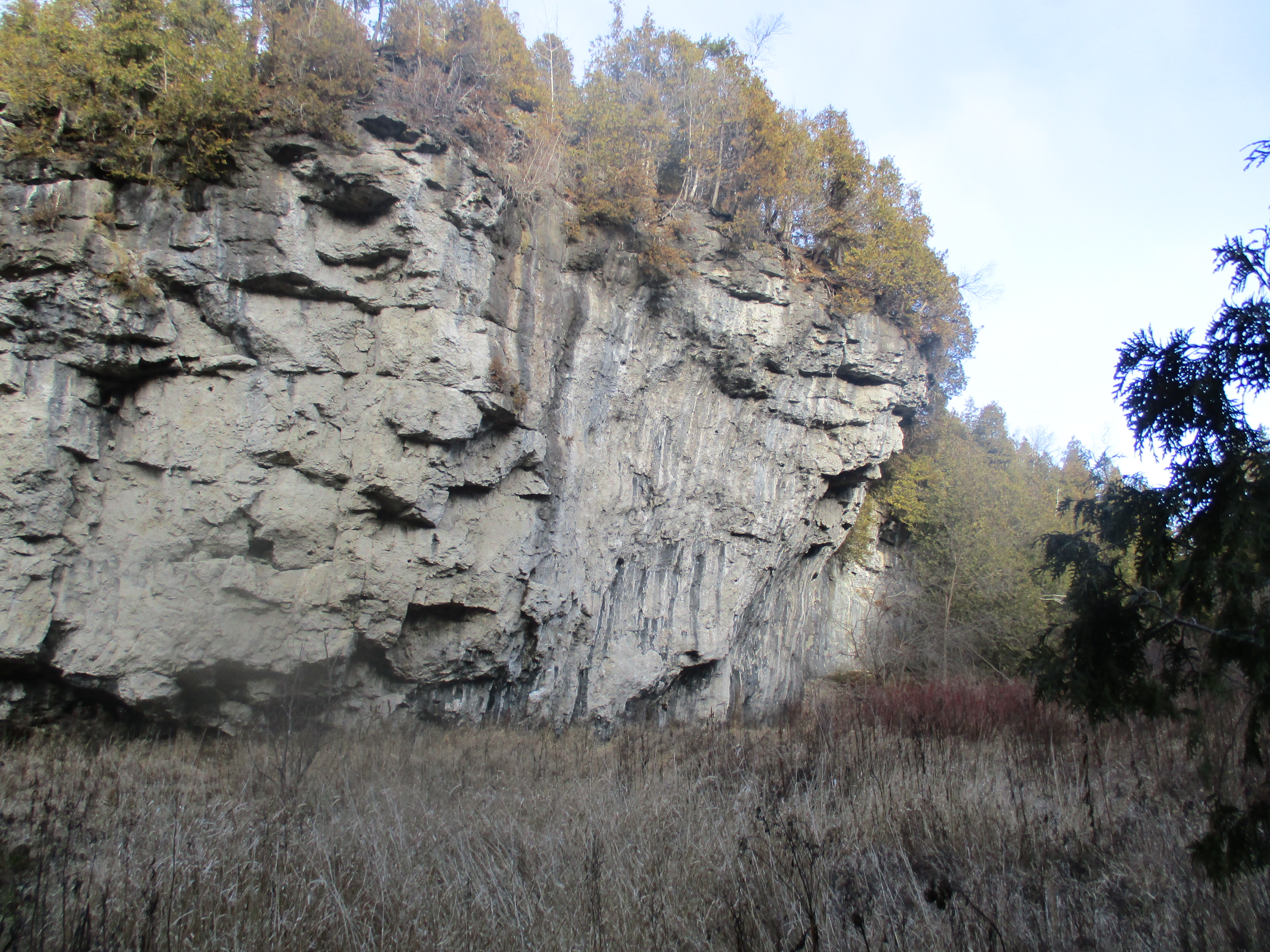
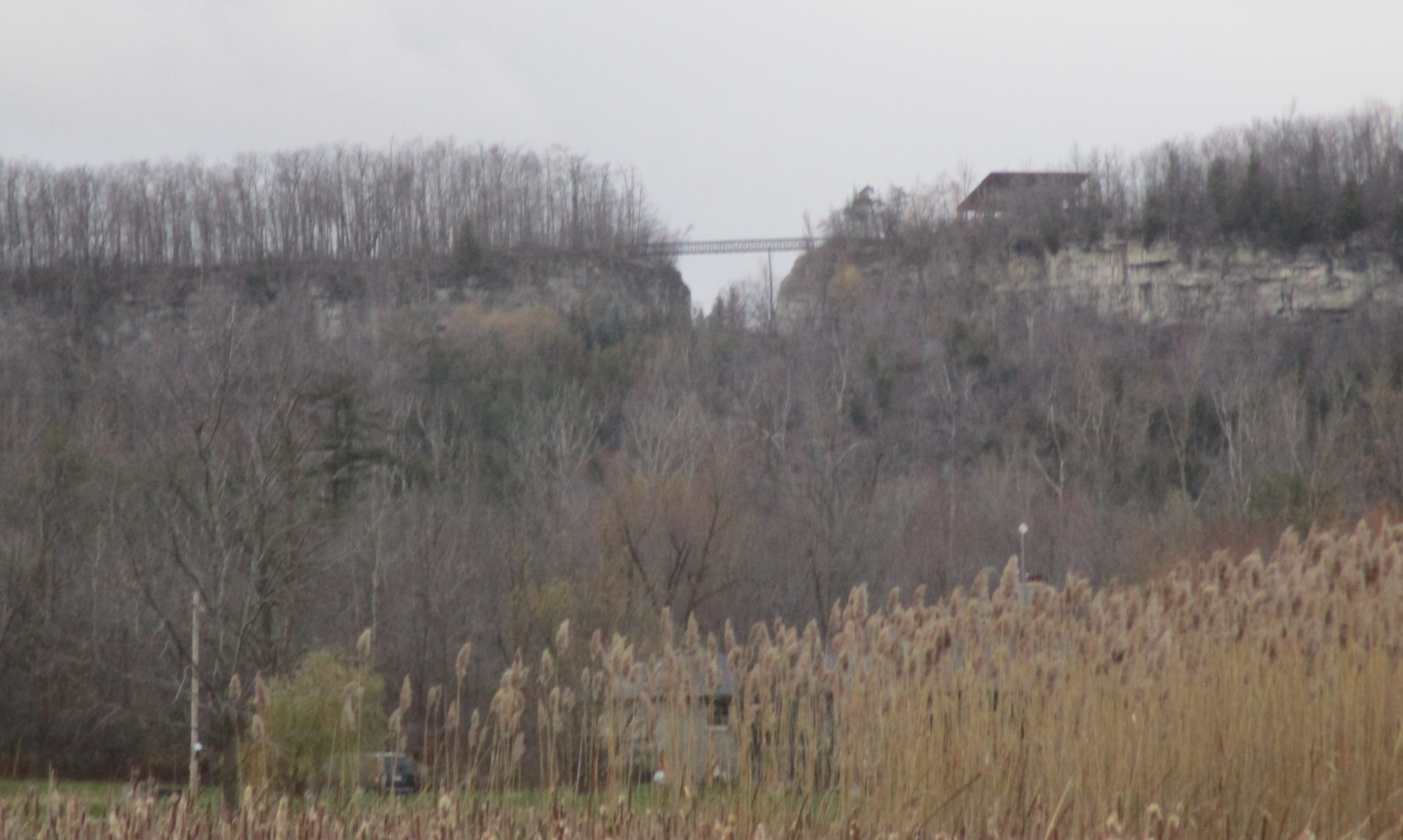
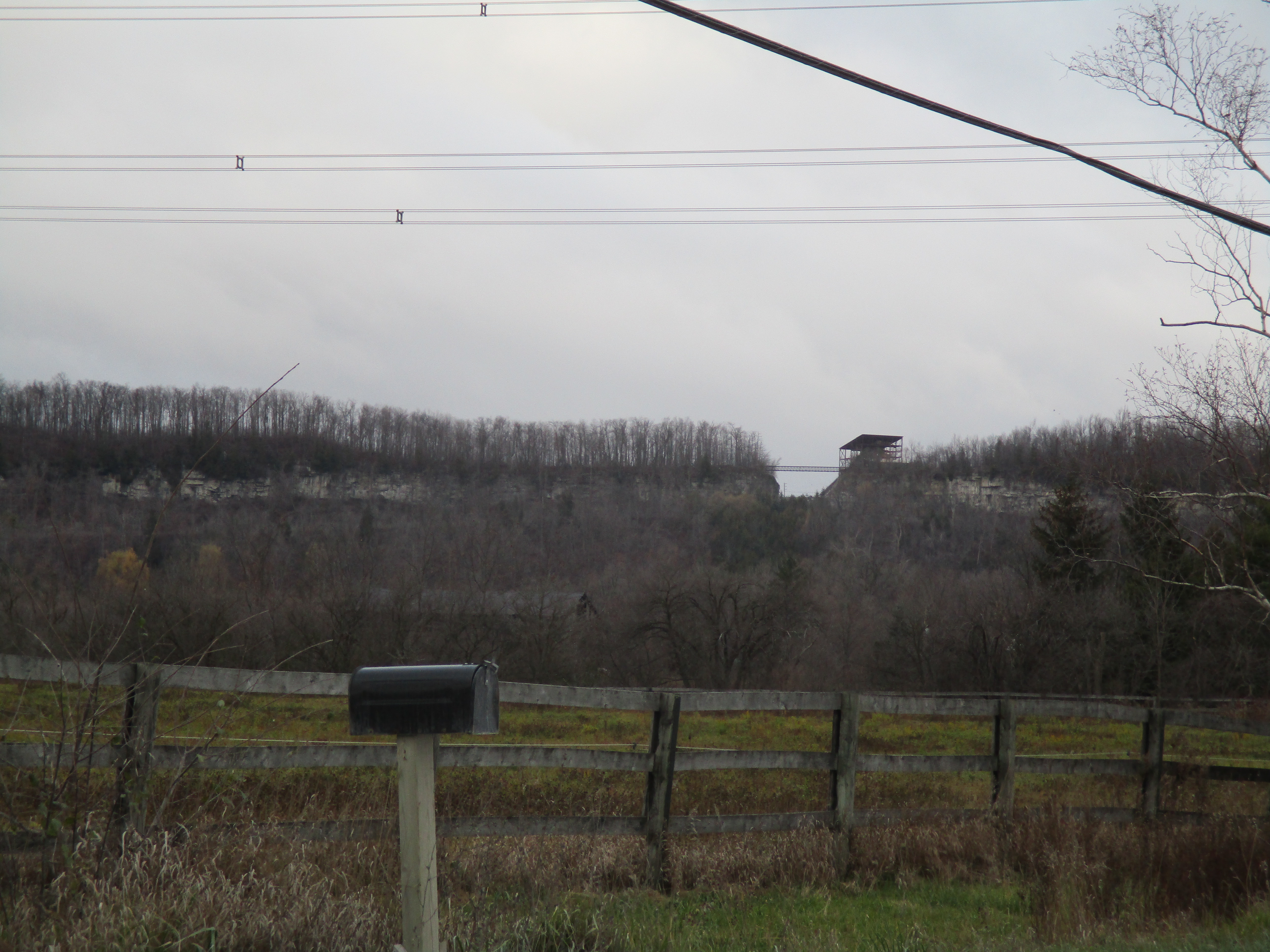
in 1962 a quarry blasted a gap in the escarpment near Milton.  We visited The Gap on Nov. 14th in a hike that went on to become the second most popular story so far.
IMG_1300

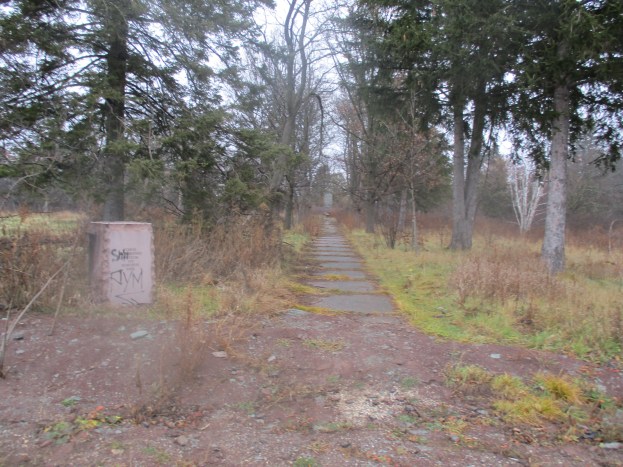
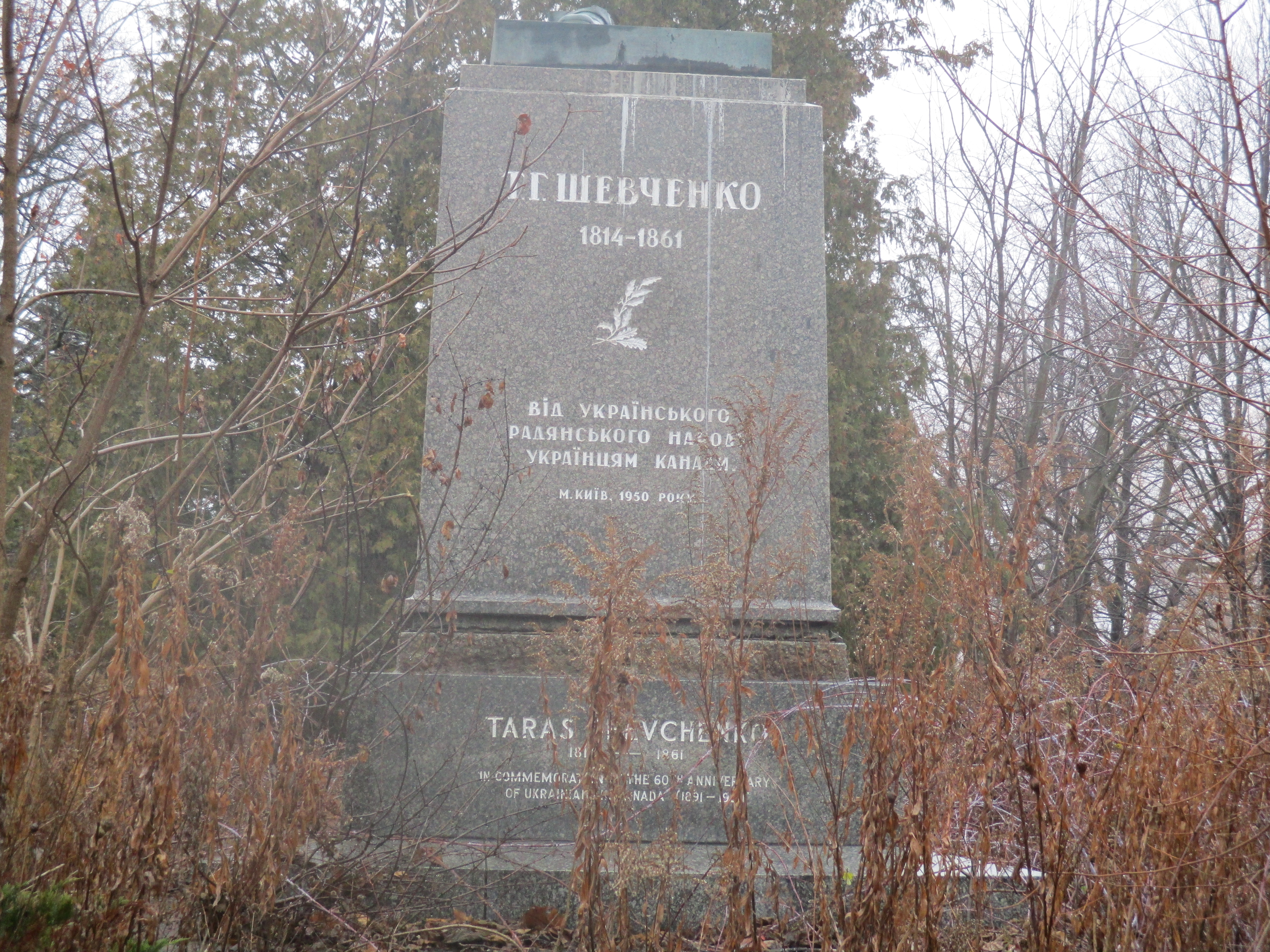
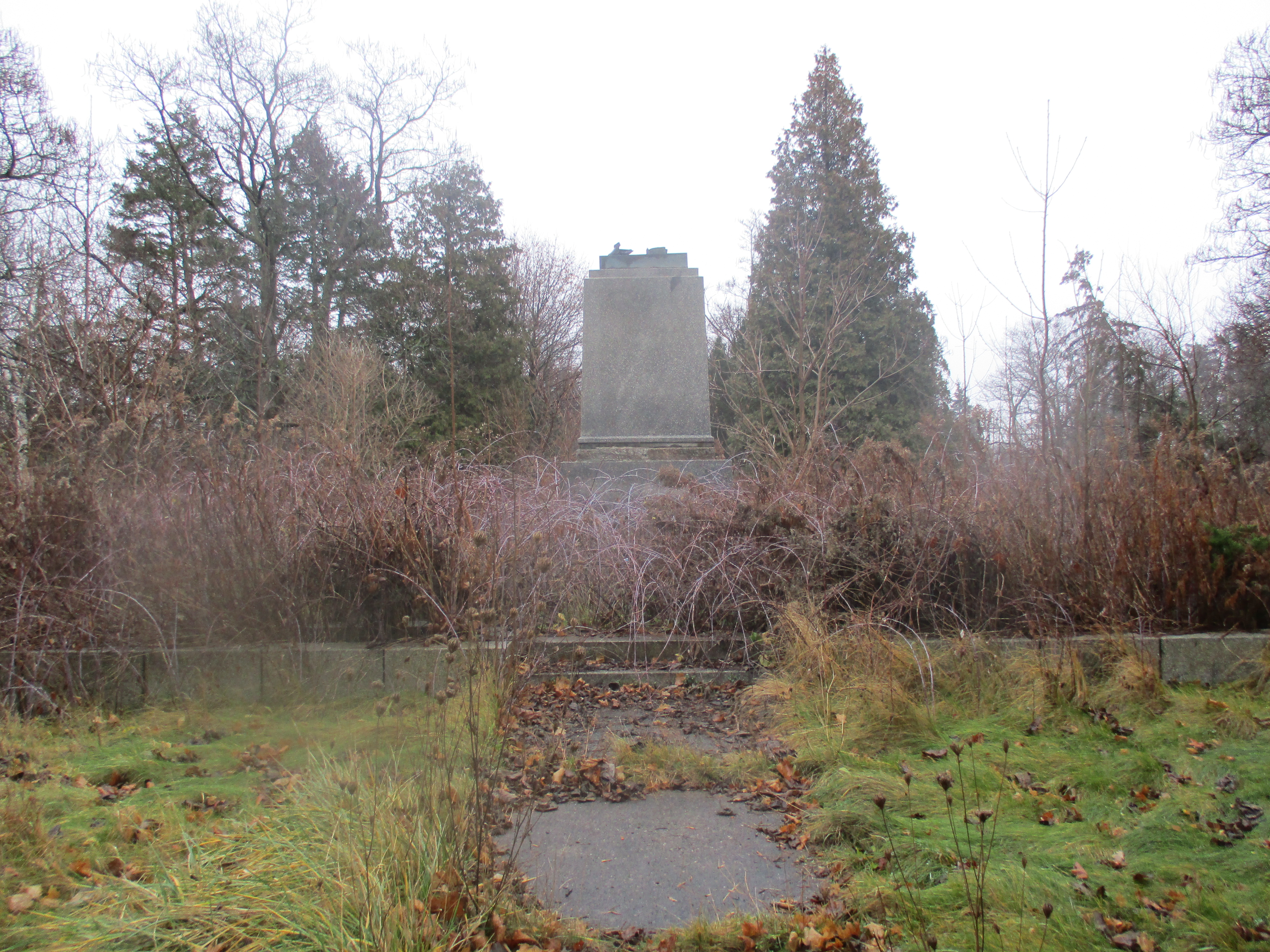
December was a busy time but it was an interesting month of hiking as well.  We were back in Oakville on Sixteen Mile Creek on Dec. 13th when we visited The Vandalized Memorial to Taras Shevchenko.  The museum was burned down, the monuments stolen and the site abandoned.
IMG_1912

Thanks again for reading Hiking the GTA in 2015 and we hope you all have a great 2016 and enjoy the trails!  We’re looking forward to many great hikes this year ourselves.

Like us at http://www.facebook.com/hikingthegta
The Devil’s Punch Bowl

Saturday Dec. 26, 2015

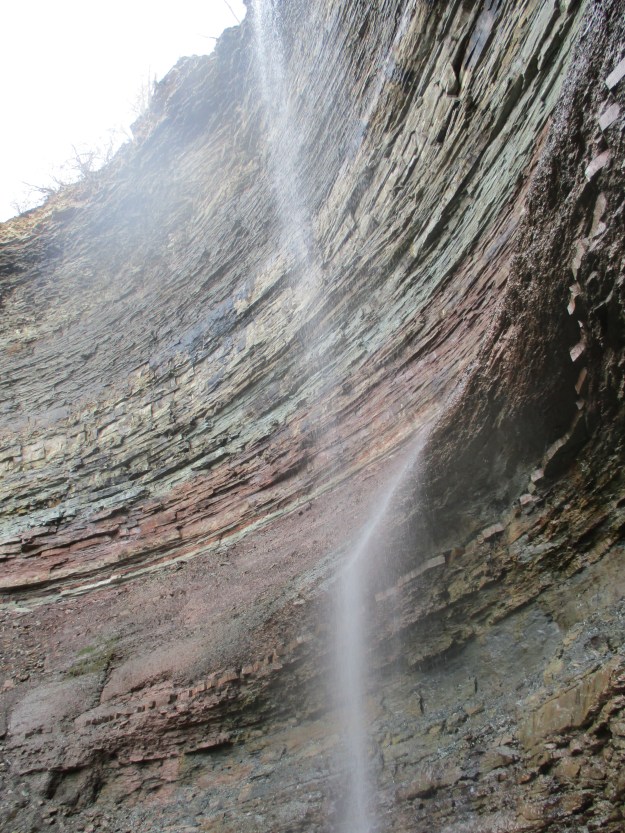
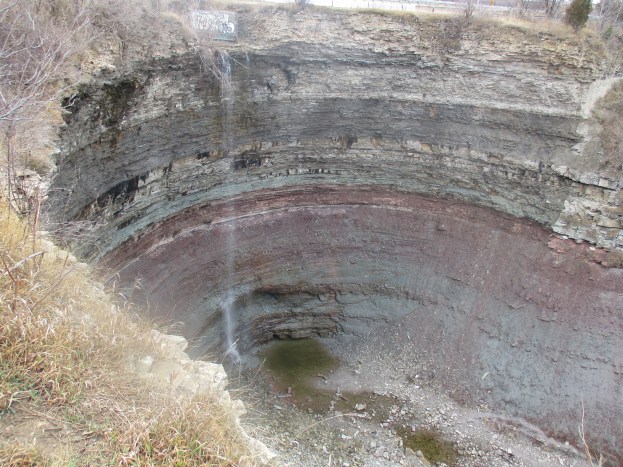
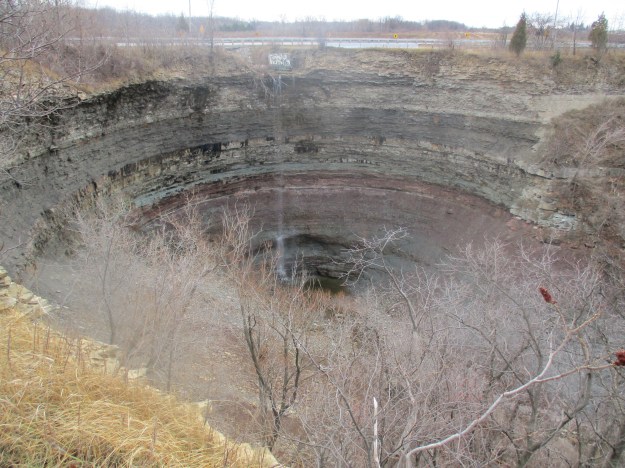
The Devil’s Punch Bowl is a 37 metre gorge in the Niagara Escarpment near Stoney Creek where all the various strata of the Paleozoic era can be seen together.  Their colourful sequence along with a pair of waterfalls makes this a gorgeous gorge.  There is paid parking in the Devil’s Punch Bowl Conservation parking lot on Ridge Road in Hamilton.

The history of the Devil’s Punch Bowl name has been lost and all that remains are stories.  One of these stories suggests that moonshiners were working along the Ridge Road and would go into the falls to get pails of fresh water for their wares.  Regardless of the origin of the name it is just one of the local geological features that have been given devilish nomenclatures.  Two other ones are The Devil’s Pulpit and The Devil’s Well, all three of which are far more beautiful than their names suggest.  The history of the gorge is as old as the escarpment and it’s formation over 450 million years ago.  The colours seen in the rock show the various layers as they were laid down in a vast inland sea.  The bowl itself was formed at the end of an ice age a million years ago from the flow of melting ice caps.  The picture below shows the gorge looking away from the punch bowl and toward Hamilton.  A steel cross stands on the right side of the gorge where it has been lit since Dec. 18, 1966 when it replaced a wooden cross on the same location.  The Toronto skyline can be seen from near the cross.

IMG_2057

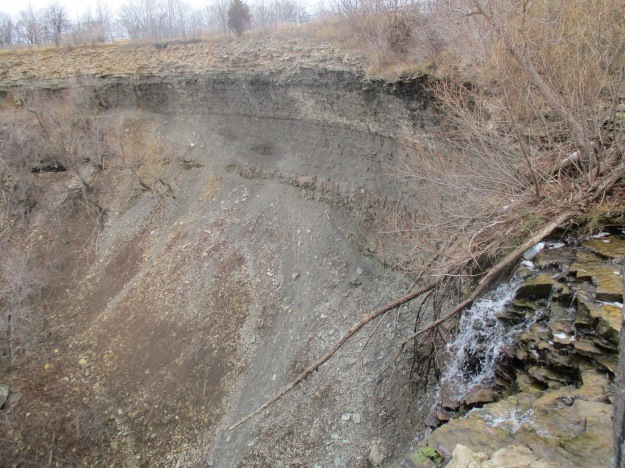
The picture below was taken from the top of the gorge where Stoney Creek plunges over the side.  Sometimes there’s a strong ribbon waterfall here but today the water level was very low.  The sides of the gorge have been filled with piles of talus which hides all but the upper rock layers. Over the years, erosion has broken rock debris off the sides of the gorge until it accumulates in sloping piles most of the way to the top. This makes decent of the sides impossible although I did notice the remains of rappelling anchors on the side of the old bridge abutment near where this photo was taken.

IMG_2067

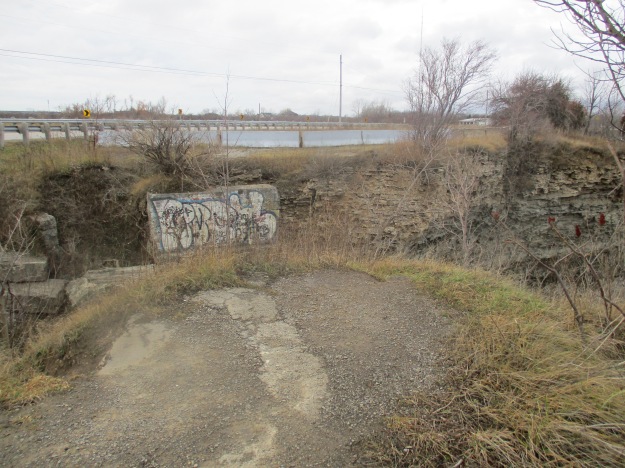
The road passed much closer to the Punch Bowl a hundred years ago.  Half of the north bridge abutment has broken off and fallen toward the creek.  The other half has been defaced with graffiti.  The bridge is right on the brink of the falls which means that either people were more adventurous in the past or the cliff edge is eroding back with time.

IMG_2056

As you walk along the side of The Devil’s Punch Bowl you can see full depth of the gorge and the waterfall.  The cover photo also shows the concrete bridge abutment where the road used to pass closer to the gorge edge .  There are stories of people who have either jumped or fallen to their death in the punch bowl and it is important to keep back from the edge as it can give way at any time.

IMG_2080

We descended a blue side trail to reach the level of Stoney Creek so we could make our way back into the punch bowl.  The creek bed is littered with broken pieces of Whirlstone formation sandstone that have trees growing up between them.  Along the way, between the train tracks and the lower punch bowl, the creek cascades over several minor waterfalls.

IMG_2103

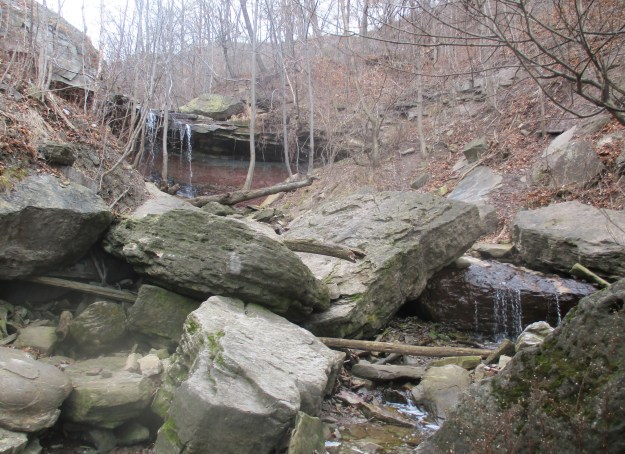
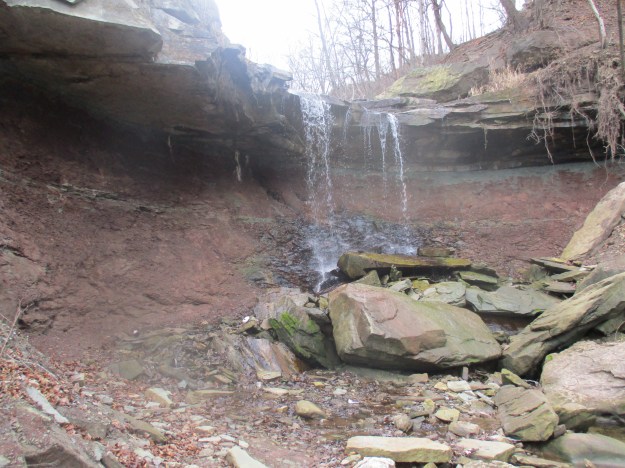
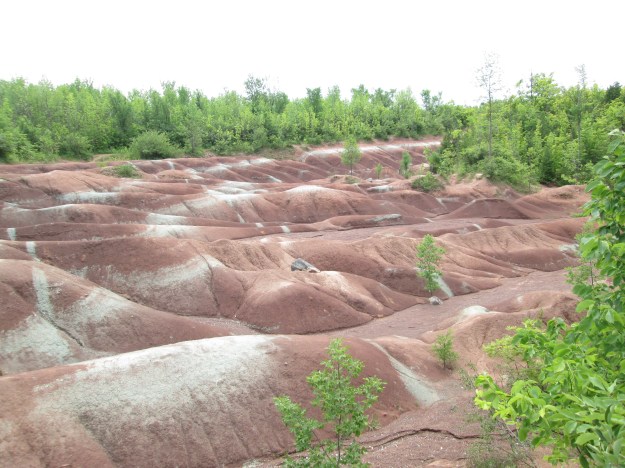
The lower punch bowl is 7 metres deep and 7 metres in diameter.  This second waterfall exposes another formation that is not visible in the upper punch bowl.  The harder sandstone of the Whirlpool formation sits on the bedrock of the Niagara Escarpment which is known as the Queenston Formation and is named after the town of Queenston.  The Queenston formation is made of maroon coloured shale that formed in slow moving waters in an area known as the Queenston Delta.  The red comes from oxidation of iron minerals and the grey-green layers contain shale that has gained an electron during oxidation in a process known as reduction.  This layer can be up to 300 metres thick and is often devoid of fossils.  The sandstone is harder than the shale and therefore it erodes slower leaving an overhang at the lower falls.  This shelf will eventually break off as can be seen by the sandstone chunks at the bottom of the falls.

IMG_2106

This is the same layer that is exposed at the Cheltenham Badlands where this picture was taken on July 4th, 2015.

IMG_6256

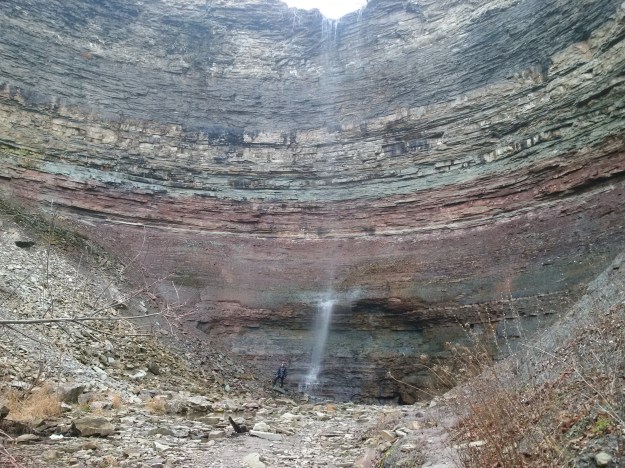
We passed the lower punch bowl and continued to climb the creek bed uphill.  As you enter the Devil’s Punch Bowl from the bottom you pass by sloping talus on both sides to emerge into the round inner bowl.  Even with only a limited waterfall the sight is incredible.  In the picture below a person is standing on talus to the left of the plunge pool at the bottom of the falls.  This gives some indication of the height of the gorge at this location. There are at least 10 distinct formations or layers that can be seen here.  The bottom visible layer is the Whirlpool formation which forms the upper shelf of the lower punch bowl falls.

Bowl

The capstone of the Niagara Escarpment is known as the Lockport formation and is a hard dolostone.  It has two distinct layers with the second being the first thin light line and below it is the softer Rochester Shale formation which is a darker grey band.  It appears near the top of the picture below.  A second thin light band of dolostone lies just below it.

IMG_2117a

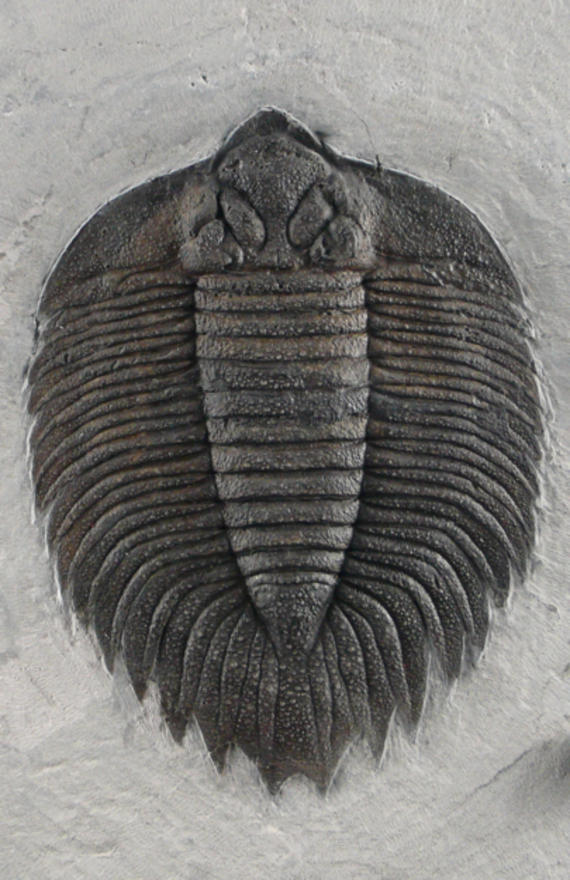
This shale formation is known for it’s heavy concentration of marine fossils including many trilobites.  The picture below is not mine, unfortunately, but shows one of these fossils that was found in the same geological layer in New York State.

trilobite-arctinurus-boltoni-2_pinboarditemoverlay

The waterfall bounces off of the reddish layer known as the Grimsby formation.  Directly above it is a grey-green layer known as the Thorold formation.  These two sections, and specifically the contact point between them, provide much of Ontario’s gas production along Lake Erie.

IMG_2115

We followed a blue side trail which runs along the the north side of the gorge and links back to Ridge Road.  Along the side of the trail stand the foundations for a former building which had a grand view of the Devil’s Punch Bowl.

IMG_2121

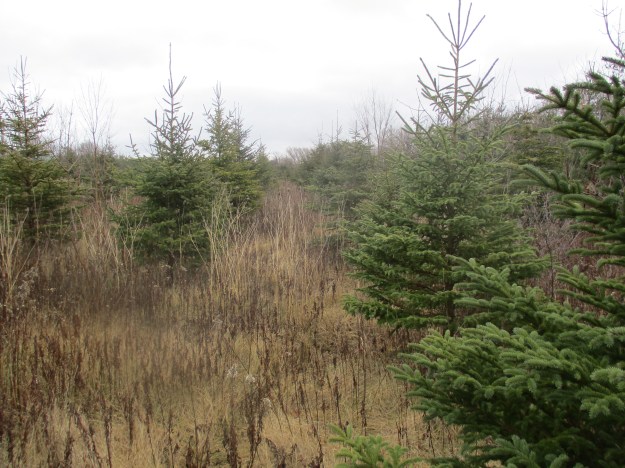
As we returned to the car we took a minute to investigate the start of the Dofasco 2000 trail which is right across the street from the parking lot.  This 11.5 kilometer trail will connect to Battlefield House where the Battle of Stoney Creek took place on June 6, 1813.  We only went a short distance where runs through what appears to be an abandoned Christmas Tree farm. This trail offers a potential future exploration.

IMG_2055

The Devil’s Punch Bowl can be found at N43.21045 W79.75594

Like us at http://www.facebook.com/hikingthegta


Guelph Radial Trail – Acton Section

Dec. 19, 2015

Revised Jan. 6, 2016

The Toronto Suburban Railway (TSR) ran between Guelph and Toronto providing commuter service until it was shut down and abandoned on August 15, 1931.  Since that time the line has been dismantled and much of the right of way has been re-purposed, some of it as a hiking trail.  We decided to visit a small section of the Guelph Radial Trail near Acton.  We parked on the edge of town near where Mill Road has been closed off at the bottom end of Fairy Lake.

Mass transit in Toronto got started in 1849 when cabinet maker Burt Williams designed and built 4 horse drawn stage coaches which he operated from St. Lawrence Market to The Red Lion Inn in Yorkville.  On Sept. 11, 1861 the Toronto Street Railway began with a similar route and made some expansions over a 30 year franchise it held with the city.  In 1891 a new 30 year franchise was granted to the Toronto Street Railway under William Mackenzie and James Ross who agreed to eliminate horse drawn buses as part of their deal with the city.  Over the next 30 years the city annexed large areas and was unable to force the Toronto Street Railway to service them under their contract.  When the contract expired in 1921 the city created the Toronto Transportation Commission (TTC) to operate mass transit.

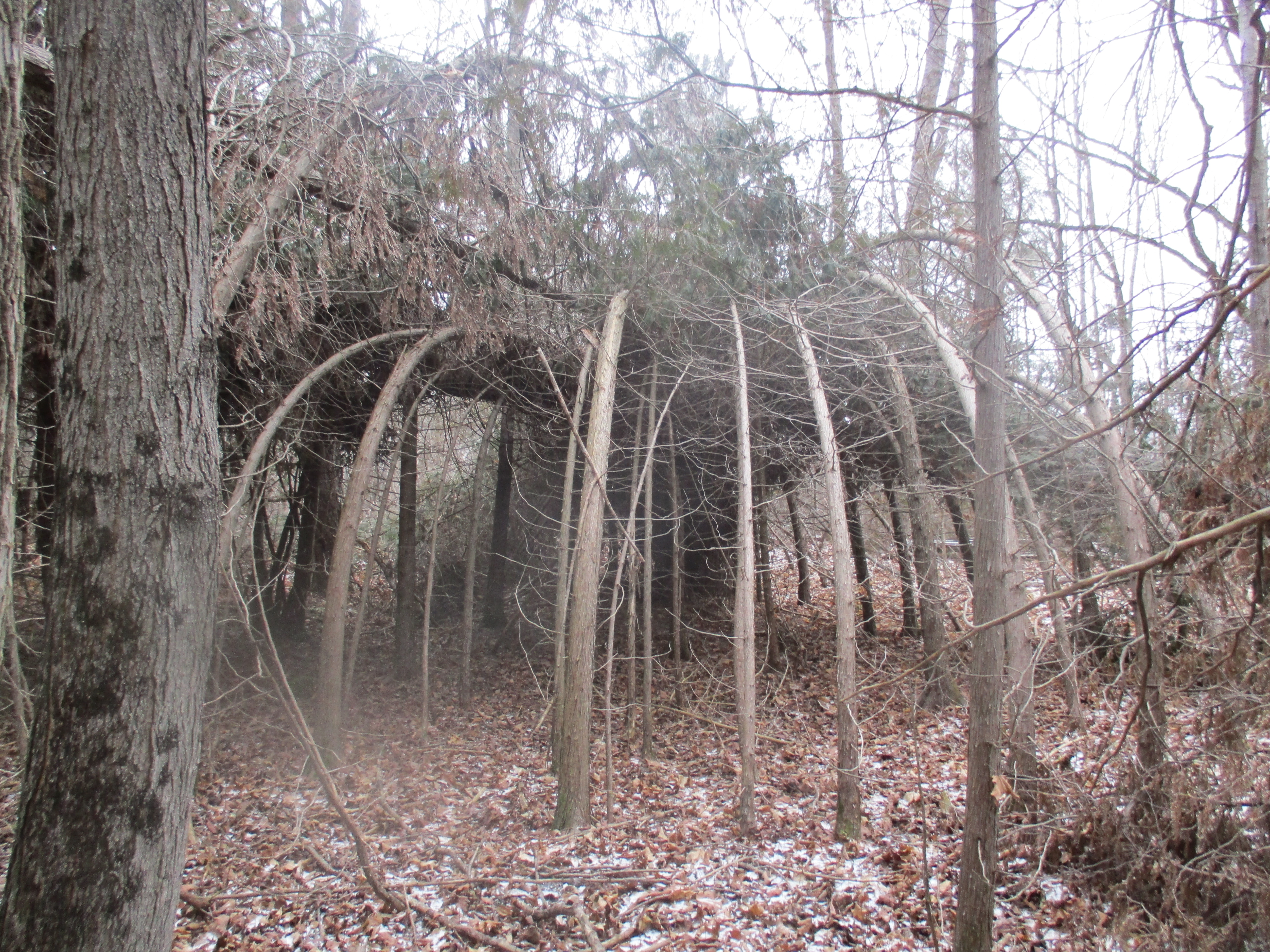
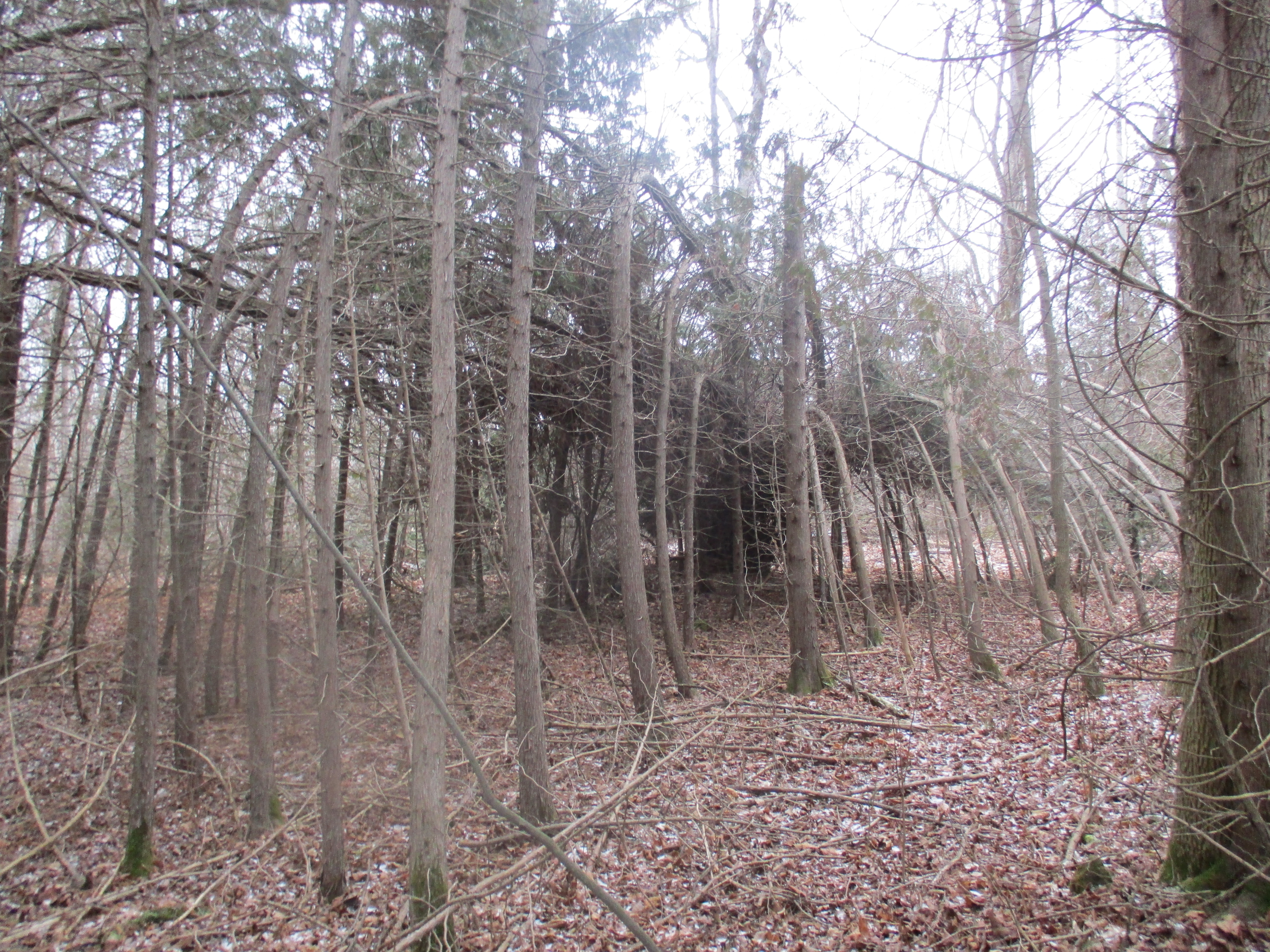
The first trail to the left takes you to the Guelph Radial Trail but first passes through a wooded area where we noticed an odd patch of trees.  There are bent trees throughout the woods but we found one spot where they all appear to have been taken from a large oval and tucked into a knot the middle.

IMG_1948

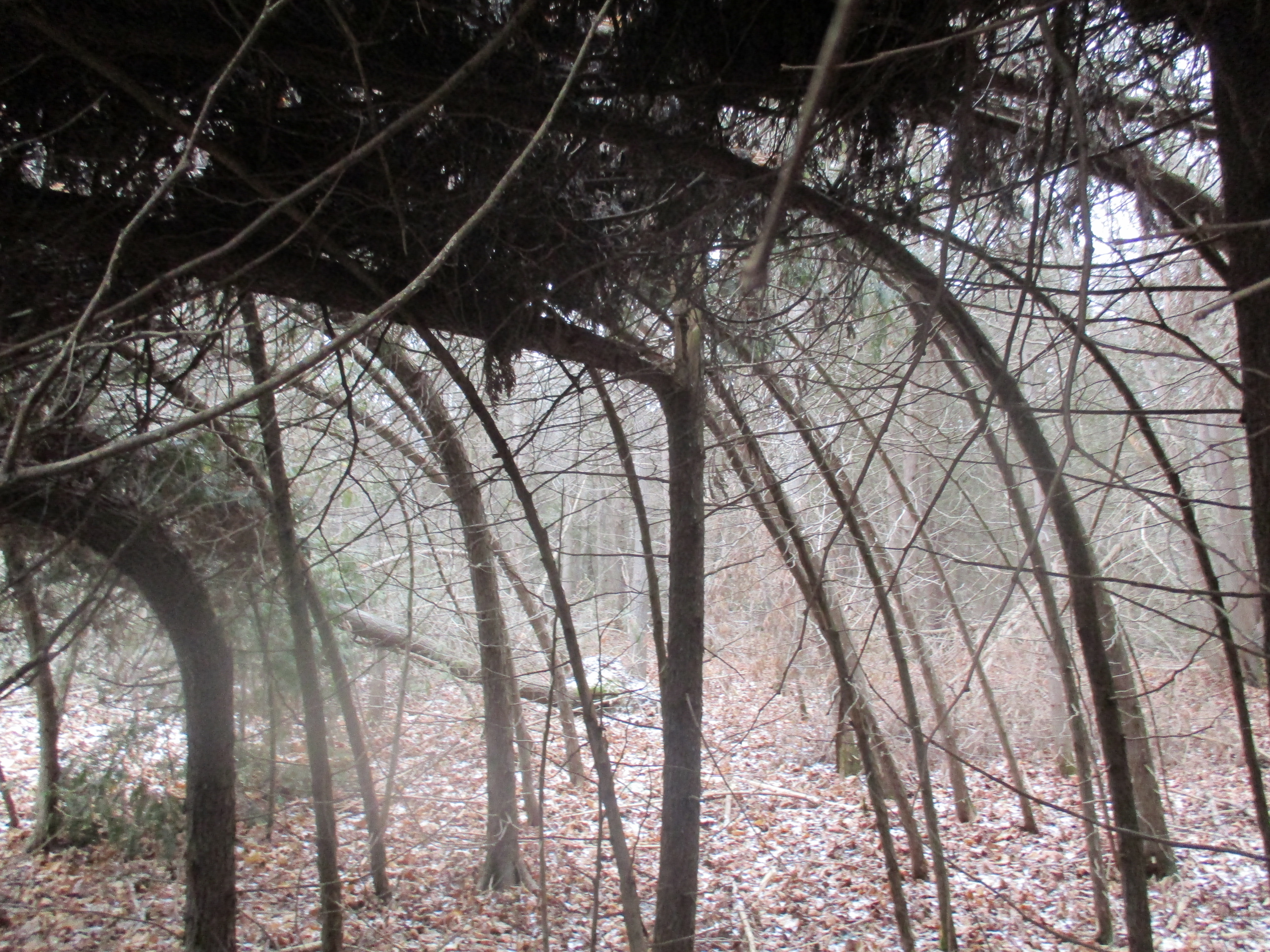
I had originally thought this looked like a circular cluster that had been produced by a spinning wind event but could find nothing on record.  A local resident confirmed that the ice storm of Dec. 22, 2013 had, in fact, caused the cedars to bend over to the ground where they stayed until the spring.  Some recovered but many didn’t leaving this reminder of just how powerful the weather can be.  This individual and his son, like countless others, helped clear the trails in the aftermath of the storm.  The long side of the oval is seen in the picture below.

IMG_1936

From the inside the bent trees it’s possible to see a few that have cracked but most of them appear to have been folded over without breaking.

IMG_1945

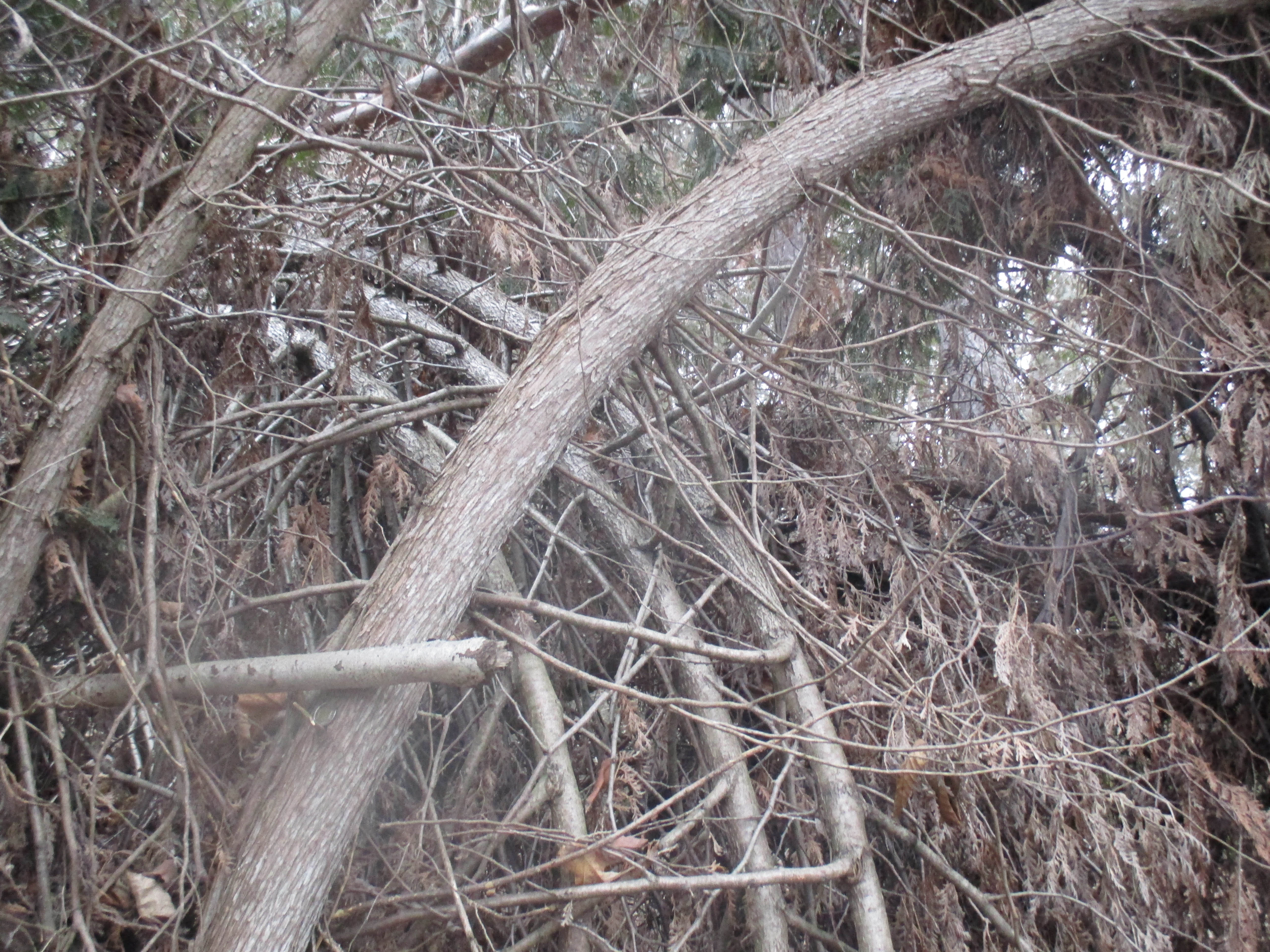
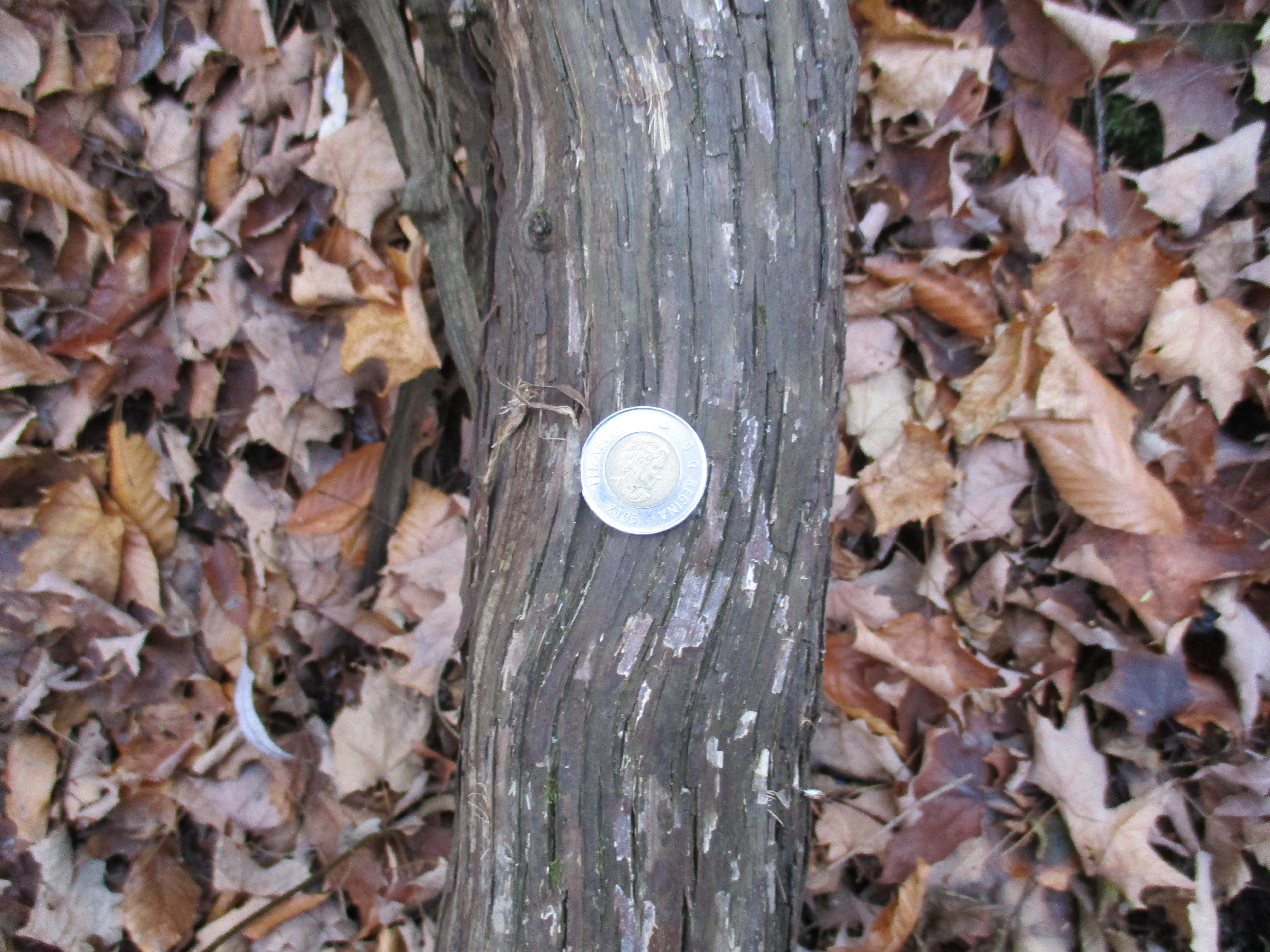
Just below the horizontal branch on the largest tree in the picture below is a “toonie” which shows that trees up to 4″ in diameter have been bent over.

IMG_1957

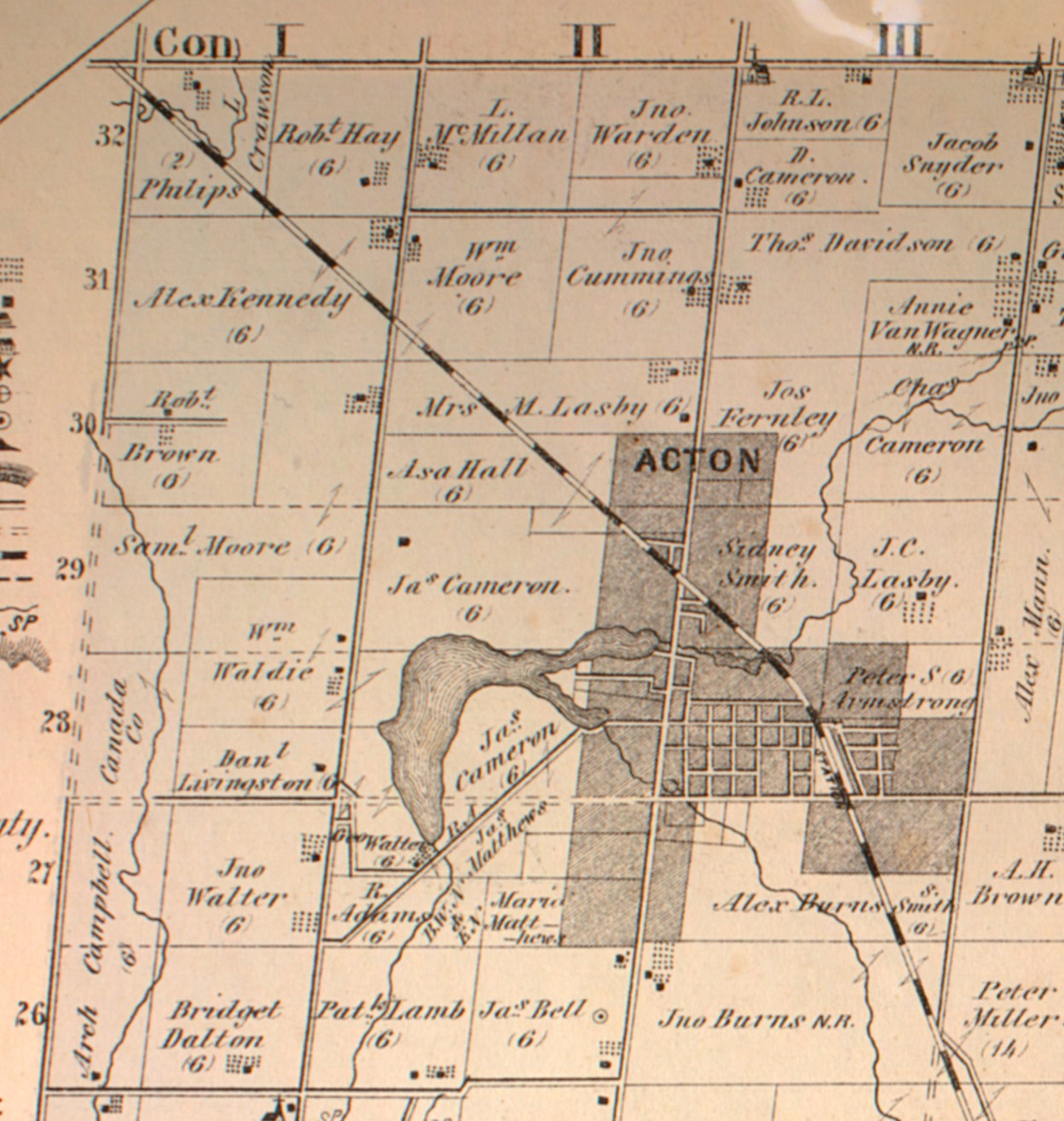
The 1877 county atlas shows Acton as having grown to the east of Fairy Lake along regional road 25 (2nd line) .  A grist mill stood at the outlet on the smaller of the two arms of the lake. Mill Street ran from the mill to Dublin Line (1st line).  We began our hike near the point where Mill Street touches the lower end of the lake.

Acton

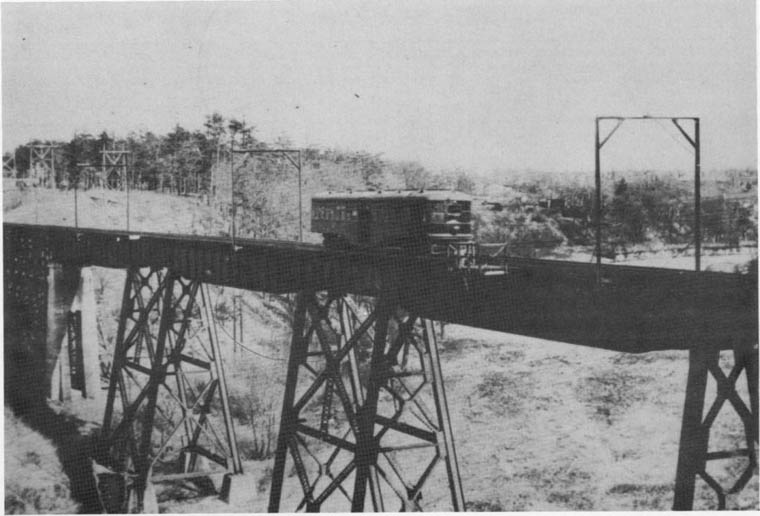
William Mackenzie, along with his partner Donald Mann, decided to expand their Toronto Street Railway service by adding radial lines to other communities.  In 1911 they surveyed the route for the Guelph Line which would run from Lambton yards for 49 miles to Guelph. Construction began in July 1912 and most of the track was installed in 1914.  The Great War slowed construction as did the building of a 711 foot bridge to cross the Humber  River.  One of the cars for the railway is seen crossing the Humber River trestle in the archive photo below.

humber-bridge_radial-car

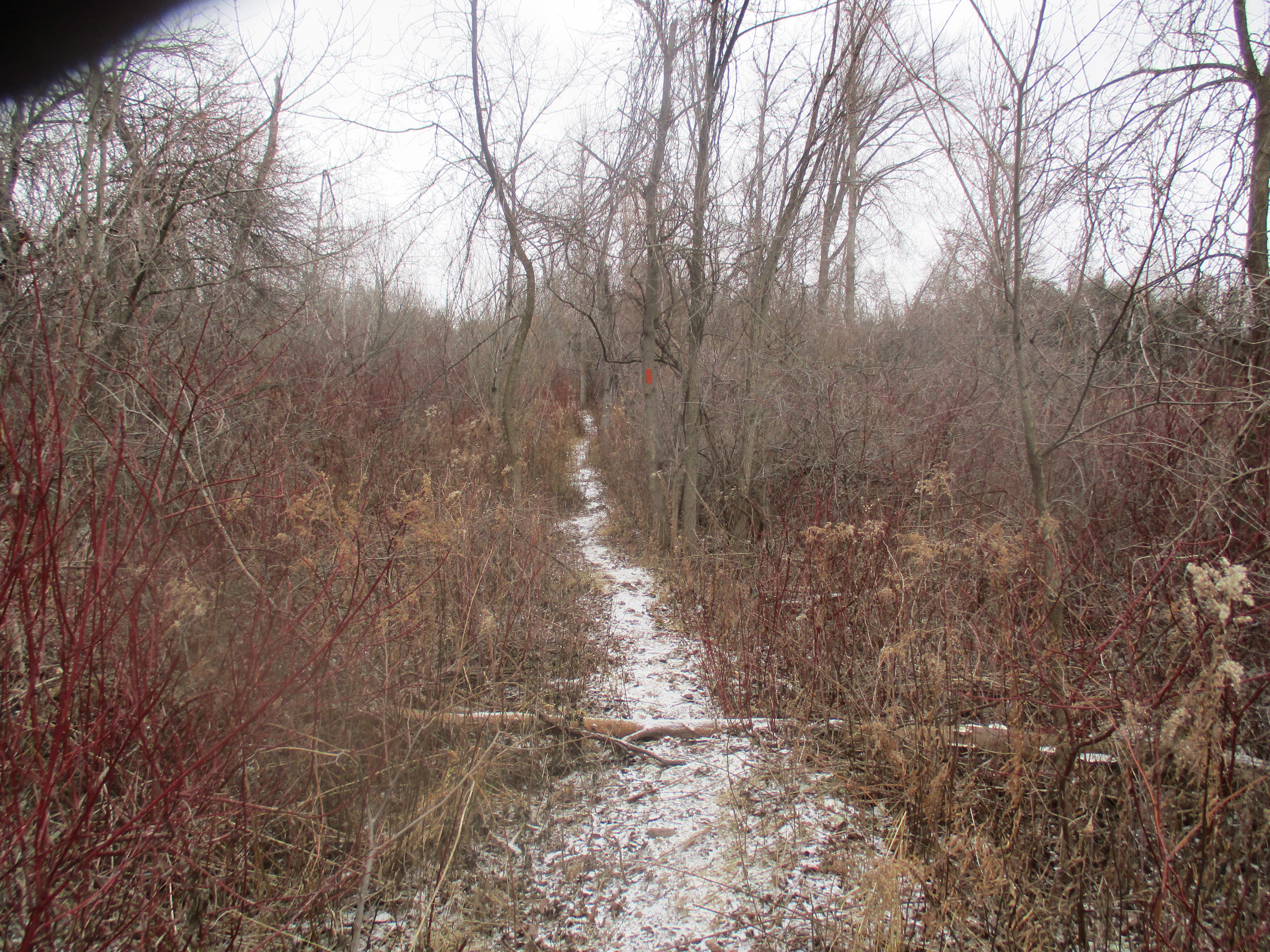
Mackenzie and Mann took steps to keep the costs down and this resulted in many curves to avoid purchasing expensive prime land for construction.  This caused the rail line to have to run slowly and this was partially responsible for it’s low ridership, especially in later years.  The line ran on private land, in some cases adjacent to highway 7, as it made it’s way toward Guelph. Personal automobiles led to the demise of the line and by 1929 it was operating at a loss.  In 1931 the daily ridership was down to just 300 passengers and service was suspended on Aug. 15.  The line was abandoned and the rails removed and re-used overseas during WW2. Today the Guelph Radial Trail covers part of the line from Limehouse into Guelph and has painted the trees with an orange blaze to mark the trail

IMG_1975

We visited remnants of the TSR in several places this summer and presented photographs in the following stories.  The crumbling remains of the bridge across Silverthorne’s grist mill tail race in Meadowvale and the rotting pilings in the mill pond at Eldorado Park are just two examples.  Today commuters sit on highway 7 and dream about a rail service on a private right of way that could run from Guelph to Toronto.  Perhaps the TSR was just 100 years ahead of its time.

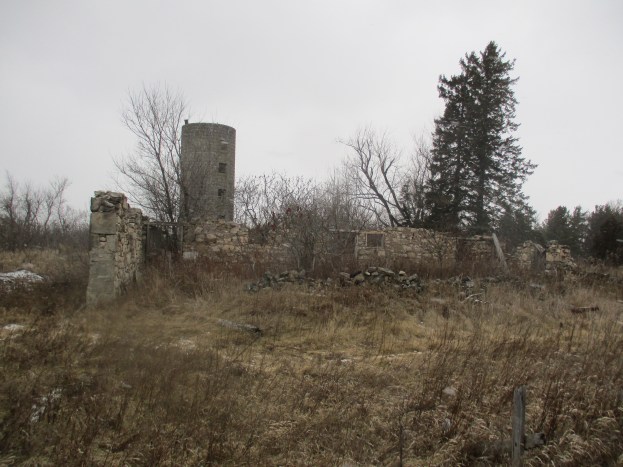
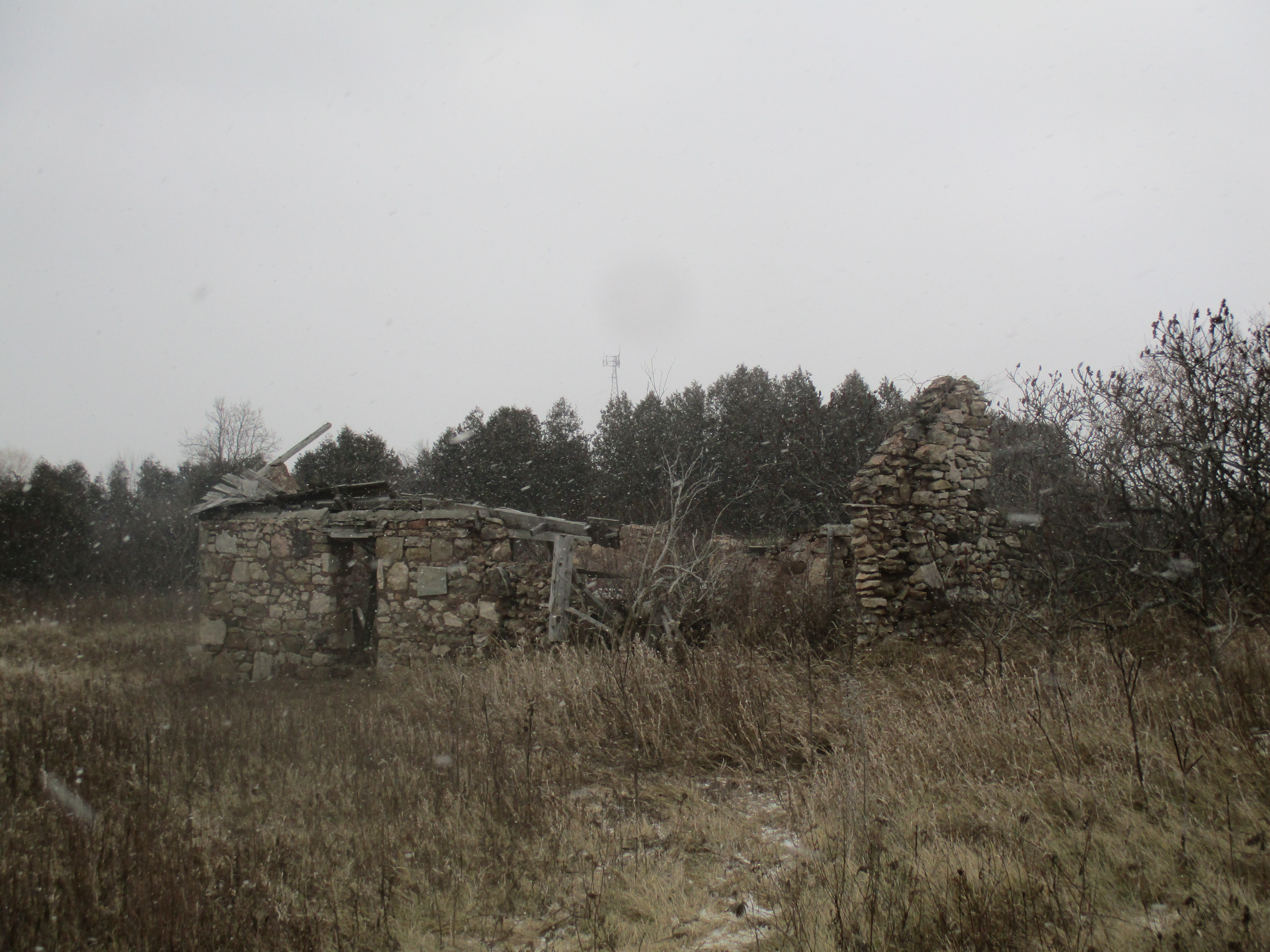
The lot on the corner of today’s regional road 25 and 25 side road was owned by James Bell in 1877 when the atlas above was drawn.  He was born in 1841 to Samuel and Ann Bell who had built the stone barn and house on the property.  The remains of the barn are featured in the cover shot along with the unique silo.  This silo is unlike most that remain in rural Ontario which are made of poured concrete.  This one has been constructed of preformed concrete blocks that were made to look like cut stone.  The Bell’s would have obtained livestock feed at the mill in Acton until the farm became more prosperous.  Later a silo was added to store feed that was grown and milled on the farm.  The block construction of the silo dates it to around the turn of the last century.  The barn has collapsed in on itself and the old beams can be seen in the bottom. Hand made nails give an indication of the age of construction.  James and Agnes Bell were married on Oct. 26, 1877 and the stone house and barn were abandoned after a new brick house was built closer to the front of the property.

IMG_1990

The old stone house stands near the barn and it too is slowly falling over.  The rear wall looks like it has about one more good wind storm left in it before it becomes a pile of rubble on the ground. When the Bells cleared the land they found an abundance of field stones which had to be removed to make the land suitable for farming.  These stones provided building materials for the barn and house as well as the fence lines to separate their fields.

IMG_1982

We arrived at regional road 25 and walked back through Acton to the car.  We noted an old steel pipe carrying water from Fairy Lake right past the mill and through the heart of town. There’s obviously lots more here for another time.

Like us at http://www.facebook.com/hikingthegta
The Vandalized Memorial – Taras Shevchenko Museum

Dec. 13, 2015

On the side of Sixteen Mile Creek stand the remains of a memorial park that has been vandalized on multiple occasions. The scattered remnants stand abandoned waiting to see if they will fall victim to land developers or be restored as a public park. We parked on the fourth line where it dead ends south of Dundas Street and set out in the light rain and 6 degree temperatures.
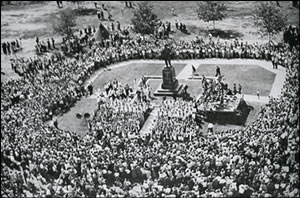
Taras Shevchenko was born in Ukraine in 1814 in the feudal system of the era. He was orphaned at the age of 11 and went on to become one of the country’s most prolific writers composing over 1000 works. Some consider him to be the Ukrainian version of Shakepeare. When his writing was seen as agitating against the czarists regime he was sentenced to serve in a military outpost and banned from writing. Although he could have lived in luxury from his work he chose to live humbly like the people he loved.  He died in 1861 just the day after his 47th birthday.  Ukrainians began to emmigrate to Canada in 1891 and by 1939 there was already a plan to erect a statue in honour of Taras. The Second World War prevented the community from getting things started but in 1950 it was picked up again. The plan was revised this time with a park and statue envisioned for the following year. Ten thousand people attended a performance in Maple Leaf Gardens on June 30th, 1951 which featured 1,500 performers. The following day the park was opened with up to 45,000 in attendance. An archive picture from the opening ceremonies is shown below.

mem_ph4

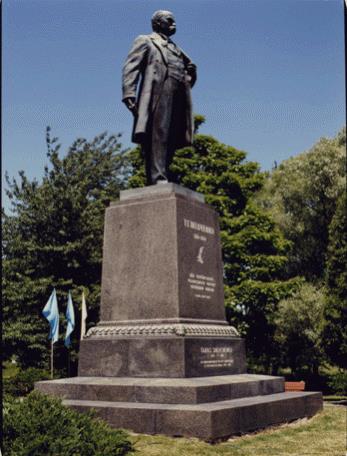
The 15 foot tall statue stood on top of a 70 tonne granite monument. It was a gift to Canada from Ukraine and was shipped here in 121 pieces which included the pedestal and garden stones. The total weight was 51 metric tonnes and the assembly work was completed by two local brothers. The statue was controversial from the start with a split between Communist and Czarist Russia causing the statue to be under 24 hour guard for some time after it opened. The Taras Shevchenko monument is seen below as it looked when the park opened on July 1, 1951.

Tass

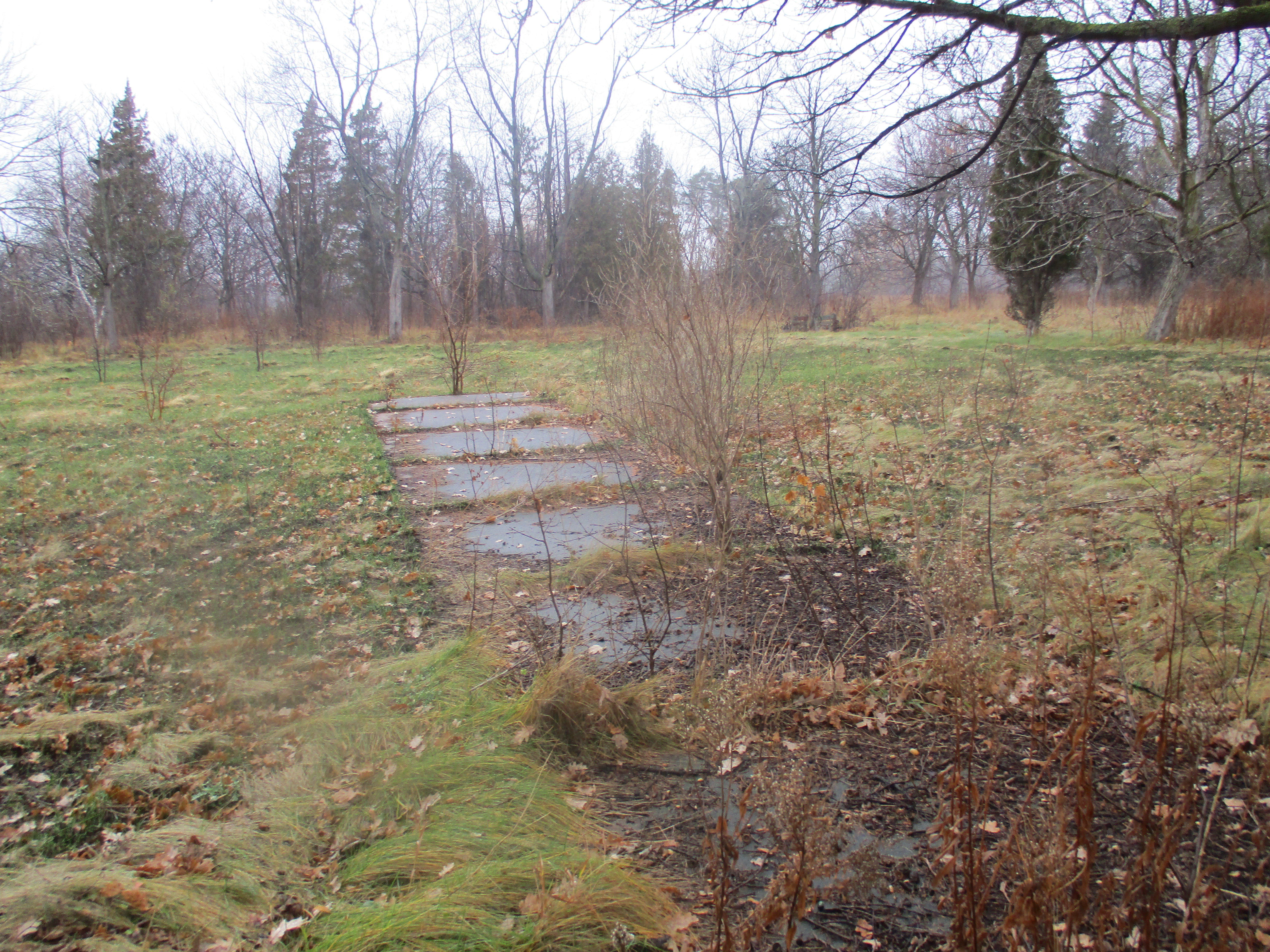
The Taras Shevchenko Museum opened a year later on July 1, 1952.  It housed over 500 exhibits, mostly from the museum in Kiev.  It included 23 of Taras’ oil paintings as well as carvings and Easter eggs.  On September 16, 1988 the museum was destroyed by an arson. The death mask, an original bronze copy of the mold was the only thing rescued from the museum. It has been moved to the new museum which was opened at 1604 Bloor Street W.  Today an old sidewalk runs to the field where the museum stood until 27 years ago.

IMG_1904

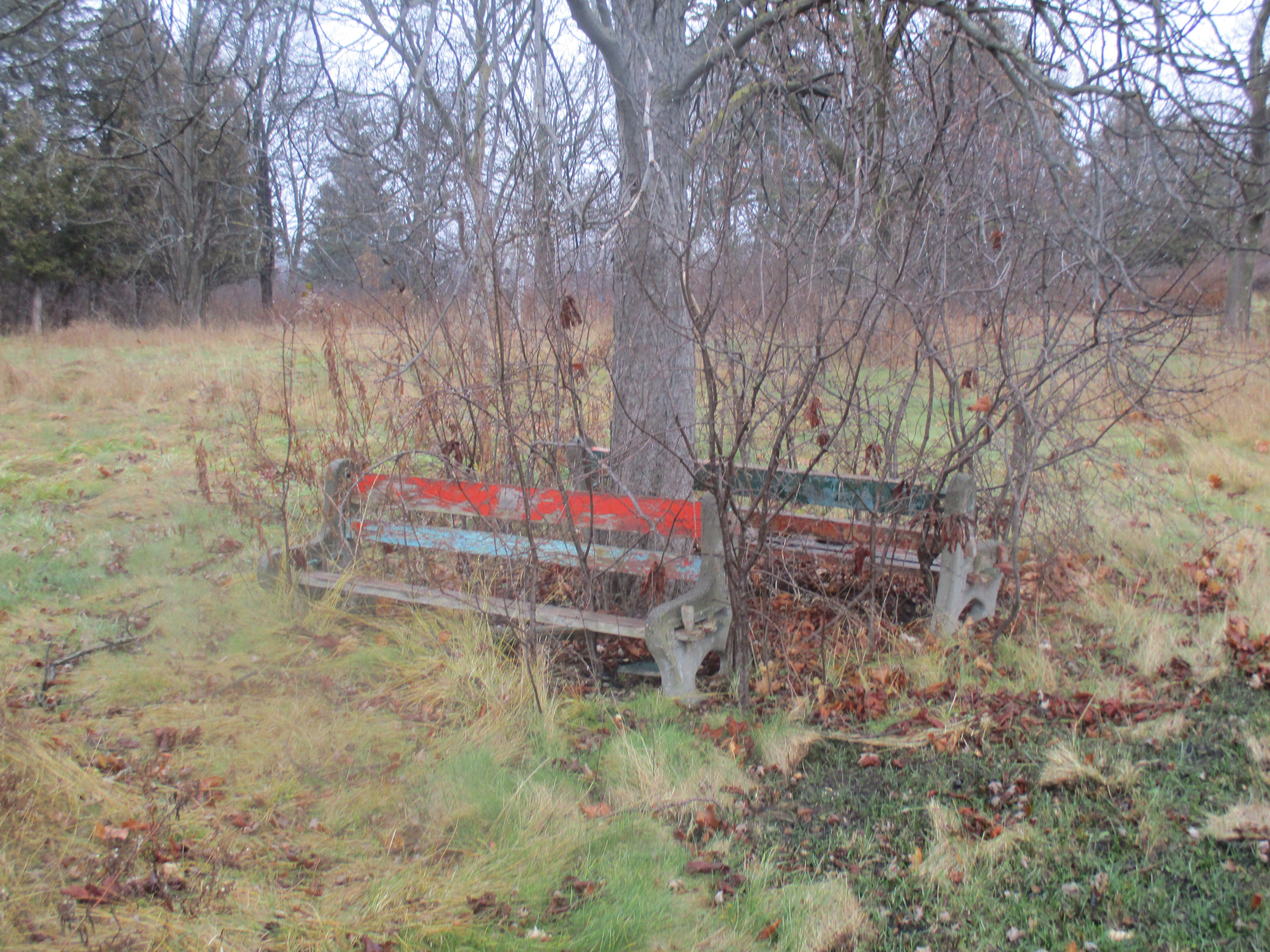
Park benches are scattered around the formerly landscaped park. 16.5 acres were planted with over 600 trees and 500 pounds of grass seed. The grass near the bench shows signs of a recent grass fire that threatened to consume the remnants of the park.

IMG_1925

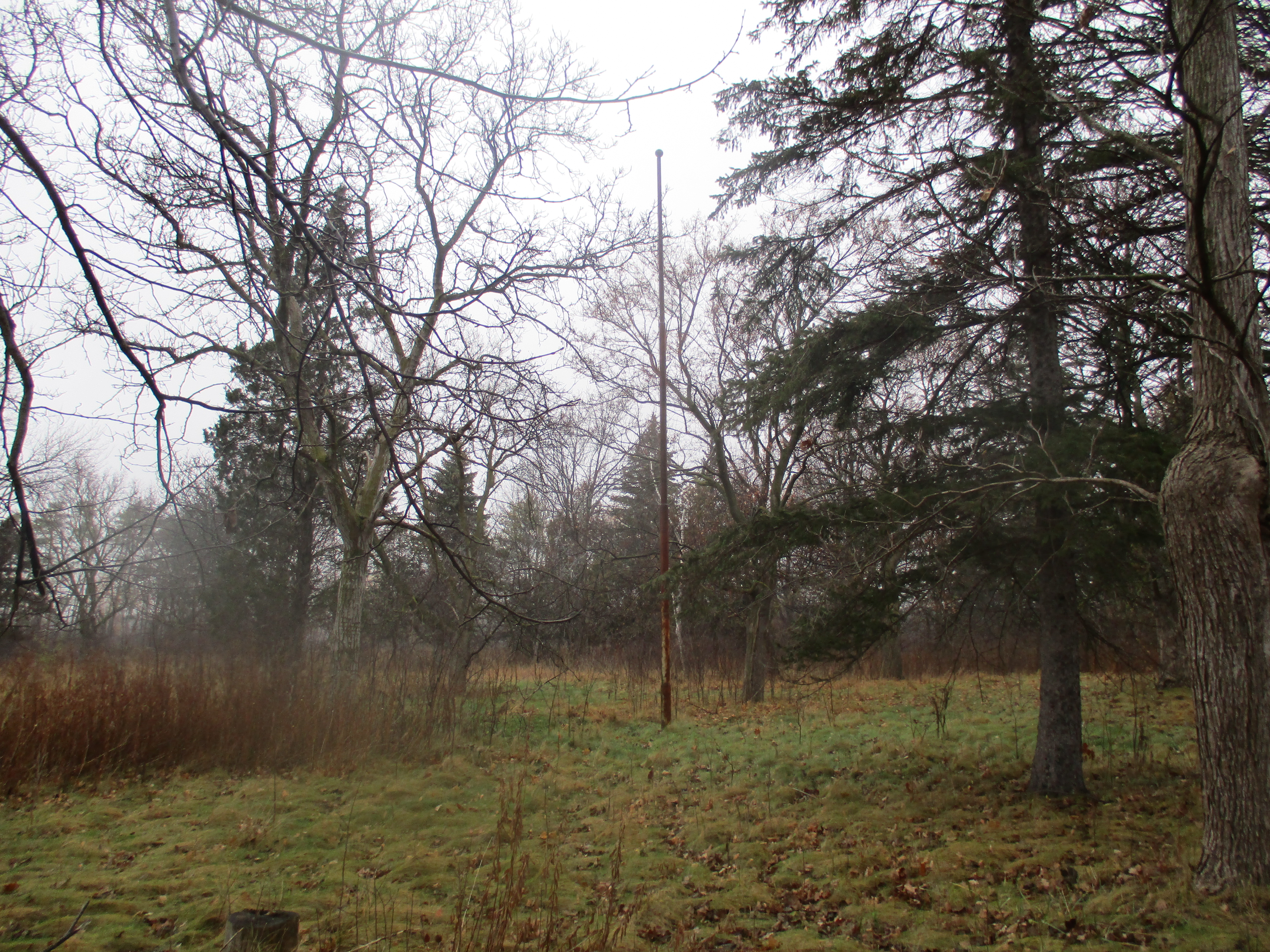
The old flag pole still stands in the open field near the monument.

IMG_1908

Sometime around Christmas 2006 thieves drove a truck up to the statue. They attached ropes to the statue using a ladder stolen from the caretaker’s property and pulled it to the ground. The scrap value was estimated at $20,000 by police and only the head was recovered. It alone weighs 170 lbs and has been placed in the new museum on Bloor Street.

IMG_1912

There was a smaller statue of Taras sitting in a chair reading a book near the entrance to the park but it was stolen in 2001 just a few days after the July 1st celebration of the park’s 50th anniversary. There also used to be ornate iron gates that welcomed visitors off of Dundas street but they too appear to have been stolen for their scrap value. The cover photo shows the entrance to the park with the broken monument in the background. Even the granite marker naming the park has been vandalized by graffiti.

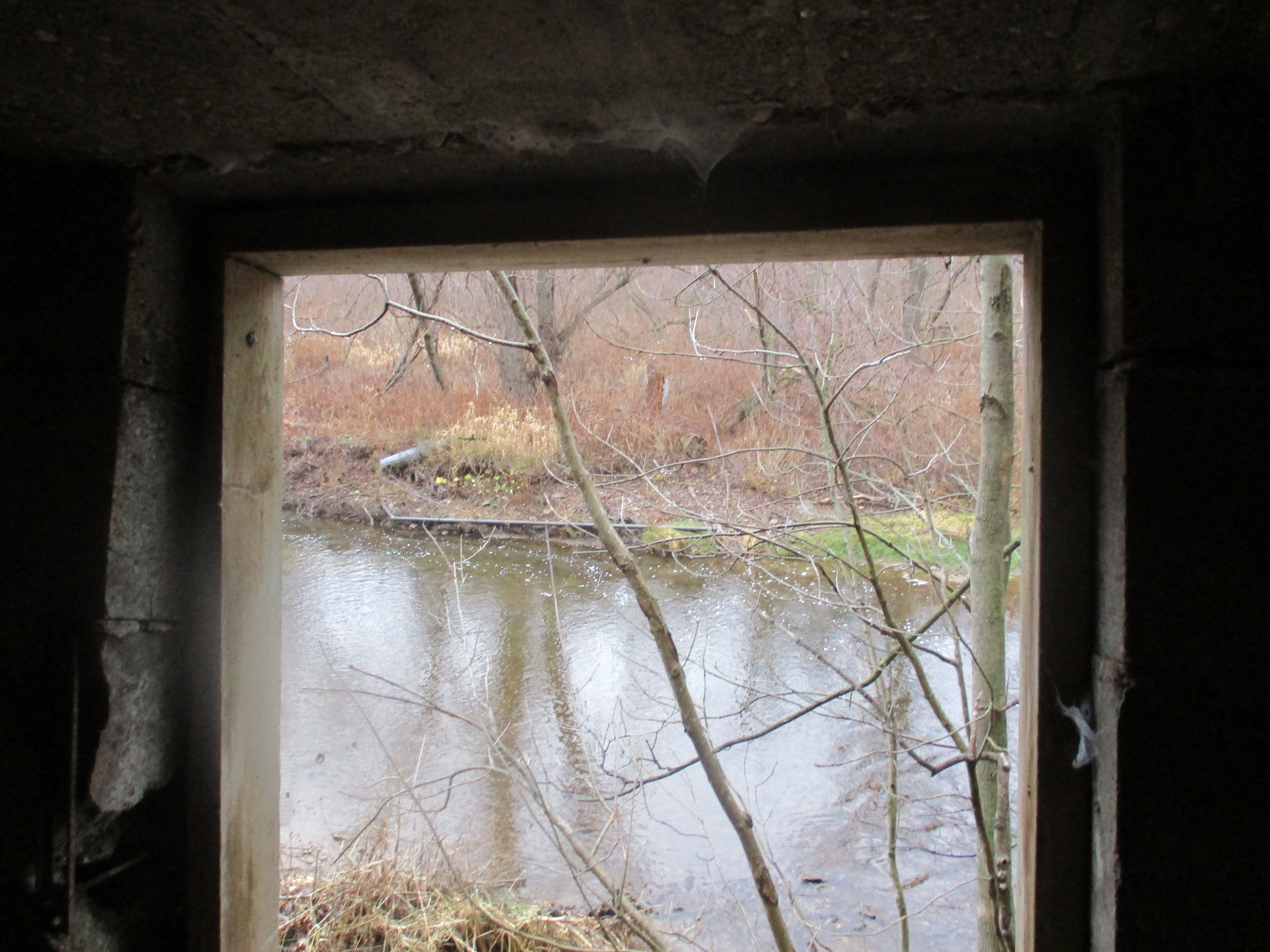
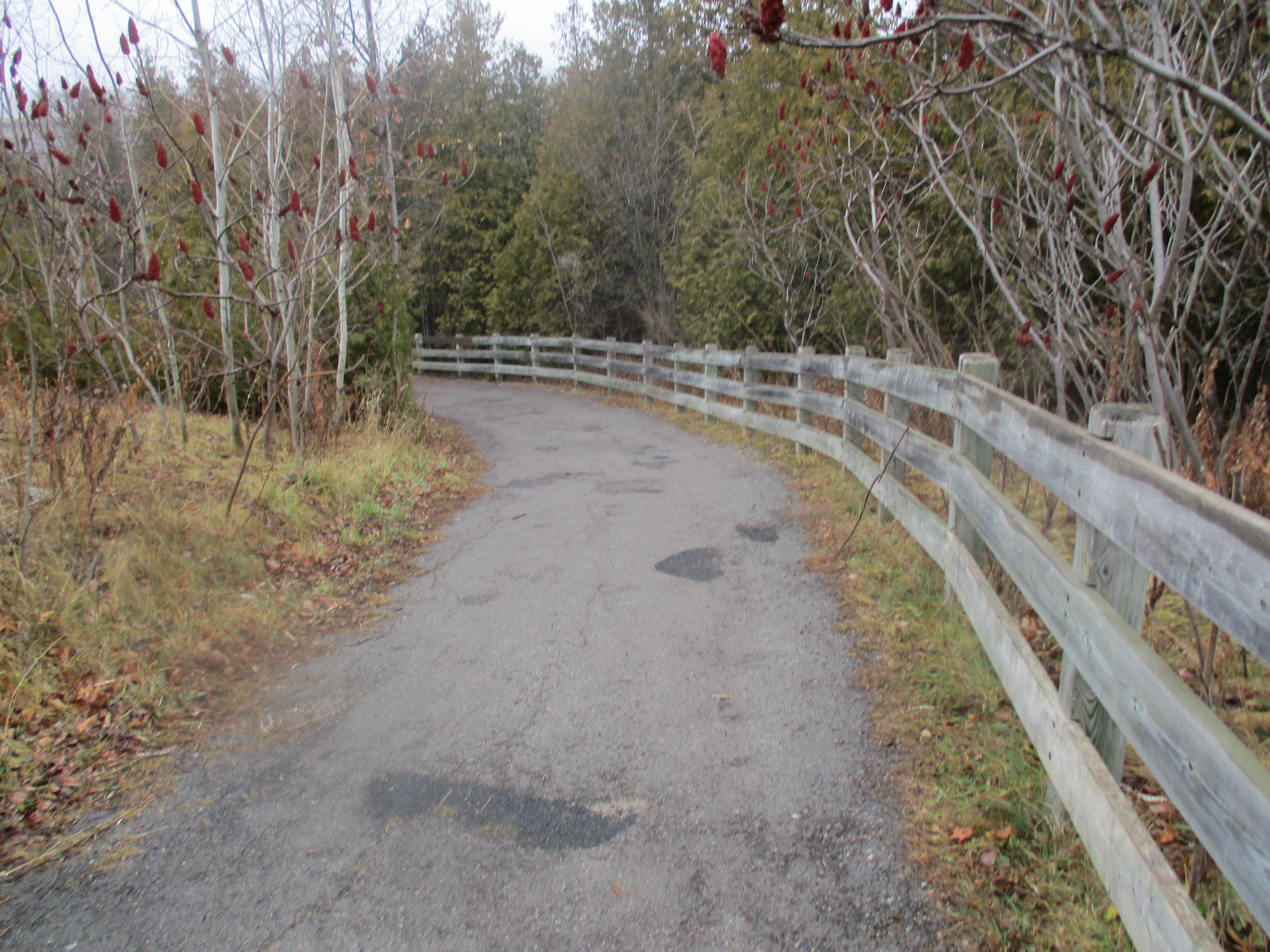
We followed the trail to where an old access road leads down to the level of Sixteen Mile Creek. There is a limited range one can travel upstream on this side before you must climb the ravine to cross a shale cliff. Near here is an old pump house on the side of the creek. There are intake pipes in the river as well as pipes running to the top of the hill. The pump house appears to have been associated with a children’s campground that occupied 47 acres adjacent to the Memorial Park. The children’s campground was closed in 1998.  The picture below shows the view through the open door facing the creek.  Pieces of PVC pipe can be seen on the far embankment and in the water.

IMG_1879

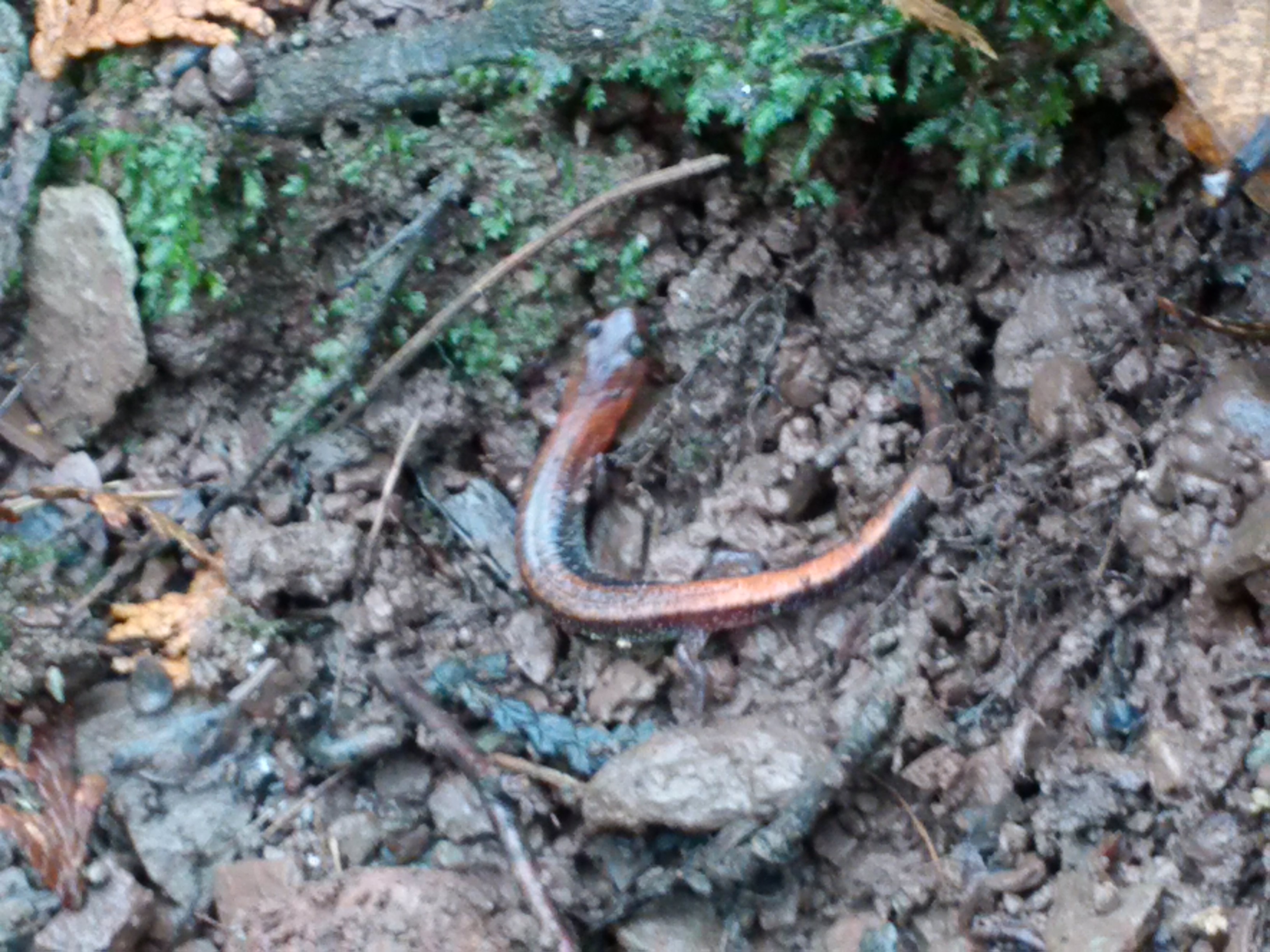
The eastern red-backed salamander lives in woodlands and is considered to be the salamander species of least concern for preservation in Southern Ontario. They typically breed in the fall but can also breed in the spring. They can reach population densities as high as 1,000 salamanders per acre. This salamander has a short hibernation period compared with other salamanders and have been known to be seen even in winter. The slow start to the winter season this year seems to have kept this one still active.

IMG_20151213_124021 (2)

Before the current Dundas Street bridge was built the road used to climb the side of the ravine in a switchback that connected with the fourth line. That road was closed to traffic and now provides a link to the hiking trails. We previously visited this site when investigating the Ghost Town of Sixteen Hollow.

IMG_1930

The future of the Taras Shevchenko memorial park is uncertain. The park owners had been in negotiations with the City of Oakville to donate the property as a city park when the statue was stolen. At the same time the surrounding land from the children’s camp has been bought by developers who plan 205 single family homes and 125 townhouses on their land. They have been actively trying to acquire the memorial site for part of their development. I’m not sure what is in store for this repeatedly vandalized memorial.

IMG_1916

Like us at http://www.facebook.com/hikingthegta
Also visit:

https://www.facebook.com/ShevchenkoMuseum/

Shalebank Hollow

Saturday Dec. 5, 2015

Mullet Creek flows through an area known as Shalebank Hollow in Mississauga.  Freshly reforested, the area still retains some evidence of it’s farming past.  Normally I like to look for the unique history of the places we hike but this week I must be satisfied to present a few pictures we took while on a short exploration.  With the passing of our father on Thursday, getting away from things briefly seemed even more necessary than usual but there isn’t time for the regular research and writing.  Therefore, please enjoy the following photo journal of some of the things we saw.

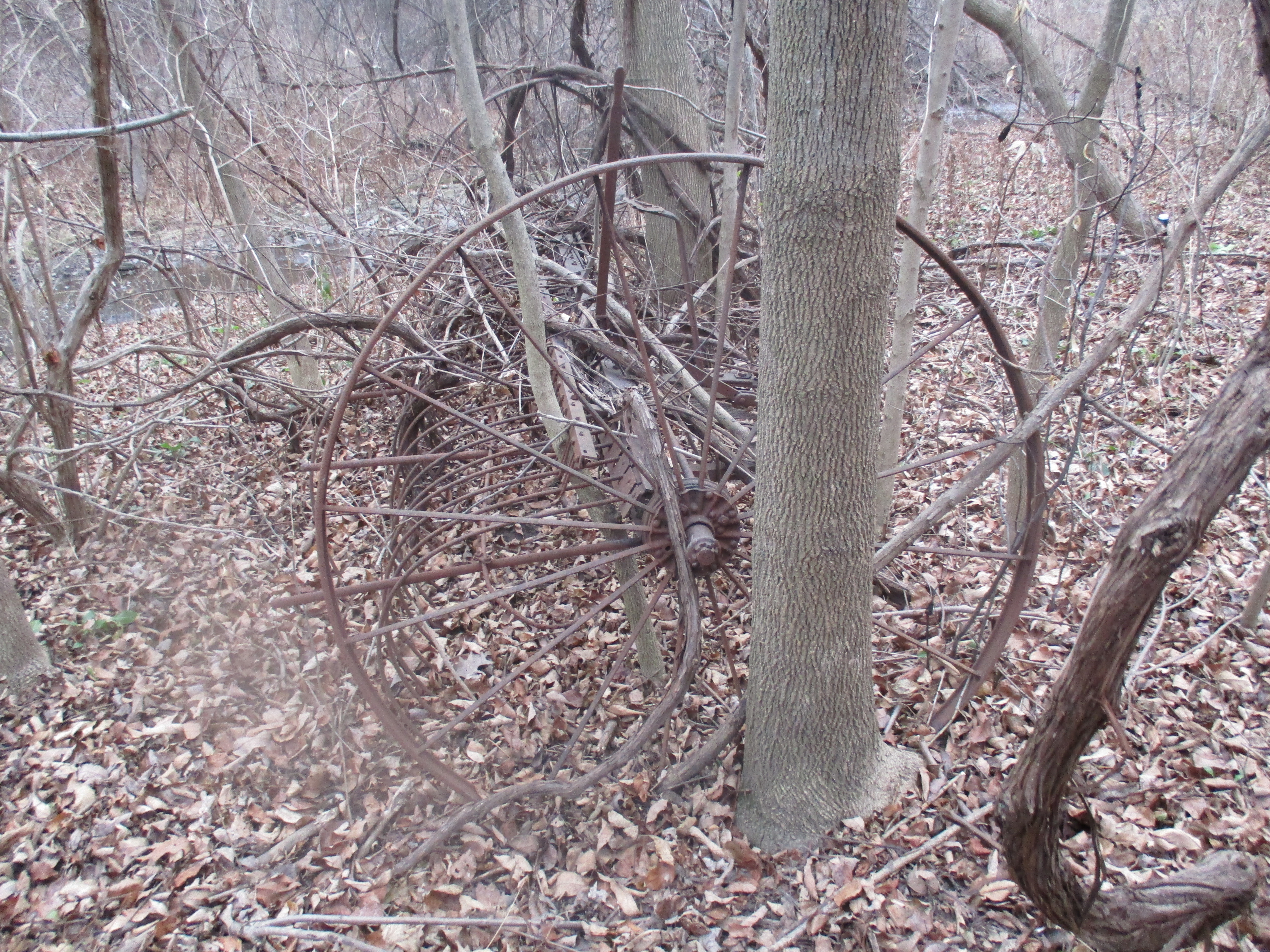
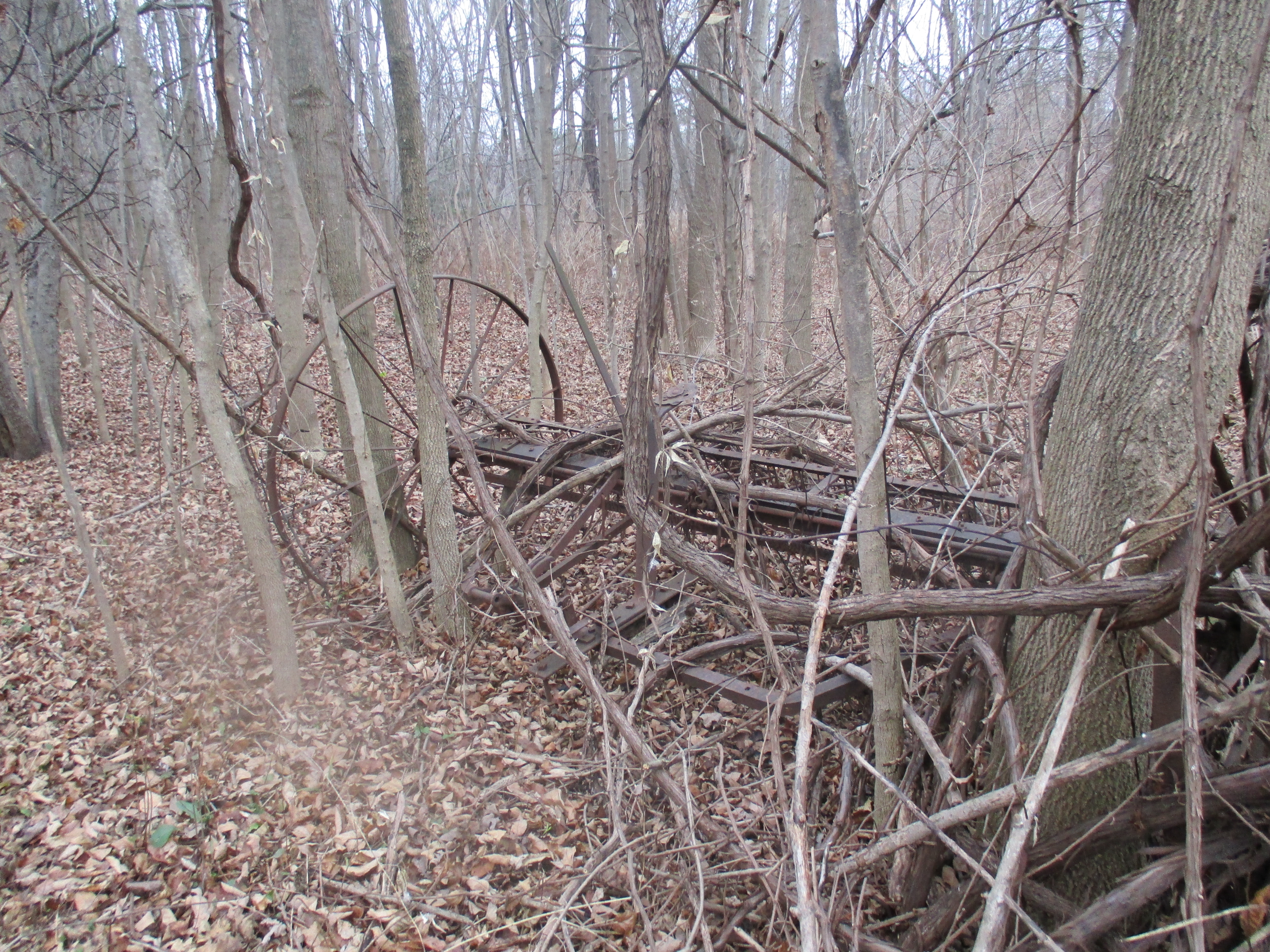
An early horse drawn hay rake known as a dump rake has been left sitting close to Mullet Creek and the trees have grown around it.  These rakes were operated from a seat above the curved steel teeth of the rake where the farmer lifted the implement as he went back and forth to create a windrow of hay.

IMG_1797

IMG_1792

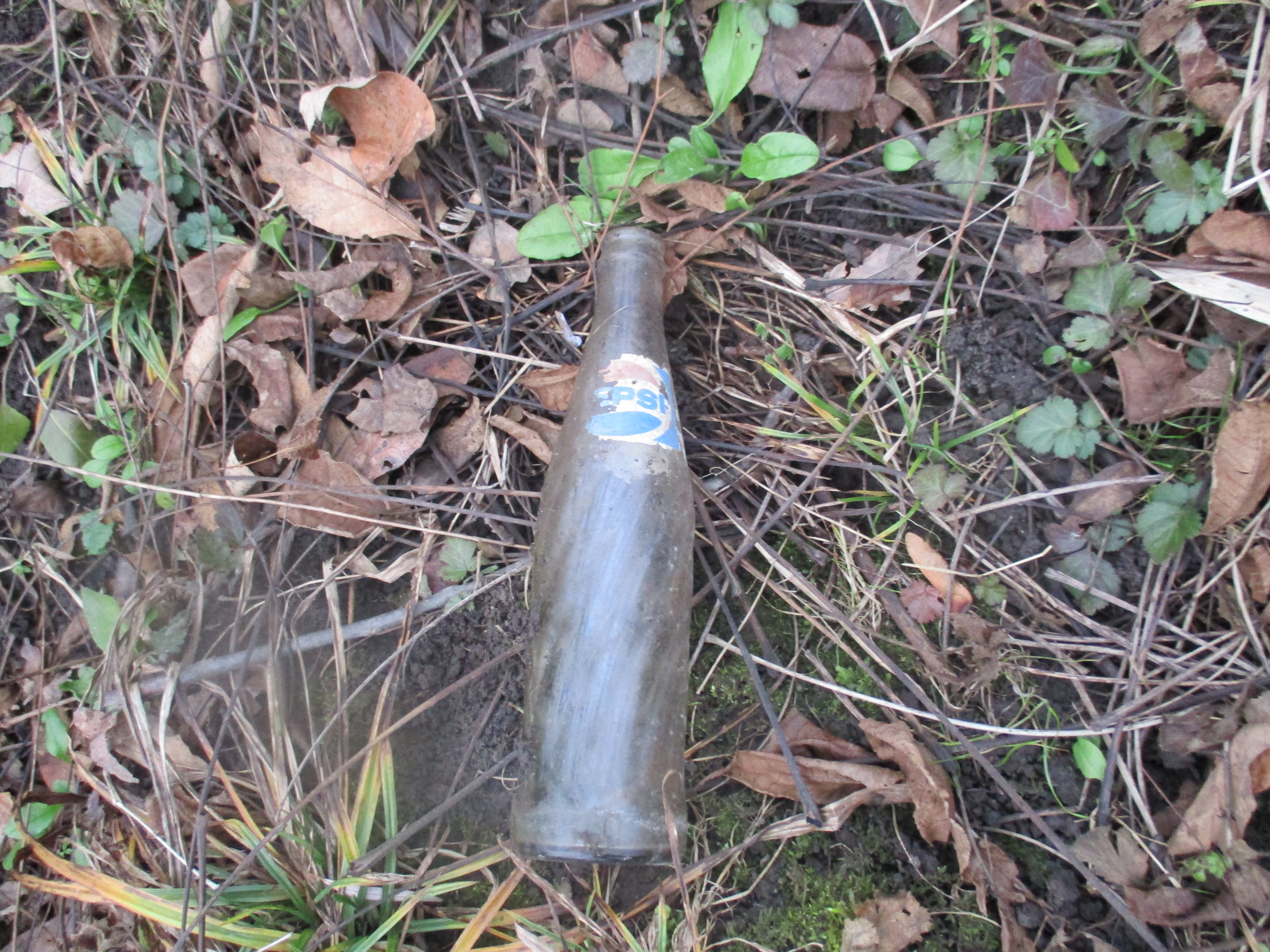
There are many old “stubby” beer bottles along here plus this worn 1973 Pepsi bottle.

IMG_1789

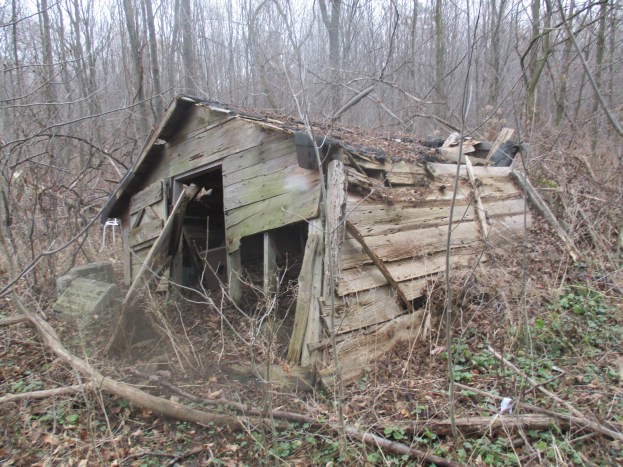
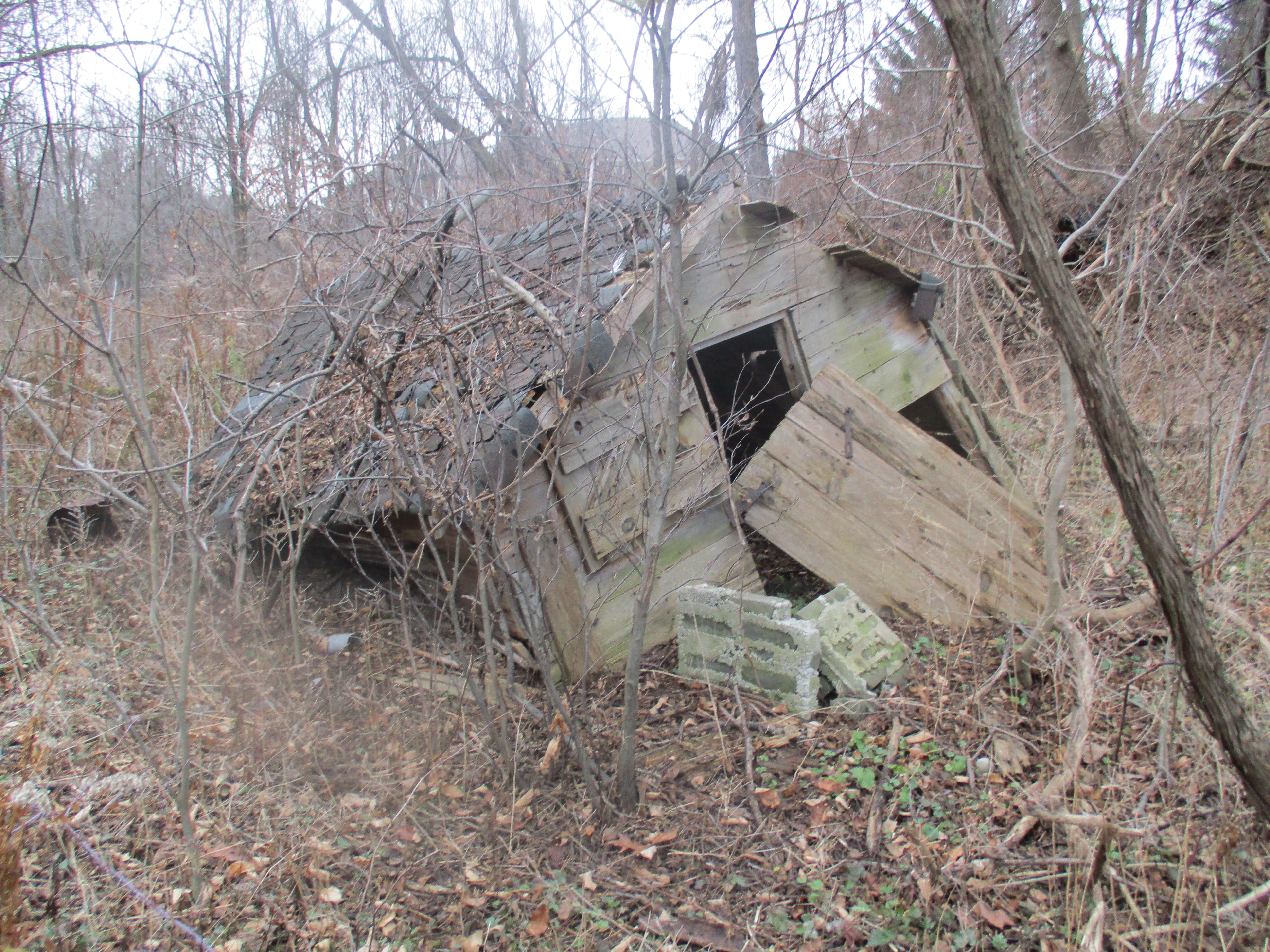
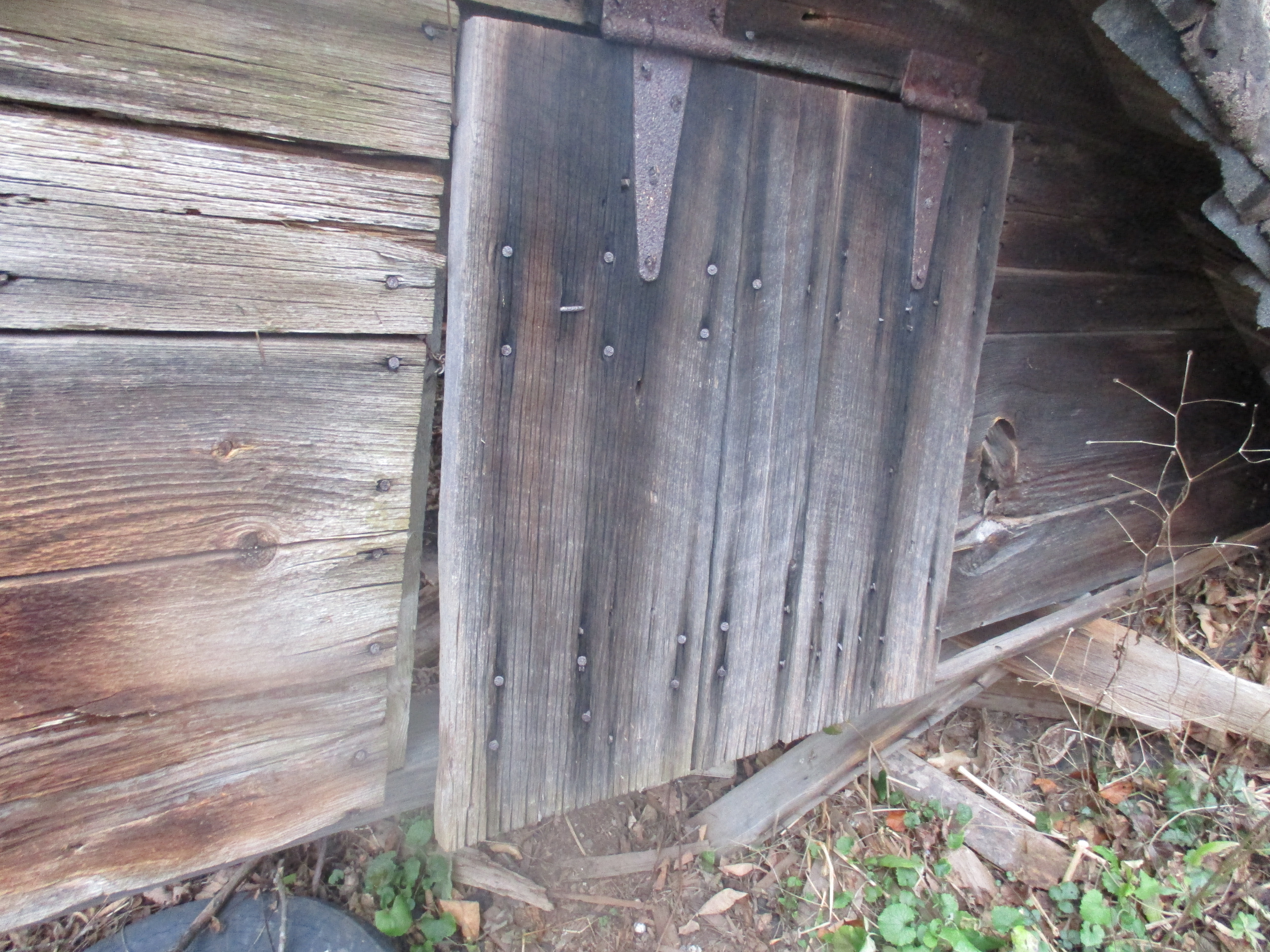
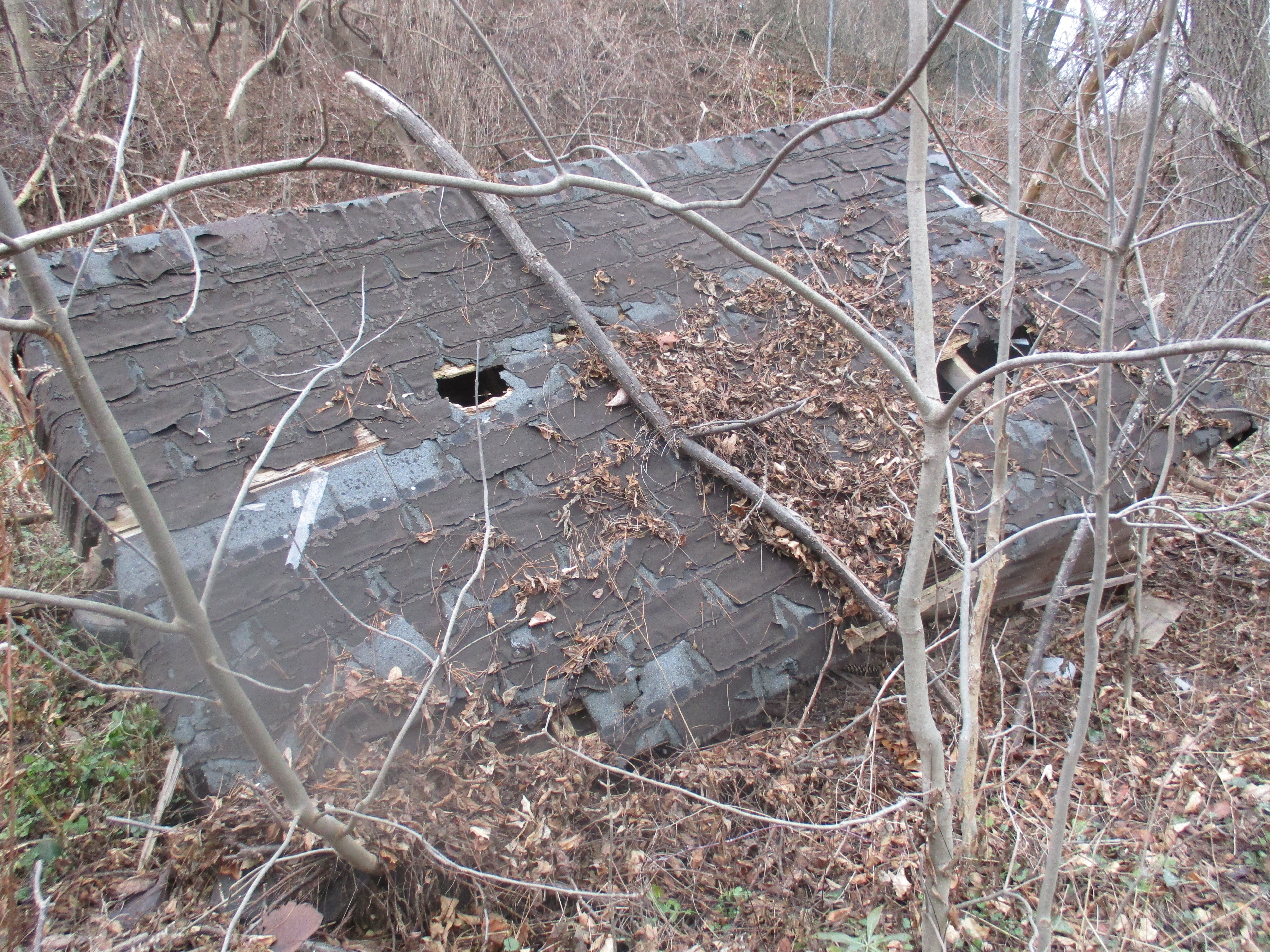
An old building on the floodplain for Mullet Creek has almost completed it’s collapse.

IMG_1810

IMG_1802

IMG_1805

IMG_1808

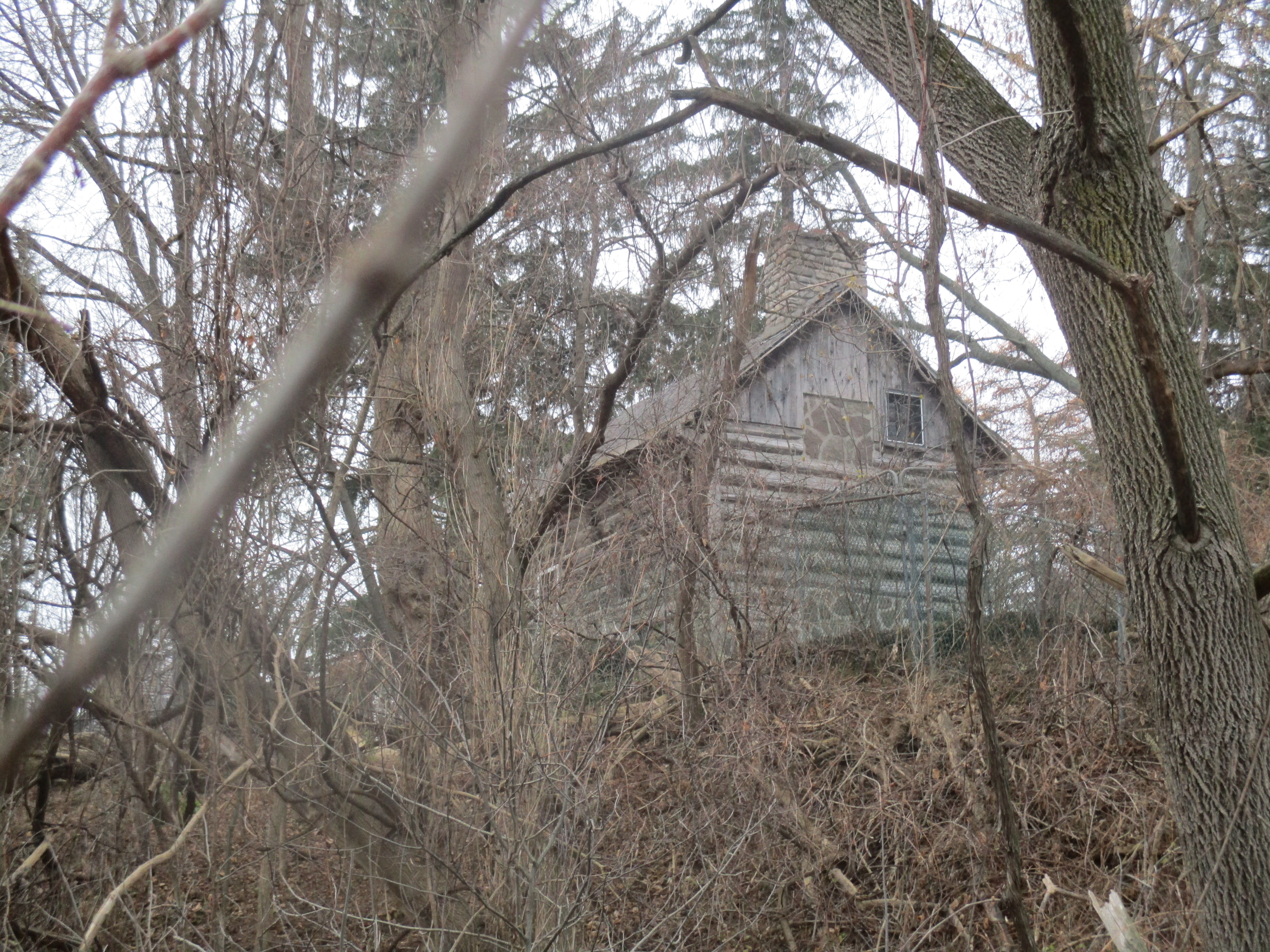
On the hill above the collapsed building stands what may be the original log home on the property.

IMG_1814

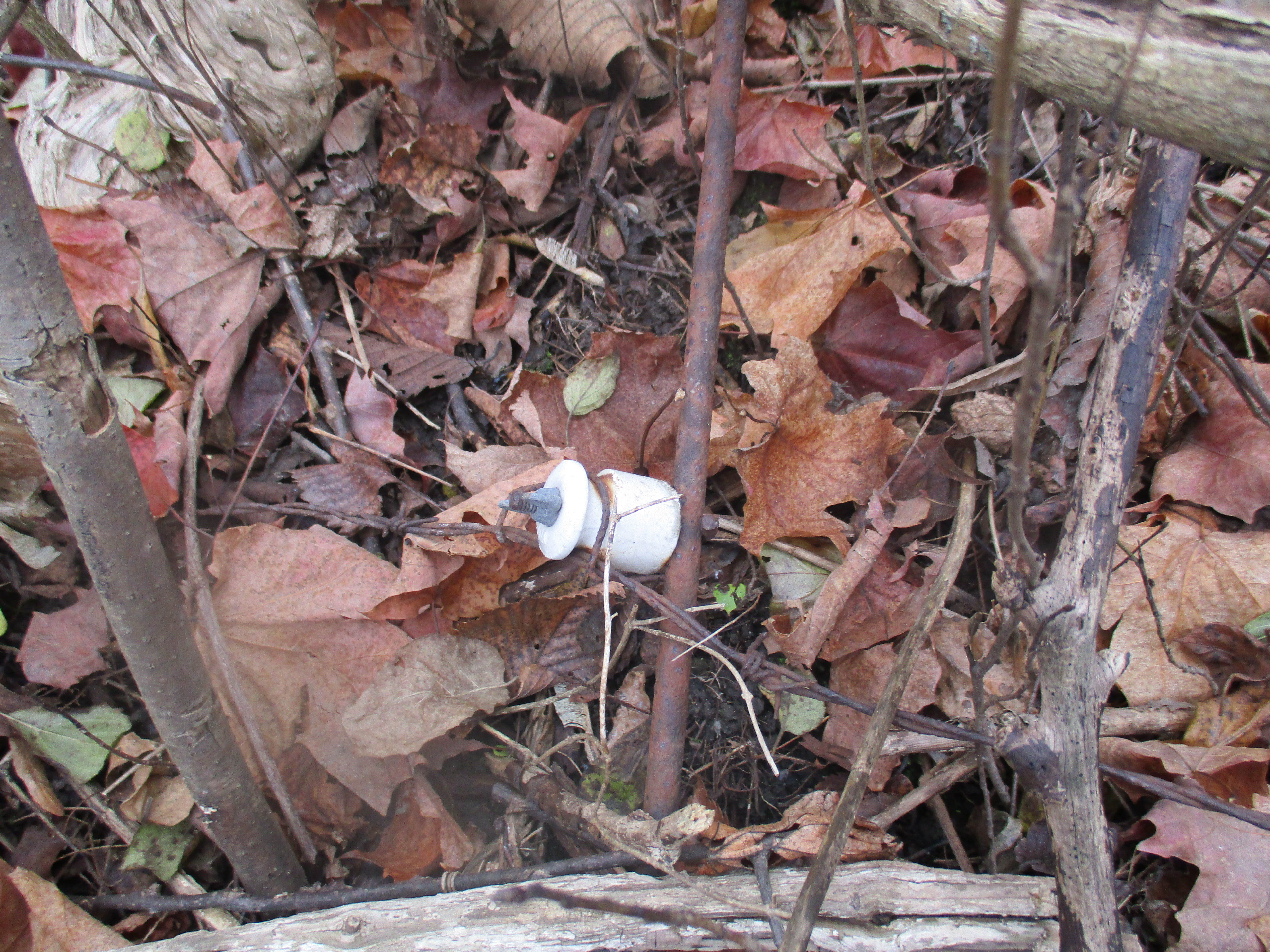
In the woods are the remains of an old electric fence complete with ceramic insulators.  This type of fence was used to keep livestock from wandering away.

IMG_1825

This old steel stove liner is being used in a shelter built in an old deer stand.

IMG_1833

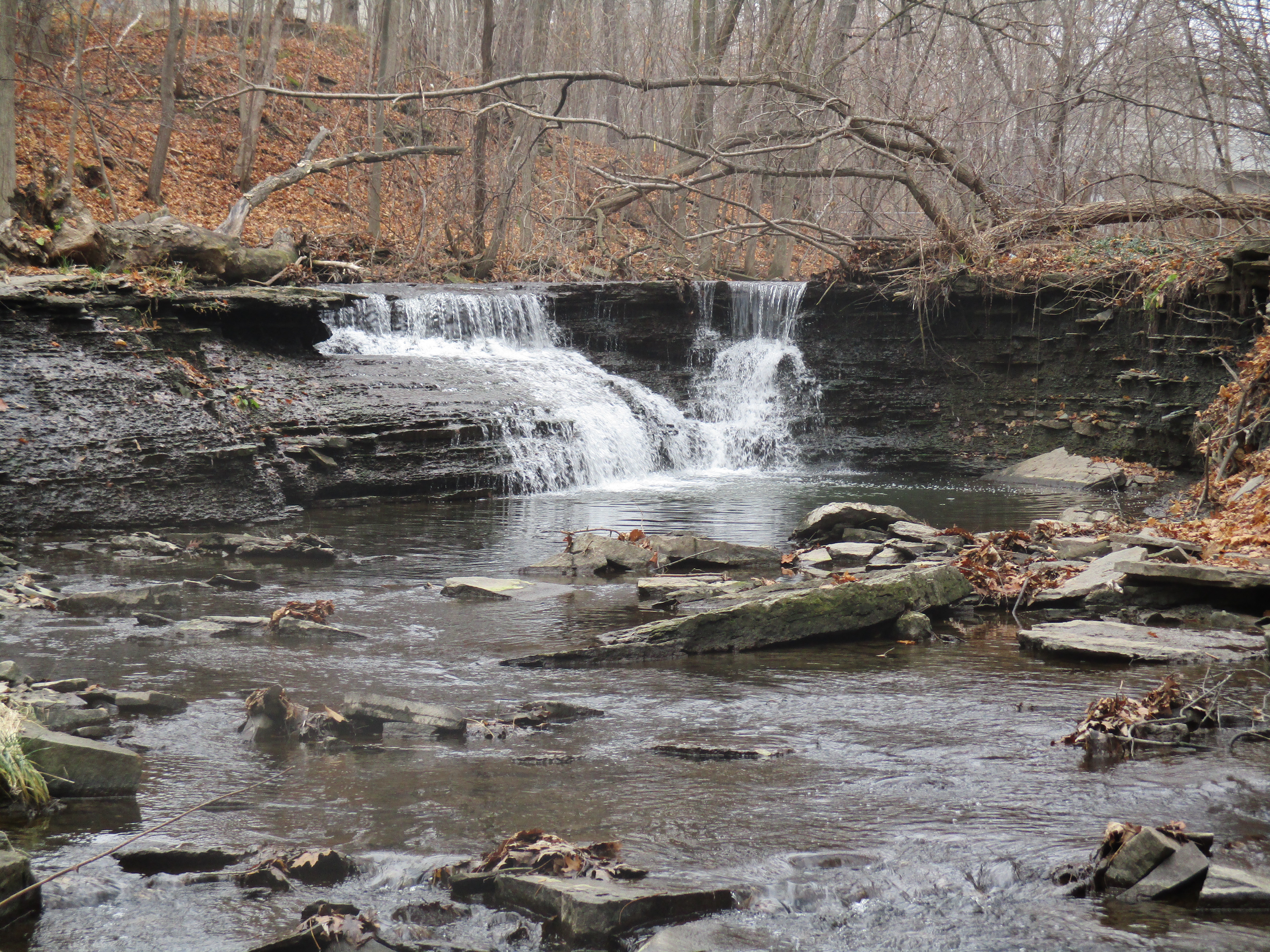
Where Mullet Creek crosses Mississauga Road there is this beautiful and restful waterfall that was featured in Mullet Creek’s Secret Waterfalls.

IMG_1838

Look for a full feature story coming next week.

Like us at http://www.facebook.com/hikingthegta
Eden Mills – Back To The Garden

Saturday Nov. 28, 2015

The historic village of Eden Mills is home to 350 people who share the dream to become North America’s first carbon neutral village.  Starting on Nov. 7, 2007, Eden Mills set themselves the ambitious goal of balancing the amount of CO2 that the village emits with the amount it absorbs. Having hiked to The Devil’s Well in the morning we decided to take a short detour on the way home and check out the village. We parked in the parking lot for the community hall and explored a little.

The original inhabitants of the area were the Neutral Confederacy.  They were a group of North American natives who lived up to their name by trading with both the Hurons and Iroquois, two tribes who were at war with each other.  Their territory covered much of what is now Southern Ontario with their numbers reaching toward 40,000 prior to the onset of Europeans who came with their diseases that the natives had no immunity to.  The Neutral may well have been the builders of the Longhouses at Crawford Lake.  The Neutrals lived in harmony with nature much more like the Garden of Eden than the later town which bears it’s name.  With the arrival of three mills on the Eramosa river starting in 1842 the town of Eden Mills was born.  Founded by David Kribbs it was originally known as Kribbs Mills.  Both saw and grist mills were built and they went through many owners in the first few years.  We see paintings of quiet mill ponds with scenic mills and a peaceful community in the countryside.  In reality mills were noisy and usually polluted land, air and water.  The local rivers were used to dispose of saw dust and other waste.  The mills themselves were responsible for making the place less like Eden than the name suggests.  The former Kribbs grist mill stands on the side of the Eramosa river.

IMG_1770

When the community began their carbon neutral project they started by determining the baseline for their carbon footprint in January 2008.  With the help of University of Guelph students they set up measurements to be able to quantify their success and provide evidence of their claims.  The 2007 figure of 4,708 tonnes of annual emissions presented the village with a huge challenge. The good news was that over half of the annual emissions were being stored by the local forest. Plans were made to plant certain species of trees that sequester carbon better than others. Sugar Maples absorb four times more CO2 than white spruce or pine trees of a similar age. Over 40,000 trees have now been planted to supplement the existing forest cover.

The picture below shows the tail race for the grist mill which passes under the roadway and returns the water back to the river. It is made of a circle of cut stone with the landscaping being designed to match.

IMG_1773

The Eden Mills pond has been drained but it creates a scenic playground in the heart of town.  It is managed and maintained by the Eden Mills Millpond Conservation Association Inc. which is a registered charity started in 1990.

IMG_1760

The dam walls and other structures were restored by a group of volunteers who devoted hundreds of hours of labour to complete the work.  This group has also been the inspiration for the current carbon neutral initiative.  A set of wooden steps can be seen at the left in the picture below that have been fixed to the far end of the concrete dam.  They lead down to the summer swimming area of the mill pond.  The pond also supplied water for the saw mill through a head race that was fed from where the spillway is seen as a cut-out section on the dam.

IMG_1759

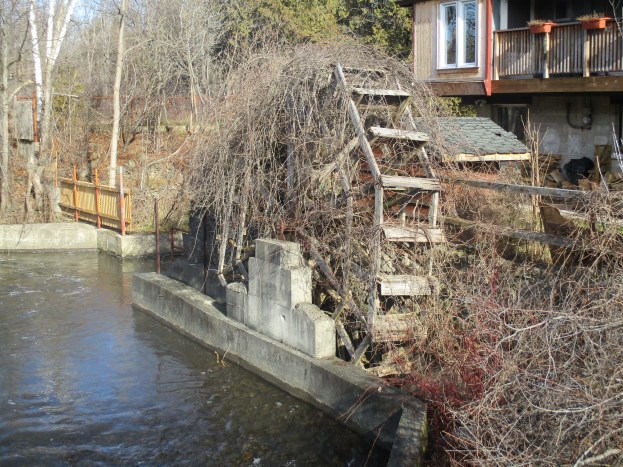
A wooden water wheel is shown in the cover photo and below.  It hasn’t been used in awhile as the overgrowth of vines shows.  This wheel spins in a counter-clockwise direction and is known as a breastshot wheel.  The wooden buckets had water dropped in them at a point near the centre line of the wheel’s edge or just above it.  Breastshot wheels are not as efficient as overshot wheels but were commonly used where high volumes of water flow were available.

IMG_1767

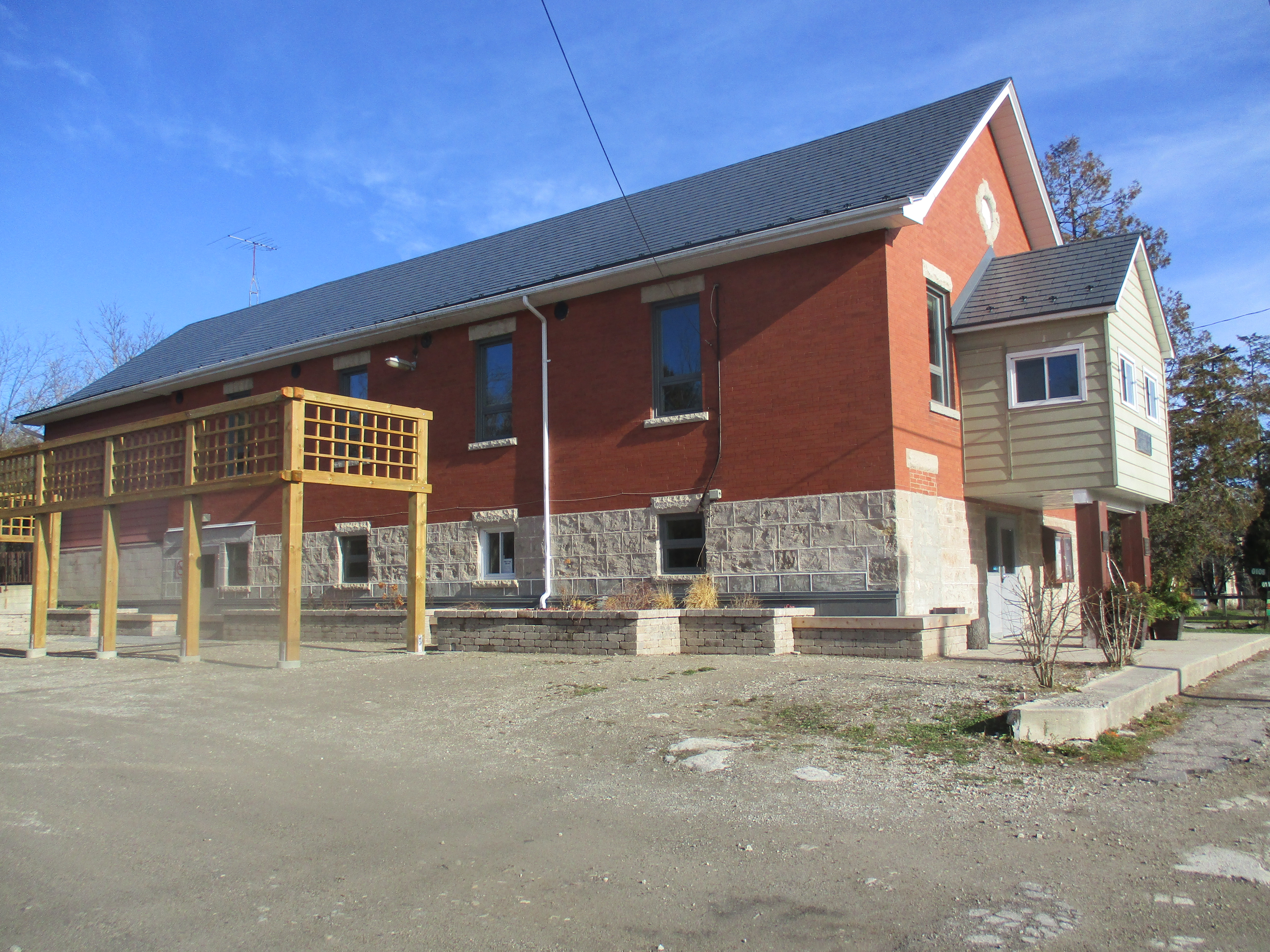
The community hall stands beside the mills.  The original building was built in 1893 but burned down in 1917.  It was immediately rebuilt and has now become a good example of the steps taken toward reducing the carbon footprint of the village.  Following a series of upgrades in 2013, it was estimated that the carbon impact of the hall would be reduced by 63%.  They installed a new metal roof and insulated the ceiling.  The windows were replaced with triple glazed Low-E argon windows for increased energy efficiency.  One of the propane furnaces was replaced with an air-to-air heat pump and two heat recovery ventilators were added.

IMG_1762

Individual households participate in biannual surveys to help track the progress of the village in reducing, replacing and absorbing CO2.  As of Dec. 1, 2013, they have achieved 75% of the target to become carbon neutral.  Another one of the main objectives was to ensure they all had fun while working on this project.  By all accounts, they have been successful at this too!

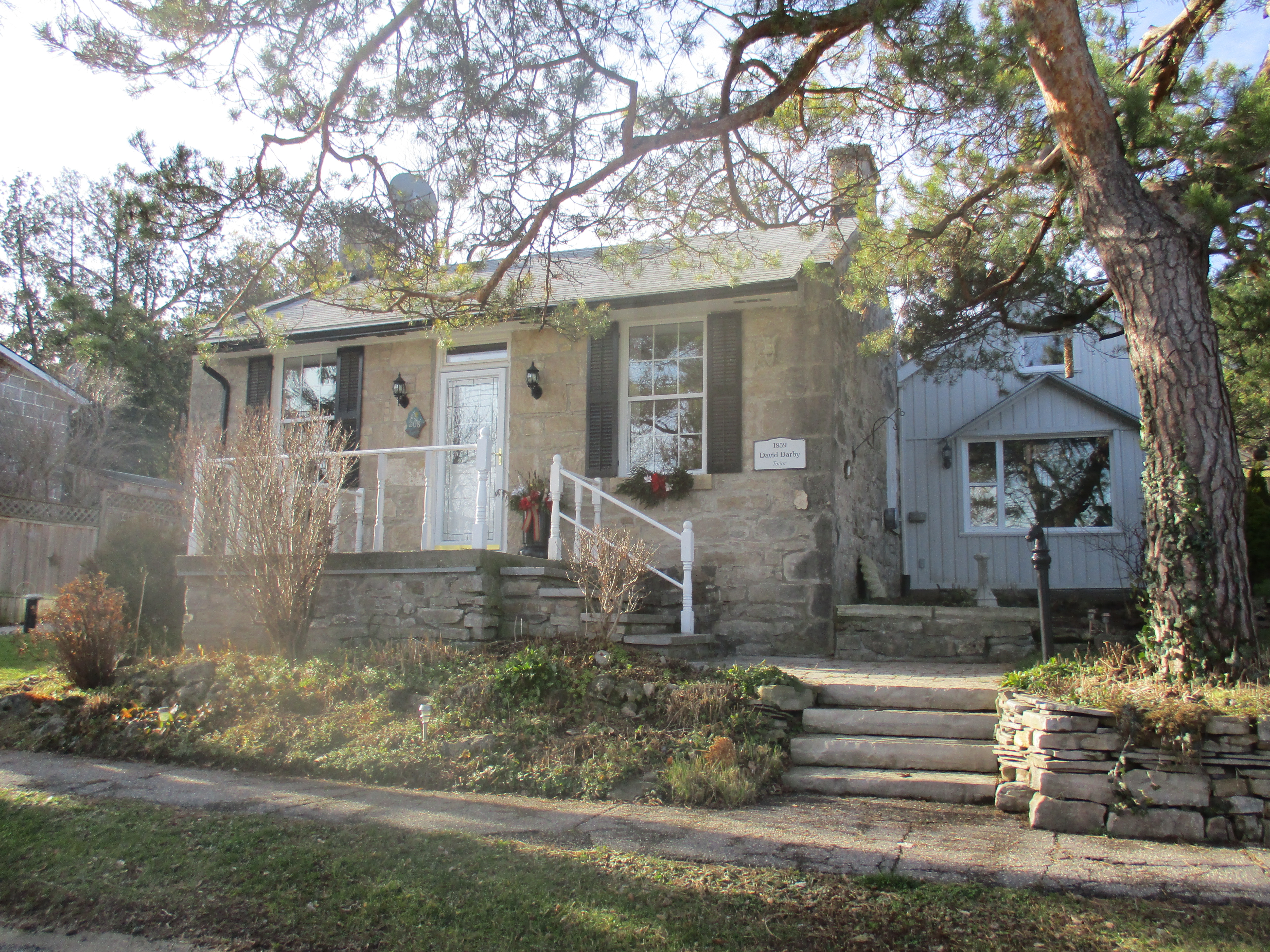
The Niagara Escarpment provides an abundance of stone for building materials and the older buildings in Eden Mills are made from cut stone blocks.  David Darby was the town tailor making and mending clothes for the community.  Darby built this stone house in 1859 showing that his trade came early to the village of Eden Mills, just as it did in the Garden of Eden.

IMG_1776

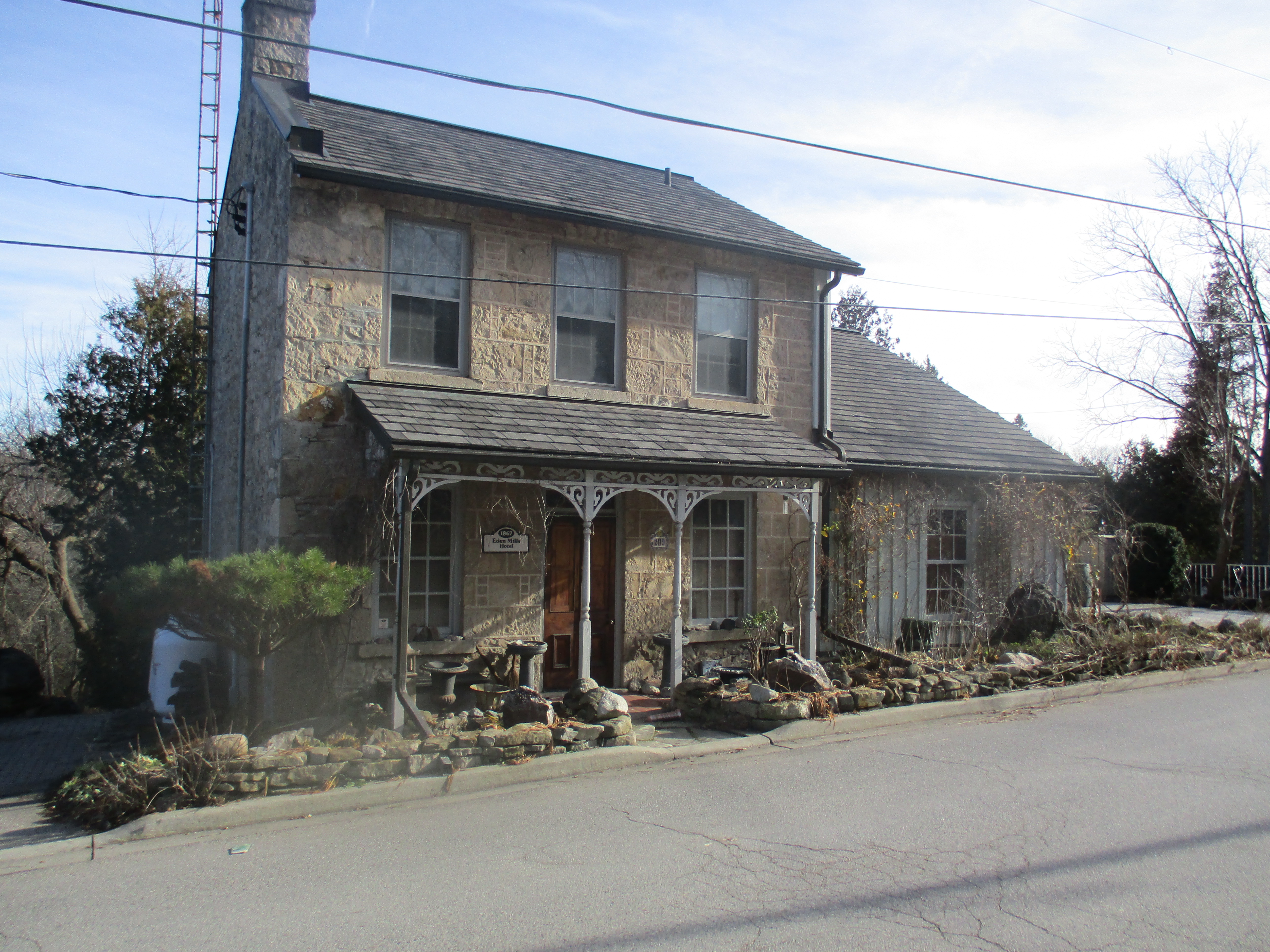
Built in the year of Confederation the Eden Mills Hotel is another example of local stone architecture.

IMG_1775

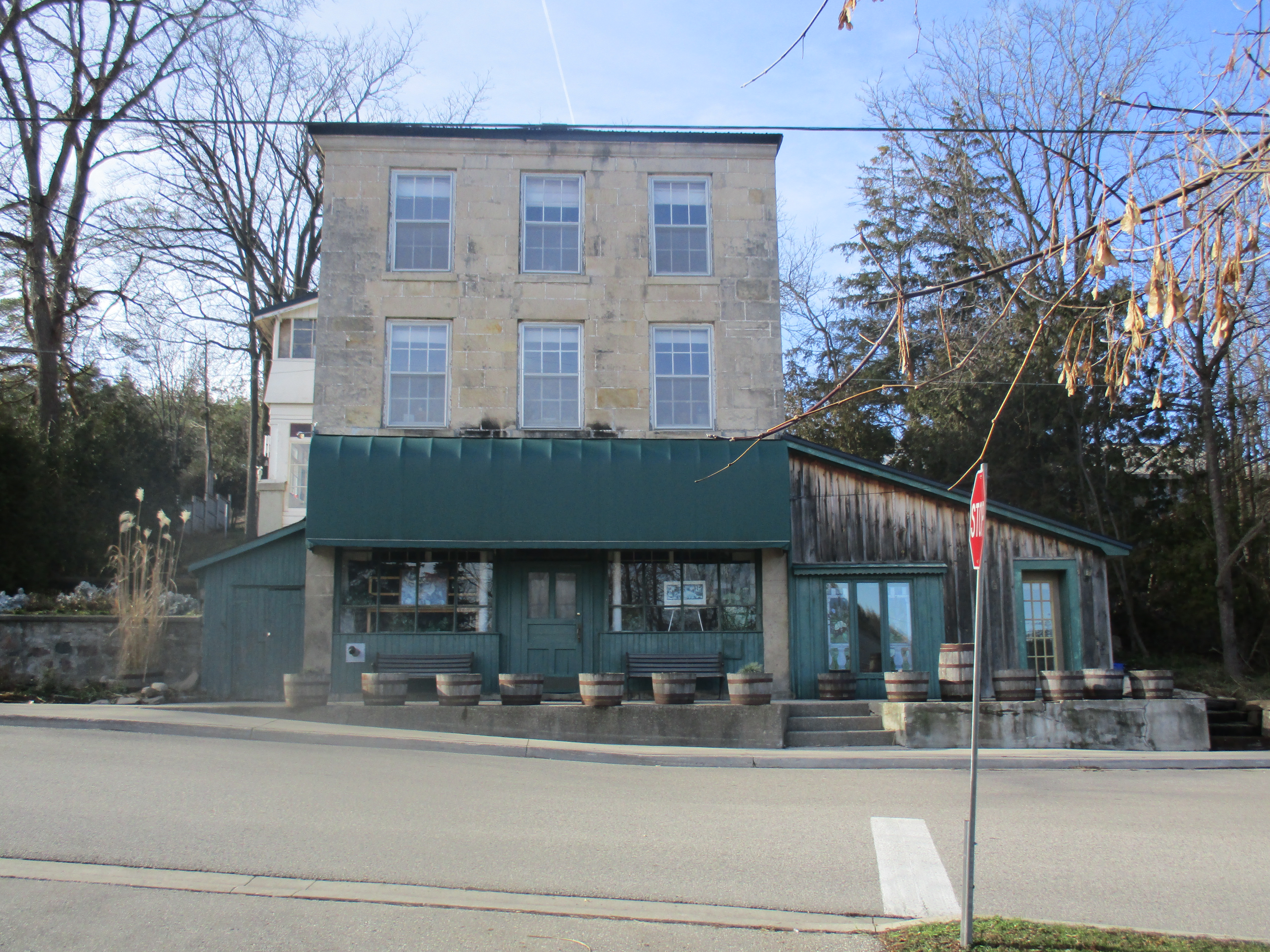
The General store is the only three-story building in the village.

IMG_1774

As the village of Eden Mills works toward being the first carbon neutral village in North America they are also becoming more and more like the garden from which their name is taken.

More information can be found at http://www.goingcarbonneutral.ca/

Google Maps link: Eden Mills

Like us at http://www.facebook.com/hikingthegta
Follow us at http://www.hikingthegta.com

The Devil’s Well

Saturday Nov. 28, 2015

If you drive in the GTA chances are you already think you have the world’s biggest pothole in your neighbourhood.  In reality, you likely do.  Represented as the world’s largest intact glacial pothole, The Devil’s Well has been submitted for inclusion in The Guinness Book Of World Records.  Intrigued, we decided to visit and so we parked in the Lion’s Club parking lot on Main Street in Rockwood and entered the park on Valley Road (see note).  Valley Road crosses the Eramosa River on an old concrete bridge from where it used to lead past mill worker’s cottages to the site of the Harris Woolen Mill.

Another trail leads you into an old quarry.  Here, the Rockwood Quarry extracted 10 metres of amabel dolomite and operated a small lime plant.  The quarry was closed in the 1960’s and is being taken back by cedar trees.  The floor of the quarry has several surveillance pipes drilled into the bedrock.  The older ones have been filled in with rocks while newer ones are locked.

IMG_1644

We followed well used trails as we made our way from the old quarry to the site of the giant pothole known as The Devil’s Well. It’s possible to walk full circle around the top of the pothole but there is no way to climb down into it due to it’s barrel shape.  The pothole is 13.1 metres deep and is 6.4 metres wide just below the rim at the top.  The bottom tapers down to 4.9 metres.  To get inside we would have to find another way down.

IMG_1657

We descended to the level of Richardson Creek hoping to find a way into the ravine that contains The Devil’s Well.  We had noted a couple of steel anchors in the rock face along the top of the ridge.  From the bottom we were able to see that there are dozens of rock climbing aids left screwed into the 25 metre cliff.  The pothole has only been cut a little over half way through this rock wall and cannot be accessed from down here.

IMG_1679

We spent a few moments exploring Richardson Creek while we were there.  It runs for less than a km from highway 7 to the Eramosa River but this is just enough to feature this picturesque little cascade waterfall.  Standing above the falls, to the left in this picture, are the remains of an old cut stone dam.

IMG_1690

Just below the dam stand two walls of an old stone building, most likely a saw mill that once used the mill pond just upstream.  The 1877 County Atlas shows the mill pond on Richardson Creek but does not denote a mill.  Likely the mill was already abandoned by that time as frequently happened when local wood supplies were exhausted.

IMG_1688

Much of the Niagara Escarpment is made of dolostone and limestone which contain high amounts of calcium and magnesium carbonates.  These can disolve in the mild acid content of most natural water.  The sinkholes, caves, springs and fissures created by this process are known as karst.  Karst topography is a common feature in our recent escarpment hikes.  Some geological studies of The Devil’s Well suggest that karst led to the forming of empty pockets within the rocks.  The rapid flow of melt water from the retreat of the Wisconsinan ice sheet created rivers along the margins and under the glacier.  Just as modern industrial processes use high pressure water and an abrasive additive to cut through steel and granite, the force of this water acting with small rocks carved out six obvious potholes along a fissure in this piece of the escarpment.  As five of these potholes enlarged they coalesced to create a short ravine with worn sides and smooth concave pockets to mark the remnants of the potholes.  The sixth pothole stands intact at the eastern end of this chain.  This intact pothole has come to be known as The Devil’s Well and is claimed to have the largest volume of any existing complete pothole in the world. We ended up using a nearby cedar tree for support as we climbed down into this ravine to get to the potholes.  This and other parts of the hike are not for novice hikers and should never to be attempted alone.  The view below is from standing in pothole number four, looking into number five with The Devil’s Well just beyond the rear wall and accessible through it.

IMG_1703

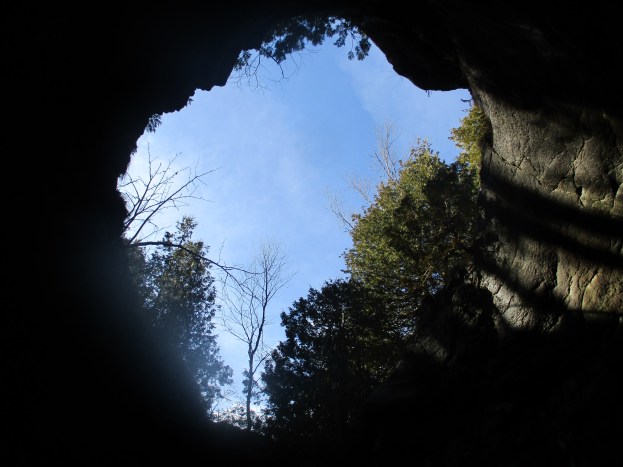
The wall to the pothole has not collapsed like the preceding ones, leaving an intact pothole behind it. There is a small crack at the bottom where you can enter from pothole #5.  The cover photo shows the view looking up out of the inside of the Devil’s Well where the trees above give an idea of the perspective.  This view is from the inside of The Devil’s Well looking back at the entrance.

IMG_1712

I did some very rough calculations to get an idea of the volume of this pothole.  This is only possible as an estimate due to the fact that it is wider in the middle than at the top and not exactly round either.  Most potholes are eroded in a slight barrel shape with the overhang quite noticeable from inside the Devil’s Well, as can be seen in the photo below.  If the city were to fill in the potholes in my neighbourhood they could fill hundreds with a single dump truck.  It seems that they should send a couple dozen trucks if they wanted to fill in this giant pothole.

IMG_1721

The surrounding property has been used for homes for mill workers at the Harris Woolen Mills as well as for a quarry operation following the time when it was an original land grant. Before the days of modern garbage collection people recycled most things.  Glass and metal that was deemed useless would be dumped on a corner of the property that wasn’t being used. This was often in a ravine or on the edge of a swamp.  Many partial antique medicine bottles and other broken glass jars can be found in several of these sites in the park.

IMG_1729

Richardson Creek empties into the Eromosa River which winds it’s way through the limestone bluffs in the Rockwood Conservation Area.

IMG_1732

The quarry was closed in the 1960’s and the Old Quarry Road has been left carry a foot path.

IMG_1733

The remains of a burned out building guard the site of the old quarry.

IMG_1737

So the next time your tire drops in that pothole on your way to work, just remember, it really is just a very small one compared to the glacial pothole known as The Devil’s Well.

Note:  This area is posted as no trespassing.  Most land owners are happy to talk about the heritage on their property and I have rarely been denied the ability to take some pictures and preserve the local history.  The biggest concern is usually that people will follow who won’t ask permission and the property owner may choose to prosecute.  Please always govern yourself accordingly.

Like us at http://www.facebook.com/hikingthegta
The Longhouse People of Crawford Lake

Saturday Nov. 21, 2015

Crawford Lake is one of a handful of meromictic lakes in Ontario and this fact led to the discovery of a pre-contact native village.  It was snowing off and on as I parked in the Crawford Lake conservation area where having correct change would have saved me including a small donation in the envelope.

In the late 1960’s a University of Toronto professor became convinced that Crawford Lake had the characteristics to be a meromictic lake.  Most lakes have the water turn over at least once per year.  As the water cools it becomes denser causing it to sink.  The water at the top mixes with the water at the bottom providing a more even temperature and oxygenation.  In meromictic lakes the surface area is less than the depth and the water doesn’t mix.  In Crawford Lake there are three sections of lake and only the top 15 metres mixes annually.  The middle depth of the lake acts as a buffer while the bottom 9 metres or more never gets disturbed.  This part of the lake is always cold and has no oxygen.  Life doesn’t exist down here and the layers of sediments tell the history of things falling in the lake. Samples taken from the lake bottom revealed 1,000 years of history.  Sediment layers representing the period between 1300 and 1600  have high levels of corn pollen trapped in them in varying concentrations.  This led to the conclusion that an agricultural society had existed near the lake, closer to the shore when the concentrations were higher.  When settlers arrived, cut down the trees and created fields ragweed spread and the upper layers of sediment reflect this.  Crawford Lake is calm in the picture below.

IMG_1607

Local land owners confirmed that they had found artifacts on their properties and when Thomas Howard sold to the conservation authority in 1971 he donated an ungrooved ax or celt he had found here.  It is part of a 10,000 artifact collection that has been uncovered between 1973 and 1989.  The post holes for the frames of 11 longhouses have been discovered and three of these have been reconstructed. Two others have been partially formed including the frame outline seen below.  The positions of the fire pits have been exposed.

IMG_1566

Completed longhouses would have looked like the ones at Crawford Lake except that experts agree there were no ‘panic bars’ on the doors and no little electrical outlets on the outsides.

IMG_1537

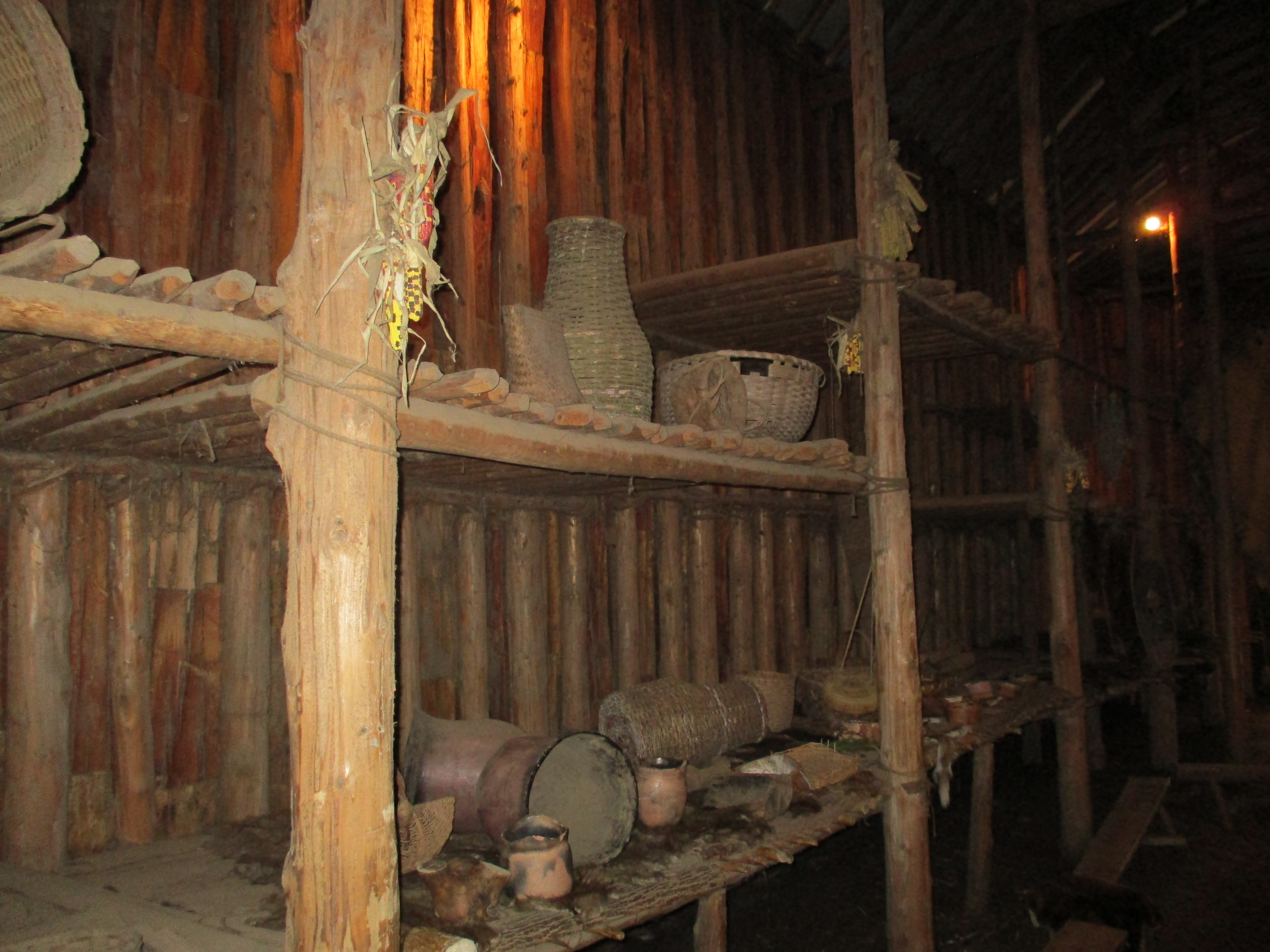
It is unknown exactly which peoples lived here.  It may have been the Wendat (Huron) or Attawandaron (Neutral) but either way they were part of the Iroquoian speaking nations and are referred here as Iroquoian for simplicity.  Inside each of the longhouses an individual clan lived. Smaller longhouses may have had 30 people while larger ones up to 100 .  Individual families lived across from each other and shared a common fire.  The lower levels were used to sleep on because they were close to the fire and below the constant smoke.  Upper levels were used for storage with food being hung in the rafters where smoke kept both insect and rodent away.  It is common to find the carbonized remains of food around the fire pits or in the dump sites and these frequently include corn, beans and squash.  For some reason there was no squash found at the Crawford Lake village.

IMG_1576

The art of making stone tools is known as knapping.  It took a great deal of skill to master it but then a piece of chert could be turned into a razor sharp projectile in just 15 minutes.  Along with arrowheads, spear tips, knives and drills were knapped.  Among the findings at the site was a tip known as a turkey-tail arrowhead.  It is out of place by up to 3,000 years suggesting that the idea of collecting antiques may have extended to this culture as well.  The turkey-tail point is displayed along with other arrowheads and is on the tallest shaft in the middle of the picture below.

IMG_1549

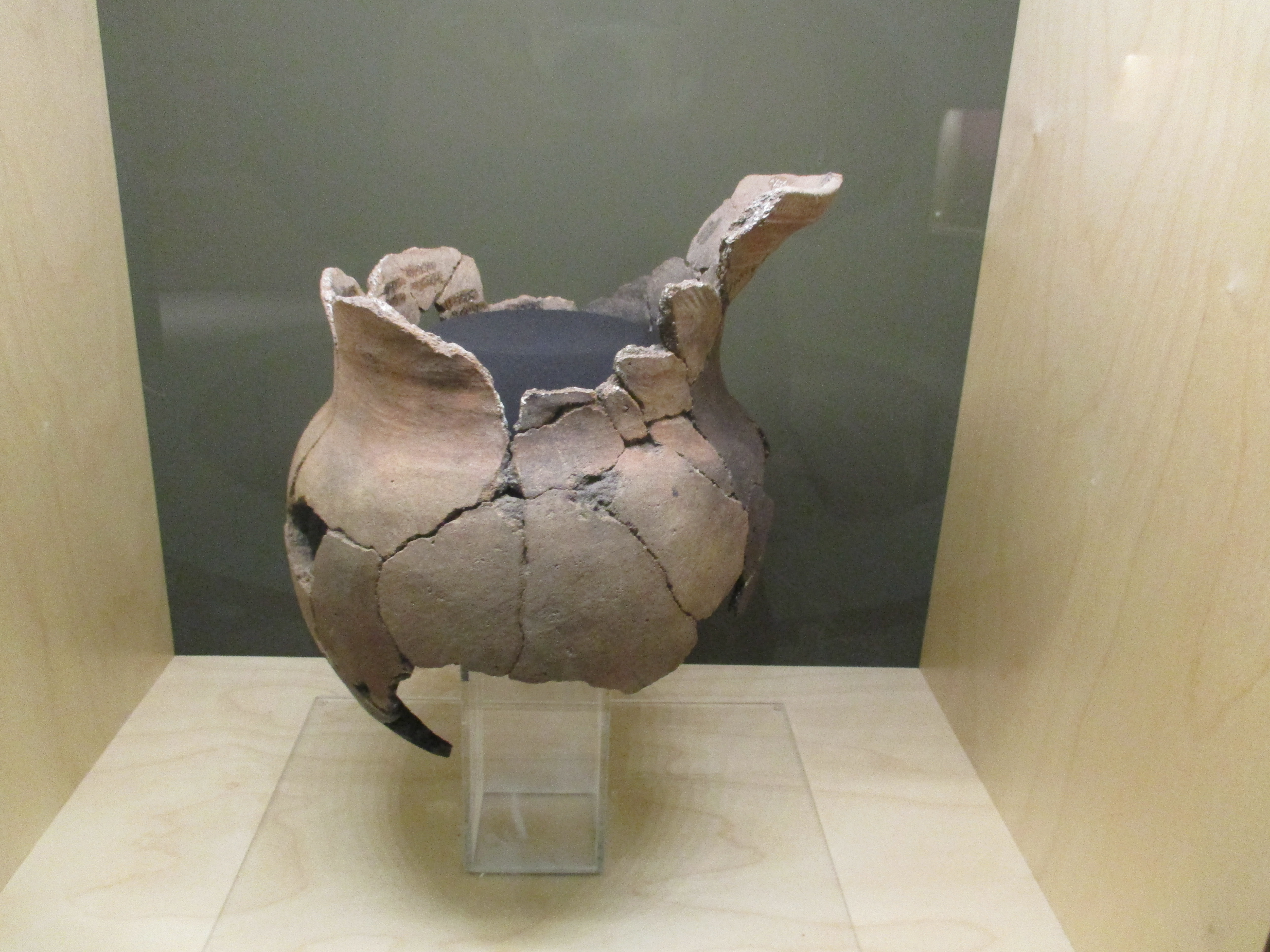
Pottery was made by the women and the vessels could be as large as 15 litres.  Each family decorated their pottery in a unique manner that was passed on from mother to daughter. Specific markings on pottery have been used to trace the movements of families and clans over time.  The pottery fragments recovered in the village have been carefully put back together including the 47 pieces of this jug.

IMG_1545

This tract of land was eventually sold to the British Crown to be granted to European settlers and the natives who had lived here for centuries would never return.

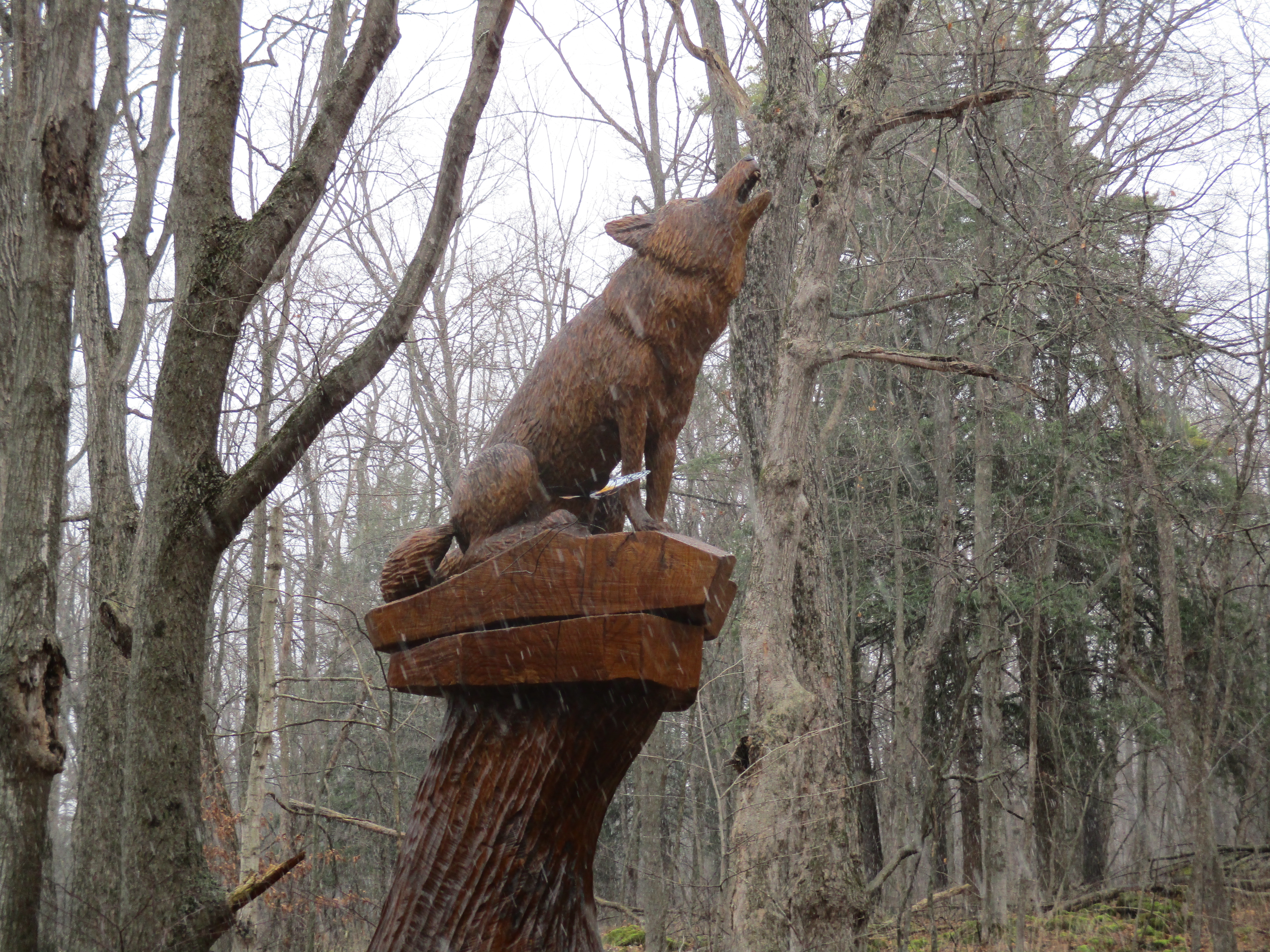
Along the Crawford Lake Trail is a series of wood carvings known as the Hide and Seek Trail. Ontario has almost 200 species that are considered to be at risk, seven of which are represented with larger than life wood carvings.  The Eastern Wolf in the carving below is pictured howling, as they commonly do, to communicate within their packs and alert other packs to stay away. They are found in Ontario and Quebec but are now predominantly in Algonquin Park.  They are unable to survive in the small patches of forest left in the more urban parts of the province.

IMG_1584

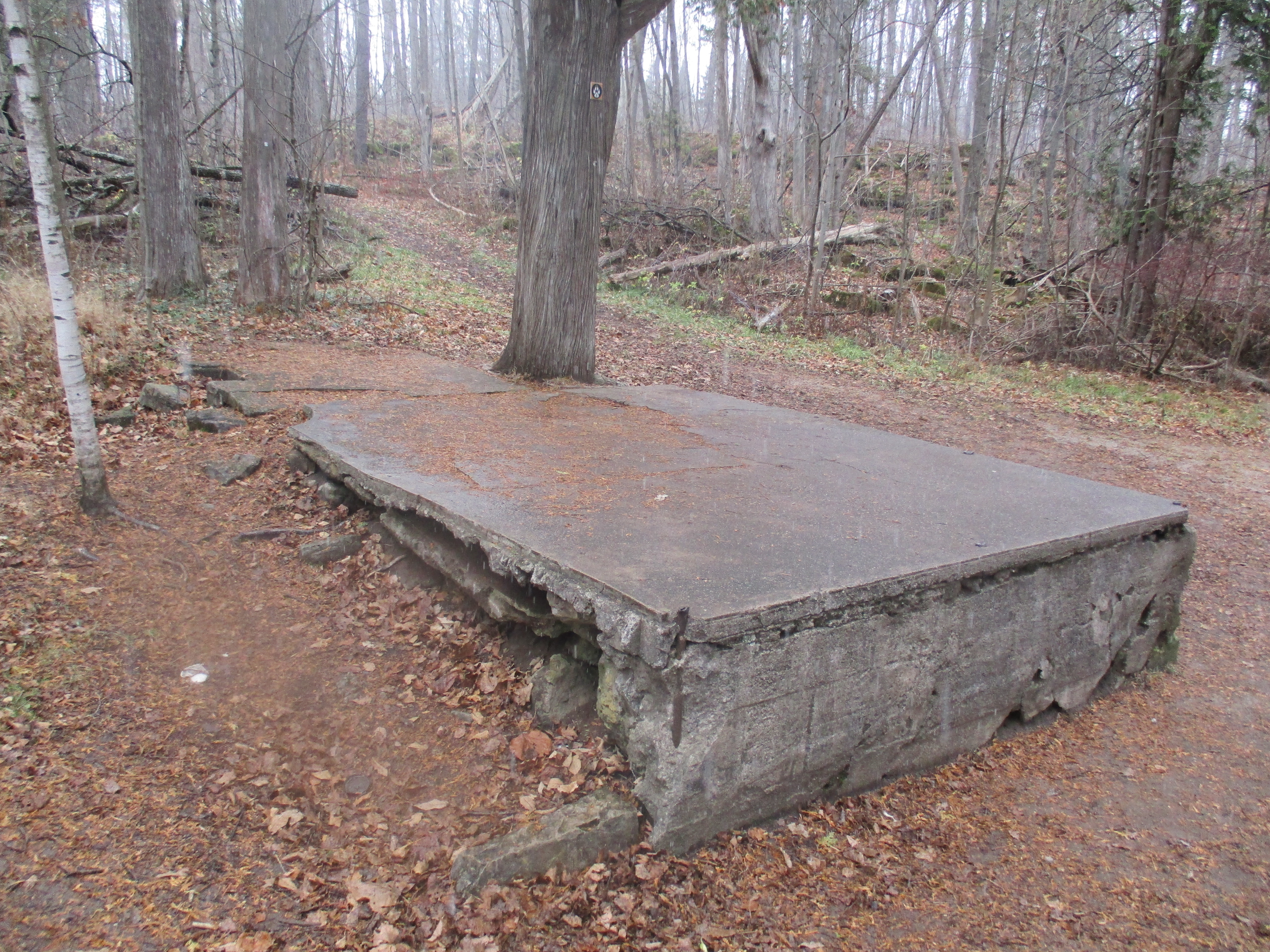
In 1883 George Crawford bought the lake and 100 acres of land which he transferred it to his son Murray a couple years later.  They operated a saw mill on the south end of the lake to take advantage of the ample timber on the surrounding lands.  In 1898 the name of the lake was changed from Little Lake to Crawford Lake when they opened the Crawford Lake Company. When times were tough during the depression the Crawford family ran a resort on the lake. They also built themselves a cottage and boathouse.  In 1969 the lake and property was sold to the conservation authority and the cottage has since been destroyed.  All that remains is the concrete from the front porch and a set of steps leading down to where the boathouse once stood.

IMG_1600

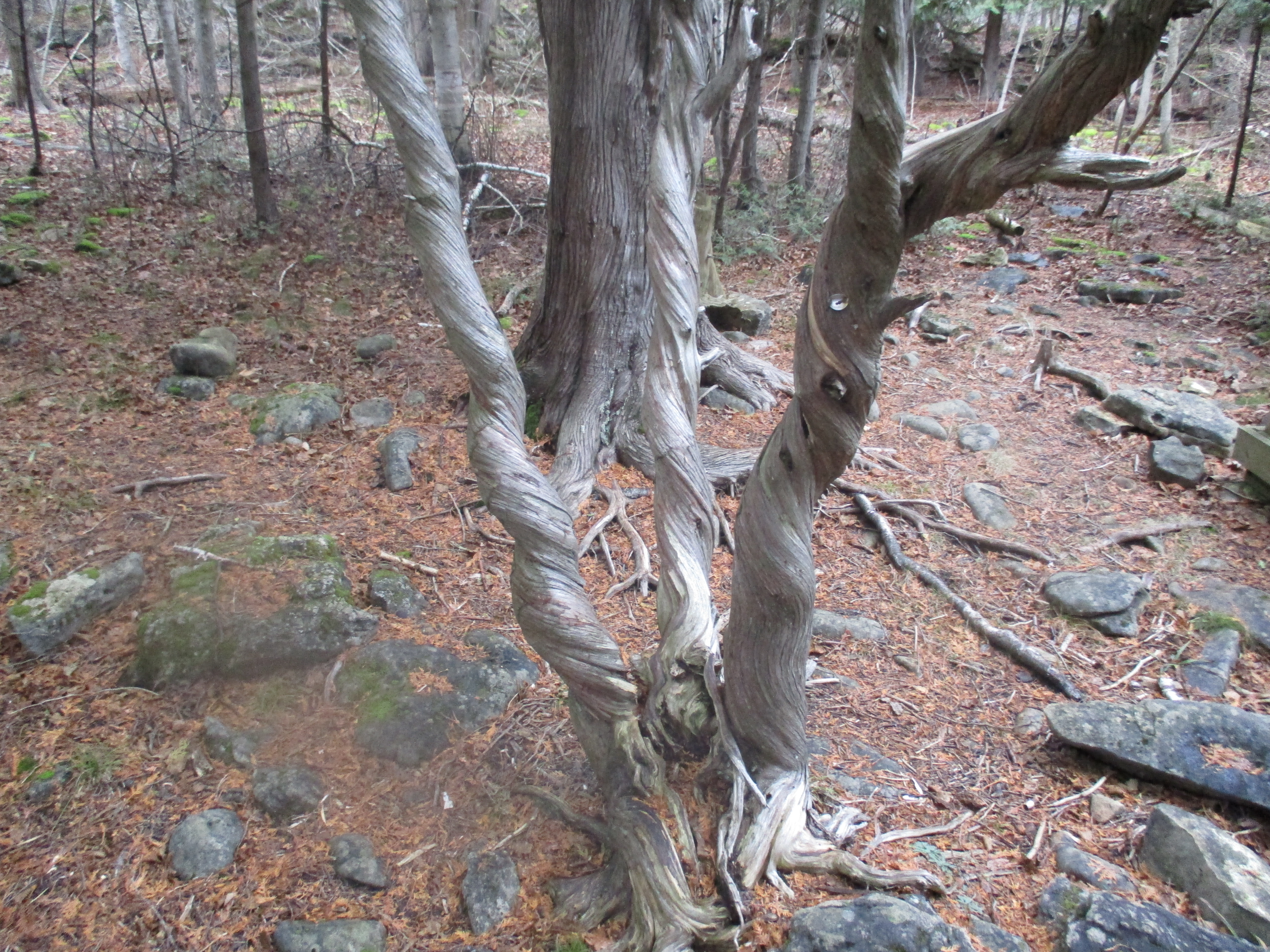
This cedar tree stands along the side of the trail and is unique in that all three stems are twisted from top to bottom.

IMG_1610

Crawford Lake was formed at the end of the last ice age and has been collecting it’s local history lesson ever since.  Steam was rising off of Crawford Lake even as the snow was falling onto it.

IMG_1616

Crawford Lake Trail and the interpretive reconstruction of the Iroquoian village has been made wheelchair accessible so no one has to miss out.

IMG_1612

I only investigated the village and Crawford Lake Trail but the conservation area contains 7 hiking trails including part of the Bruce Trail.  It looks like you can spend a whole day here and still miss things.

Google Maps Link: Crawford Lake

Like us at http://www.facebook.com/hikingthegta
Follow us at http://www.hikingthegta.com

The Haunted Hermitage

Sunday, Nov, 15, 2015

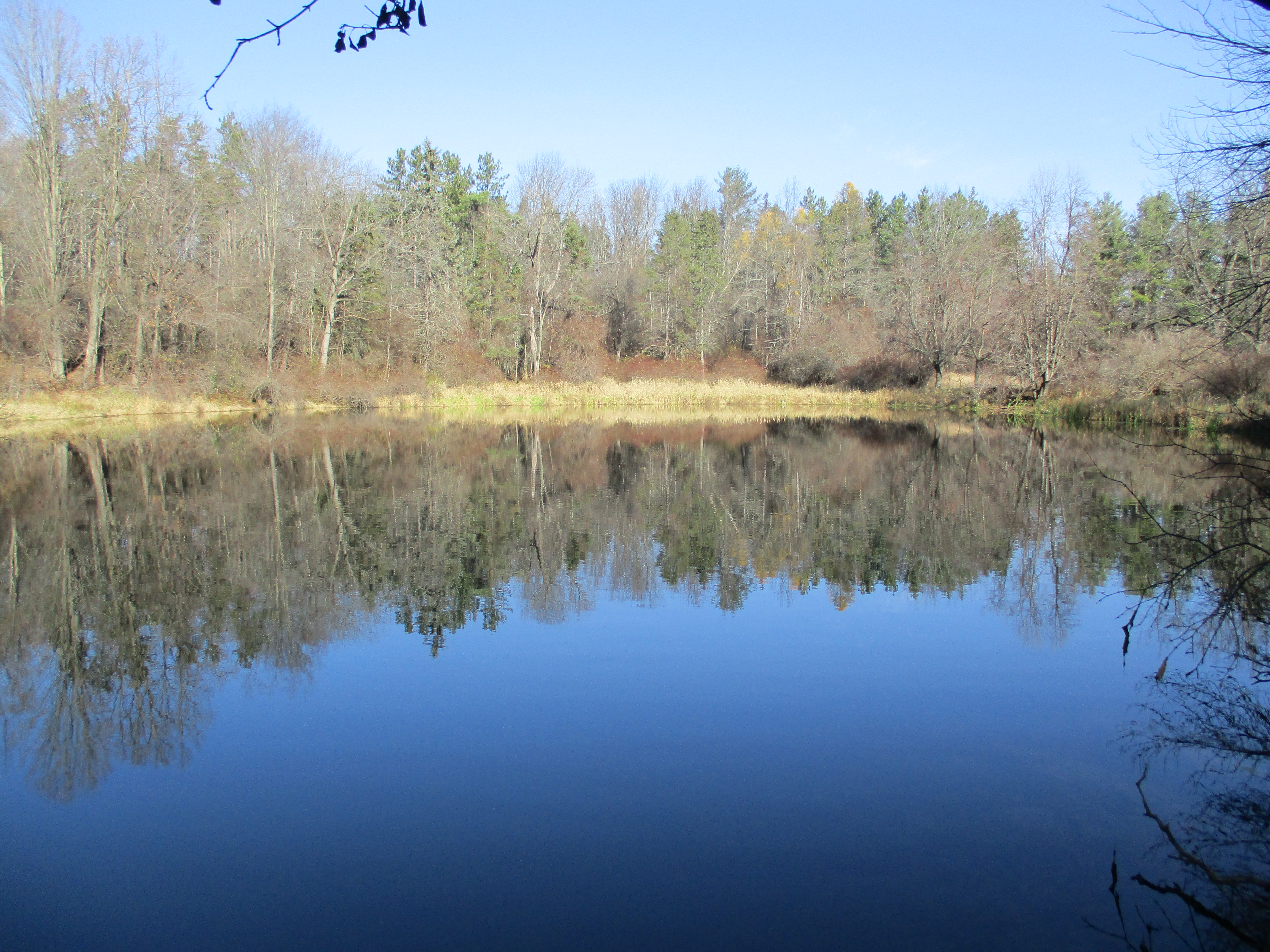
The ruins known as The Hermitage are said to be one of the best spots for ghost watchers because of it’s haunted past.  Reverend George Sheed bought this property in 1830 when he moved to Ancaster to become the first resident Presbyterian Minister.  He built a frame house on low ground close to the stream. The property seems to have had some odd things going on from the very beginning.  The first service conducted in the new church was the funeral for Reverend Sheed who had passed away suddenly in 1832.  As you walk back though the former estate grounds, now part of the Bruce Trail, you pass a small pond that was almost perfectly calm on this sunny morning.

IMG_1529

Otto Ives came to Upper Canada in 1833 and purchased the land from Sheed’s estate.  Legend has it that Ives and his wife hired a coachman named William Black to assist them.  Black became obsessed with Otto Ives’ niece who had moved to Canada with them.  Finally he worked up the nerve to ask Otto for the young woman’s hand in marriage.  William Black was quickly rejected and told he was beneath the family and could never hope to marry into it.  When he failed to turn up for work the following morning Ives went looking for him.  Whether found hanging in the rafters or a tree it is recorded that heartbreak caused Walter to take his own life. Otto then cut the body down and took it for burial.  Suicides could not be buried in the church cemetery and so the body was transported via a manure wheel barrow to a burial site near Lover’s Lane. They say that the ghost haunts the property today looking for his lost love.  There are many claims of sightings and the park is now closed at night as a result.

George Gordon Brown Leith bought the property in 1855 and he built a two story home in a park-like setting that came to be known as The Hermitage.  The front and side walls were made of hammered limestone while the rest was made of random field stones.   The house has been in ruins for years with the walls being propped up from the inside.  For safety the walls either needed to be lowered to waist height or be secured.  It was decided to rebuild the walls. Restoring the Hermitage is a $600,000 project and was started in July.  Each stone was removed, numbered and set aside.  A new foundation was poured and steel support beams installed to support the walls.  The stone masons are busy putting the walls back in place.  In the end we will have a set of restored ruins.

IMG_1457

Behind the two story home an extended carriage house also contained a workroom and space for wood storage.  This building itself was 85 feet long.  There was also a smaller building which housed the nursery.  Their ruins can be seen in relation to the Hermitage in the picture below.

IMG_1467

At the rear of the house was a two room building that housed the laundry.  One of these rooms had a cistern built into the floor.  The ruins of the laundry are relatively more intact than the stable or nursery.  The cover photo shows the inside of the laundry while the picture below is from the rear.

IMG_1473

Beside the parking lot on Sulphur Springs Road stands the gatehouse which was built around the same time as the rest of the structures.  It was also called The Lodge and was occupied by the gatekeeper and his family. His duties included opening the gate for the family and their guests and escorting people back to the house.  For many years it was lived in by the grand daughter of George Leith.  Today the gatehouse hosts a museum on the property.

Gatehouse

By the 1860’s the farm was quite prosperous with 150 acres cleared and cultivated out of the total 250.  The family of 8 shared the home with five servants and lived in relative opulance for the time period.  Slowly the family died off with Mr. Leith going first in 1887 followed by his wife in 1900.  Their daughter, Mrs. Alma Dick-Lauder, lived in the house after they were gone.  In October 1934 there was a fire that totally destroyed the buildings leaving only ruins.  In another small example of unusual behaviour on the property, Mrs. Lauder lived in a tent while she had a smaller new home built inside the ruins.  She lived there until her death in 1942 when the farm began to return to the forested condition it enjoys today.  Among the trees grow wild grapes, some of which have reached massive sizes as the vine below illustrates.

IMG_1477

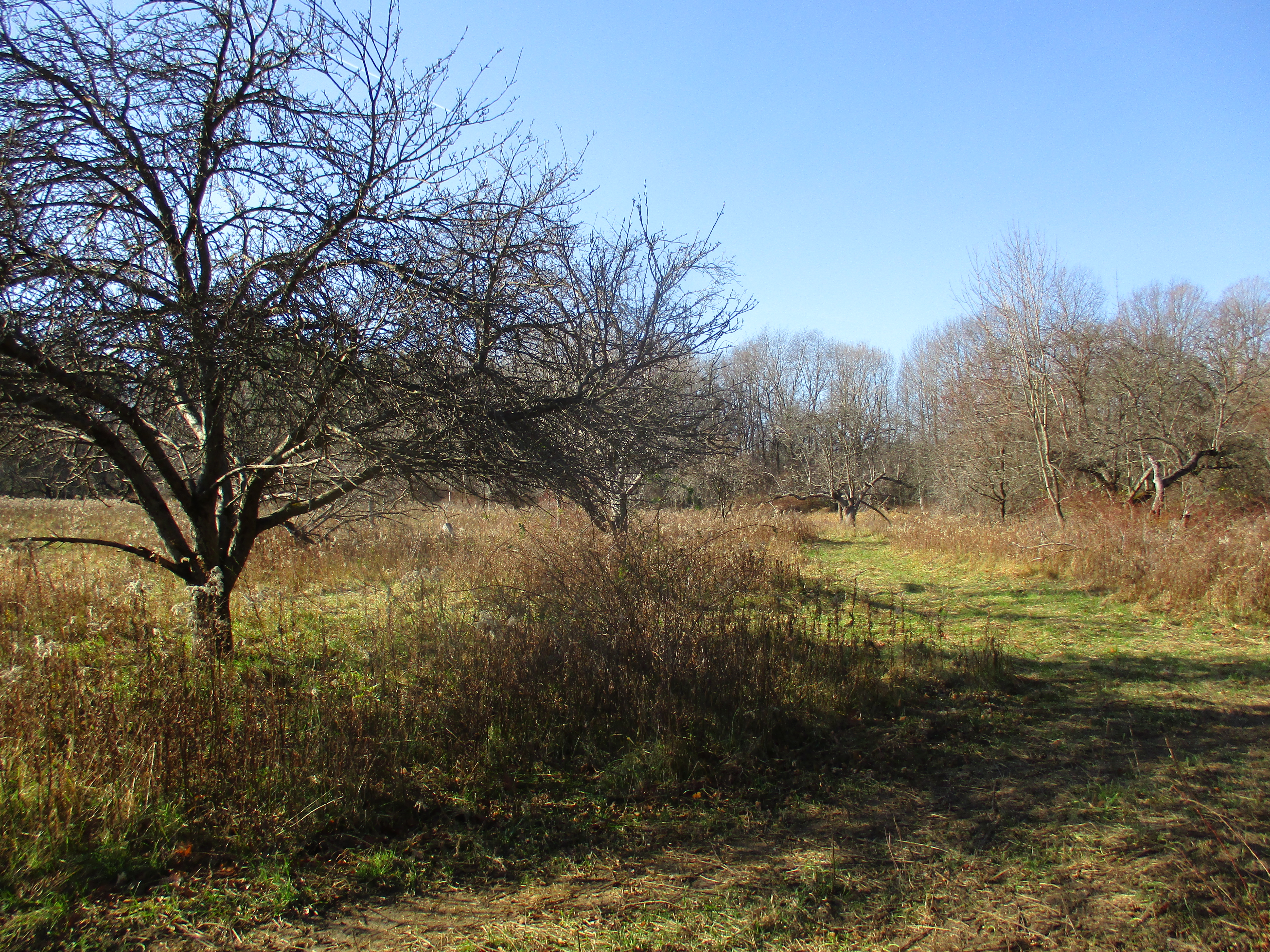
The park is full of deer tracks, some of them very fresh.  I followed what looked to be the freshest ones and soon came to a set of deer bones scattered on the ground.  Thinking the tracks were much newer than this, I carried on and came to an old orchard.  This is a prime area to see deer, especially at this time of year when they can find some apples to eat.

IMG_1485

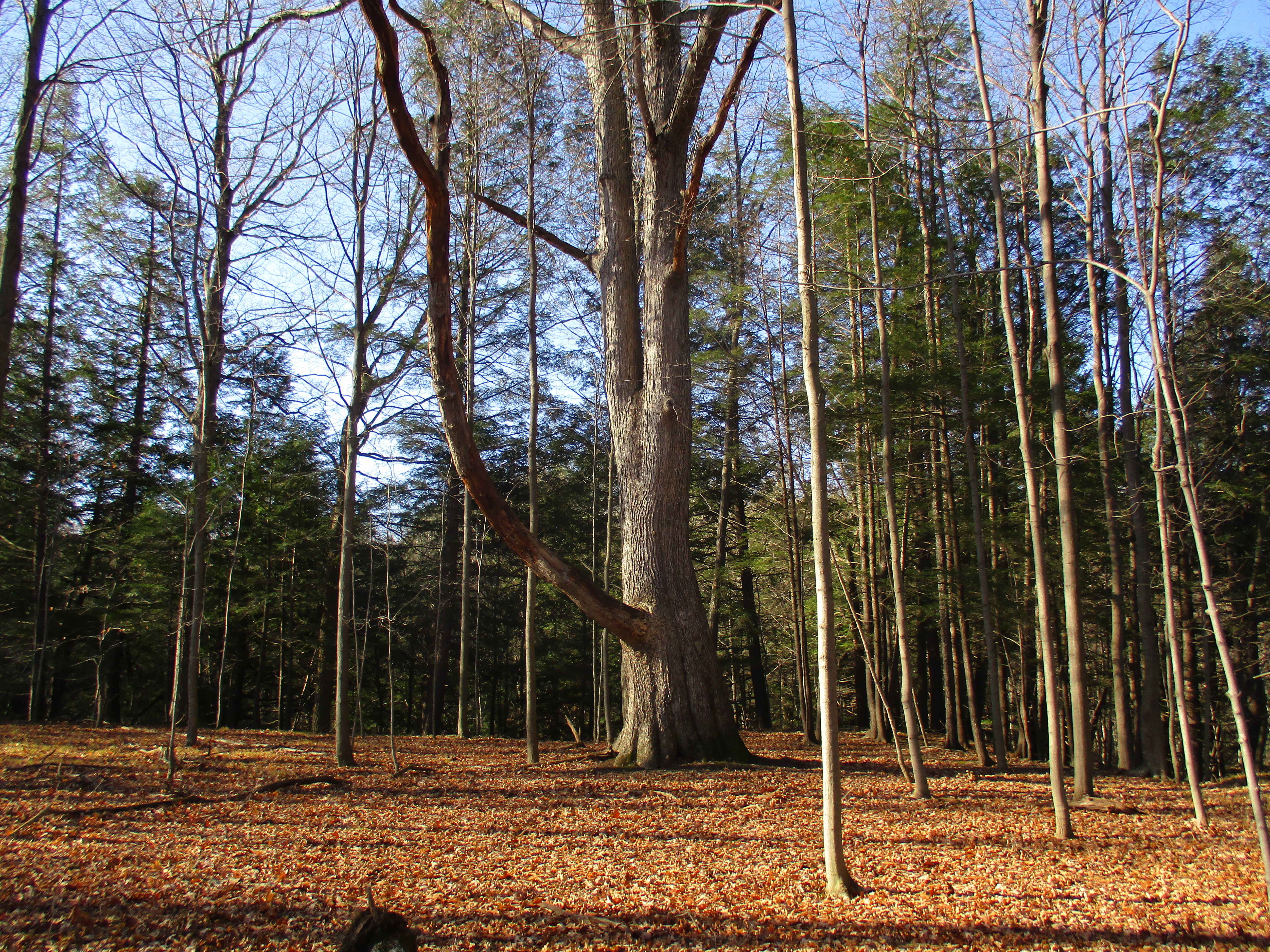
At the end of the orchard stands a giant old red oak tree.  I estimated that it must be six feet across at the base of the trunk.  These trees can live to be 600 years old.

IMG_1494

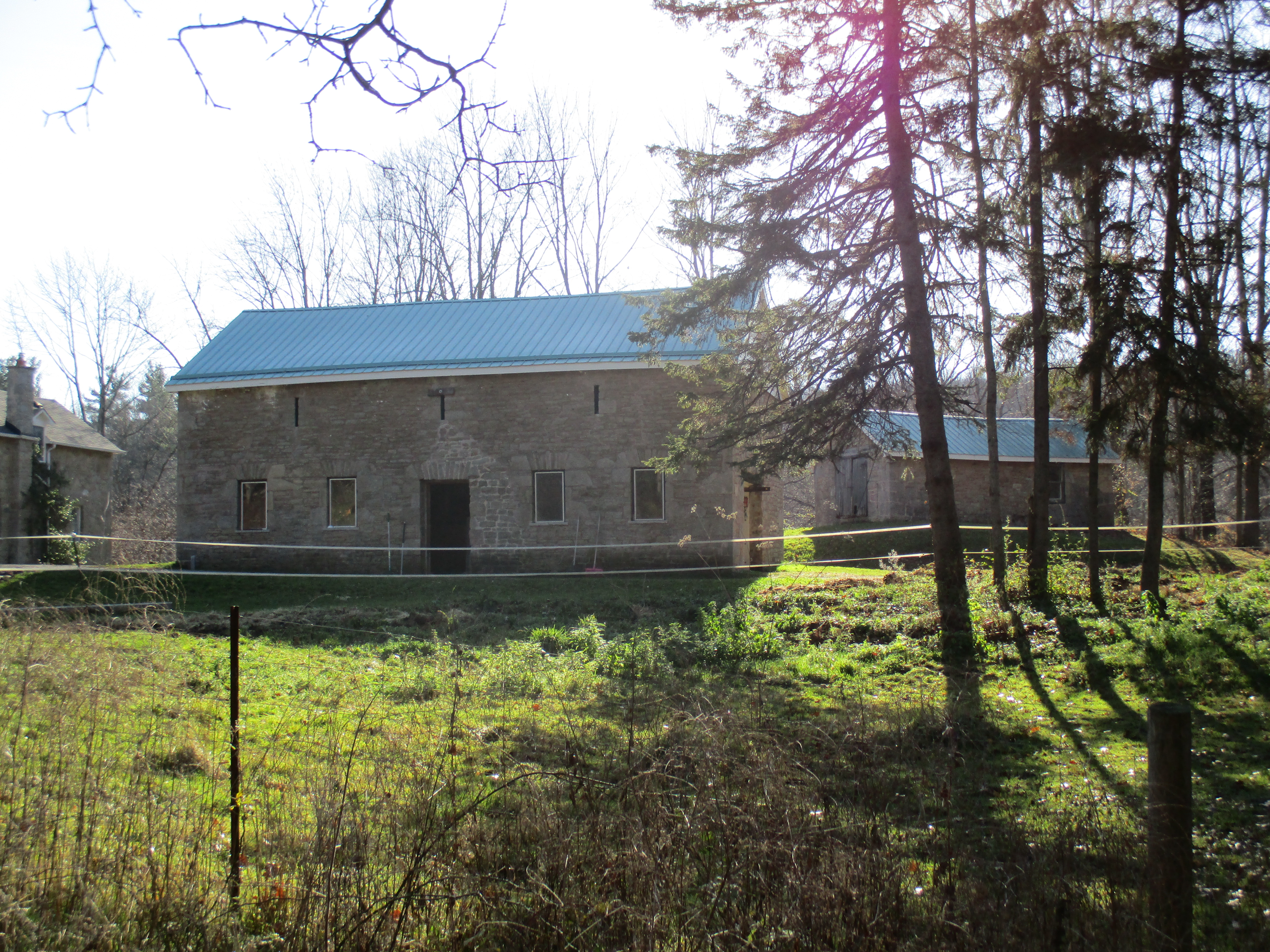
In the park is a section which belongs to a private residence. These structures were built by Leith for the farmer who lived there and tended the farm for him.  There is a house, granary and a barn.  It is clearly fenced off and as I admired the old architecture I wondered if those might not be three arrowslits in the top of the wall on the second story of the barn.  How many times has a musket poked out of one of those I wondered?

IMG_1498

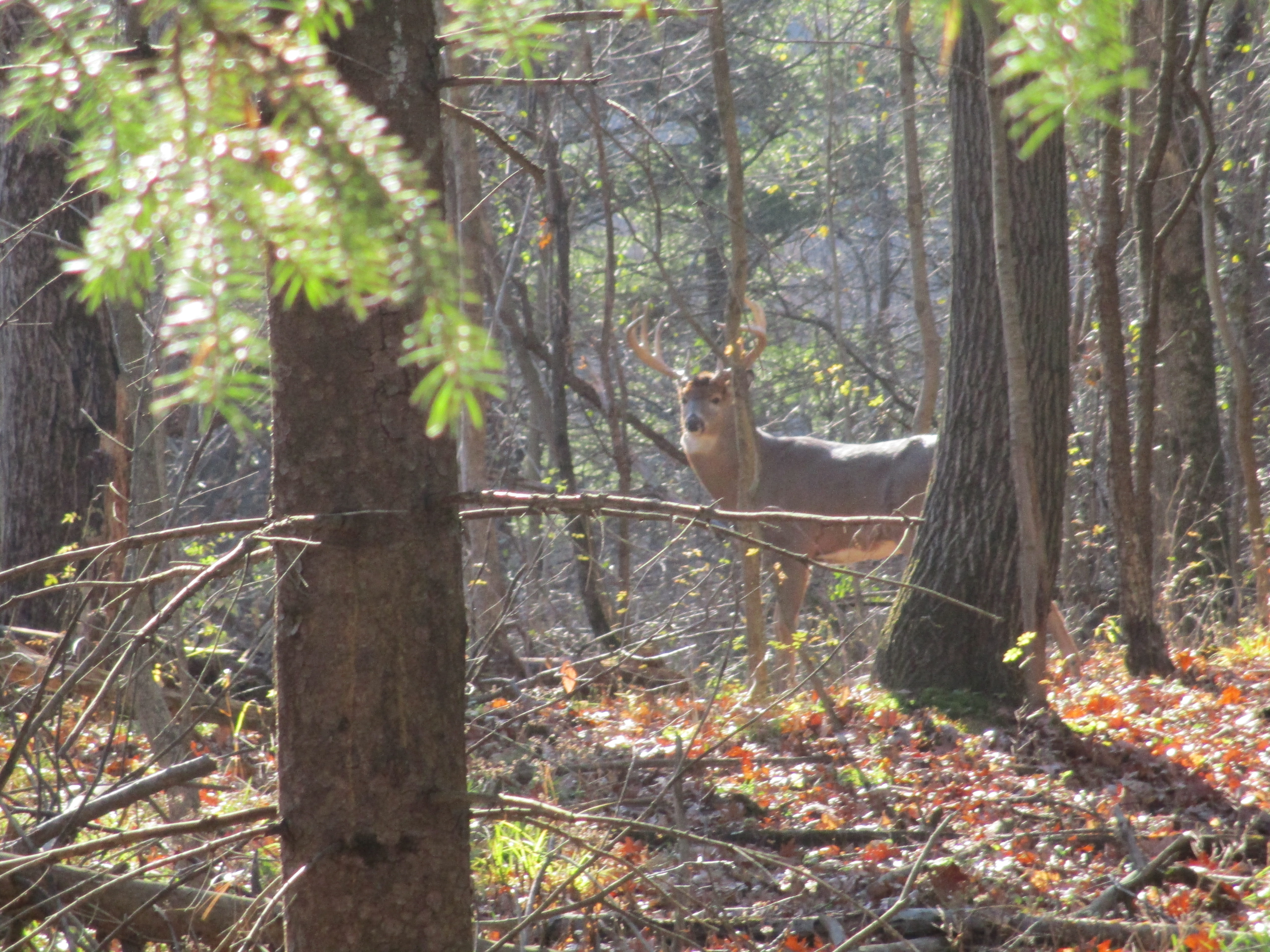
Finally, my following deer tracks paid off as I came to a buck and doe grazing.  They both posed for some great shots but the buck was especially proud of himself.  Following wild animals through the woods is hazardous because they are unpredictable and they are, therefore, safer enjoyed by photo and video.

IMG_1508

After a few pictures he decided to strut off into the woods as if I didn’t concern him at all.

I didn’t feel anything that was unusual while I was around the Hermitage.  Perhaps the restoration project has caused the ghost of William Black to find temporary new lodgings.  And then again, was that a musket in the arrowslit on the old barn?

Like us at http://www.facebook.com/hikingthegta
The Gap

Saturday Nov. 14, 2015

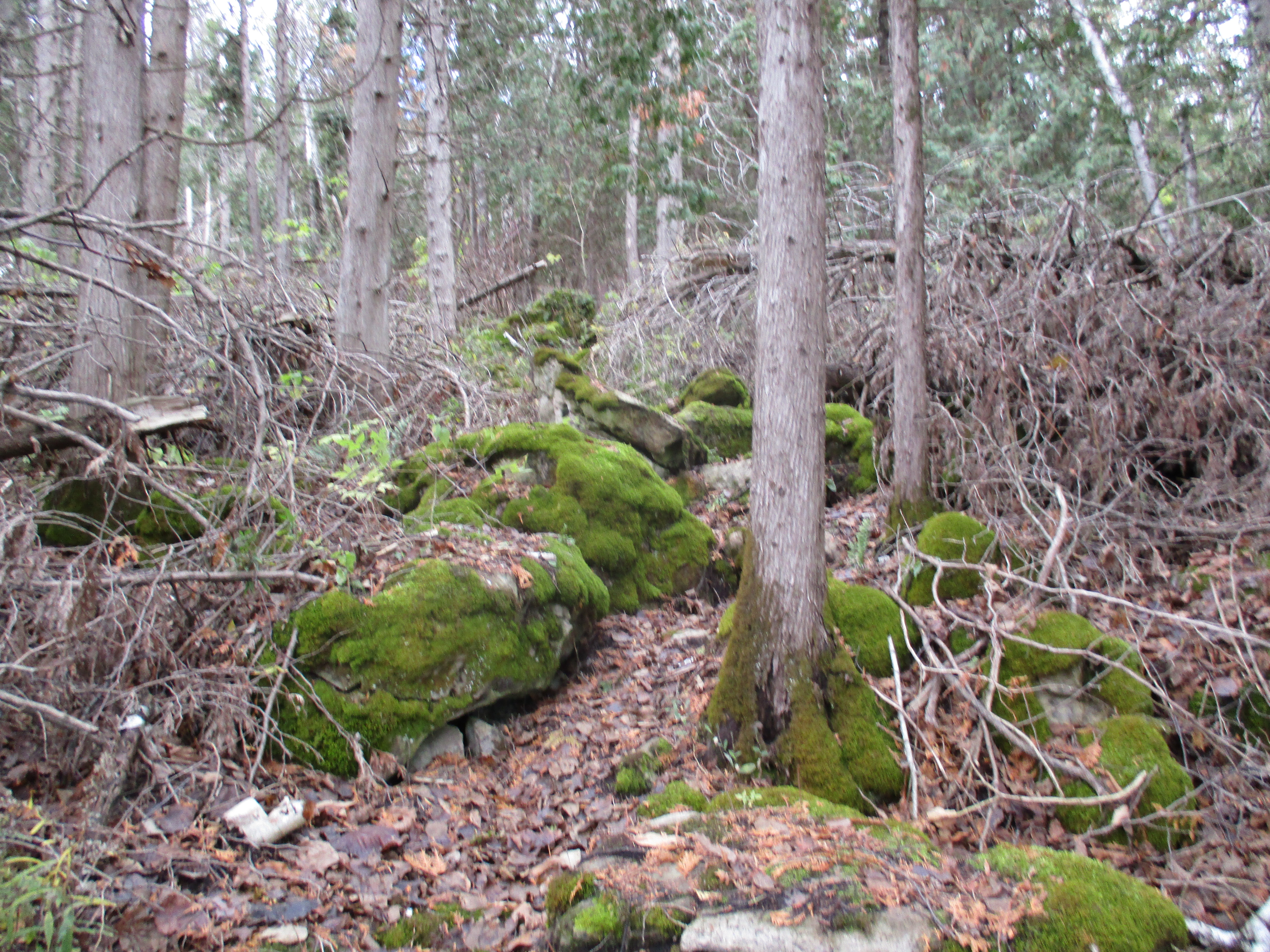
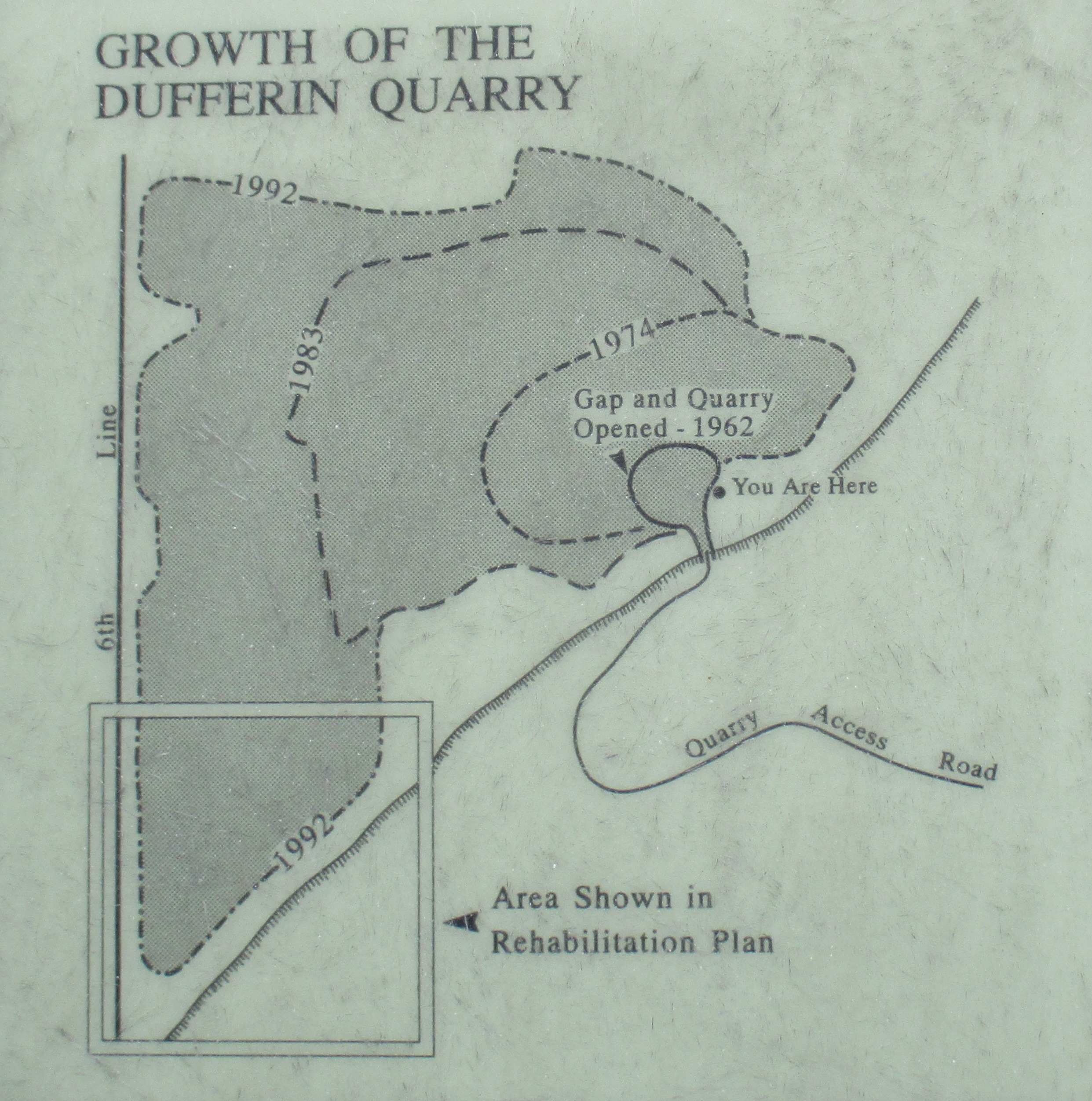
In 1962 a quarry blasted a huge gap in the Niagara Escarpment and set off a chain reaction that led to the escarpment being declared a World Biosphere Reserve by UNESCO.  The gap in the escarpment can be seen from the 401 which is 3 km away.  We parked at the turn around loop on Dublin Line and made our way along a small trail that departs from the cul-de-sac.  It was 2 degrees but feeling like minus 2 as we started up the side of the escarpment.  We followed a trail that led between the moss covered boulders, seeking the Bruce Trail that runs along the top of the escarpment.

IMG_1321

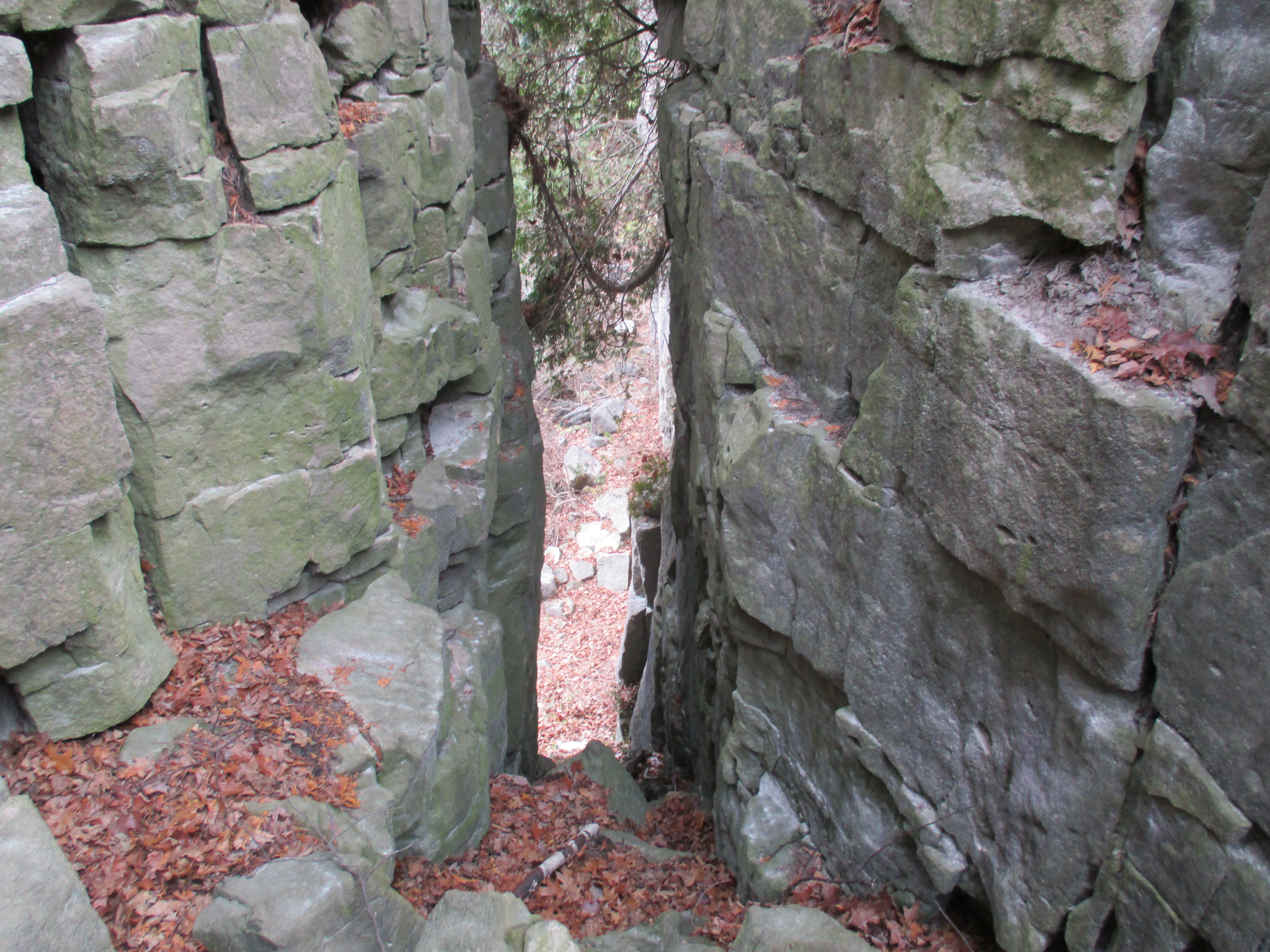
The escarpment is over 700 km long and is full of valuable natural resources.  The area around Milton is important as a source of dolomitic limestone which is used in construction.  The location is critical because there is about 30 meters of good limestone very close to the surface. It is also close to the highway for transportation and the GTA which is the largest market in the country.  We needed to get to the top of the escarpment and found a natural gap in the rock where we were able to climb up.

IMG_1351

Even from before the creation of the gap there had been a movement to keep quarries under some tighter controls.  The Sixteen Mile Creek Conservation Authority was formed in 1956 and three years later they had acquired an 88 acre chunk of the escarpment to prevent quarry expansion. This would become Mount Nemo Conservation Area with Rattlesnake Point being created in 1961. Then, like a missing front tooth, came the visible scar of the gap.

From the top of the escarpment you can see the towers in the city.  The CN tower has been a landmark for 40 years but now, taking their place on the right of the tower, are the so called Marilyn Monroe towers in Mississauga.

IMG_1355

Concerned, Ontario Premier John Robarts commissioned a 1967 report on protecting the escarpment, the first of it’s kind.  In 1973 the government passed an act creating the Niagara Escarpment Commission which began to control development.  The Coalition on the Niagara Escarpment (CONE) was established in 1978 to make recommendations on preserving the escarpment.  Through their efforts the Niagara Escarpment Plan would be passed by the government in 1985.  In 1990 the Southern Ontario portion of the escarpment was designated a World Biosphere Reserve.

The processing plant can be seen from the highway, not only through the gap, but rising above the limestone cliffs to the east of it.  This processing plant was built in 1974 and the earlier one closed down.  It has since been removed and the site put into the rehabilitation plan.

IMG_1382

This large size cable spool had rolled down the side of the excavation berm and come to rest on the fence.  The steel fence post is about 2 feet shorter than the spool making it about 7 feet in diameter.  Made in Japan, this Canada Belt product contained 925 feet of cable on the spool. There were a lot of empty Texaco lubricant tin buckets, a Zenith washing machine, a lawnmower and other trash in the same area.

IMG_1388

In 1989 the Bruce Trail Association started a campaign to bridge the gap and connect their conservation lands on either side.  $150,000 was raised through donations to build the 40 metre bridge.  This allowed the trail to be relocated onto a better route.  The bridge was officially opened in May 1991.

IMG_1421

Over the years the quarry grew to take in larger and larger sections of the escarpment.  In 2006 they applied for and later received an extension to the licensed area of the quarry.

IMG_1431

Parts of the original quarry have now been put into a regeneration project.  There will be wetlands and wild life habitat created.  Every year since 1993 Scouts Canada has planted trees in the closed section of the quarry as part of their Earth Day celebrations.  In 2008 they planted their 100,000th tree.  Both forests and meadows are being created as well as lakes.  When we got back to the natural gap in the rock and had descended, we decided to make our way along the front face of the limestone cliff.  The large loose chunks hanging out over our heads and broken pieces under our feet were a constant reminder that they fall on a regular basis.

IMG_1440

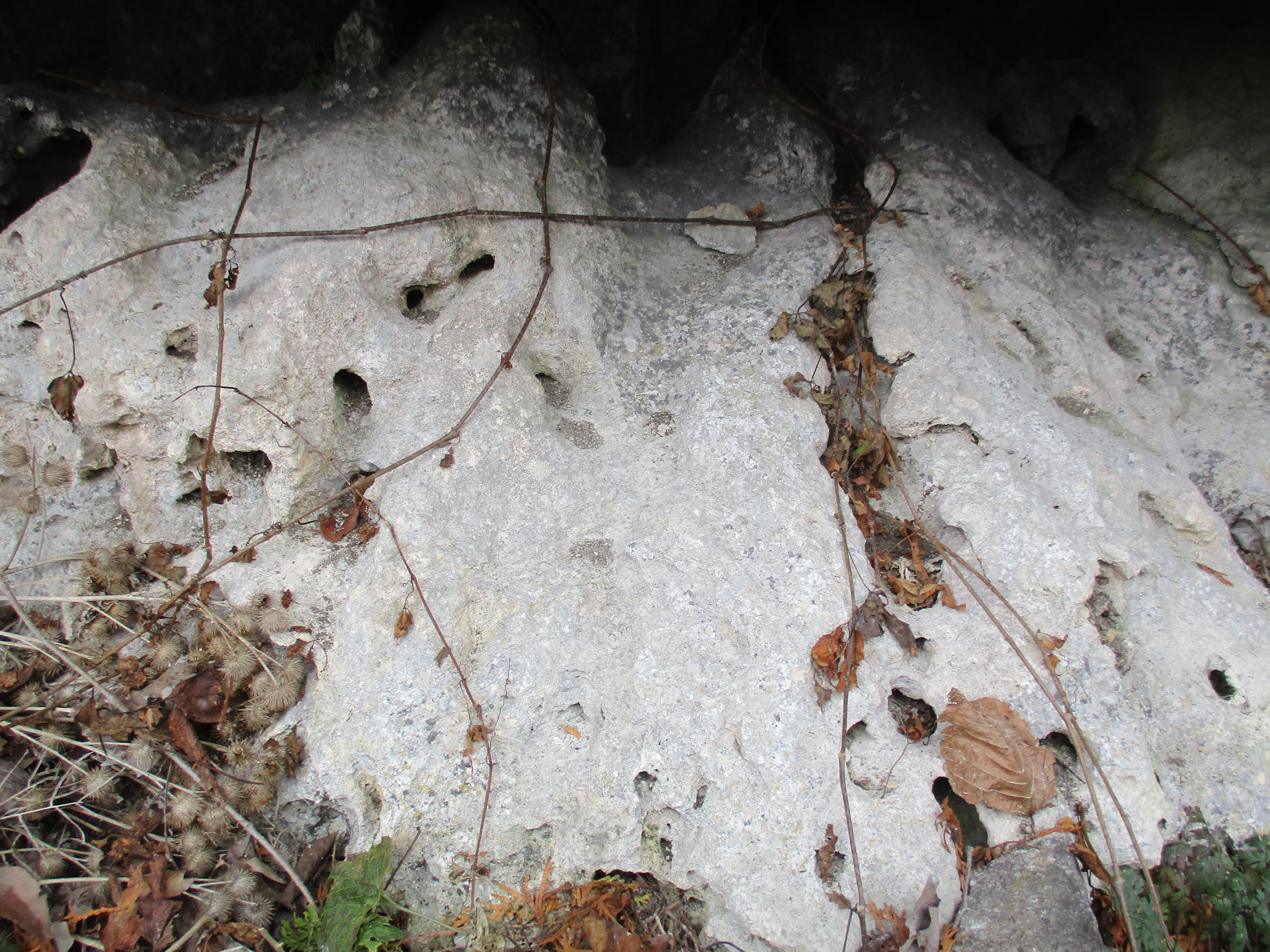
We found this hardened lime at the bottom of the cliff in a couple of places.  It was drilled in several spots with little animal holes.

IMG_1448

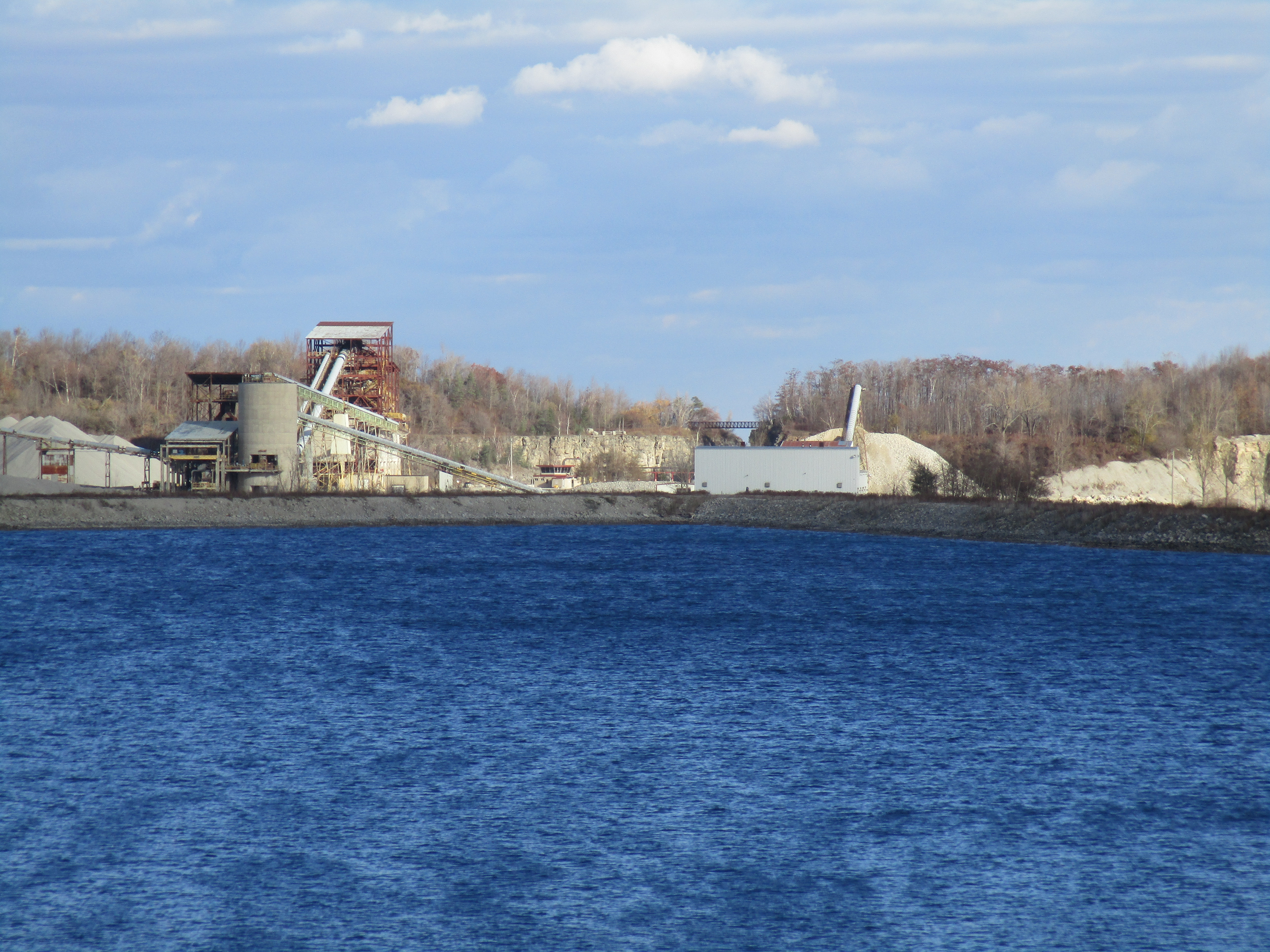
Based on current mining rates it is expected that the Dufferin Quarry site will run out in about 25 years or less.  When the rehabilitation is complete over 400 ha of parkland will be handed over to the conservation authority creating one of the largest public land holdings in the entire GTA. The picture below was taken on November 1, 2015 during our Hilton Falls excursion.  It shows the quarry lake and the back of the processing plant.  The bridge across the gap is also seen in the distance in the centre of the picture.

IMG_1128

Part of the recent approval for expansion that was granted included the company dealing with the industrial scar of the gap.  In the short term they have planted as many trees as possible to screen the gap.  When the quarry closes they will implement a more permanent solution.  Filling the gap back in is one option but would restrict the animal traffic that now uses it. This could be overcome by creating a tunnel with fill on the top.  Building a new land form behind the gap to create the illusion of it being closed is yet another option being investigated.  A more creative idea includes building a terrace across the gap with trees planted on it.

IMG_1301

Many believe that it was the destruction of this small section of the escarpment that led directly to the creation of the NEC and ultimately to recognition by the UNESCO (United Nations Educational Scientific and Cultural Organization).

Other popular hikes in the area include Rattlesnake Point and Mount Nemo.

Google Maps: The Gap

Like us at http://www.facebook.com/hikingthegta

Follow us at http://www.hikingthegta.com