Snow Day in G. Ross Lord Park

Saturday, February 10, 2018

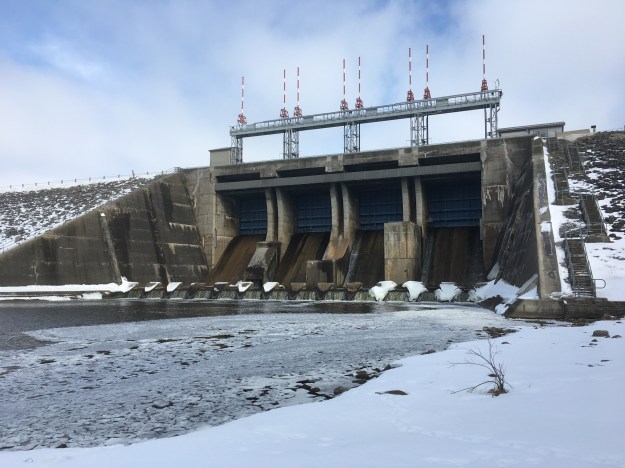
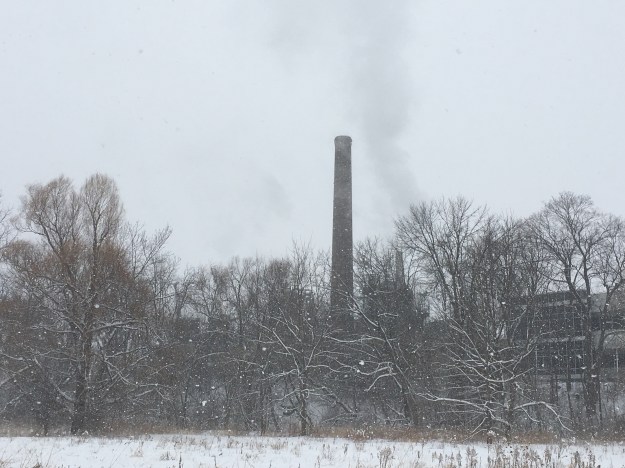
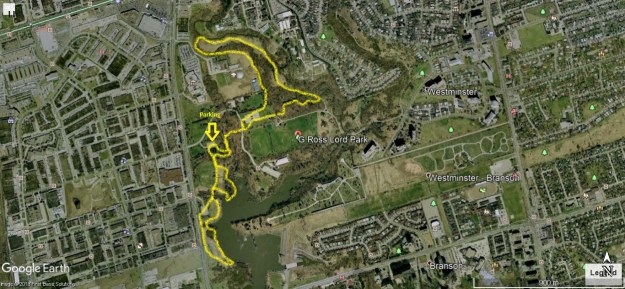
Here we have Hiking the GTA’s White Blog.  It was minus five Celsius and snowing steady the entire time we explored G Ross Lord Park.  The park was the subject of one of our earliest blogs, the seventh one, and so the local history won’t be repeated in this post, you can read it here.  The Google Earth capture below has been marked to show where we wandered from the car,  We did the southern section down to where we could see the G Ross Lord flood control dam.  Then we returned and made our way to the Don River flood plain to check it out.  There is a large section of the park to the east that could serve as an adventure for another day.

G Ross Lord

From the parking lot we went down to where Westminster Creek flows into the G Ross Lord reservoir.  There is a small section of land along the west side of the creek that is home to one of the local coyotes

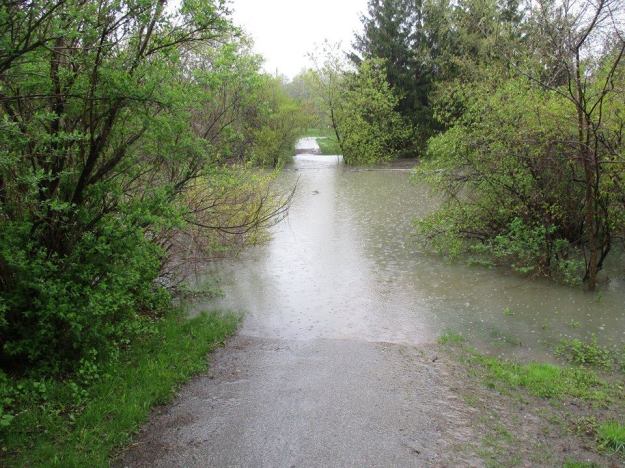
.  There were coyote tracks everywhere but on this day squirrels were the main wildlife braving the storm.  You have to return to the main path to cross this little industrial outflow.  The foot bridge in the picture below will likely be flooded well above the hand rail during the spring melt when the reservoir is used retain a sudden inflow and then deliver a steady flow of water down stream.  The water level in the entire reservoir can rise by over ten feet in a matter of a day or so making the bridge completely disappear.

IMG_2502

The picture below was taken on May 9th, 2017 when the water level in the reservoir had risen above the level of the hand rails on the bridge.

Bridge in G Ross

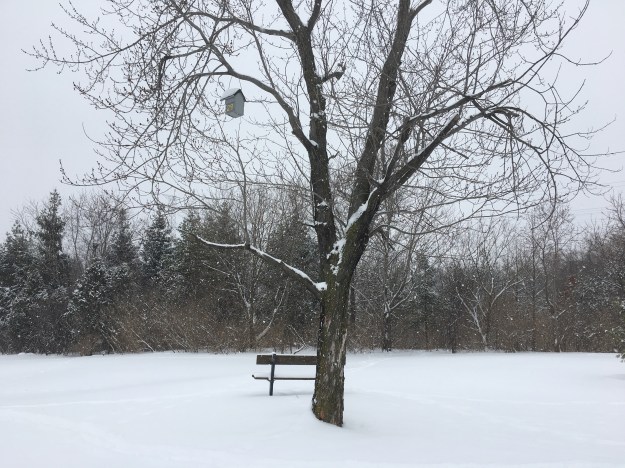
The southern parking lot is closed for the winter but as we passed through we noted this bird house.  It is number 29 and many others can be found throughout the park.  They were added last year.

IMG_2511

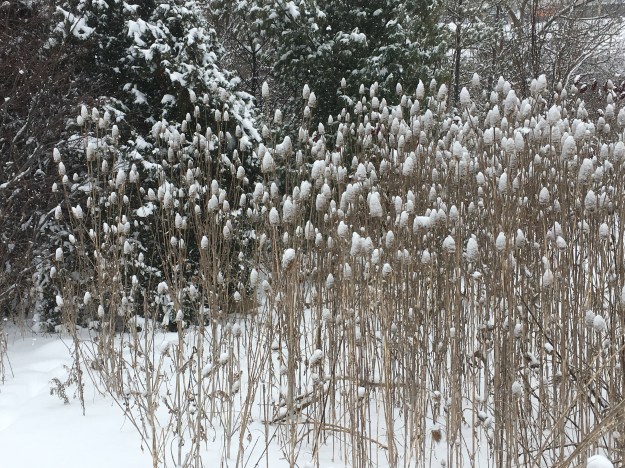
There are several different terrain types in the park including grasslands, wetlands and meadows making the park an excellent place for bird watchers.  Teasels grow in abundance in the park and their purple heads are quite spectacular when they are in bloom in early summer.  Today they sport a white cap of snow.

IMG_2515

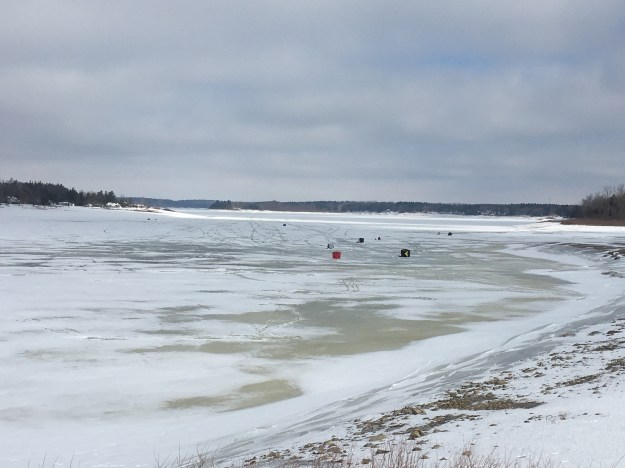
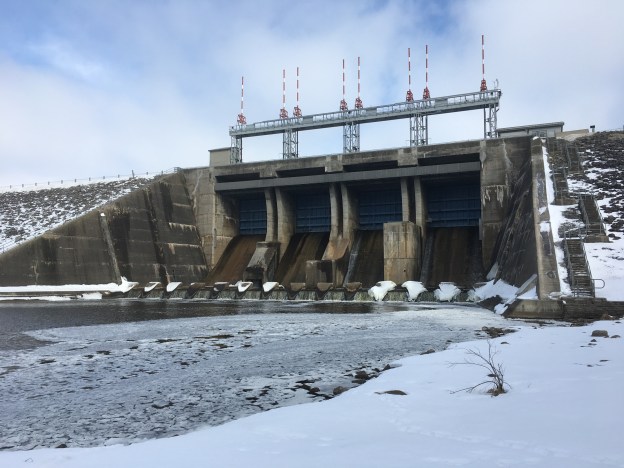
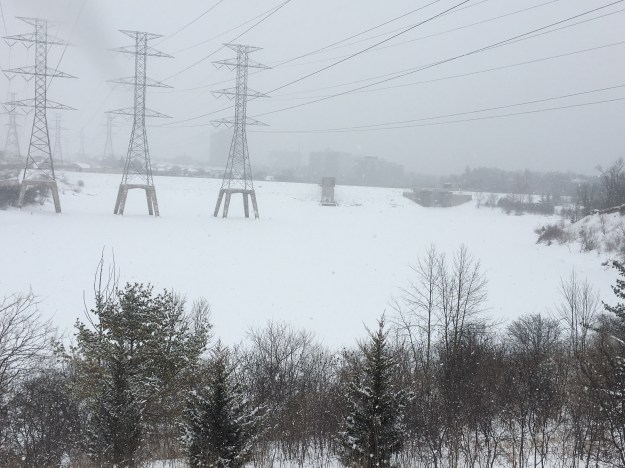
The reservoir is frozen over but I don’t think the ice is very reliable because the water level fluctuates so much.  The park was created in 1972 and G Ross Lord Dam is one of three flood control dams built following Hurricane Hazel.  The Claireville Dam and Milne Dam are the other two.  Three hydro towers stand on concrete platforms in the middle of the reservoir.

IMG_2519

The picture below shows the reservoir looking north and helps give an idea of the size of the flood control pond.  Also the amount of water required to fill the entire pond to the level seen in the spring flood picture above.

IMG_2521

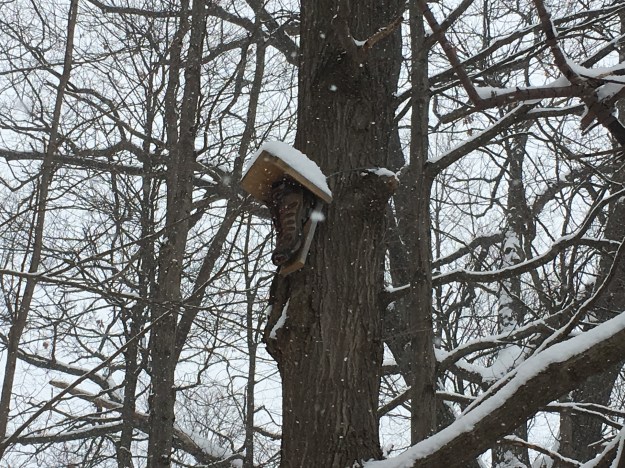
In a great example of re-purposing old things, a running shoe has been converted into a bird house.

IMG_2528

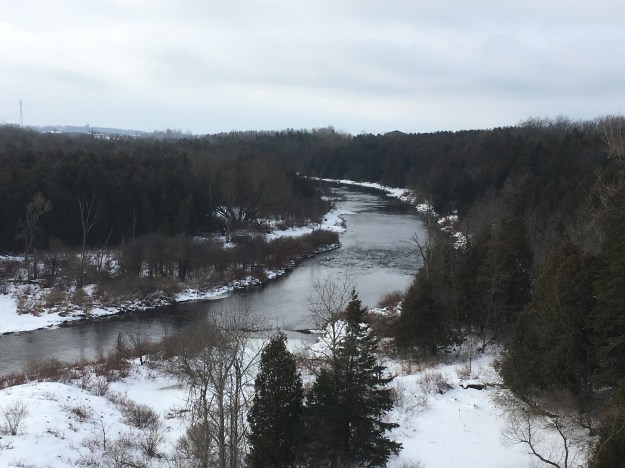
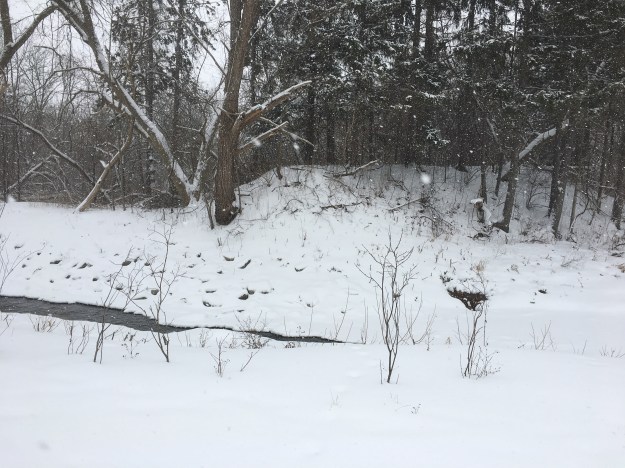
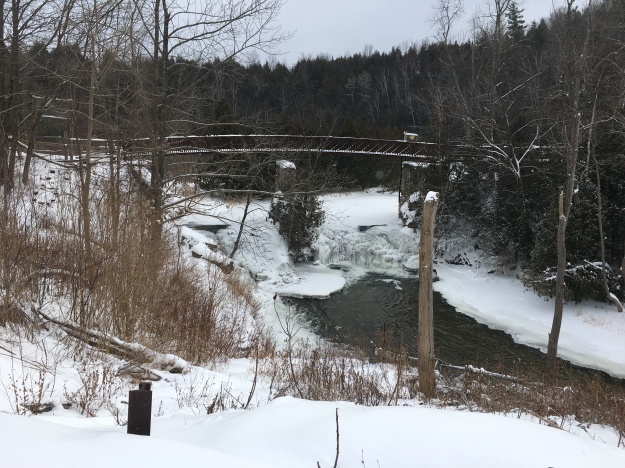
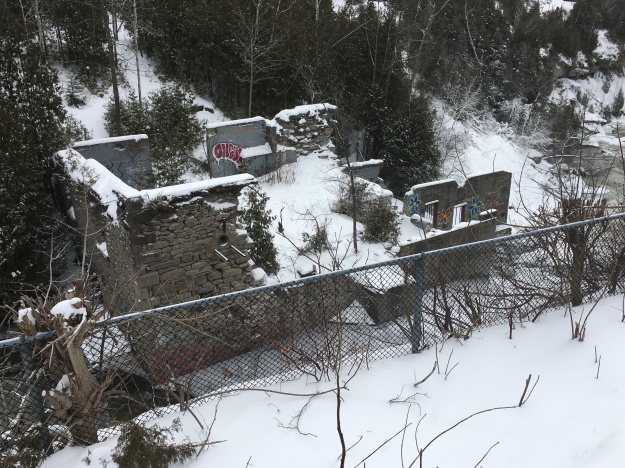
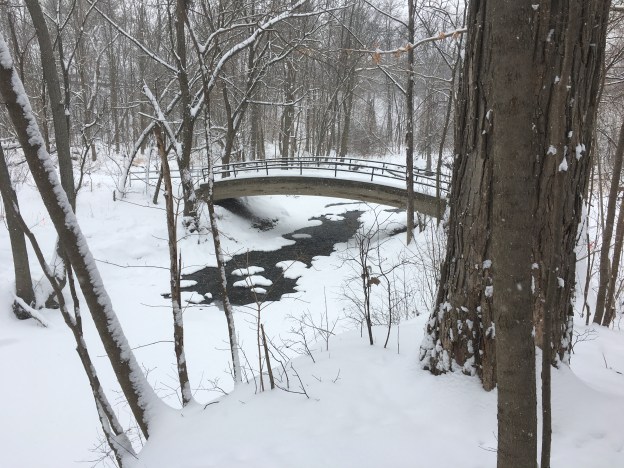
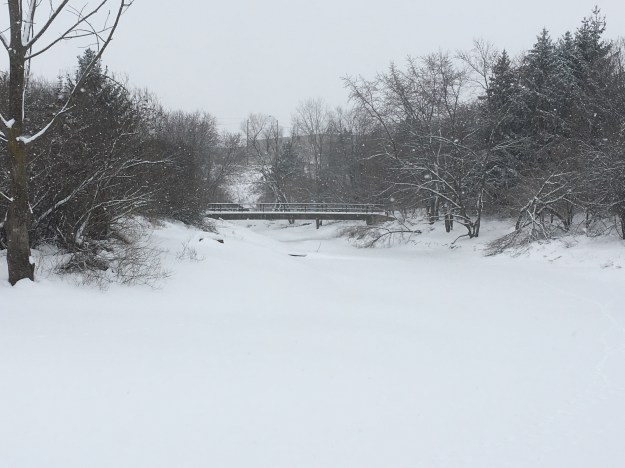
Returning to the bottom of the hill near the parking lot we turned right and crossed Westminster Creek on the foot bridge.  Following the creek for a short distance we came to the roadway and the main parking lot.  Beyond it the West Don River flows through a deep ravine.  The cover photo shows the first of two foot bridges that cross the winding river.  The original land owner was Jacob Fisher and he built a grist mill soon after settling.  Aside from some foundations hidden under snow on the opposite side of the river, the only remaining evidence of his mill is the large earthen berm that used to hold back the mill pond.  River bank restoration in 2017 resulted in the removal of a small amount of concrete from the dam that used to sit in the water.  The berm can be seen on both sides of the trail and is clearly marked by the only row of tall pine trees in the area.  It can be seen in the picture below as the berm rises just beyond the river bank.

IMG_2544

The mill closed in 1912 and the farm was later bought for the use of horse farming to facilitate the production of vaccines.  Connaught Labs was the original facility and has a museum that Hiking the GTA was able to visit with a guided tour.  Today, Sinofi Pasteur is a major provider of vaccines to the world and for decades was the sole producer of insulin for diabetics.

IMG_2548

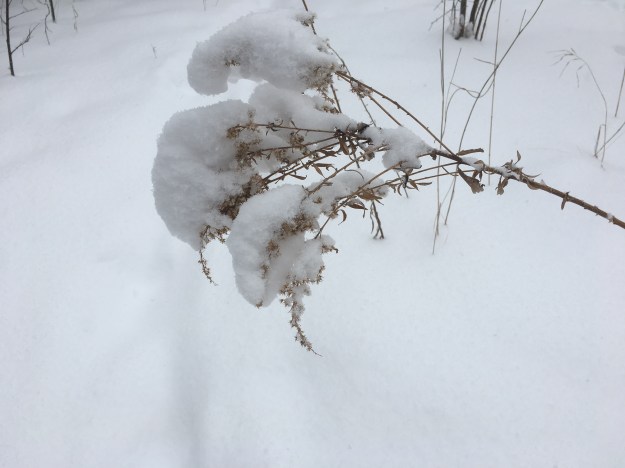
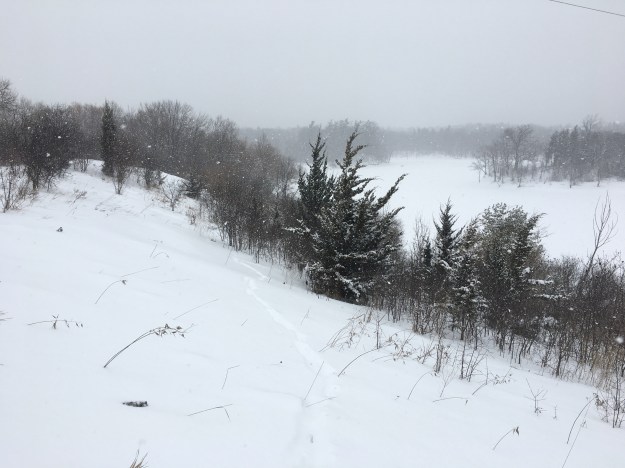
Just before the main trail turns toward Steeles Avenue and the former community of Fisherville, there is a short trail to the top of the ravine.  We made the climb and followed the upper trail back toward the parking lots.  By this time the snow was really starting to pile up and goldenrod were feeling the weight of it all.

IMG_2551

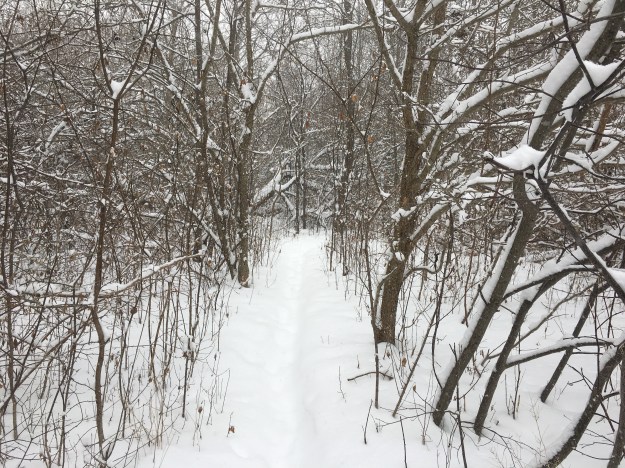
The trails were deserted and the fresh snow made them quite beautiful.

IMG_2554

Here are the links mentioned in the story: G Ross Lord Park, Fisherville, Connaught Labs, Clairville Dam, Milne Dam

Google Maps Link: G Ross Lord Park

Like us at http://www.facebook.com/hikingthegta

Follow us at http://www.hikingthegta.com
Ringwood – Ghost Towns of the GTA

Jan. 21, 2018

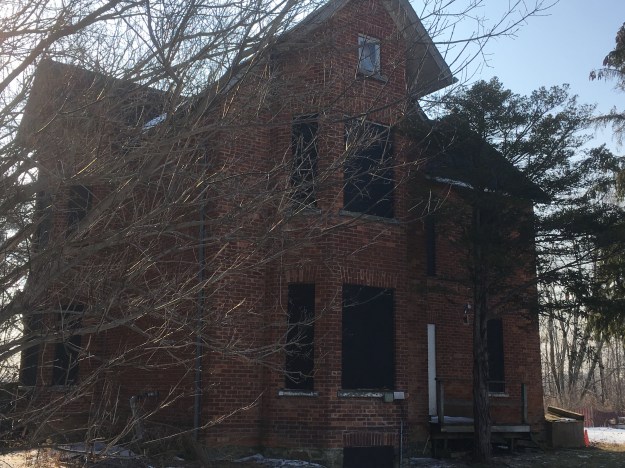
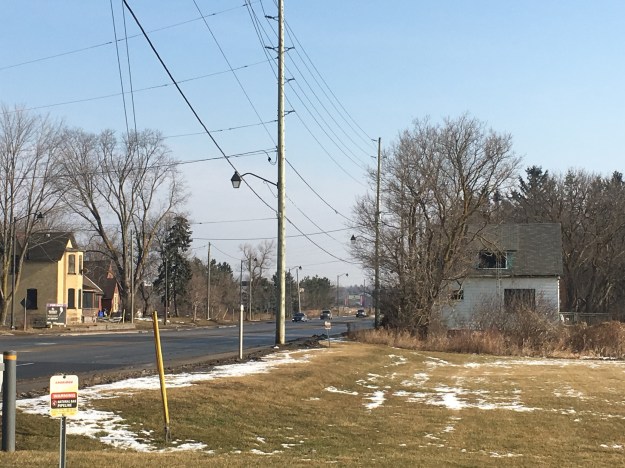
George Fockler bought 200 acres of land at the intersection of the Markham-Stouffville Townline (Stouffville Road) and the 8th concession (Highway 48, Markham Road) and moved his family from Pennsylvania in the late 1790’s.  George owned the northwest corner of the intersection and later his son Sam bought the north east corner lot and built a hotel there.  Revere House opened in 1809 and stood until 1957 when it was demolished to allow for road widening.  The original crown survey created a system of road allowances that were 1 chain (66 feet) wide and this was suitable for the horse and buggy system that was in place at the time.  Stores and hotels were often built close to the road and countless numbers of these structures have disappeared across Ontario as roads get widened to four lanes.  This late Victorian house is for sale and looks like it wouldn’t take too much to fix it up and make it livable again.

IMG_2277

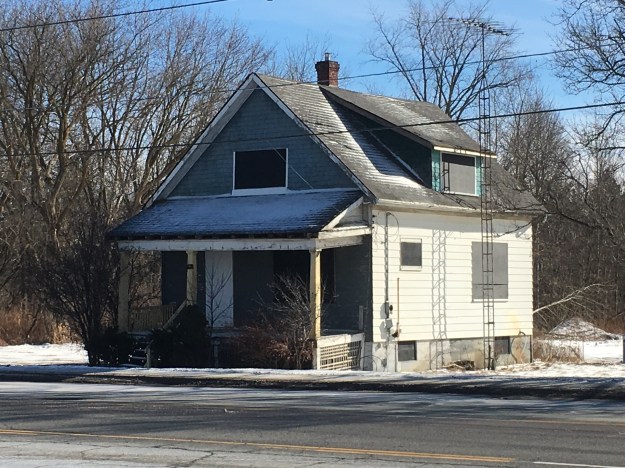
Ludwig Wideman arrived in Ringwood along with his parents in 1805.  Thirty years later when William Lyon Mackenzie was fomenting rebellion, the area of Whitchurch Stouffville was firmly on Mackenzie’s side.  Ludwig joined up with the rebels at Montgomery’s Tavern and became one of the casualties there when the rebellion failed on Dec. 7, 1837.  The picture below shows one of a dozen abandoned homes in the former core of Ringwood.

IMG_2328

George Sylvester came from Ringwood, England to the growing community and opened a general store on the north west corner of the intersection.  In 1856 the new post office in town was located in his general store and he named the town Ringwood after his hometown.  The name stuck but the residents took to calling the town Circle City in jest.  The post office survived until 1970 when the population had decreased to just 40 and it was replaced with mail boxes, one of which stands where the Revere House used to be.

IMG_2270

According to the Annual Report of the Bureau of Industries for the Province of Ontario, A. B. Grove operated a cheese factory in town in the early 1890’s, one of two at the time.  A Chevrolet dealership was established in town by 1928 and was run by the McKenzie family and employed 7 people.    This barn still stands in what was once downtown Ringwood and would have been behind the Revere House Hotel, before it was demolished.  It may have served as stables at one time.

IMG_2327

The Lehman house was built around 1870 and there is most likely is a patterned brick house hiding behind the veneer of siding that was been added at a later date.

IMG_2287

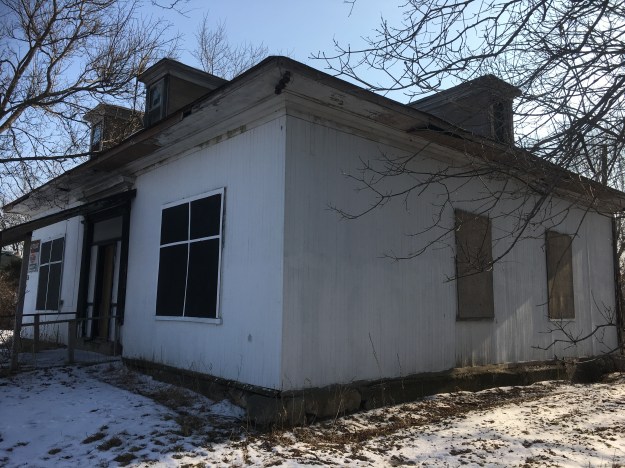
At the peak, Ringwood had two of many of the standard small town professionals, 2 hotels as well as two general stores, shoe shops, carriage makers, cheese makers, sawmills and blacksmiths.  By the 1850’s a plank road had been built between Stouffville and Richmond Hill and it was served by a stagecoach that would stop at Ringwood to take on passengers.  This sprawling Victorian house once stood among these vanished businesses on the main street of town.

IMG_2274

One of the last businesses to close in Ringwood was the diner.  It is reported to have become a biker hangout in the last days of operation.  It stands at the corner of Markham Road and Stouffville Road, which used to have a slight jog in it.  This was where the surveys in the two townships on either side of the road didn’t quite align and an adjustment was made.  When the roadway was widened and straightened in 1957 one of the hotels, a harness shop, several homes and two garages were demolished.

IMG_2280

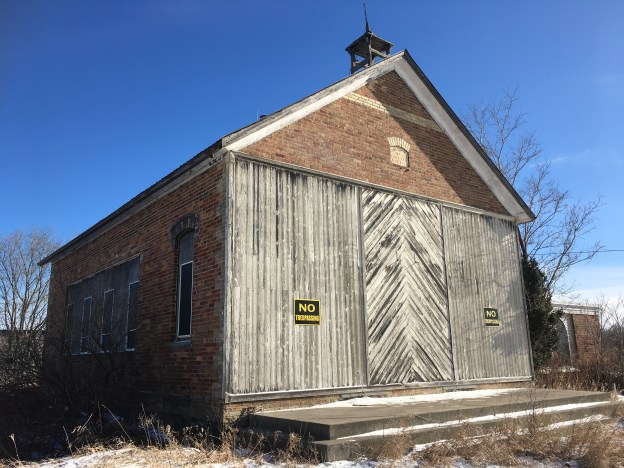
The one room Ringwood school was built in 1838 and was known as a union school section because it served students from two townships.  This is because Ringwood sat on both sides of the town line.  As the town grew the school became too small and was replaced with this dichromate brick building in 1887.  The town population had swelled to 300 by this time.  Twenty years later there were less than 200 people in town and by 1939 there were just 13 students enrolled in the school.  That was the year that the school trustees voted against installing electric lights or hiring a dedicated music teacher.  The $1200 salary for the one teacher was already more than the budget would allow.  The school closed in 1971 and then was used by the Bethel Pentecostal Assembly as a church building.  Today it sits empty with an unknown future.

IMG_2325

With the arrival of the Toronto and Nippising Railway and also the Lake Simcoe Junction Railway in Stouffville, the decline of Ringwood began.  The railway provided access to markets and the businesses of Ringwood packed up and moved down the road.  The picture below shows the view looking from the main intersection into Ringwood where the once bustling main street now has only a few boarded up houses.

IMG_2279

West of the main intersection a strip of original Ringwood remains in use, although there is a development sign here too.    The Christian Church was built in 1868 but has recently been converted into an interesting looking residence.  This lovely little 1860’s house should be preserved, in my opinion, along with several others that are still inhabited, but endangered by the Ringwood Secondary Plan.  It calls for mixed use commercial / residential in this area.

IMG_2282

There is a new master plan for the redevelopment of Ringwood that will likely see the removal of most of the buildings in this post within the next two years.  I’m glad I got to visit before this happens.


Google Maps Link: Ringwood

Like us at http://www.facebook.com/hikingthegta

Follow us at http://www.hikingthegta.com
Duffins Creek

Saturday, January 20, 2018

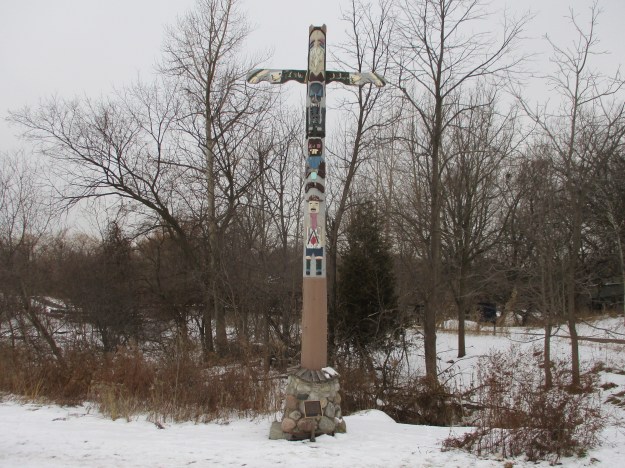
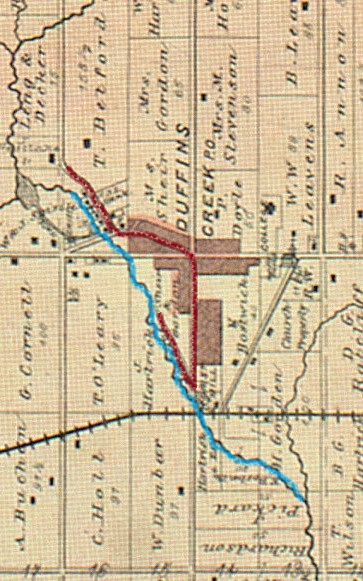
Pickering Township was surveyed in 1791 by Augustus Jones but a trader named Duffins had already been established for 3 years and the local creek had taken on his name.  Major John Smith was awarded 4,800 acres of land in Pickering Township for his services in the Revolutionary War in the USA and soon a small settlement began around the bridge where Kingston Road crossed Duffins Creek.  To supplement the few houses, John’s son David, determined to build a saw and grist mill and an order was placed with the Commissary-General’s department for the issue of the mill stones and hardware.  We parked on Elizabeth Street near the entrance to Duffins Creek Trail.  There is a totem pole in the park which was installed in 2007 to commemorate the 100th anniversary of Scouting.  We had previously visited the remains of the Camp of The Crooked Creek in Morningside Park.

IMG_1673

Although the mill equipment had arrived by 1799 the mills were never erected and it is likely that they were sold along with 850 acres of land to Timothy Rogers in 1807.  Kingston Road had been complete just two years earlier and a small community of Quakers began to form at Duffins Creek.  The mills started a long progression of changing hands and going in and out of business.  Stores established in the early community also kept failing.  In 1824 Francie Leys opened a store and used his house as an inn to accommodate travelers.  When he opened a post office in his store in 1829 it was called Pickering, the community continued to be known as Duffins Creek.  The 1878 atlas below still shows the community as Duffins Creek although the name was officially changed to Pickering a decade earlier.  The original village has become overgrown with development and is now referred to as Pickering Village.

Duffins Creek (2)

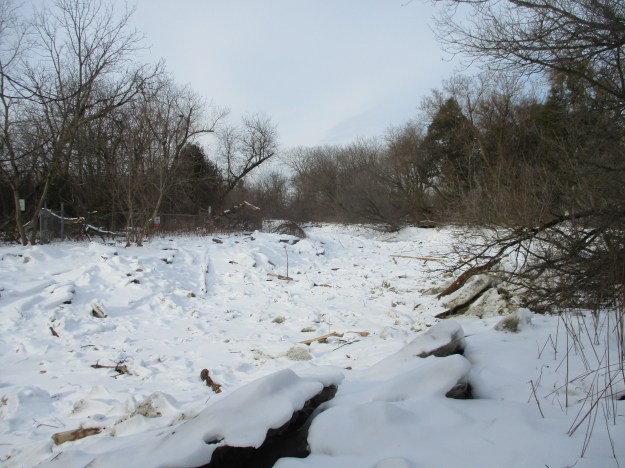
By 1846 the population was about 130 and there were four churches.  These were comprised of a Presbyterian, Weslyan, Quaker and Roman Catholic.  The usual small town professionals had also arrived including blacksmiths, tanners, tailors, shoemakers, and inn keepers.  Through the 1850s there were at least 3 grist and saw mills operating at the same time, located above and below Kingston Road.  In August of 1856 the Grand Trunk Railway gave the community access to new markets and each of the mills had a spur line.  Milling became the main industry with one grist mill surviving until 1934 and the other in 1956.  Duffins Creek has previously frozen over but the recent warm spell flooded the creek with melt water, breaking the ice and washing it onto the creek banks.  Some of these chunks are over 30 centimetres thick.

IMG_1680

As we followed the creek we came to the place where a weir has been built to prevent sea lamprey from having access to the upper reaches of the creek.  Sea lamprey are an invasive species that aggressively feed on the body fluids of fish by attaching themselves with their suction cup mouths and rows of sharp teeth.  The first weir on both Duffins Creek and the Humber River are designed with traps in them to catch the adult lamprey as they move upstream to spawn.  The lamprey weir on Duffins Creek was not visible under all the blocks of ice in the creek.

IMG_1686

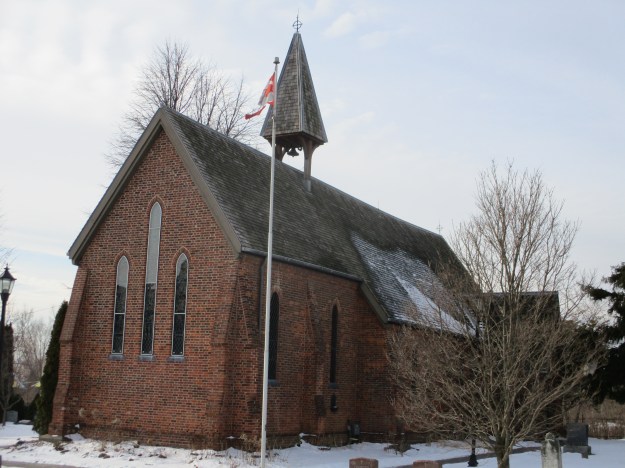
St. George’s Anglican Church was built in 1841 and is the oldest surviving church building, not only in Pickering but in all of Ajax as well.  The red bricks for the church were provided by the Grand Trunk Railway in exchange for a right of way across lands that belonged to the church.

IMG_1713

The Roman Catholic Church was built in 1871 and is the tallest building in the old village.  Built in the Gothic Revival style with pointed arches throughout and even the roof shingles have been laid with an interesting pattern to catch the eye.  Many early communities did not have a Roman Catholic church and so this is a little unusual.  The fact that the roof is cut with dormer windows is very rare in a church.

IMG_1703

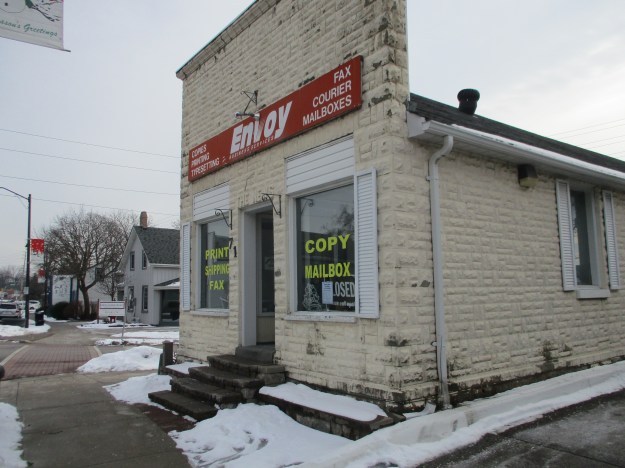
Pickering village attained a population of 1000 by 1900 and had its own newspaper called The Pickering News.  In 1890 an annual subscription was $1.00 Strictly in advance, $1.25 If not so paid.  This little building with a boomtown front still houses a print shop. Notice the words “The News” above the door, however, this was not the original building for the newspaper.  The prefabricated blocks are designed to look like cut stone and this innovation didn’t come out until around 1900.

IMG_1734

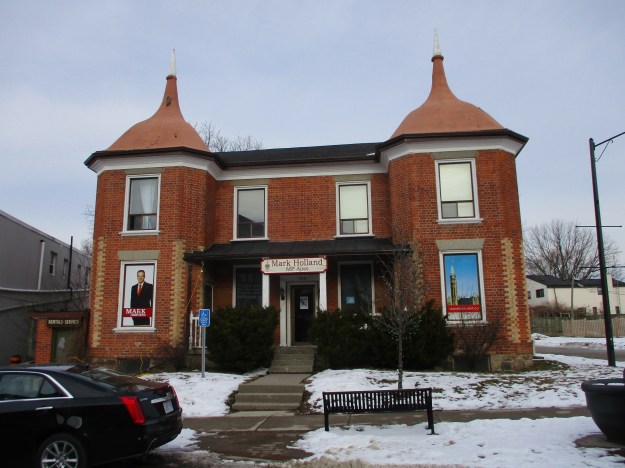
In 1850 Dr Robert Burns had this unusual home built to accommodate his family and his medical practice.  The two story extended bays with copper cupolas give the building a decorative look that stands out on the main street of the town.  In the 1860’s, two family doctors ran their practices out of this early medical building

IMG_1738

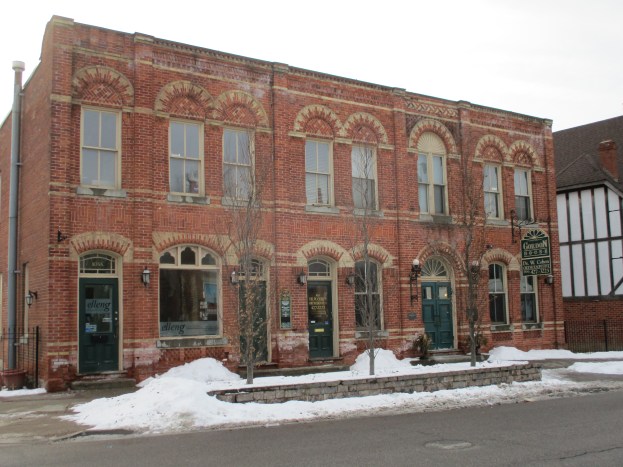
The cover photo features one of the more decorative buildings in the old town.  John Cuthbert’s Hotel features extensive dichromate brick patterns and a recessed main entrance.  The hotel was built in 1881 and was operated by the Gordon Family from 1893 until 1952.

IMG_1737

The Trans Canada Trail also follows Duffins Creek Trail and the entire area is a flood plain for the creek.  During the recent melt, this whole section of park was flooded and then the surface froze several centimetres thick.  When the water drained out from underneath it left the ice clinging to the bottom of the trees.

IMG_1690

The original village of Duffins Creek, now known as Pickering Village has many other historic buildings that can be enjoyed on a walking tour.  The historical society has produced a tour map that can be found here.

Google Maps Link: Pickering Village

Like us at http://www.facebook.com/hikingthegta

Follow us at http://www.hikingthegta.com


Massey-Goulding Estate

Saturday, January 13, 2018

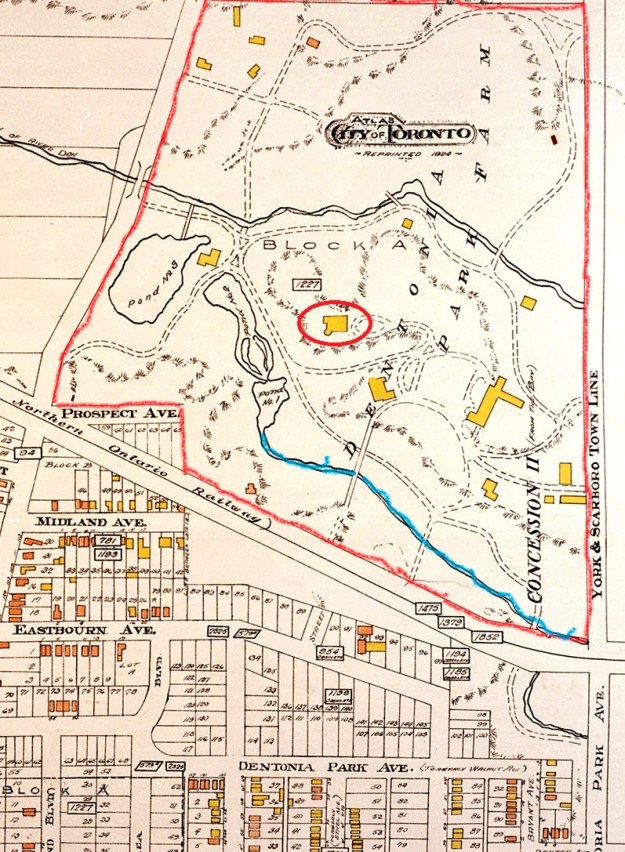
Canada’s first major industrialist was Hart Massey whose agricultural implement manufacturing eventually became Massey Ferguson.  In 1855 he moved his father’s business from Newcastle to Toronto.  His son, Walter, was born in 1864 and in 1887 he bought a 240-acre farm which he named Dentonia after his wife’s maiden name of Denton.  The historical map below shows the original extent of the farm and all of the buildings have been marked in yellow.  The one circled in red is the only remaining one and is the cover picture for this post.

sub-history-map (2)

The farm sold fresh eggs and dairy products to the public. City Dairy opened in 1900 and was the first in the city to offer pasteurized milk.  At this time it was estimated that 400 children a year died in Toronto due to contaminated dairy products.  The archive photo below shows the farm in its heyday.  All of the buildings in this picture have been demolished and replaced with Crescent Town towers.

DEntonia Dairy

Walter and Susan Massey had a daughter named Dorothy who got married in 1921 to Dr. Arthur Goulding and they built a house as a wedding gift for her.  The house was built in the arts and crafts style that was popular at the time.  Arthur and Dorothy raised their family in the house and she encouraged her own children and their friends to perform fairy tales and plays as a way of occupying their time.  This grew into the Toronto Children’s Theatre.  This may have been an influence on her nephew, Walter Massey the famous Canadian actor. The house is 5000 square feet and has highly detailed windows.

IMG_2183

Walter Massey had pioneered the sale of pasteurized milk in Toronto but ended up dying at the age of 37 due to typhoid that he contracted from unclean drinking water he got on a train.  Susan kept running the City Dairy until 1930 when it was sold to Bordens.  The 240-acre farm was then slowly sold off for development.  Susan donated 60 acres of land to the city for a public park on the condition that it be known as Dentonia Park. The Gouldings were fond of their horses and the house features an oversized porch to allow riders to get beneath it.

IMG_2185

When Dorothy died in 1972 the house became the property of the borough of East York and sat vacant until 1997 when it was restored.  Today it serves as the Children’s Peace Theatre, a use that Dorothy would have approved of.

We parked on Victoria Park Avenue, originally known as York and Scarborough Town Line.  Taylor-Massey Creek is named, in part, after the family farm that it flowed through on its way to join the Don River.  It passes under Victoria Park Avenue in a large concrete culvert that is a replacement for an earlier bridge seen on the map.

IMG_2173

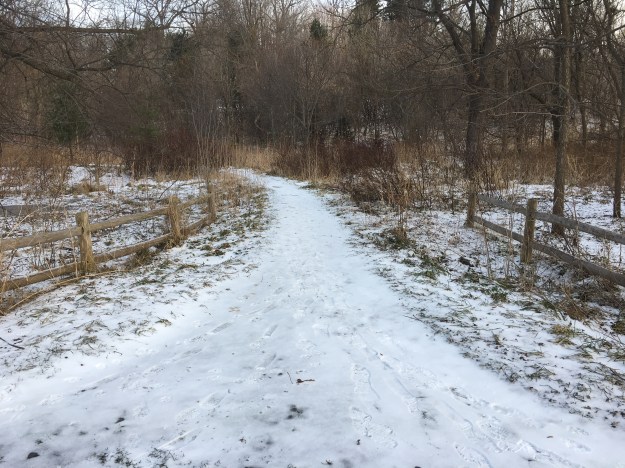
The trail through the park passes a lot of new growth trees as the farm returns to a more natural forest cover.

IMG_2174

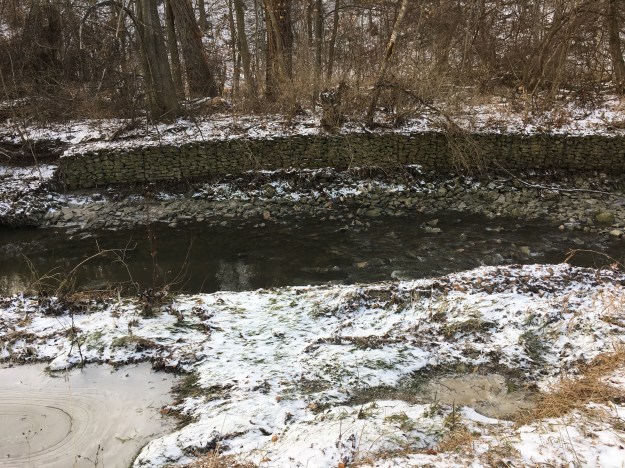
Taylor-Massey Creek is one of the most degraded watercourses in the city.  The upper reaches collect pollution off of the 401 and carry it through a long industrial section.  The city has updated its master plan for the revival of the creek and the repair of failing gabion baskets that were installed 50 or 60 years ago.  The ones through this part of the park are in fairly good condition.

IMG_2175

Winter camping, or homeless living, in Toronto’s parks must have been a very cold experience so far this winter.  We saw a Jolly Roger flag flying on the top of a small rise along the side of the ravine.  Pirates this far from the bay required investigation and so we proceeded to do so.  There were no recent footprints in the snow and, unsure if the tents were occupied or not, decided to leave them alone.

IMG_2206

We followed the trail along Taylor-Massey Creek past all three locations of the ponds seen in the historical map.  Crossing to the unmaintained trail on the other side of the creek we made our way until we could see the O’Connor Drive bridge over the ravine.  This marked the point where we had made it to during our previous hike in Taylor Creek Park.

IMG_2225

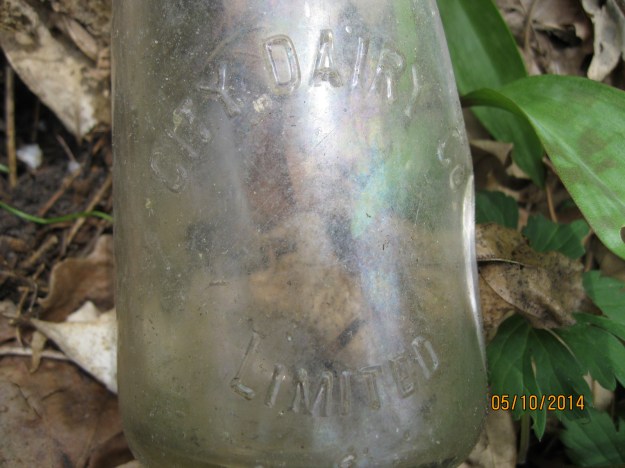
The picture below is from our investigation of some of some abandoned ovens on the back of Baby Point opposite to The Old Mill.  At that time we found a number of old bottles including this partial City Dairy milk bottle.

city dairy

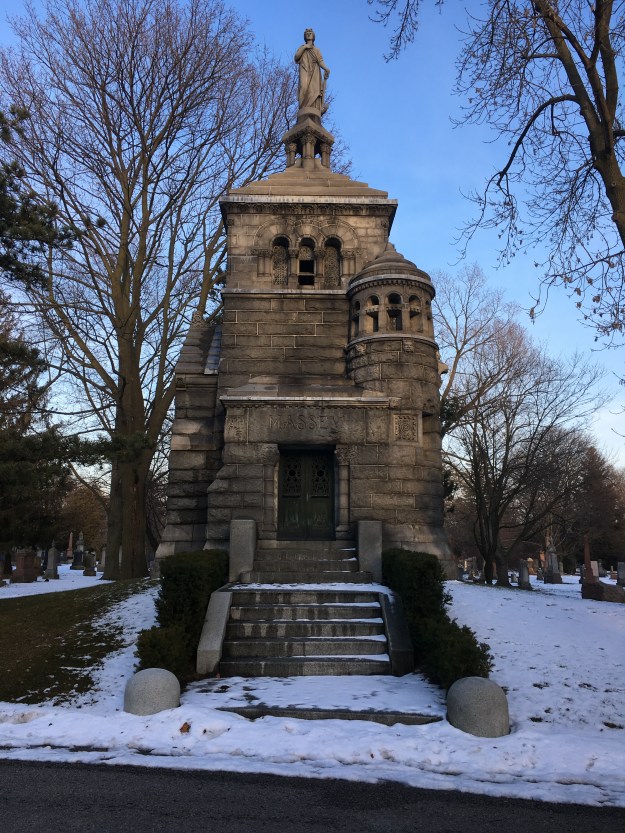
It is a fitting ending that one of the leading industrial and philanthropic families in the history of Toronto is entombed in a mausoleum designed by the most prolific architect of the late 19th century in the city.  J. E. Lennox designed the mausoleum which was built between 1890 and 1894.  All of the Masseys and their spouses that are part of this story are interred in this family mausoleum in Mount Pleasant Cemetery.  It has been repaired over the years and in 1967 the underground crypt was filled in.  In 2000 it was designated as having architectural and historical value.

IMG_2254

The Massey family is remembered in Toronto by Massey Hall and the new 60-story Massey Tower rising behind it.  Dentonia Park and Dentonia Park Golf Course are also remnants of the old farm and recall the family.  Their agricultural implements manufacturing lives on in Massey Ferguson a major brand, worldwide.

Google Maps Link: Taylor Creek Park

Like us at http://www.facebook.com/hikingthegta

Follow us at http://www.hikingthegta.com
Norway – Ghost Towns of the GTA

Sunday, January 14, 2018

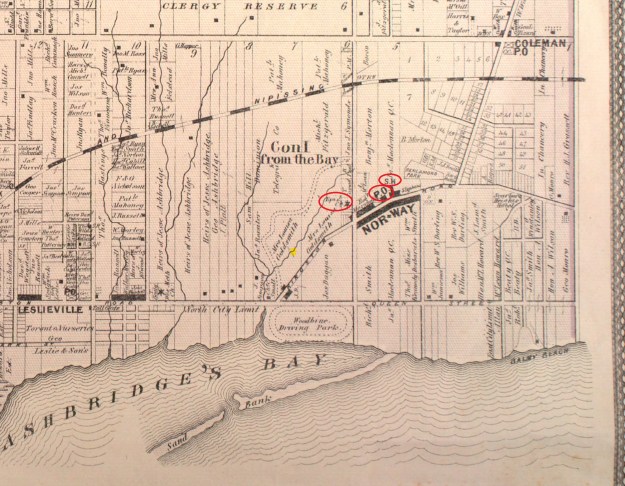
The first capital of the united colonies of Upper and Lower Canada was in Kingston.  The British military was stationed at Kingston and a road was needed for rapid troop transportation in case of trouble from the newly created United States of America to the south.  A road was cut through the forest from York (Toronto) to Kingston.  Asa Danforth Jr. was contracted to build the road at a cost of $90 per mile to run from York to the mouth of the Trent River.  It was completed by December 1800 but was poorly maintained.  It served as a route for the mail coach and needed to be better maintained.  A series of toll booths were set up to collect funds for the ongoing repair of the road.  One of these toll booths was located at the intersection of the road with modern Woodbine Avenue.  This was the first area near the beaches to have a community arise and an early name for the town was Berkley.  By 1837 it is said that there were 80 people living in the community and they had a hotel, store, brewery and a steam-operated saw mill.  The mill still existed at the time of the county atlas in 1877 and is marked below as SM.  It stood east of the Post Office that had been erected at 320 Kingston Road in 1866 but which has since been removed.

Norway map (2)

A stagecoach ran every week between York and Kingston, beginning in 1817, usually taking four days to complete the journey.  Over the next 15 years, the frequency increased to a daily run that included regular delivery of mail to the village.   Tracks were laid along Kingston Road in 1874 to allow the operation of horse-drawn streetcars which were replaced in 1893 with the  Toronto and Scarboro’ Electric Railway, Light and Power Company.  This radial line was absorbed into the Toronto and York Radial Railway in 1904.

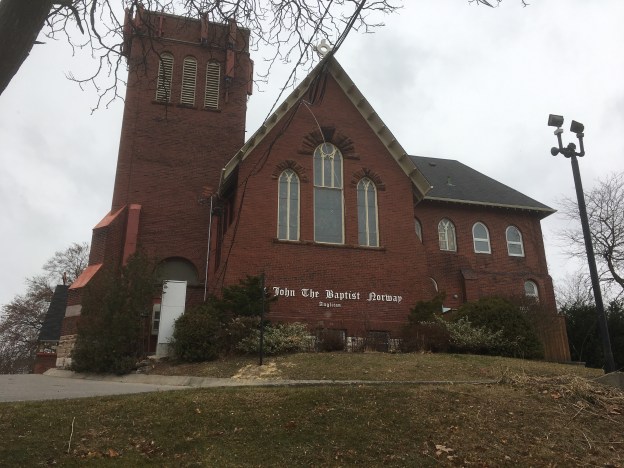
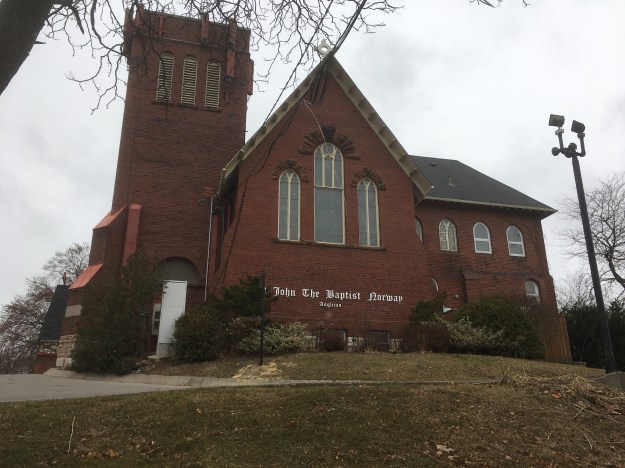
In 1853 Charles Coxwell Small donated 3 acres off his 472-acre estate to erect a church building and create a cemetery so that the local Anglican church could move their meetings out of O’Sullivan’s Tavern and into their own building.  The first building on the site was the old school house which had been purchased by the congregation and then moved by a team of oxen.  According to the terms of the land agreement the church was called St. John’s, Berkley.  The name was later changed to St. John the Baptist Norway at some point following Small’s death.  The picture below shows the original church as it appeared in the late 1920’s.  It had been replaced with the current building in 1893 which can be seen in the corner of the picture.

St. John's Anglican Norway, old church, close. - October 4, 1927

The congregation began to build their new brick church in 1892 and that is the date on the cornerstone.  The building was opened in 1893 and by 1915 an expansion was needed.

IMG_1639 (1)

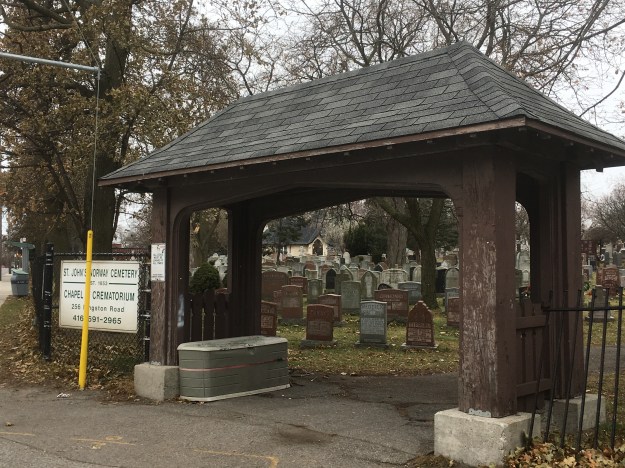
The term Lychgate comes from the ancient Saxon word for corpse.  English churches often had a lychgate where the body would lie in state until burial.  People often died at home and the body was moved to the lychgate to await burial.  Bodysnatchers forced most of these to be guarded and very often there were seats for the family to sit and mourn for the deceased.  The first part of the funeral service would often be performed under the lychgate.

IMG_1630

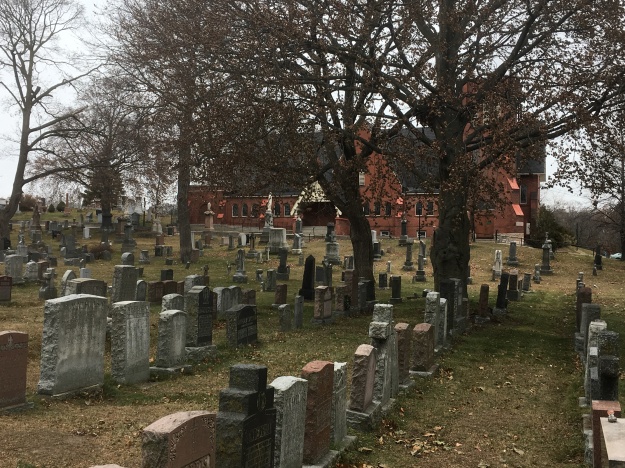
The cemetery at St. John the Baptist has been in operation since 1853 and has over 80,000 interments.  Originally the cemetery was Anglican only but has been opened up as an interfaith burial grounds.  Many of the early pioneers of the city are buried here as well as founding families of the Beaches area.  Joseph Williams who was the founder of Kew Gardens along with many members of his family is buried here.

IMG_1631

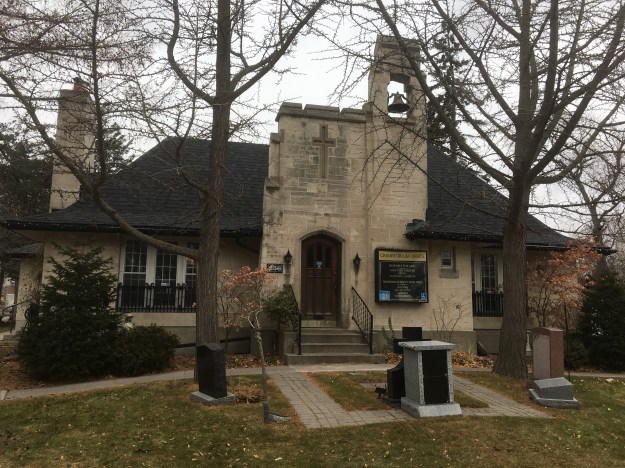
The cemetery features a crematorium in which the bell from the original school has been preserved.

IMG_1632

The current Norway public school was built in 1976 and is at least the third building to occupy the site.

IMG_1618

The building at 340 Kingston Road appears to be one of the original buildings based on the brickwork and the fact that the ground level windows have been buried over time.  Only the bricks of the lintel show at street level.

IMG_1625

This store occupies a building that has an unusual name stone at the top.  Where one might find a date or bank name we see the letters T.W.M. which is likely the initials of the person who built the block.

IMG_1616

Norway has recently acquired a lot of low rise condos along Kingston Road where the historic buildings are falling, one at a time in the name of progress.

Google Maps link: Norway

Like us at http://www.facebook.com/hikingthegtacom

Follow us at http://www.hikingthegta.com
The Castle – Glengrove Substation

Friday, December 29, 2017

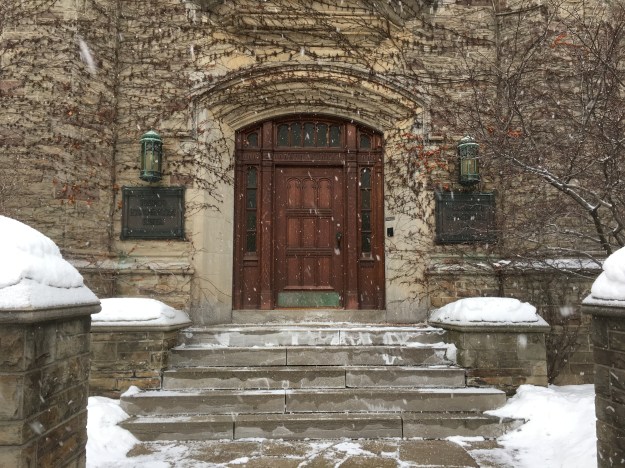
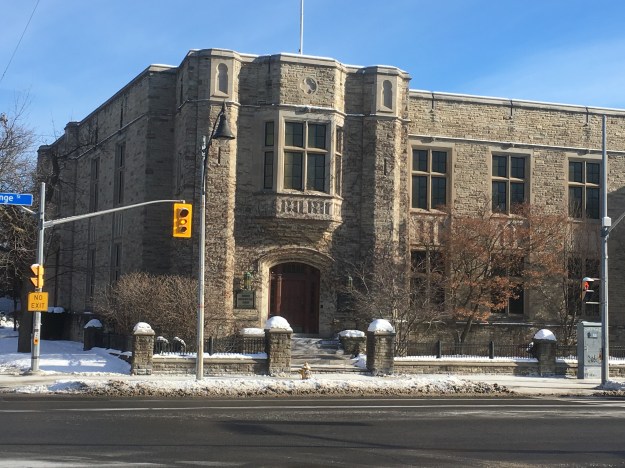
Electrical power came to Toronto in 1910 and the network for distribution was born.  Power generated at Niagara Falls was brought to the city on high tension transmission lines.  It had to be converted to currents that could be used by the average consumer but nobody wanted the large sets of transformers, wires and resistors next door for their children to play in.  Toronto Hydro decided to hide them and several designs were developed that allowed the substations to blend in.  In March 2016 we checked out the abandoned Transformer House on Bayview Avenue beside Sunnybrook Hospital.  There were over 250 of these built but perhaps the most elaborate was built in 1930 in North Toronto.  This is the front door to the Glengrove Substation that has become known as The Castle.

IMG_2011

The date plate stands on the right side of the front door.

IMG_2012

The windows and rough-cut stone architecture give the substation the appearance of a castle that could be found on the moors of England.


The windows on the building come to life at night when the interior lighting switches on.

IMG_2087


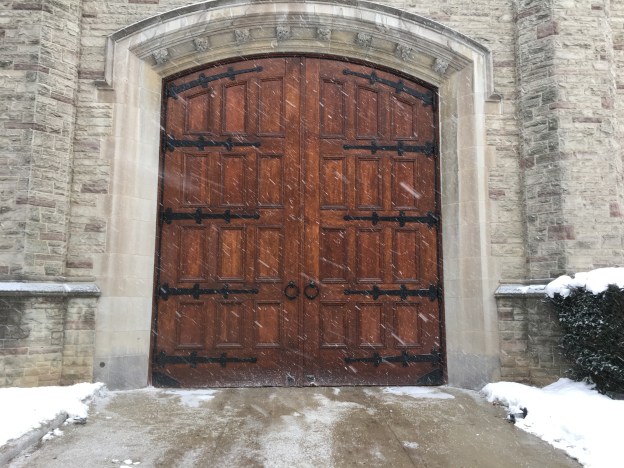
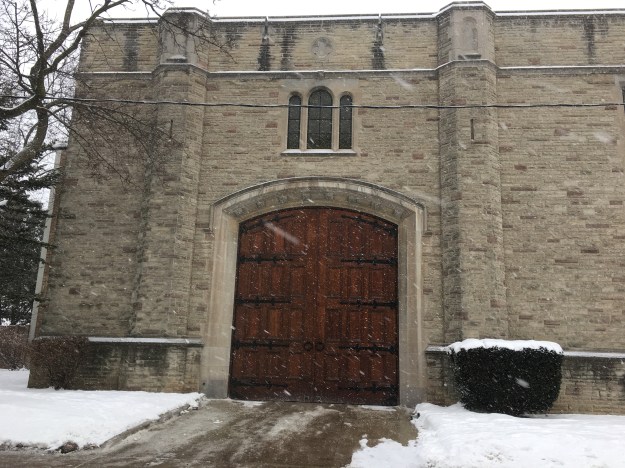
On the Glengrove side of the building, there is a very tall set of oak doors with the appearance of a drawbridge.  These doors allow the installation and repair of the large transformers inside.

IMG_2009

Two major construction projects were going on at the same time that The Castle was being built that had an obvious influence on the design and construction materials used for the sub-station.  In November 1926 a new parish was opened to serve the Catholics in the expanding area of North Toronto.  In the spring of 1929 construction began on their new church building with the first services being held on June 1, 1930.  The rough cut stone and Gothic Revival arch doorways are dominant on both buildings.

IMG_2089

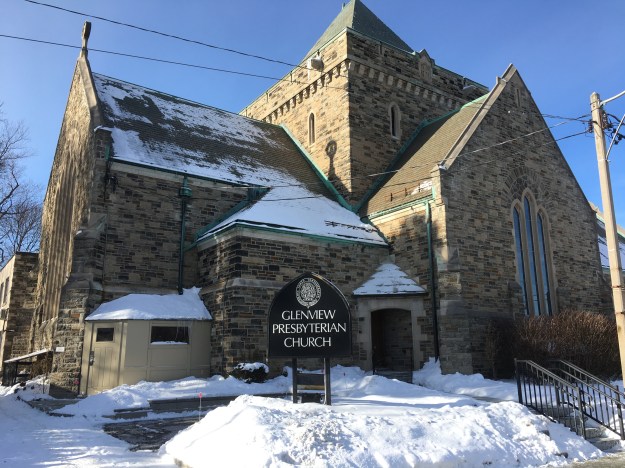
The Presbyterian church had been meeting in Eglinton, later renamed North Toronto, since 1860.  In 1929 they moved into their new building kitty-corner across Yonge Street from the sub-station.

IMG_2083

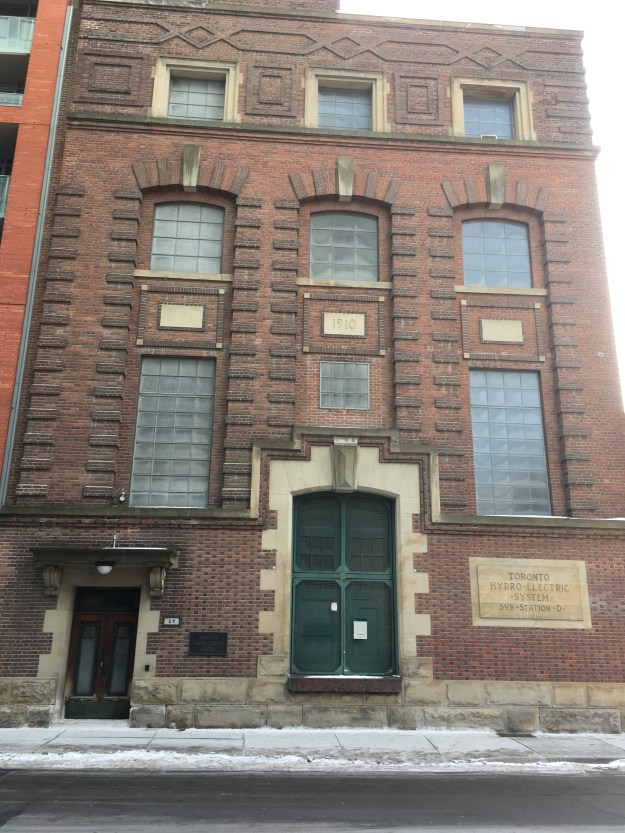
A different example of disguised transformer buildings can be seen in the Entertainment District downtown.  The corner of Duncan Street and Nelson Street was home to factories and warehouses in 1910 when the sub-station D was built.  Therefore it looks like a typical factory building of the era and is one of the original buildings in the distribution system.

IMG_2075

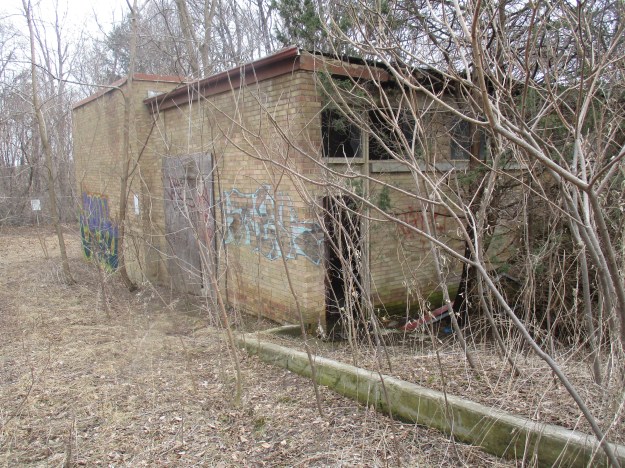
The transformer house on Bayview Avenue near Sunnybrook Hospital was designed to look like one of the hospital outbuildings.  It has now been abandoned and is in serious decay.  The story of the Bayview Transformer House can be read in greater detail with additional pictures at the link above.

transformer

Google Maps Link: Glengrove Substation

Like us at http://www.facebook.com/hikingthegta

Follow us at http://www.hikingthegta.com


Forks of the Credit Provincial Park

Saturday, December 30, 2017

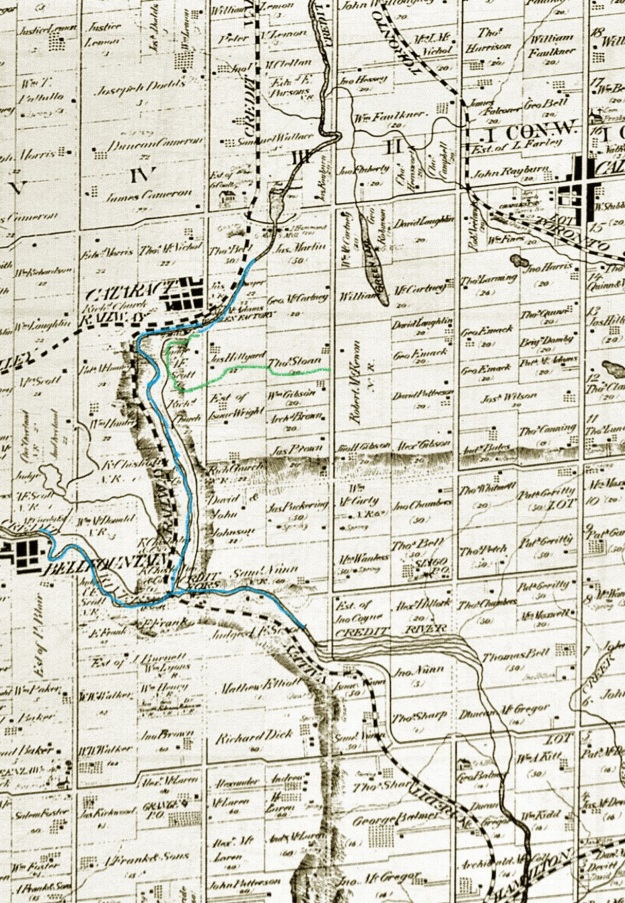
Forks of the Credit Provincial Park has many things to offer from hiking trails to closed roads and historic ruins.  A Niagara Escarpment study in 1968 made the recommendation that a park should be created near the Forks of the Credit.  The Government of Ontario accepted the proposal and in 1985 the Forks of the Credit Provincial Park was officially opened.  Official parking is found off of Mclaren Road but it is metered and $7.50 for 4 hours or $14.00 for the full day.  We roughly followed the route marked in green on the 1877 county atlas below.

Forks of Credit (2)

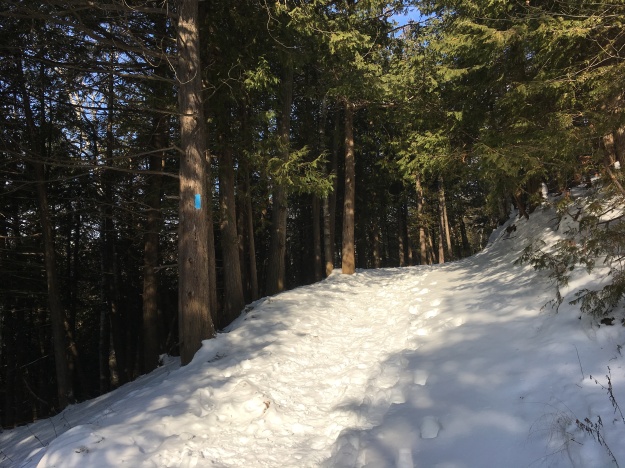
From the parking lot, you can follow the Meadow Trail past Kettle Lake, featured below, and on until you come to a washroom facility at the junction of the Dominion Trail.  Along the way, you will pass a short trail called Kettle Trail which links to the Trans Canada Trail.  To get to the falls you will use a portion of the Bruce Trail as a link.  It is good that someone has taken the time to mark the trails with little white signs “falls” and “return to parking” to make the direct route less confusing.

IMG_2018

The Credit River runs through the park as does The Bruce Trail.  From the south, the Bruce Trail follows old Dominion Road north from Forks of the Credit Road through the ghost town of Brimstone until it reaches the entrance to the park.  From this point the old road becomes Dominion Trail and the road is closed.  A portion of it was washed out in 1912 and never replaced.  There are also blue Bruce Trail side trails that lead to the ruins at the cataract falls, making the park a great place to hike.

IMG_2040

In 1879 the Credit Valley Railway built a1,146-foot wooden trestle, 85 feet high to cross the valley.  At the time it was the longest curved trestle in Ontario but safety concerns led to much of it being filled in by dumping gravel through the trestle.  From there the line heads north through the area of the park.  It runs along the edge of the river and crosses it on the bridge shown below.

IMG_2044

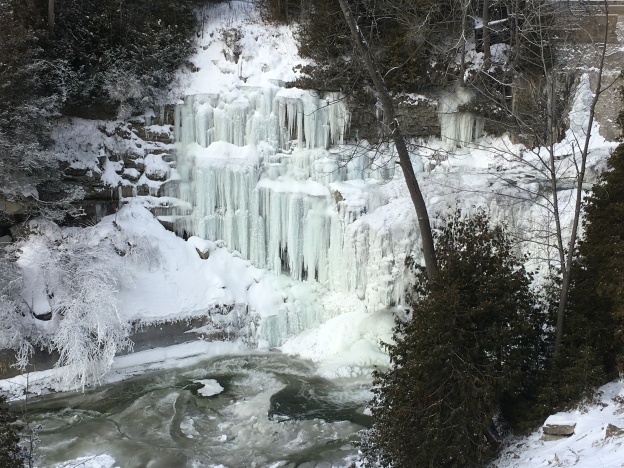
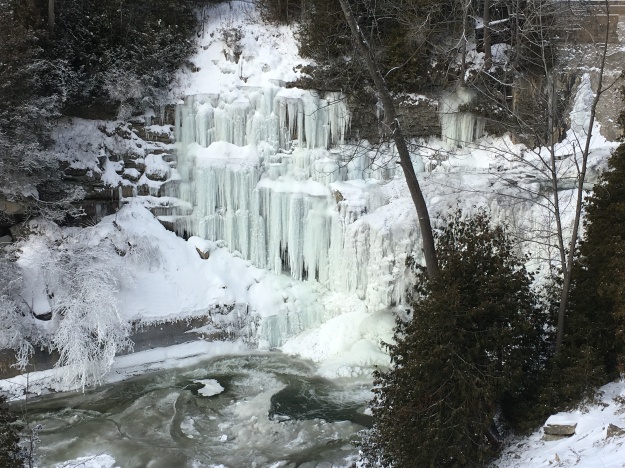
Cataract Falls is 13 metres tall and 9 metres wide.  Like many waterfalls, it takes on a spectacular formation of ice in the winter months.  The falls appear to be much wider because there are so many cracks in the shale layers that seep water which adds to the majesty of the falls.

IMG_2052

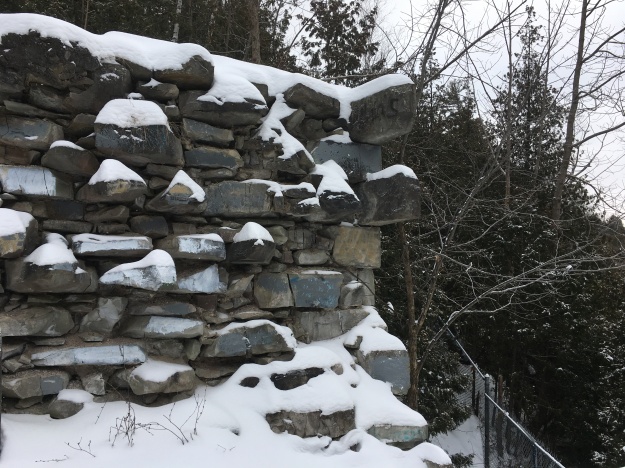
A sawmill and two grist mills stood on this site before it was converted to the production of electricity.  The older parts of the mill were constructed of stone which was apparently quarried behind the waterfalls in the winter time.

IMG_2068

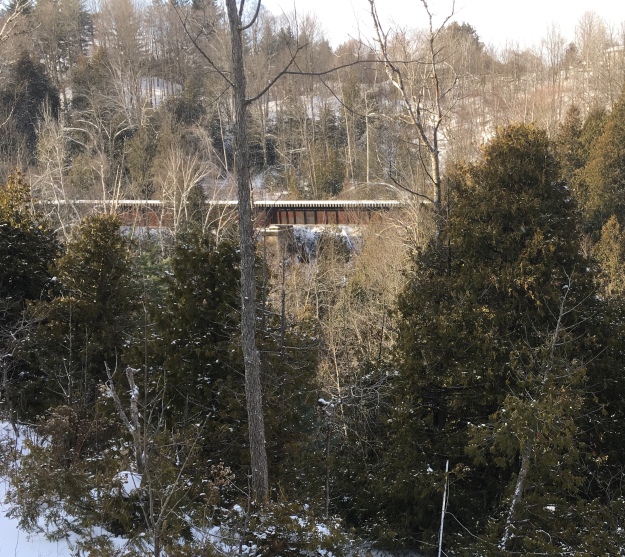
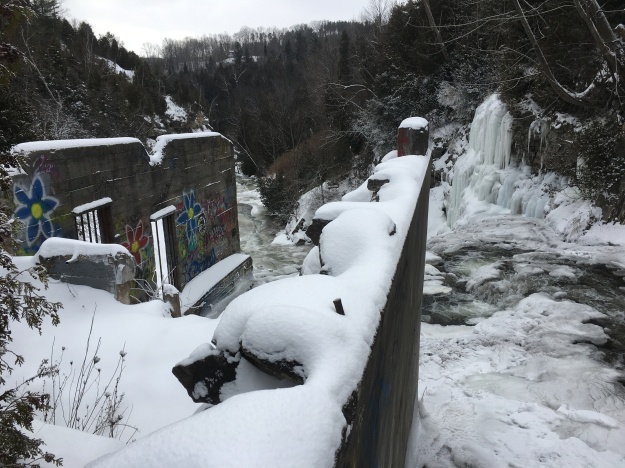
The foundations of the Cataract Electric Company stand on the crest of the falls.  This had been the site of mills since 1820 and the power company operated from 1899 until 1947 when it was deemed to be too inefficient to continue.  The frozen waterfalls can be seen to the right of the picture below.

IMG_2064

Cataract Lake was held behind the dam and was allowed to survive the closing of the electric power generating plant.  John Deagle was interested to increase the output of his power generating plant and so had begun to construct a tunnel from the lake to the mill wheel.  A major flood in 1912 washed out the dam and put an end to Deagles dreams of tunnelling.  A concrete dam was built as a replacement.    In 1953 the dam was destroyed by dynamite and the lake was drained.  The railway had been concerned that the lake was undermining the railway tracks.  The sluice gates remain from the old dam and are now used as abutments for the footbridge on the Ruins Trail.

IMG_2071

A better perspective of the old mill buildings can be gained from the footbridge.

IMG_2074

The Forks of the Credit Provincial Park has many trails and interesting things to see but parking fees apply.  It is perhaps better to park at the end of Dominion Road and walk in along The Bruce Trail.

Google Maps Link: Forks of the Credit Provincial Park

Like us at http://www.facebook.com/hikingthegta

Follow us at www.hikingthegta.com

The Best of 2017

January 1, 2018

In 2017 we published 59 posts which, naturally means that we got to explore some pretty interesting places.  Based on readership, here are the 12 most popular releases of 2017. The cover photo shows the Japanese Cherry Blossoms in High Park which was our overall most popular picture published on our Facebook page in 2017.

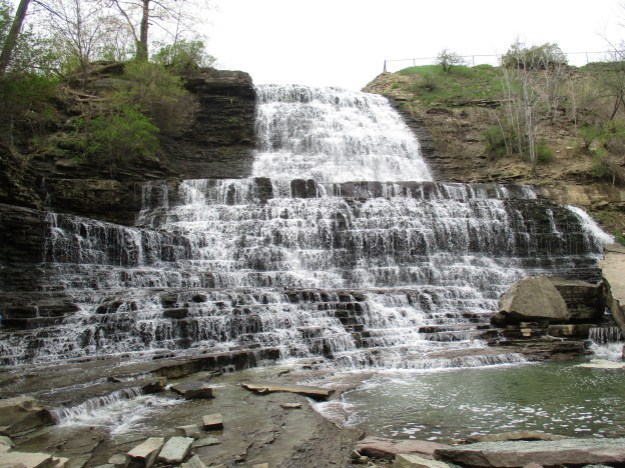
12)  Albion Falls

We were fortunate to visit Albion Falls before the fences went up.  Now getting to the bottom requires a hike up the ravine trail from below the falls.

Albion A

11) Glenorchy – Ghost Towns of the GTA

Glenorchy was the site of a bridge failure when construction routed a full potato truck over a bridge that couldn’t support it.

IMG_1590

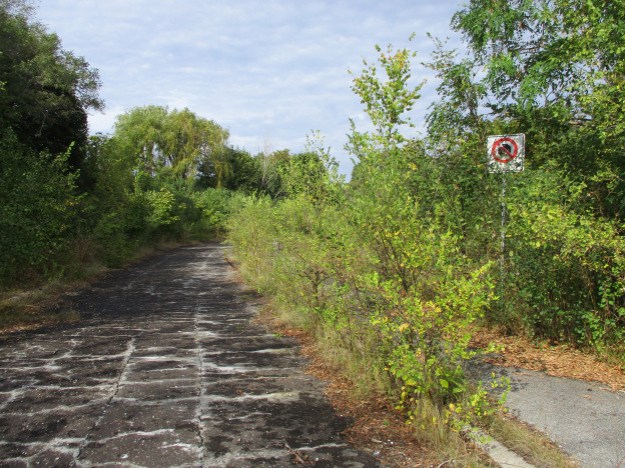
10) Abandoned DVP Ramp

One of the clover-leaf ramps to the Don Valley Parkway at York Mills that is very quickly becoming overgrown.

DVP

9) Humber Grove – Ghost Towns of the GTA

North of Bolton on the Humber River a small community was removed following Hurricane Hazel.  The lines of roads can still be traced leading to various foundations and abandoned bridges.

Humber grove road

8) Rosetta McClain Gardens

On the top of the Scarborough Bluffs is a beautiful garden on the former home of Rosetta McClain.  Her home has been allowed to crumble but retains a certain mystical charm.

rosetta home

7) Hog’s Back Park – Oakville

While looking for the tunnel from the old dam in Oakville through the Hog’s Back we found some interesting surprises instead.

back

6) Flynntown – Ghost Towns of the GTA

Not much remains of this ghost town except for the concrete support for one of the dams on the Don River but it made for an interesting exploration.

flynntown

5) Taber Hill Ossuary

A small mound in a park in Scarborough contains a native ossuary with the remains of 523 people who were buried here before 1250 A.D.

taber

4) Joshua Creek

This exploration of the mouth of Joshua Creek ended with this splendid estate built in 1938.

Joshua Estate

3) Mimico Branch Asylum

When the Mimico Branch Asylum opened on January 21, 1889, it was known as the Mimico Branch Asylum.  When it became independent of the Queen Street Asylum in 1894 it took on the name Mimico Insane Asylum.

mimico asylum

2) Toronto’s Abandoned Roads

This post features previously released stories of various abandoned roads in Toronto and was popular with explorers.

Bayview bridge


1) Palermo – Ghost Towns of the GTA

The ghost town of Palermo, unlike many of the other ones we’ve visited, still has many buildings left from 100 or more years ago.  Most of these are vacant and some are almost beyond repair but concern over these historic homes led this story to become the most popular one of 2017.

Palermo house

We had a lot of fun in 2017 and look forward to many more adventures in 2018.  Thanks for coming along on the journey.

Like us at http://www.facebook.com/hikingthegta

Follow us at http://www.hikingthegta.com
Mountain Sanatorium

Wednesday, December 27, 2017

Tuberculosis has the historic name of Consumption because one of the symptoms is weight loss.  This, along with a chronic cough, fever, night sweats and blood in the sputum would kill half of the people who developed an active bacterial infection.  The disease is transmitted by the coughing or sneezing of an infected person.  By the 1880s a campaign was started in Britain to have victims enter sanatoria to keep them isolated and provide fresh air and labour to help facilitate a cure.  In  Canada, the first sanatorium was opened in 1898 in Gravenhurst and a second one was added in 1902.  These were both filled and soon Calydor Sanatorium was opened in 1908 as well.  The third sanatorium in Canada was opened in Weston in 1904 with the Mountain Sanatorium being fourth in 1906.

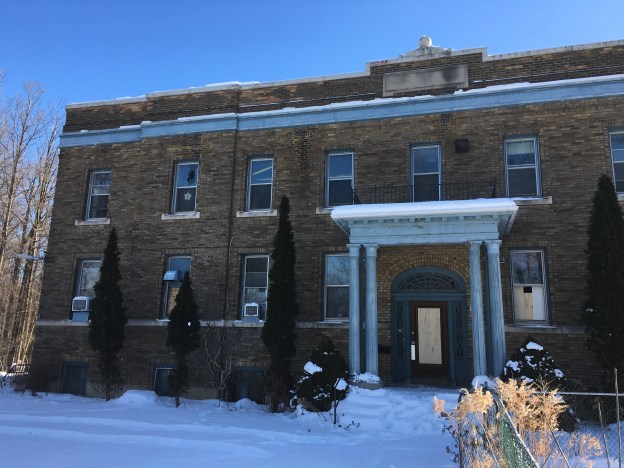
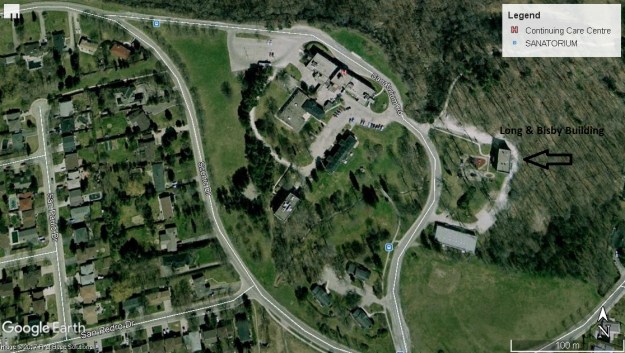
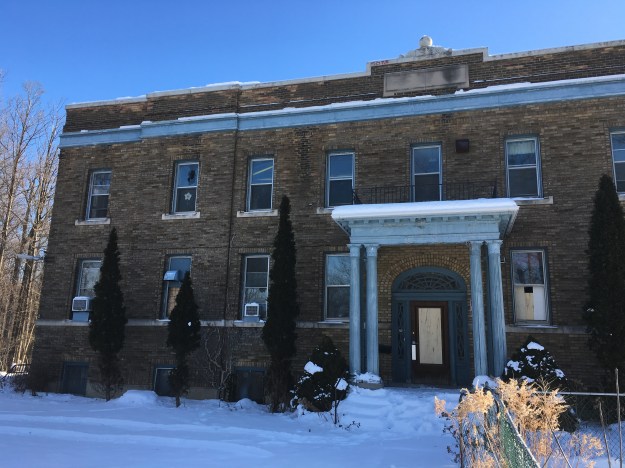
Originally the hospital consisted of 8 patients in 2 tents on a donated farm atop Hamilton Mountain.  In 1943 drug therapy replaced years of bedrest and suddenly the Sanatorium was empty and in danger of closing.  The TB clinic was extended by bringing in Inuit patients from the north where there were no clinics. By 1961 even these patients were not enough to keep the hospital busy and it began to serve as the Chedoke General and Children’s Hospital.  In 1979 it merged with McMaster Hospitals and by 1997 was known as the Chedoke Hospital of Hamilton Health Sciences.  It has since been closed and abandoned.  The property has been sold to developers who have started to remove the old buildings.  All of the buildings encircled by Sanatorium Road and Scenic Drive were removed between 2013 and 2014.  Only the Long & Bisby Building remains.

Sanatorium Dec. 31, 20015

The Long & Bisby Building is one of the oldest remaining structures on the site, having been built in 1920 as a nurses residence.  The building is named after the people who owned the property in 1906 and donated it for the construction of the hospital.  I’m glad this building is standing, at least for the time being.  I wonder if Mr. W. D. Long and Mrs. George H. Bixby would approve of the housing development that is about to happen on their former property.

IMG_1965

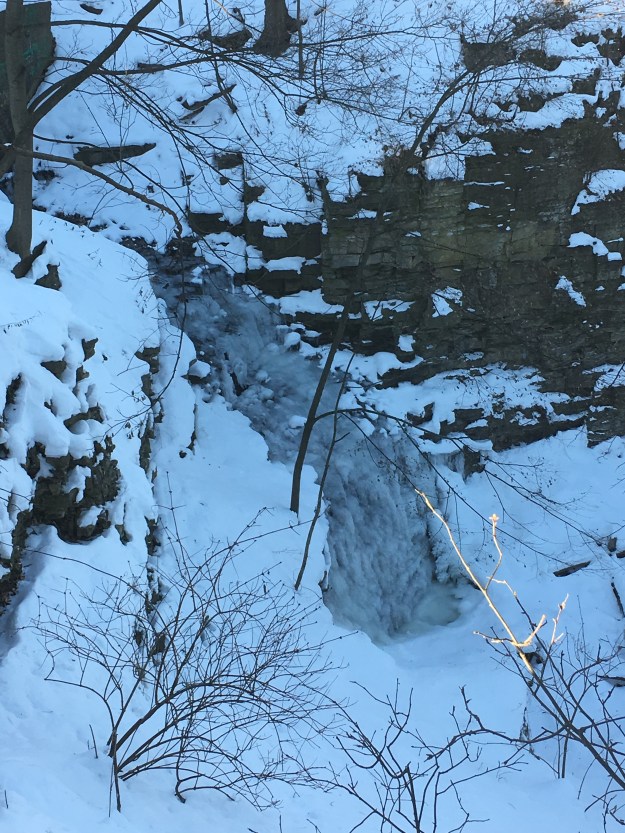
Near the Long & Bisby Building and right near the road is Upper Sanatorium Falls.  It is 9-metres high and classified as a complex ribbon cascade.  It is 3-metres wide and carries a tributary of Chedoke Creek over the escarpment.  When the Sanatorium opened there was a set of concrete steps on the west side and a bridge that led to a long set of wooden steps.  These steps led to the Brantford and Hamilton Electric Railway Company line that allowed employees who lived at the site to get easy access to town for schooling and shopping.  Two original stone pillars remain beside the road to mark the spot.

IMG_1942

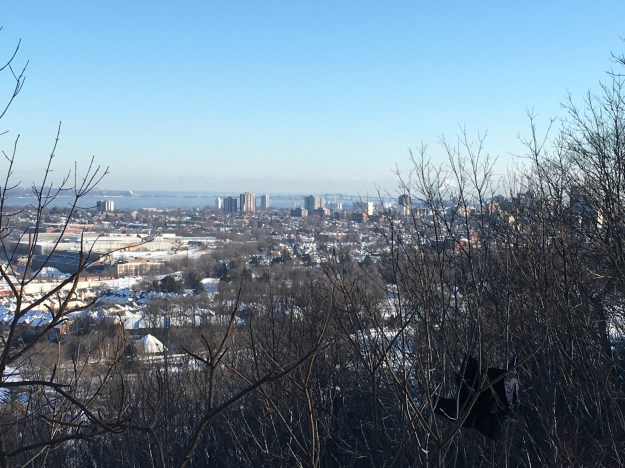
From the top of the escarpment, you can see the city of Hamilton with the Skyway Bridge in the background.

IMG_1947

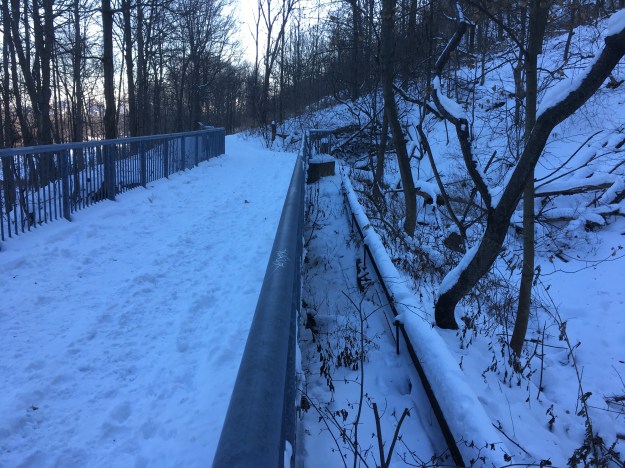
Following the blue side trail, you come to an unmaintained foot trail that snakes its way down the side of the escarpment to meet the rail trail part way down.  The Brantford and Hamilton Electric Railway Company was opened in 1908 and operated until 1931.  It ran electric radial cars from Brantford to Hamilton every hour but generally provided no freight service on the line.  The Depression took a toll on the rail line and it was sold and closed on July 30, 1931.  Most of the rails were removed in 1932 and now there is a 2.7-kilometre section that is operated as the Chedoke Rail Trail but is also shared by The Bruce Trail.  The picture below shows the bridge on the trail that replaces the original rail bridge on the creek below Sanatorium Falls.

IMG_1951

Returning to the area where so many of the Sanatorium buildings have been removed you can still make out traces of the elaborate landscaping that existed for therapeutic purposes.  An old footbridge remains but it connects two places that no longer exist.

IMG_1971

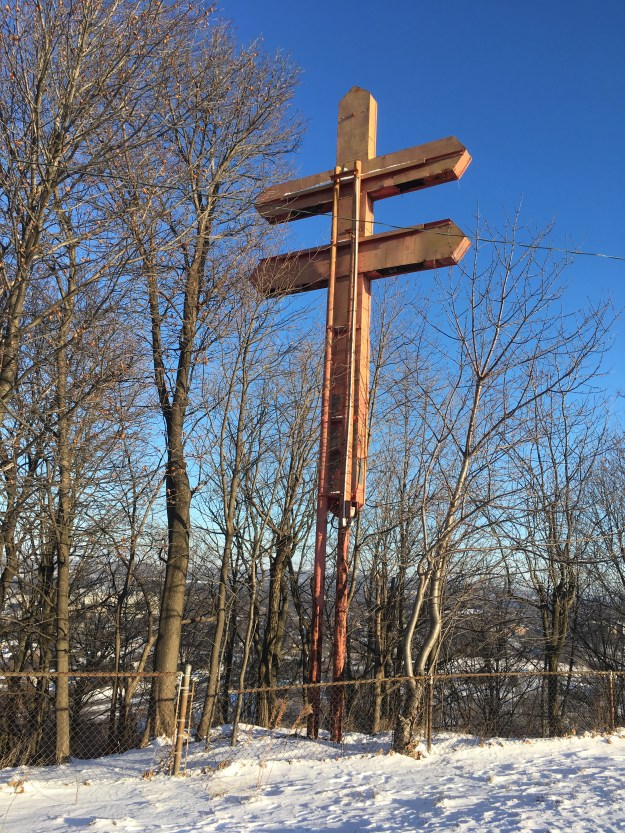
The Cross of Lorraine is styled as a two-beamed cross and dates back to the 12th century. In 1902 the American Lung Association selected the cross as symbolic of the fight against tuberculosis.  As the Mountain Sanatorium was built to combat tuberculosis it is appropriate that in November 1953 one was constructed on the side of the escarpment near the main buildings.

IMG_1941

The second cluster of buildings stands to the west of the escarpment face, now separated by a housing development.  Most of the buildings on the north side of Sanatorium Road appear to be waiting for demolition to make way for Chedoke Heights housing development.  On the south side of the road is the Medical Superintendents Residence which was built in 1922.  Initially, the Medical Superintendent lived in the Macklem family farmhouse until it was destroyed by fire.  This building stands behind the 1932 Patterson Building which was constructed as a 4-story nurses residence.

IMG_1982

The Empire Building was constructed in 1926-1927 to replace the Empire Shack which was one of the first buildings to be constructed following the period where patients were housed in tents.  This building appears to be in danger of demolition.

IMG_1989

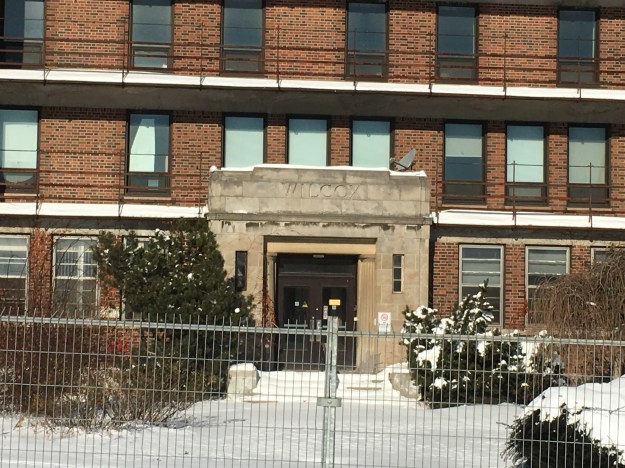
Also in danger of demolition is the Wilcox Building.  Charles Seward Wilcox made a donation of $250,000 for the construction of this pavilion and the sod turning ceremony took place on July 18, 1938.  By the time the Wilcox Building opened on January 7, 1939, its benefactor had been dead for six weeks of an illness that he had been suffering from at the time of the sod turning.  This building is also in the way of some badly needed housing development.

IMG_1984

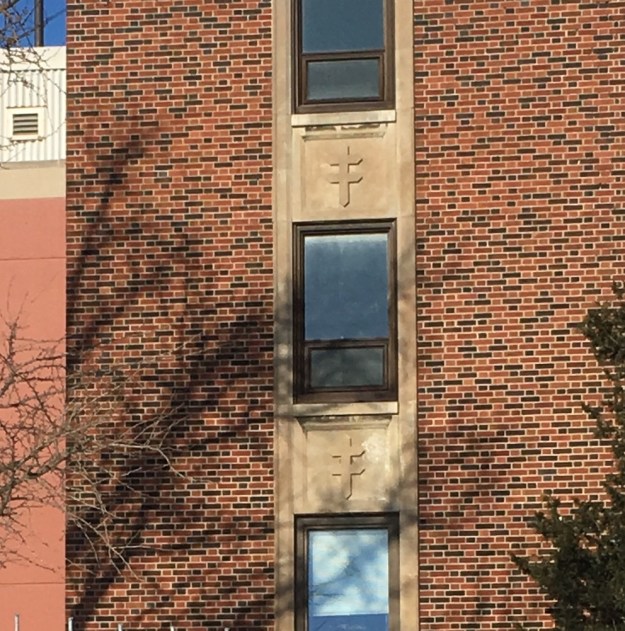
The building has the Cross of Lorraine in the concrete below the windows.  The Wilcox building is surrounded by several others that are slated for demolition.

IMG_1992

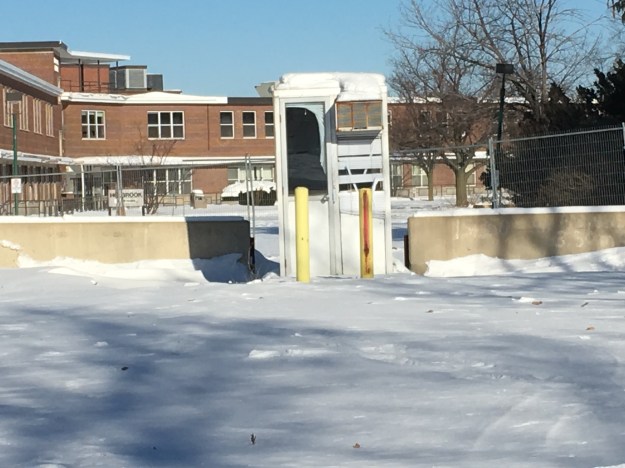
The Holbrook Pavillion was built in 1950-1951 but no one stands in the parking control booth anymore.

IMG_1994

It remains to be seen what the neighbourhood will look like in ten years but I’m glad to have got some pictures before the historical side of the Sanatorium is lost forever.

Google Maps Link: Sanatorium Falls

Like us at http://www.facebook.com/hikingthegta

Follow us at http://www.hikingthegta.com
Taylor Creek Park

Saturday, December 16, 2017

Taylor-Massey Creek is one of the most significant tributaries of The Don River.  It joins the river near the Forks of the Don and was at one time known as the East Don River and today’s East Don was then known as Middle Don.  The county atlas below shows the extent that the Taylor family controlled the lands around the Don River and Taylor-Massey Creek.  They had a huge share in the early paper industry in York (Toronto) as they had opened the first paper mill in the city at Todmorden.  They eventually owned three paper mills with the upper mill being at the Forks of the Don.  The Taylors also formed the Don Valley Brick Works and were among the leading early 19th century industrialists in the city.  By 1877 most of the original forest cover had been removed but Warden Woods (circled in green) remained with Taylor-Massey Creek flowing through it.  As a point of interest, looking at the property owners on the left side of the map reveals the origin of the name “Leaside”.

Taylor Creek (2)

Taylor-Massey Creek joins the Don River just west of the old Don Mills Road.  This morning the ice was just forming on the confluence of the creek and river.  There is free parking in the Taylor Creek parking lot.  From the lot, we made the short trek back to the mouth of the creek before setting out to explore the unmaintained trail on the west side of the creek.  The Taylor Creek Trail forms a maintained path that runs for 3.5 kilometres along the creek.

IMG_1709

Old Don Mills Road is still used as a recreational trail and cars still cross the concrete bowstring bridge which was built in 1921.  The county atlas above shows the road in brown and a previous bridge to this one.  By 1877 it is possible the road was already using a second bridge to facilitate the traffic the paper mill brought.  The road was also the only concession that had been opened and all north-south traffic had to use this crossing.

IMG_1708

Also, near the parking lot are the elevated wetlands.  From this angle the structures look like they are walking along, following each other.  These sculptures turn art into habitat as they each contain a wetland, complete with all the wildlife they support, mostly birds and flying insects.  The water from the Don River is pumped into the wetlands by solar pumps and filtered through the wetland to be returned to the river cleaner than it began.  Each wetland features small ponds, a couple of small trees and wetland grasses.
IMG_1711

In 1994 the creek was assessed as the most degraded of the main tributaries in the Don Watershed.  The Underwriter’s Reach still shows many of the concrete channels that the creek was forced into when surrounding lands were developed for housing.  The Task Force To Bring Back The Don and other groups have put together a 40 step plan that includes restoring this watershed.  Some of this is discussed in our feature on Terraview and Willowfield Gardens Parks which showcase some impressive restoration projects.  In the picture below you can see the roadway that passes through the creek in the park.

IMG_1717

Stairways jig-jag up and down the sides of the ravine to provide access to the park from the communities on the tablelands.  The sets of steps tend to be 100-120 in length and provide good cardio workouts for those so inclined.
IMG_1798

The Musqueam people lived near the mouth of the Frazer River in British Columbia.  They were very accomplished weavers and their cultural heritage has been incorporated into paintings of five benches in Taylor Creek Park.  The benches were designed and painted by members of STEPS who as an organization attempt to revitalize public spaces and connect communities.  The final designs on the five benches incorporate elements from Musquean, Ojibwa from Southern Ontario, Northern Oaxacan (Southern Mexican), and South Asian culture.  There is other artwork in the park that includes a spiral mural in the parking lot that we couldn’t see due to snow cover.

2811

The benches were painted as part of the celebrations for the Pan Am games that were held in Toronto in July of 2015.  Also created for those games was the Pan Am Path which runs for over 80 kilometres through the city.  On one end it connects Clairville Dam and on the other Rouge Beach Park.  There is a second branch that runs to Centennial Park in Etobicoke.  The Alder Stairs are one of the connection points on the Path and the bench featured above is found at the top of these stairs.

IMG_1810

The ravine formed by Taylor-Massey Creek is cut through the side by another ravine that is separated from the trail by a wetland.  The ravine in the centre of the picture runs up the north side of Glenwood Crescent.

IMG_1812

The bridge on O’Connor Drive was built in 1932 as an extension of Woodbine Avenue and has the formal name Woodbine Bridge.  Later, O’Connor Drive was formed by piecing sections of unconnected road together, mostly under the guidance of Frank O’Connor, founder of Laura Secord Chocolates and the Frank O’Connor Estate.

IMG_1828

Having made our way up the less travelled side of the creek we crossed back to the paved trail.

IMG_1836

Taylor Creek Trail continues past this point but we left it for another day.  That part of the trail continues onto a property owned by the Massey family hat operated a huge farm equipment manufacturing plant in Toronto and lends their name to the creek along with the Taylor family.  There is an old mansion waiting at the other end of the trail.

Google Maps Link: Taylor Massey Creek

Like us at http://www.facebook.com/hikingthegta

Follow us at www.hikngthegta.com