Ontario Place

July 15, 2018

Ontario Place was a jewel on the Toronto waterfront for 40 years before declining attendance caused the government to shut it down in October 2011 for the last time.  Plans were immediately announced that major renovations were planned and the park would re-open in time for Canada 150 in July 2017.  This didn’t happen and a change of provincial governments threatens to derail the project further.  I decided to take a walk around the park and see what is going on these days.

IMG_5271

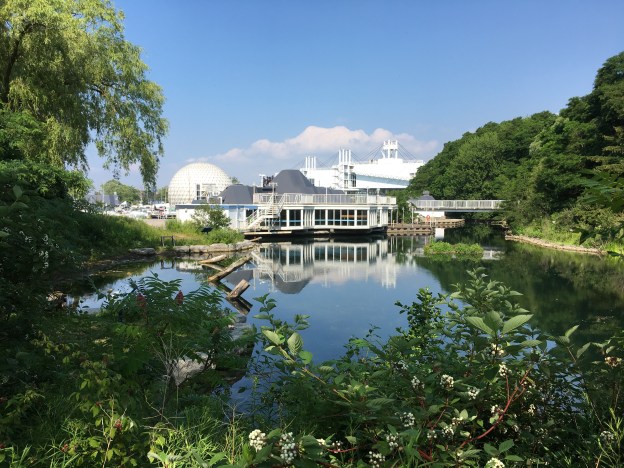
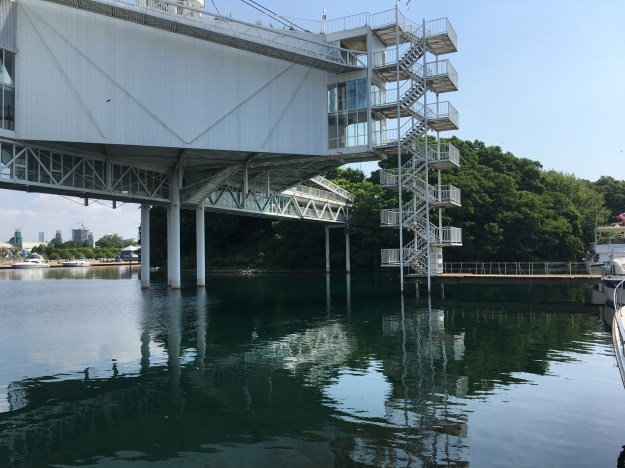
Ontario Place was designed by Toronto architect Eberhard Zeidler.  A large part of the concept for Ontario Place came from the idea to have large display pods built over the water.  The idea likely was inspired by Expo 67 where Pods were built over the Saint Lawrence River in Montreal.  Three artificial islands were created in the harbour that are connected to the mainland by three bridges.  The central bridge connects to the set of pods which make up the middle island.  The five elevated pods are interconnected as they stand above Lake Ontario.  Each pod is a three story structure that encloses 743 square metres of space.  Originally used for multimedia exhibitions, they were intended to be flexible and accommodate other uses over the years.

IMG_5275

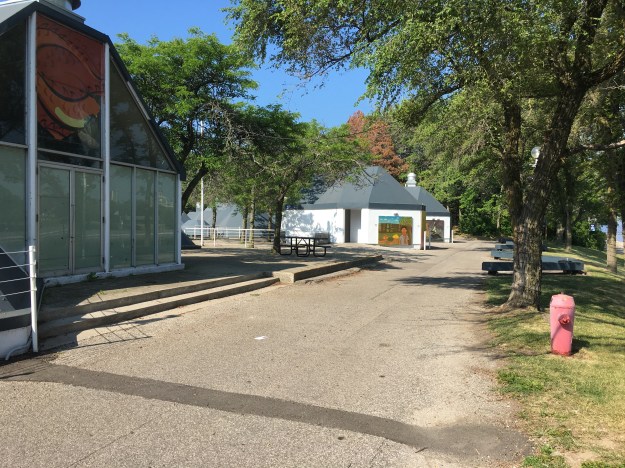
This is the seventh season that Ontario Place has been largely abandoned although it does appear to be open as I was not challenged by the staff I passed on the bridge.  The entire time that I spent walking through the park I met less than twenty other people.  It truly felt like walking through a ghost town.
IMG_5278

In the 1980’s over 3 million people per year visited the park but by 2010 the number was down to only 10% of that.  The log flume on the west island was always sure to soak the riders, a welcome treat on a hot day.

IMG_5286

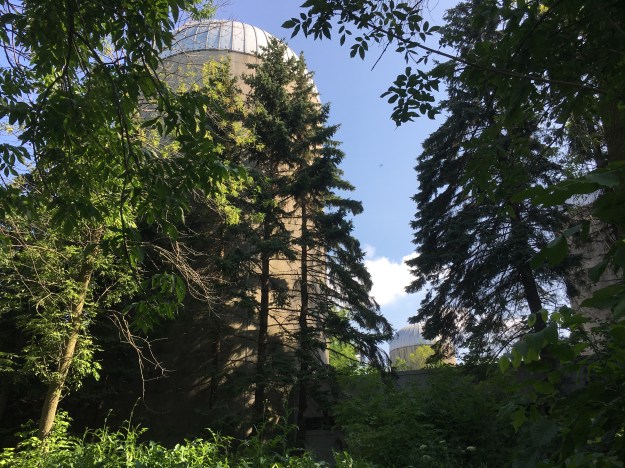
The park was in a continual state of development with new attractions being added as the years went by.  The original pods were not the raving success that was envisioned but the idea of showcasing the northern part of the province was seen as a way of potentially attracting professionals to relocate north where there was a shortage of people.  In 1980 silos were constructed that resemble farm silos that stand across rural Ontario.  The wildlife displays didn’t do as well as expected and the silos were eventually converted into additional rides.
IMG_5290

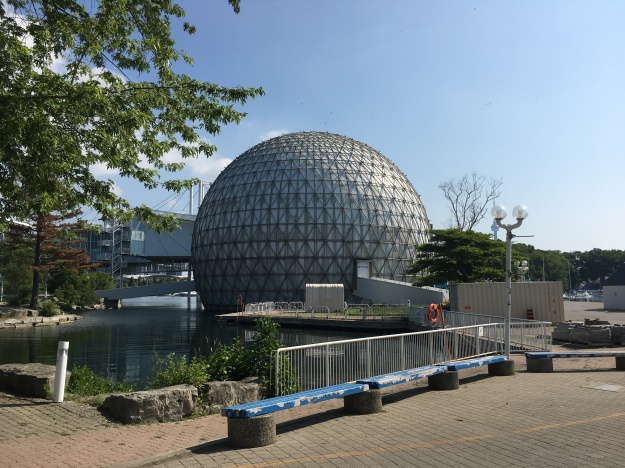
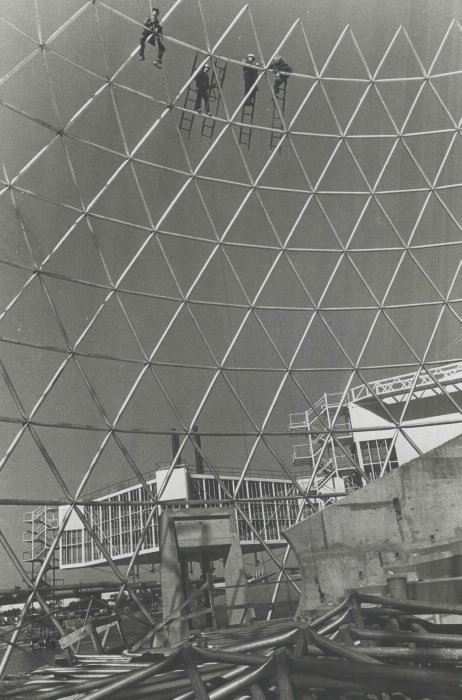
The Cinesphere showcased the world’s first permanent IMAX projector on a screen that was 24 metres wide and 18 metres high.  The dome is 35 metres wide and when it opened in 1971 it became the icon of Ontario Place.  It was so successful that there was a regular line-up to get in.  On a school trip we saw a movie called Snow Day in which it felt like we were in a school bus running out of control on snowy roads.  A good choice for kids who had arrived via school bus.  Cinesphere was closed in 2012 along with the rest of the park but in 2014 the dome was given a cultural heritage designation.  As of 2017 the theater is open again on a full time basis with state of the art equipment.
IMG_5299

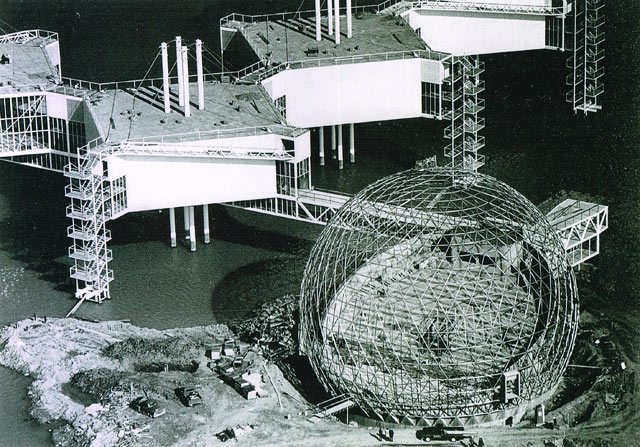
March of 1969 saw the first activity in the building of Ontario Place and it opened just over two years later on May 22, 1971.  Construction of the Cinesphere and the pods is seen in this 1970 photograph from the Toronto Archives.
20120201constructionview

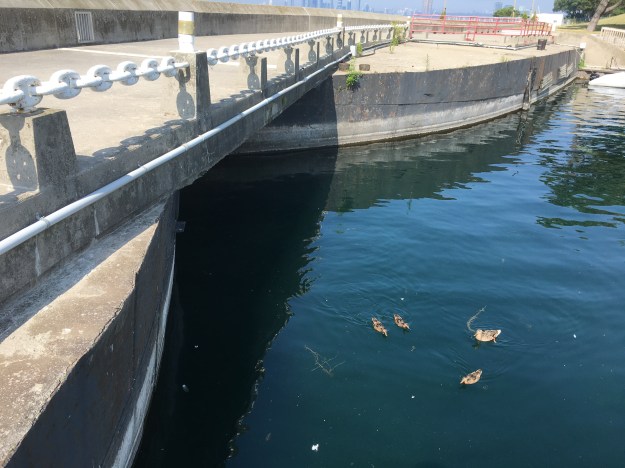
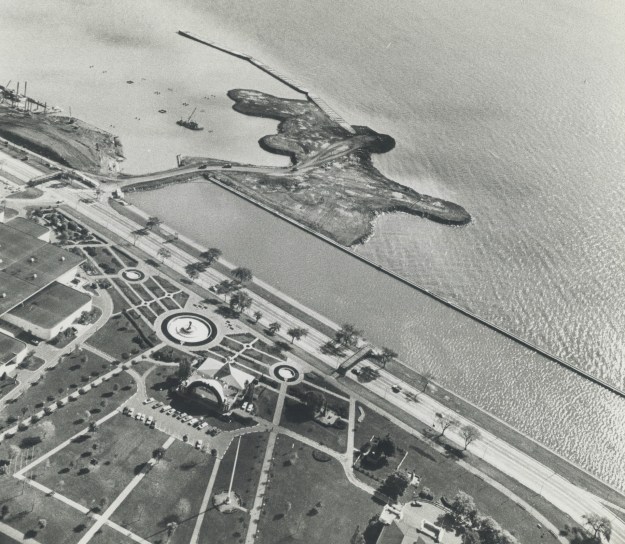
The design called for display pods suspended over the water to display the scientific and technological wonders of Ontario.  Constructing the pods over open water became an engineering problem and the costs mounted to the point of consuming the budget.  To reduce the costs a protective break wall was designed using three obsolete lake freighters.  They were sunk and filled with concrete to create a safe harbour for a marina.  The ships can be walked out to the end where one of the bridges is open for exploration.  The three ships anchors are also preserved on the third ship.  The picture below shows the outline of two of the ships where they meet.
IMG_5302

The 1970 photo below shows the three ships, reported to be the The Shaw, The Houghton and The Victorious in their positions with the west island being formed out of lake fill.
Ships

The pods are now underutilized and the iconic sets of stairs on the outside are peeling and no longer ring with the sounds of crowds filled with laughter.
IMG_5321

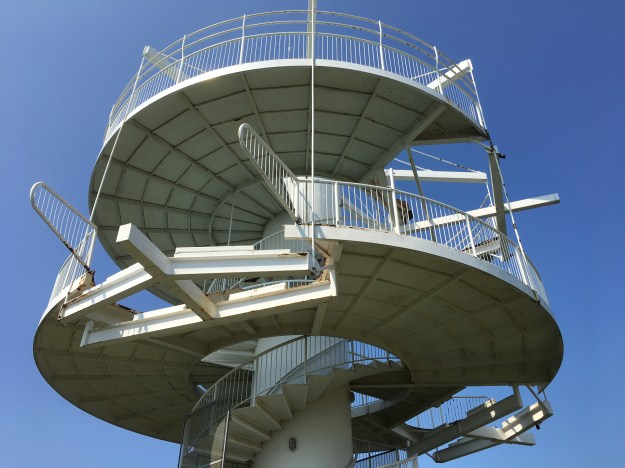
The water park covered much of the east island and went under the name Soak City.  A series of coloured water slides was installed in the 1990’s and was a popular attraction until the park closed.  The slides remained in place until May of 2016 when they were disassembled to prevent a potential injury to people who insisted on climbing up and even rollerblading down them.  Today the central support tower is all that’s left except for a few abutments to mark the site of the water park.
IMG_5341

Trillium Park, containing the William G.  Davis Trail is the first part of Ontario Place to get a completely new lease on life.  This area was formerly a 7.5 acre parking lot.  Today it has been converted into a lush green space with a 1.3 kilometre trail named after Bill Davis who was premier in Ontario in 1971 when Ontario Place first opened.  The trail passes through an artificial ravine and contains the Moccasin Marker.  The carvings on either side of the ravine are intended to remind us of those who were here before us.

IMG_5350

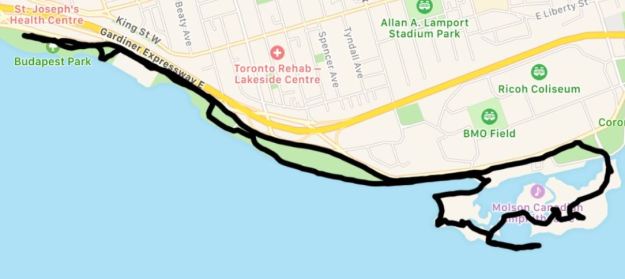
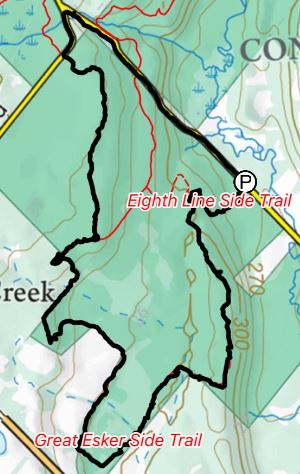
I picked a good time to visit as the Indy was on and parts of Lakeshore Avenue were closed for the race.  I decided to park at Budapest Park and walk part of the Martin Goodman Trail to reach Ontario Place.  I used the Bruce Trail App to track my walk which came out to 10.4 kilometres.  By parking at Ontario Place you can explore the area with three or four kilometres worth of walking.   Be sure to make the walk along along the three sunken ships that is represented by the tail extending out into the lake on the map below.
Ontario Place

Having visited the park in 1972 or 1973 with my aunt and uncle, both of whom have passed on, I have fond memories of an Ontario Place that was vibrant and full of people.  It’s sad to see what has become of our waterfront park especially when there is no clear timeline for completion of the renovations.

As a parting thought, would you have wanted this job building the Cinesphere?
Cinesphere

Google Maps Link: Ontario Place

For additional places to explore visit our recent Greatest Treks 3 post.

Like us at http://www.facebook.com/hikingthegta

Follow us at http://www.hikingthegta.com

The Great Esker

July 7, 2018

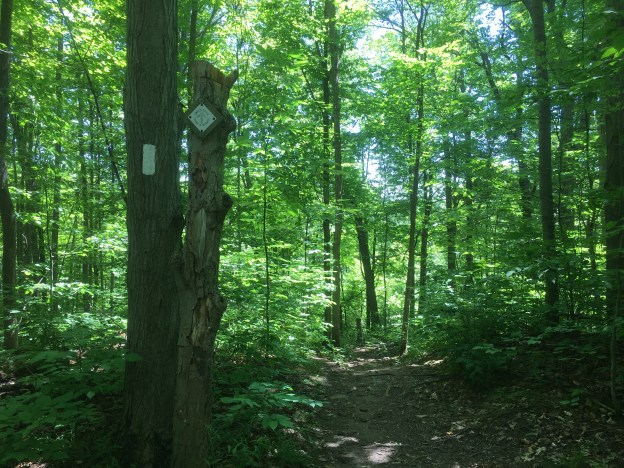
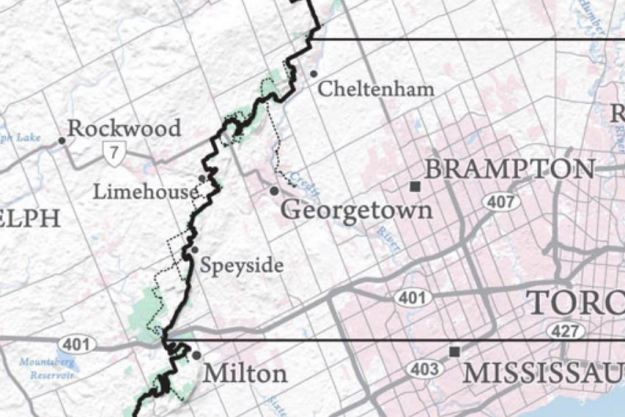
This week I bought the Bruce Trail App for my phone and so it got it’s first workout.  After identifying a section we hadn’t been on before we set out for the parking area on the map (8th line north of 22 Side road, north of Georgetown).  There are several places that you can pull off and park that are not on the map including where the main trail crosses the road a little farther north.  With the tracking feature turned on it marked our trail as we progressed and created a record of the hike that can be saved toward earning trail badges.

Great Esker

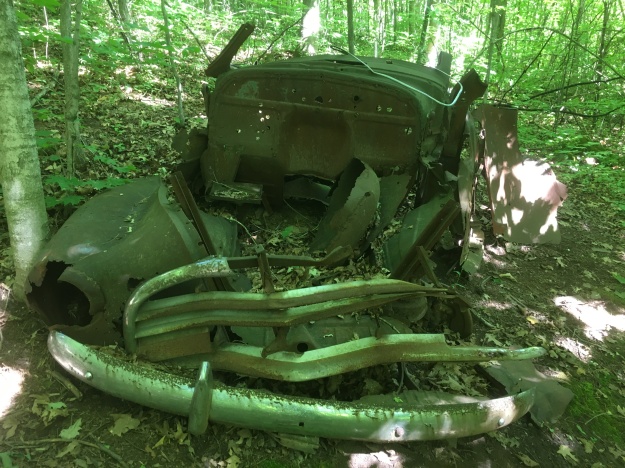
We entered on the Eight Line Side Trail and made our way to The Great Esker Side Trail.  Along the way we identified the remains of an old car in the woods.  It has clearly been there for decades as it has no motor and is surrounded by mature trees. It is in a very advanced state of decay.  The front bumpers and grill pattern were quite unique in the various car models of the 1940’s.  Having looked through hundreds of online pictures, positive identification wasn’t possible but the closest candidate was a 1946 Chevy Stylemaster.  That particular car was a sedan and this model was most likely a truck.

IMG_5128

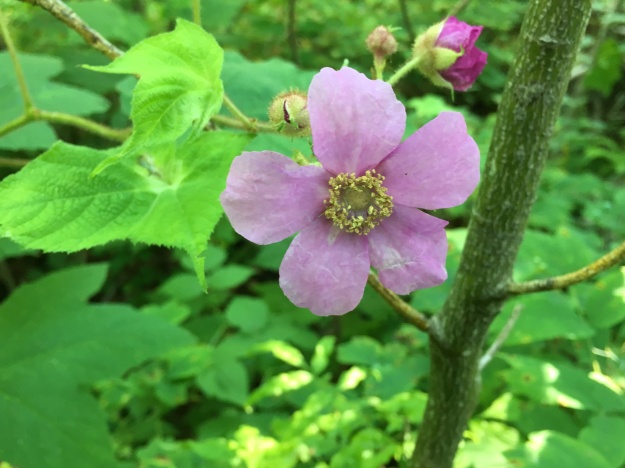
Flowering Raspberries grow along the trail in many places.  Their flowers are quite large for the raspberry family and have a long period of blooms which also makes them of special interest to honey bees.  The fruit looks like a large flat raspberry and is used by mammals and birds.

IMG_5176

Eskers are glacial deposits that run in nearly straight lines and rise above the surrounding landscapes.  They are formed during the melting phase of the ice age when water is rushing in a river either over or under the ice.  The formation of eskers is described in greater detail in our earlier post The Brampton Esker.  The Great Esker Side Trail runs, in part, along the top of an esker.  It stands about 30 metres above the surrounding terrain but is much shorter than the one in Brampton.  As far as eskers go, the Great Esker isn’t so great.  The Thelon Esker is almost 800 kilomtres long.  The trail leads directly up the esker.

IMG_5133

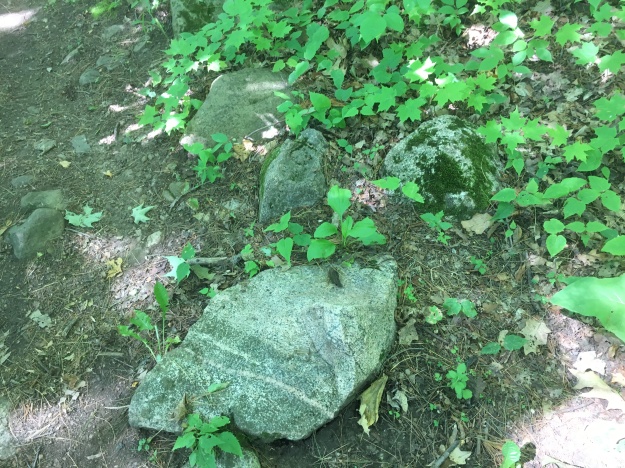
The escarpment is made up of limestone and harder layers of dolostone.  Scattered throughout the landscape are large granite boulders that appear to be out of place.  They have been carried by the glacier and deposited across the province by the retreating ice sheet.  Rocks that are different sizes or minerals than the ones common to where they are found are known as glacial erratics.

IMG_5134

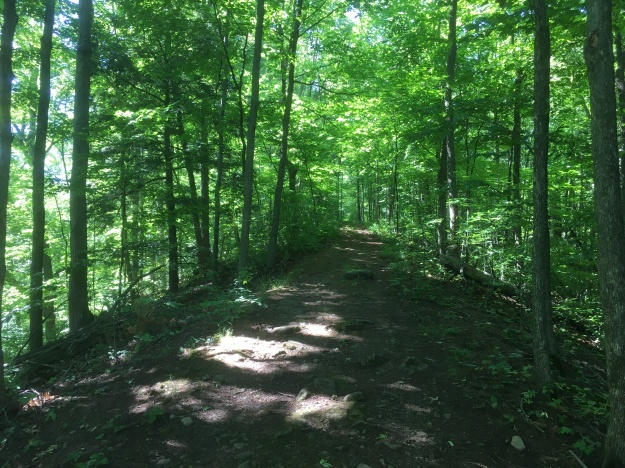
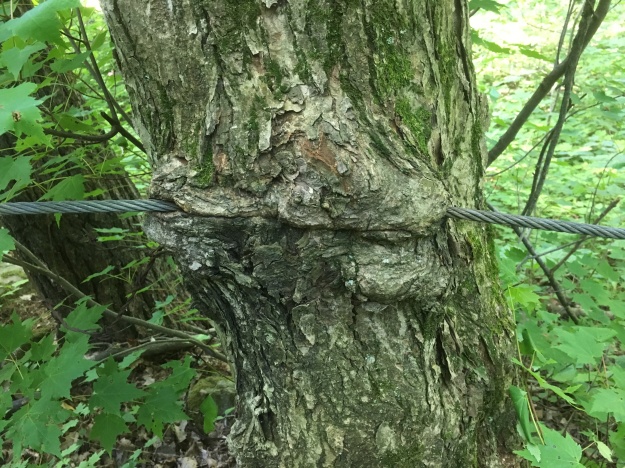
Old stone fences run through the trees marking off the earlier fields.  More recently some guide wires have been put in some places along the trail.  These are growing into the trees in several spots.

IMG_5135

Most of the mayapples, or mandrakes, have been harvested by the local wildlife but a couple large ones remained that are still green.  When they start to turn yellow they will put off a pungent odor that attracts raccoons. It is suggested to remove the seeds if you do happen to harvest some of this native fruit.  You’ll have to be lucky because the raccoons check daily for the newly ripening fruit.

IMG_5137

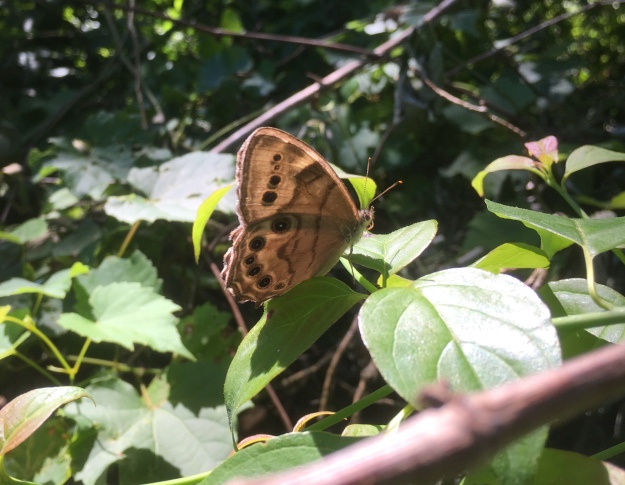
Butterflies abound along the trial and this Appalachian Brown was one of several flittering among the plants.

IMG_5141

The poison ivy doing very well along the sides of the trails.  Urushiol oil in the leaves and stem causes an allergic reaction in 85% of people.  It is white when the stem is broken but turns black upon exposure to oxygen.  The oil is highly concentrated and a drop the size of a pin head can cause an allergic reaction in 500 people.  In the United States about 350,000 people a year get a rash that can last for up to 3 weeks.

IMG_5144

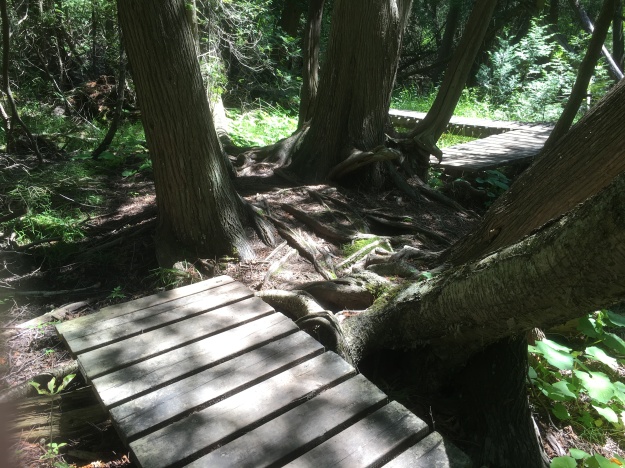
One of the truly interesting boardwalks is this one that takes advantage of this tree and the massive root system to carry the trail.

IMG_5152

Snow’s Creek Falls are located at the intersection of 27th side road and the 8th line so we made a detour to see how much water was there at this time.

IMG_5163

It was certainly cool to check out the Great Esker Side Trail and take the Bruce Trail App for a test run.  It likely means more hikes on the Bruce in the near future.

Google Maps Link: The Great Esker Side Trail

Like us at http://www.facebook.com/hikingthegta

Follow us at http://www.hikinghtegta.com

Bruce Trail – Toronto Section

Sunday, July 8, 2018

Starting in 1959 the Bruce Trail was conceived and developed with the northern terminus being unveiled in 1967.  The trail covers 890 kilometers between Tobermory and Queenston.

For those in the GTA we are lucky because the Bruce Trail runs across our doorstep with large parts being accessible within an hour from midtown Toronto.  The Toronto Section covers 50 kilometers of main trail and 55 additional ones of side trails between Kelso and Cheltenham.  Exact maps of this section can be purchased from the Bruce Trail maps covering maps 11-14 and a more general overview is seen below.  For slightly more than the price of four maps you can buy the Bruce Trail App for your phone.  It does pretty much everything except hike the trail for you.  The annual section end to end hike is scheduled for September 8-9, 2018 and covers an area that has been explored both in terms of the trail and local history in a number of stories.  Hiking the GTA has put together a series of links to these local treasures along the trail.


Toronto section

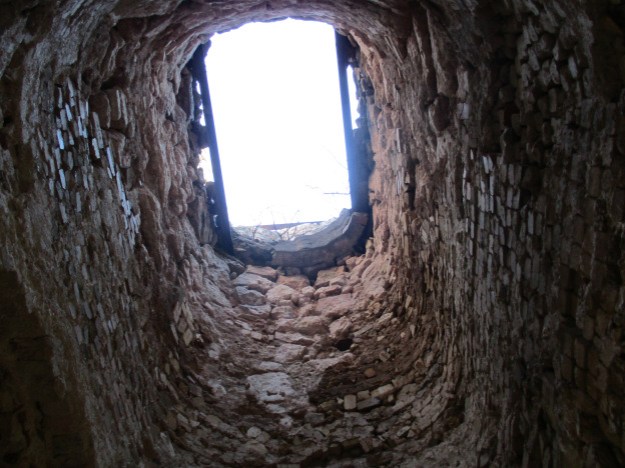
The trail section starts at Kelso if you are hiking from the south toward the north.  The conservation area has many of it’s own trails and the area was once home to a lime industry.  Two kilns remain near the main trail.

img_1235

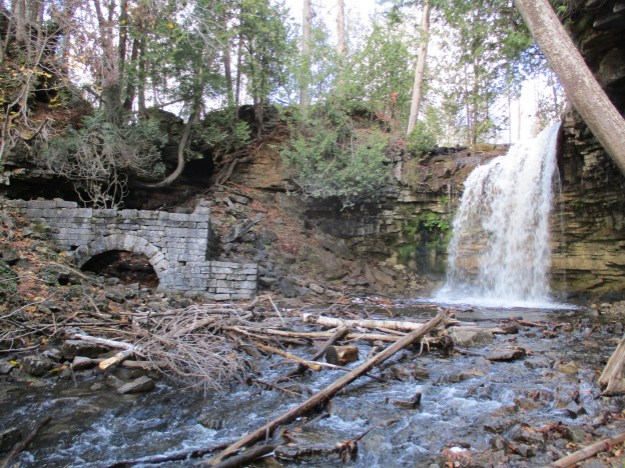
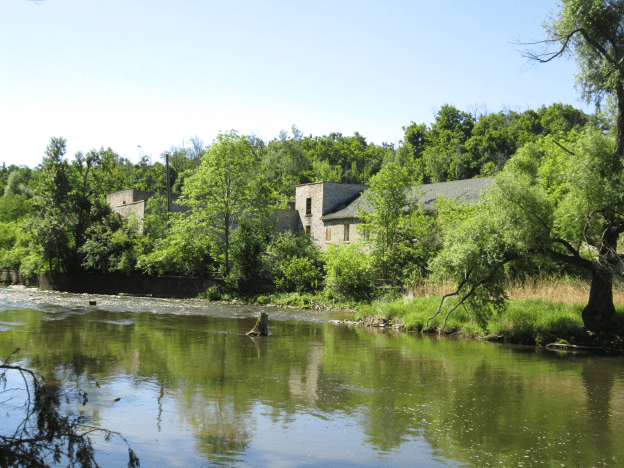
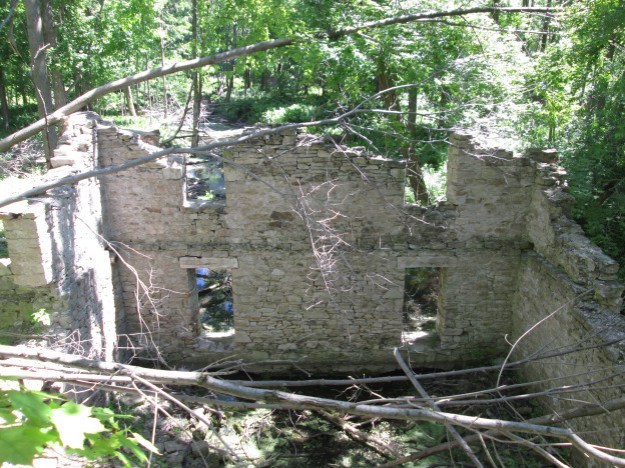
Just a short distance north of the 401 the Hilton Falls side trail runs for 9.2 km and let’s you visit the falls with the remaining portions of the original mill.

Hilton

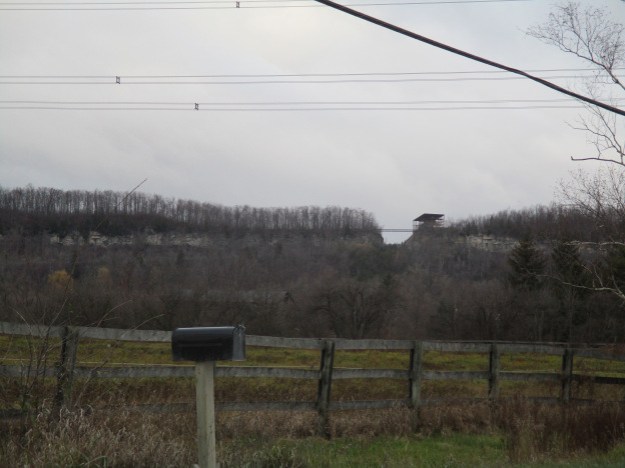
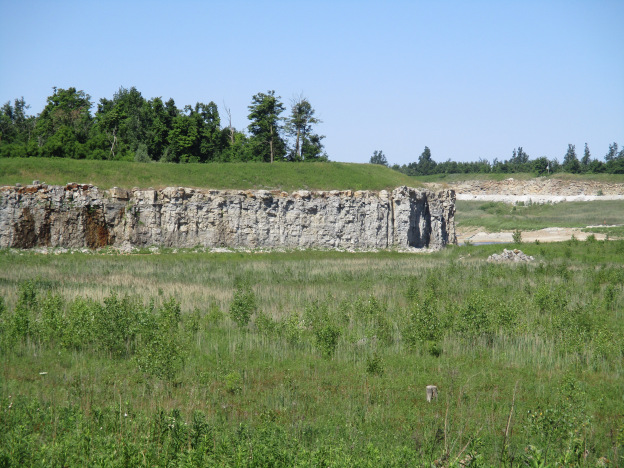
The trail follows the edge of the escarpment and passes The Gap created by Dufferin Quarries in 1962 to allow extraction of aggregates from an open pit mine.  The trail crosses the gap on a bridge allowing you to see the restoration efforts that will eventually turn this area into a parkland.  The aptly named Restoration Side Trail will let you have a view of the restoration process in a closed section of the pit.

img_1300

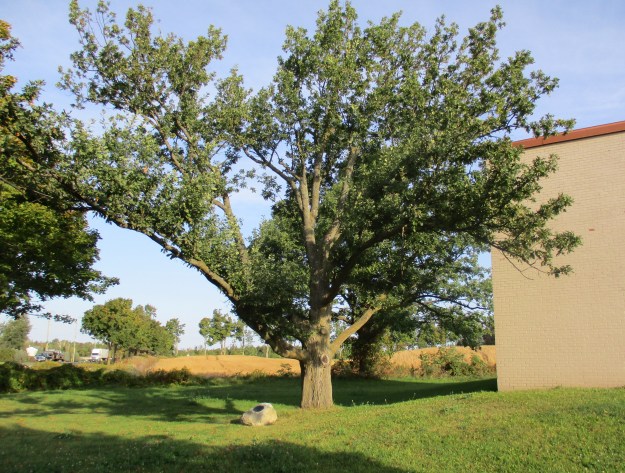
After passing through the Scotch Block the trail leads to Speyside.  This little community has one of Ontario’s only heritage trees. In 1937, to celebrate the coronation of King George VI on May 12th, acorns from Windsor Park in England were sent all across the commonwealth. The Royal Oak Of Speyside was planted by the local school children.

img_0309

Several side trails extend from the main trail over the next few kilometres.  One of these, The Canada Goose Side Trail, leads through an old homestead and along the edge of another one of Dufferin Quarries limestone extraction operations.

img_2518

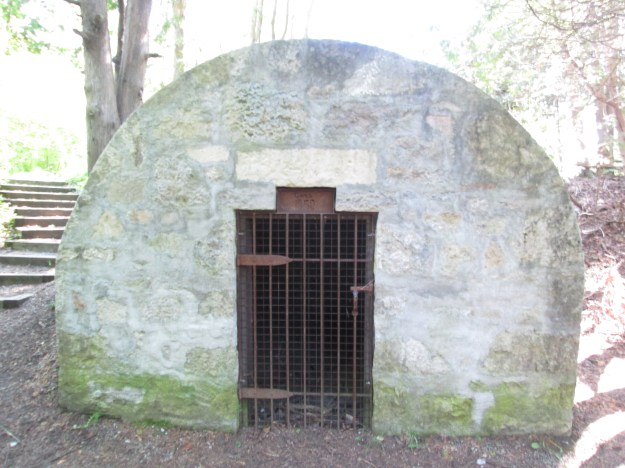
The next heritage site along the trail is found at Limehouse where the remains of several lime kilns have been preserved.  This area became well known for the production of lime used in the construction industry.  One of the interesting artifacts is the restored powder house where the blasting powder was stored.

Attachment-1

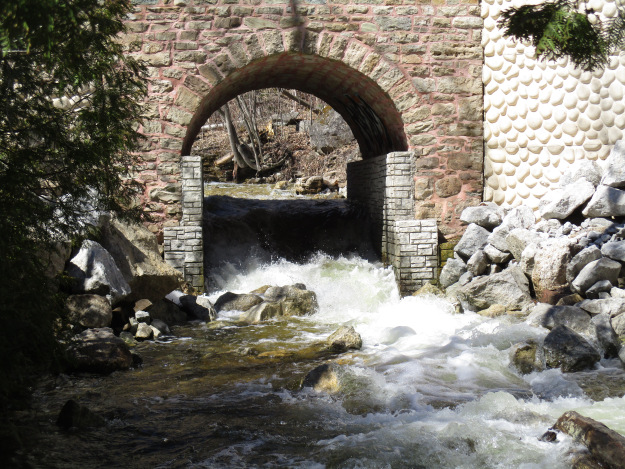
From Limehouse the trail continues north using a combination of trails and sections of roads until it reaches Silver Creek and Scotsdale Farm.  One of the defining features of Fallbrook is the stone arch bridge that was built in the 1870’s.  The stone for the bridge was taken from the decommissioned saw mill just downstream.

img_7651

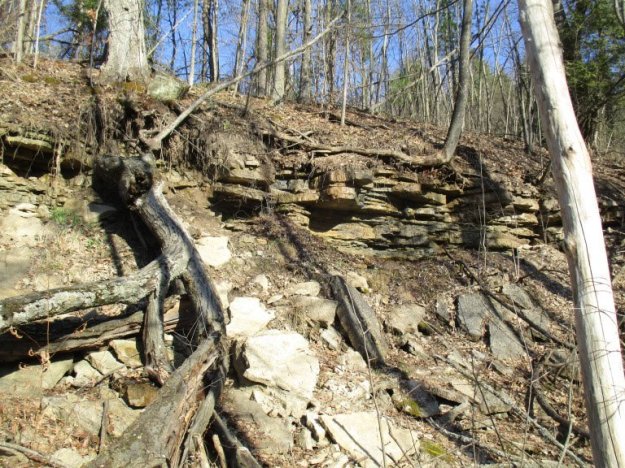
Silver Creek Conservation area is also home to the Irwin Quarry Side Trail.  This trail leads to one of the 50 small quarries that have come and gone along the escarpment.  The quarry was successful because the layer of soil on top of the limestone was very shallow allow for easy extraction.

IMG_5117

The Credit Valley Footpath is another side trail that runs for almost 10 kilometres and leads to two historical sites.  The Barber Paper Mills in Georgetown dates back to 1837 but unfortunately it is suffering from demolition through neglect.

Barber

A couple of kilometres farther downstream the Barbers erected the first dynamo in Canada to generate electricity and transmit it over wires to power a mill.

dynamo 4

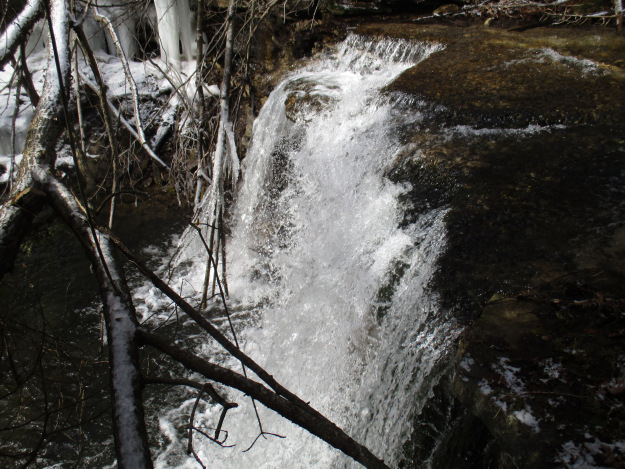
Meanwhile, the main trail carries on through the Terra Cotta Conservation Area.  This park has many of its own trails and is home to a 12-metre plunge waterfall on Roger’s Creek.

terra

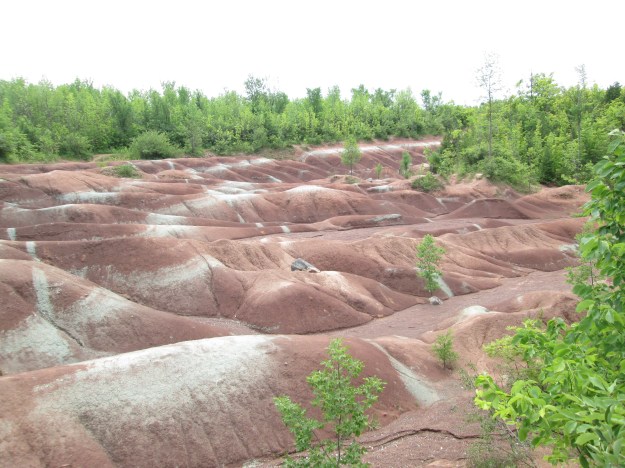
The Toronto Section of the Bruce Trail ends near the Cheltenham badlands.  This area of Queenston Shale was exposed to erosion in the 1930’s and was crossed by the main trail until recently.  The area had been closed for a few years because people wouldn’t stay on the trail and were increasing the erosion.   A new parking lot and boardwalk have been installed this year to allow people to check it out up close.

Badlands

The Toronto Section of the Bruce Trail, along with all the side trails, provide people in the GTA with quick access to some great hiking with plenty of views and historical artifacts.

Google Maps Links for the stories are included within the links.

Check out all three of our Greatest Treks compilations here: OneTwo, Three

Like us at http://www.facebook.com/hikingthegta

Follow us at http://www.hikingthegta.com
 

Greatest Treks 3

Sunday, July 1, 2018

Hiking the GTA recently passed a couple of milestones having released over 300 stories with over 500,000 reads.  This post gives a quick look at some of the most popular posts from the past 12 months.  A short description of the blog as well as a picture and a link are provided.  If you represent one of those half-million reads we owe you our gratitude and present this summary as our way of saying “Thank You”.

15. River and Ruin Side Trail 

The River and Ruin Side Trail allows you to visit the ruins of James Cleaver’s house.  The mill that he built still stands in Lowville as a public residence.

14. Griffin House

Eneral Griffin came to Canada via the undergound railroad that helped runaway American slaves find their way to a new life.  Griffin set up home in this house in 1834 in a white community where he lived as a welcome member of society.

13. Burnhamthorpe – Ghost Towns of The GTA

Only four buildings survive in the former community of Burnhamthorpe, one of which is the old Methodist Church built in 1874.

12. Camp 30 – Bowmanville POW Camp

Built as a boys school in the 1920’s these buildings, and several others, were taken over for use as a prisoner of war camp in 1941.  The buildings have since been abandoned and although they have heritage value are being allowed to deteriorate to the point where they may no longer be salvageable.

11. Devil’s Cave

The cave entrance has collapsed but it used to be wide enough to slide through into the cavern beyond. It is said that William Lyon Mackenzie hid in here when he was fleeing after his failed rebellion in 1837.

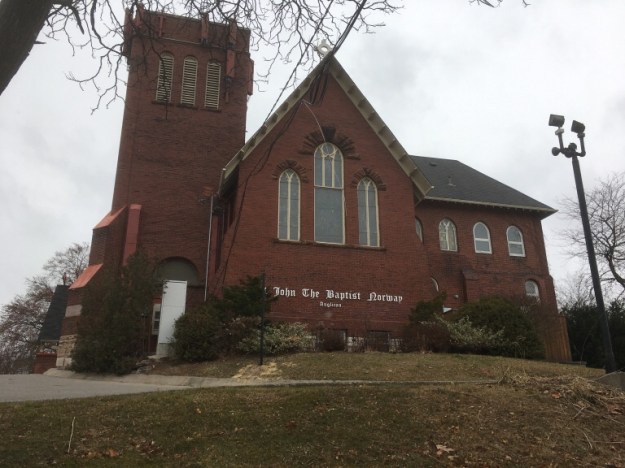
10. Norway – Ghost Towns of The GTA

A community formed along the Kingston Road in the area of the beaches that had 80 residents.  The early name was Berkley but it was later changed to Norway.

9. Abandoned DVP Ramp

Nature is reclaiming this former on ramp for the DVP.  It was closed in 2005 because it was the site of multiple accidents over the years.  It was too close to an exit ramp and cars were speeding up and slowing down on the same short stretch of highway.

8. Glenorchy – Ghost Towns of The GTA

The community of Glenorchy is probably best remembered for the collapse of the local bridge under the weight of a fully loaded potato truck.  This 1835 log cabin is one of the few remaining buildings from Glenorchy.

7. Massey – Golding Estate

Hart Massey was Canada’s first major industrialist.  His family built an empire around the manufacture of farming equipment.  The family house still stands in Taylor Park and the family is remembered through Massey Hall and the new Massey Tower downtown.

6. Humber Grove – Ghost Towns of The GTA

Humber Grove was a quiet community just north of Bolton on the Humber River until 1954 and the arrival of Hurricane Hazel.  The town was in the flood plain and were deemed to be at risk of future flooding.  The conservation authorities across the GTA were authorized to buy the houses in the various flood plains and have them demolished.

5. Rosetta McClain Gardens

Rosetta McClain turned her 40 acre property overlooking the Scarborough Bluffs into a beautiful flower garden.  When she passed away in 1940 her husband wanted to commemorate her and in 1959 he gave the property to the city as a park.  Her house is in ruins but adds a certain charm to the park.

4. The Bloor Viaduct

The Bloor Viaduct opened 100 years ago and was built with provisions for a subway that wouldn’t be added for 50 years.  The section in the Rosedale Ravine has subway tunnels that were never used.

IMG_4768

3. Palermo – Ghost Towns of The GTA

On the northern edge of Oakville, Palermo has become a collection of empty houses waiting for restoration or demolition.  Redevelopment all around has left these historic buildings in a context that the three hundred residents that lived here in 1869 would find most peculiar.

IMG_1211

2. Rice Lake’s Sunken Railway

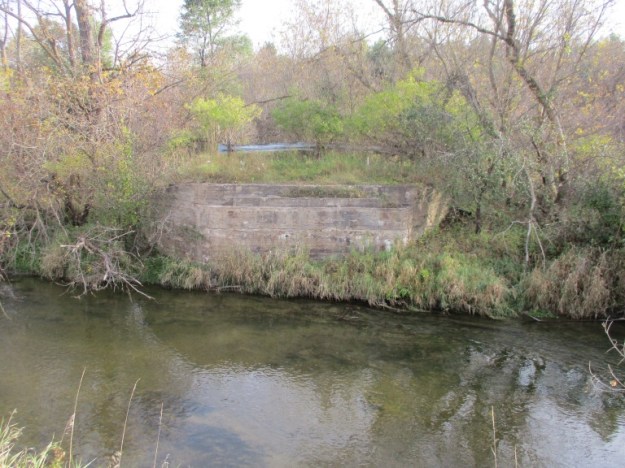
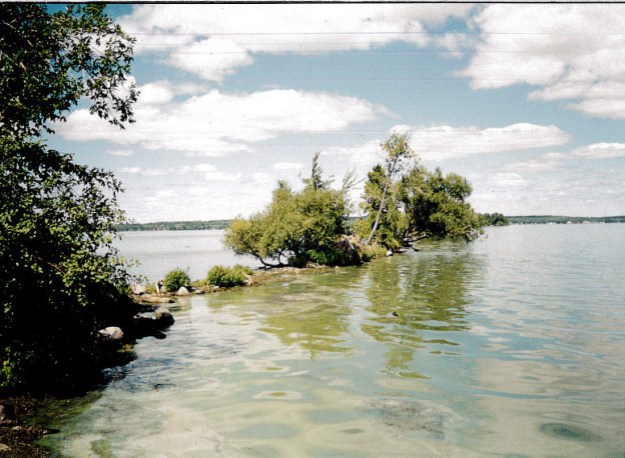
Built in 1853 the Cobourg and Peterborough Railway included a trestle across Rice Lake.  It was nearly 5 kilometres long but was damaged annually by winter ice until it was closed in 1866.  Much of the old railway still lies just below the surface of Rice Lake.

harwood-1

1. Ringwood – Ghost Towns Of The GTA

Ringwood proved to be one of the most popular in our series of ghost towns in the GTA.  It has several abandoned houses as well as the school pictured below.

IMG_2326

For our greatest treks from the earlier blogs please see:

Greatest Treks

Greatest Treks 2

Google Maps links are contained within each story.

Like us at http://www.facebook.com/hikingthegta

Follow us at http://www.hikingthegta.com
Claireville Conservation Area

Saturday, June 16, 2018

Claireville Conservation Area is nestled between four major communities in the GTA.  A gore is a triangular piece of land and Gore Township is shaped like this.  It means the  conservation area is easily accessible from Toronto, Brampton, Mississauga and Vaughan.  There is free parking in a small lot off Highway 50 just north of Steeles Avenue.

As soon as we stepped out of the car we spotted a female white tailed deer in the field beyond.  A healthy looking deer she wasn’t too keen on a photo shoot and quickly disappeared.  There are sightings of a leucistic deer in the park.  We didn’t see any white deer on this expedition. but they are seen regularly by visitors to the park.

IMG_4858

Orchard Grass grows in the old farmstead.  They don’t grow from underground rhizomes but rather spread through a process known as tillering.  The subsequent stalks are produced off the original root, having been established from an original seed.  The flowers on these examples were in full bloom and producing a pollen that I am allergic to.

IMG_4865

There is a main trail through the park but we found that it was used by cars who drove quick enough to stir up a choking cloud of dust.  As usual the secondary trails were much better.

IMG_4864

Pearl Crescent butterflies have a wide range of habitat throughout North America.  It is quite common throughout the United States but in Ontario it is not as common as the Northern Crescent.  The main distinguishing feature between the male and female is the colour of the antenna knobs.  The males usually have black ones while the female seen below has white antenna knobs.

IMG_4881

Claireville Conservation Area features a tree caching trail.  Nineteen trees along the trail have been tagged so that hikers with smartphones can access information about the tree species in the park.  With my phone I only had to take a picture of this tag to find out that it is an American Beech.  The link provides considerable information about the tree including the fact that it could live for 300 years.  For those with an understanding of environmental concerns they also tell you that this tree is storing over 2000 kilograms of carbon.

IMG_4869

John and Rebecca Wiley emigrated to Upper Canada in 1836 and settled in Gore Township.  Their one hundred acre farm was called River-view Farm and was divided between their two sons when John passed away in 1864.  The two properties of Leonard and William are outlined in yellow on the 1877 county atlas below.  The Wiley family operated the farm until 1962 when it was sold to the Metropolitan Conservation Authority.  The bridge over the West Humber on Gorewood Drive was named after the family.

Wiley

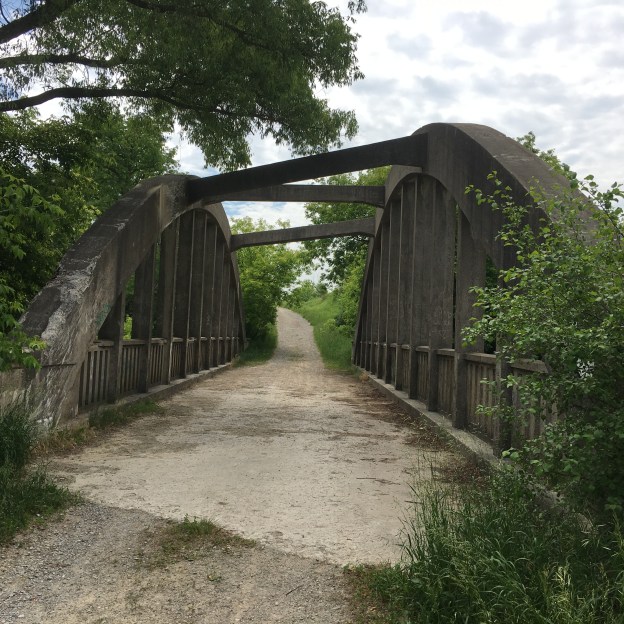
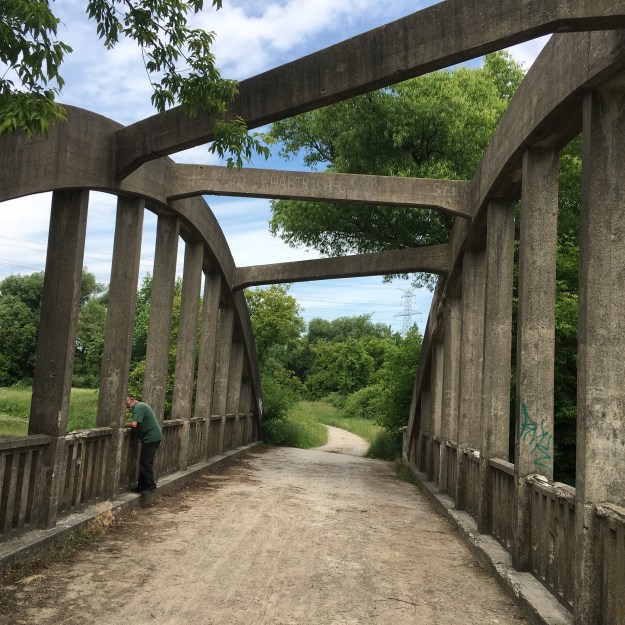
Wooden bridges were built across the many streams and rivers in Ontario using timber from trees that were cut to clear the road.  These bridges were in constant need of repair and early in the 20th century concrete bridges became popular.  Concrete bowstring bridges were popular because they were able to use local materials and labour.  By the 1920’s there were about 65 concrete bowstring bridges in Canada, almost all of them in Ontario.  Only a few of these remain in place and even less of these remain open to vehicle traffic.  There are only two remaining in Brampton, the other one being on Creditview Road near Eldorado Park.

IMG_4892

The Wiley Bridge was named after the local family and built in 1924 from materials likely quarried on the property.  It was built on a bias, which means that it crosses the river on an angle.  The bridge was reinforced with three overhead concrete girders that join the two bowstring arches.  These run on opposing angles as can be seen in the preceding picture.  All this combines to give the bridge an odd appearance as if one side is longer than the other, or that it is wider at one end than the other.  The bridge has a continuous span deck and concrete hangers and parapet, all of which is still in very good condition.  The bridge was given heritage protection in 2013.

IMG_4895

Claireville Conservation area also includes the reservoir south of Steeles Avenue that was featured in the post Claireville.  With 848 acres to explore and a rare white deer to be seen, there is plenty of reasons to return to Claireville Conservation Area.

Google Maps Link: Claireville Conservation Area

Like us at http://www.facebook.com/hikingthegta

Follow us at http://www.hikingthegta.com
The Bloor Viaduct

Sunday June 10, 2018

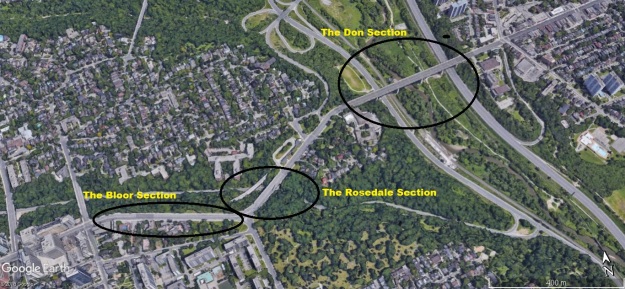
When people think of the Bloor Street Viaduct they usually think of the bridge over the Don River and Don Valley Parkway.  Or, thoughts of Toronto’s suicide bridge may come to mind.  Few people realize that the viaduct is comprised of two bridges and a length of landfill.  These are known as the Don Section which spans the Don River and is 1620 feet long and 131 feet above the river.  The Rosedale Section is another bridge, this one over the Rosedale Ravine while the Bloor Section is landfill along the side of the Rosedale Ravine, connecting the original portion of Bloor Street with the Rosedale Section.

Bloor Viaduct

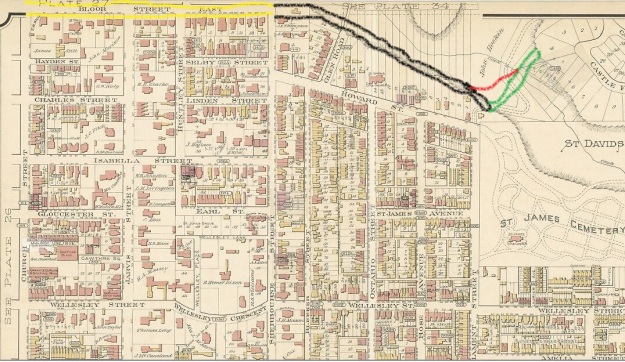
In 1899 when the fire map below was created, Bloor Street ended at Sherbourne Street and there was no easy access across the Rosedale Ravine and the Don River Valley.  A plan was put forth to build bridges across the two waterways and connect Bloor Street with Danforth Avenue on the east end.  The existing section of Bloor Street is coloured yellow.  The Bloor section of the Bloor Viaduct is coloured black while the Rosedale Section is coloured green with the eventual TTC bridge in red.

Bloor 1899

By 1901 the city was expanding to the east but the only two bridges across the Don River were on Queen Street and Gerrard Street and they were unable to handle the increased traffic that expansion brought.  A proposal was put forward to survey the best route for connecting Bloor Street with Danforth.  Although the proposal would come up again in 1906 and 1907 it wasn’t until the area of Danforth was annexed to the city in 1909 that things got serious.

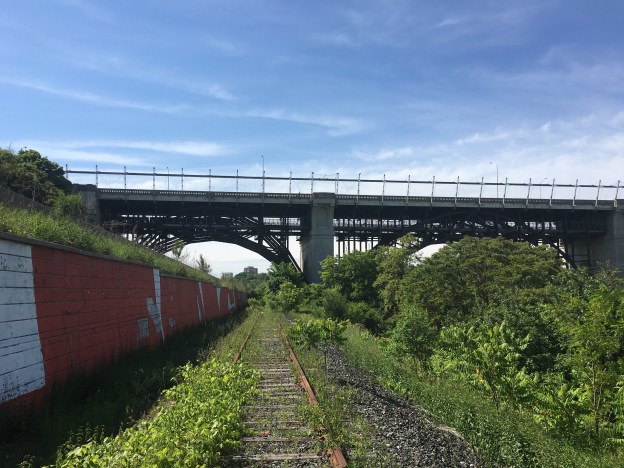
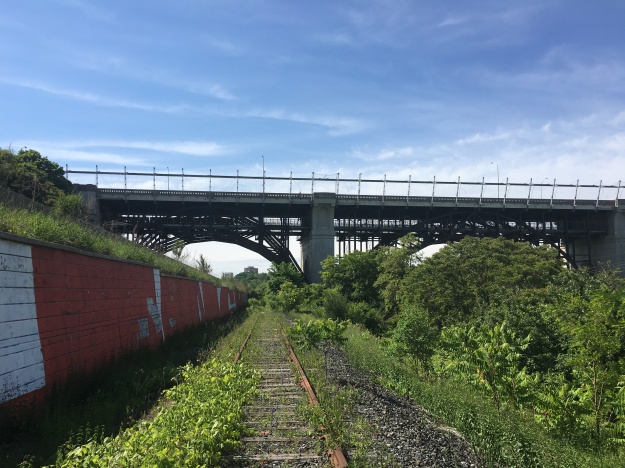
To investigate the viaduct in its entirety I had to do it in two portions, starting below the Don Section.  This was accessed from Riverale Park using a combination of The Lower Don Trail and the abandoned Canadian Pacific tracks that run from Half Mile Bridge.  The picture below shows the viaduct looking south.  The abandoned railway and the Don Valley Parkway run between piers A and B.  The Lower Don Trail runs between B and C.

IMG_4768

On January 1, 1910 the people voted No to a referendum but the need for a bridge didn’t go away.  City Council hired a firm of traffic consultants to see if a subway might be the answer to their traffic problems.  Their report of August 25th, 1910 suggested a Yonge Street, Queen Street and Bloor Street subway line.  They proposed a double deck bridge over both the Don Valley and Rosedale Ravine with a subway on the lower deck.  On January 1, 1913 the people approved construction on the viaduct on an altered route that required an angled bridge across Rosedale Ravine and landfill between Sherbourne and Parliament Streets.

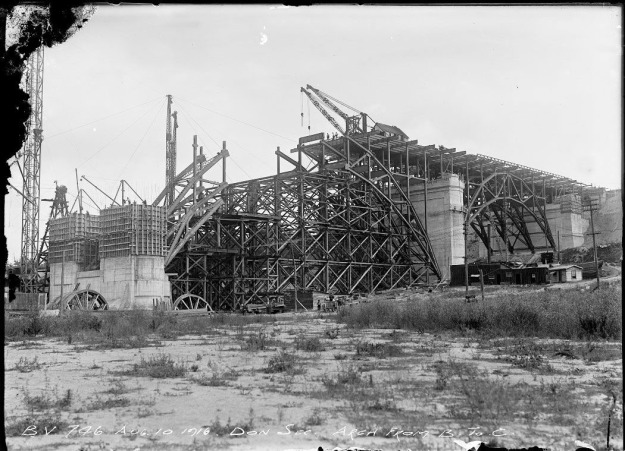
Seen from the opposite direction the archive picture below shows construction of the Bloor Viaduct.  Pier C is in the foreground with the crane sitting above pier B.  A series of falseworks were constructed below the bridge to support the steel structure during assembly and later removed.  The steel girders of the bridge can be seen extending out from each pier to an eventual connection in the middle.  Each girder has three hinges, one on either end and one in the middle.

Falsework 2

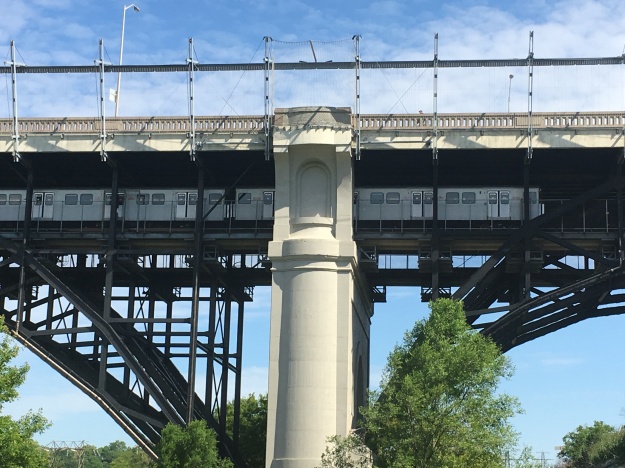
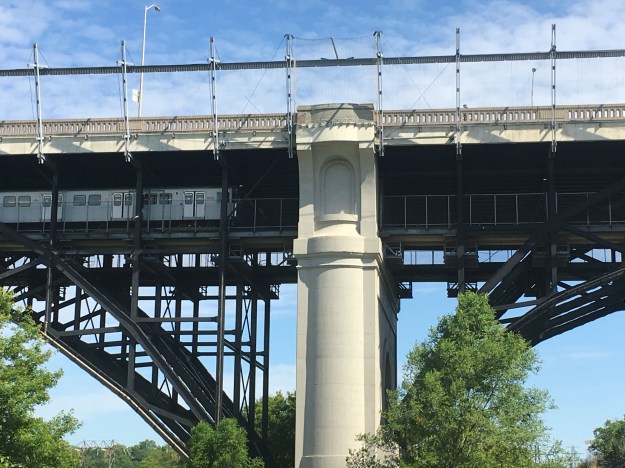
Rolland Caldwell Harris was Commissioner of Public Works and he supported the idea of including the subway decks for eventual use.  The sod turning ceremony took place on January 16, 1915 with construction of the piers beginning immediately.  Four of the piers across the Don River section are sunk over 40 feet below the river to sit on the bedrock.  The subway line along Bloor Street didn’t open until February 26, 1966 but the lower deck saved the TTC millions of dollars in construction costs.  A subway train makes its way east under Don Section in the picture below.

IMG_4757

Having explored below the viaduct I wanted to examine the Bloor section and the Rosedale Section.  I was able to find parking on Bloor Street right near Sherbourne and so I set off to explore the section of landfill that now carries five lanes of traffic and two bicycle lanes.  The side of the embankment down to Rosedale Valley Road is steep in places but has developed a mature tree cover.

IMG_4799

During construction the viaduct was opened in three phases with the Bloor Section opening to traffic last.  The Rosedale Section being the shortest was completed and opened in October of 1917 and the Don Section was opened on October 18, 1918.  As the fill settled in the Bloor Section it continued to crack and it wasn’t until August 23, 1919 that this last section was opened.  A long portion of the embankment has been supported with concrete and provides an easy way down.

IMG_4802

The Rosedale section is 190 feet long and stands 90 feet above the ravine floor.  There is only one span in this section and the steel beams were assembled on the ground and then hoisted into position.  This eliminated the need for falsework under this bridge.

IMG_4807

When it came time to build the subway it was decided that the curve created by the Rosedale Bridge was too severe for safe operation of the trains and so the subway deck was never used.  From below the bridge you can still see the screened off openings for both the east and west lines.  The eastbound lane is marked in yellow on this picture of the west abutment.

IMG_4813

A new covered bridge for the subway was installed beside the Rosedale Bridge in 1966.

IMG_4832

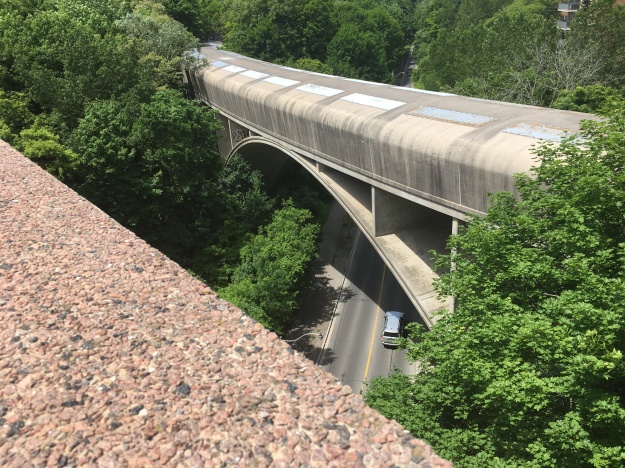
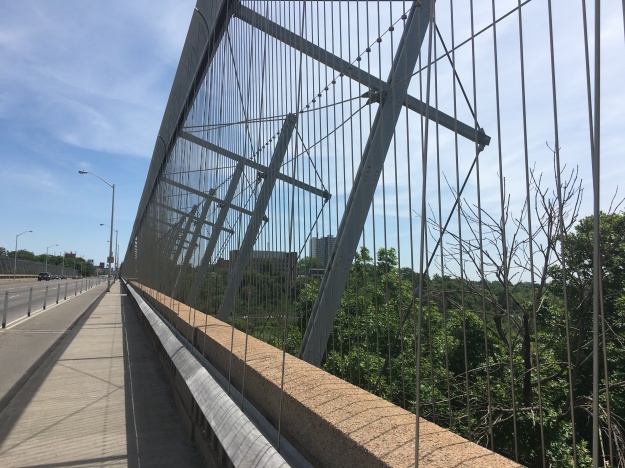
After passing Castle Frank and its subway station you come to the longer Don Section of the viaduct.  The bridge had become the most popular place in Toronto to commit suicide and by 2003 nearly 500 people had jumped to their deaths.  The city approved a barrier in 1998 but delayed 5 years over funding issues.  Meanwhile, over 48 more people jumped creating  a hazard to traffic below.  The Luminous Veil was installed at a cost of $5.5 million dollars and has put an end to the unfortunate use of the bridge but suicide rates in the city remain unchanged .

IMG_4823

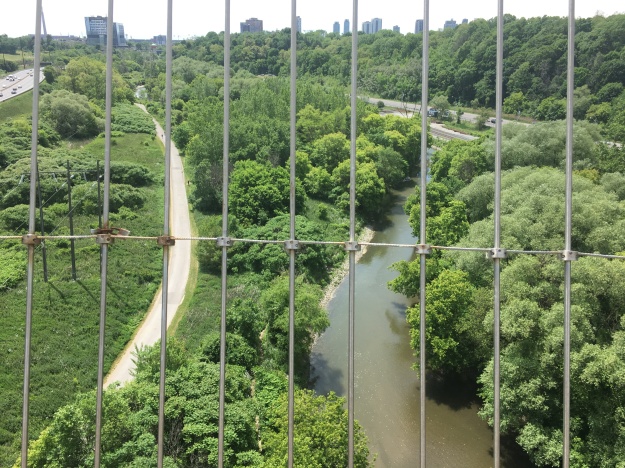
The view south from the bridge shows the DVP in the left corner and the Lower Don Trail beside it.  The river separates the trail from the Canadian Pacific tracks and the Bayview Avenue Extension.  The Luminous Veil does mess up the view to a large degree.

IMG_4826

The Bloor Street Viaduct was officially named Prince Edward Viaduct when it opened in 1918 although it retains the more popular Bloor Street Viaduct as a common name.  The abandoned railway under the viaduct belongs to Metrolinks and would make a good footpath between several downtown parks, even if only temporary.  We make the proposal in our post Half Mile Bridge Trail.

Google Maps Link: Bloor Viaduct

Like us at: http://www.facebook.com/hikingthegta

Follow us at: http://www.hikingthegta.com

Half Mile Bridge Trail

Sunday June 10, 2018

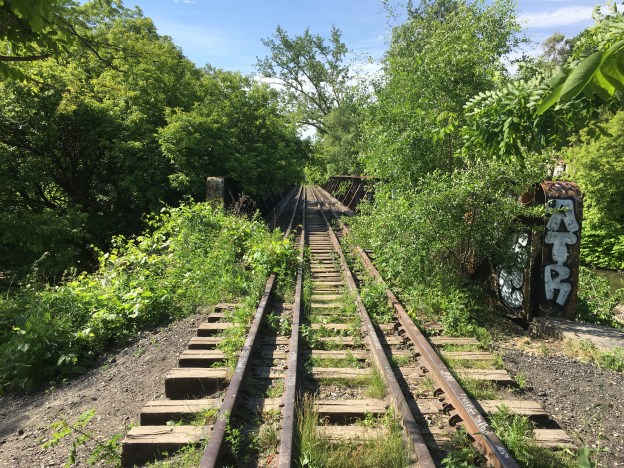
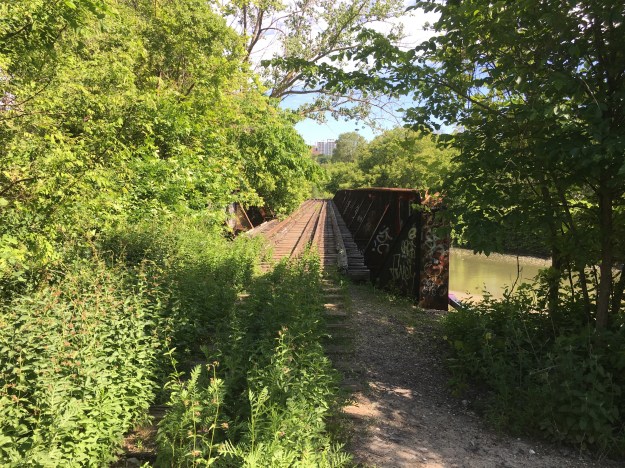
When the Canadian Pacific Railway was built through the GTA in the 1880’s it passed through Leaside and The Junction but didn’t run south to Union Station.  In 1888 they were given approval to build a spur line through the Don Valley and into downtown Toronto.  The line was in use until 2007 when it was closed and the right of way is currently owned by Metrolinx with an unspecified plan for potential future use.  Hiking the GTA proposes that this old rail line would make a perfect hiking trail connecting several parks that will soon be joined under the name of Wonscotonach Parklands.

Starting at Riverdale the trail would pass under the Bloor Viaduct and on toward the Half Mile Bridge.  The Don Valley Brickworks with a large park in the former quarry is located at the far end of the bridge.  This park links to The Belt Line Trail that runs through Mount Pleasant Cemetery and into midtown.  The trail then would pass under Bayview Avenue and on toward Crother’s Woods where it would end at the trail head behind the Loblaws.  A short side trail could be constructed on the right of way for the closed section of Pottery Road that would connect to Todmorden Mills, an 18th century paper mill.

Half Mile Trail


I parked on Carlton Street at Riverdale Park and took the stairs to the bottom of the hill.  There is access to the Lower Don Trail from the pedestrian bridge over the Don Valley Parkway.  Turning north you quickly come to a pedestrian bridge over the Don River and a small side trail that leads to the old Canadian Pacific Railway bridge over the Don River.

IMG_4668


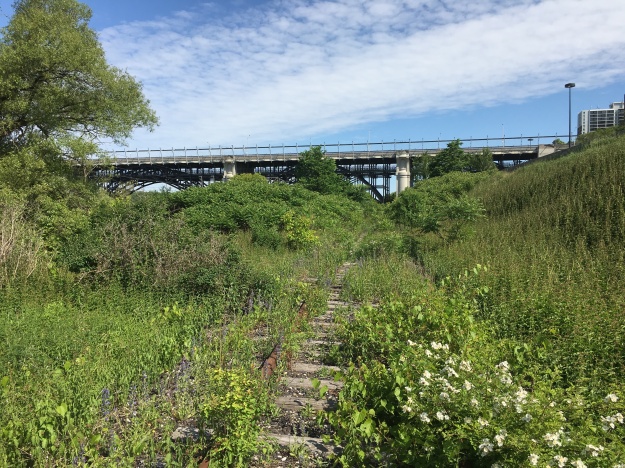
There are plenty of places where the rail line has all but vanished into new growth in the past ten years.

IMG_4673

The old railway passes under the Bloor Viaduct, one of Toronto’s best known bridges.

IMG_4676

From the railway you will have the chance to watch TTC subway trains running below Bloor Street.  The eastbound train above is running on a subway deck that was built into the bridge 50 years before it would host the first commuters.

IMG_4756

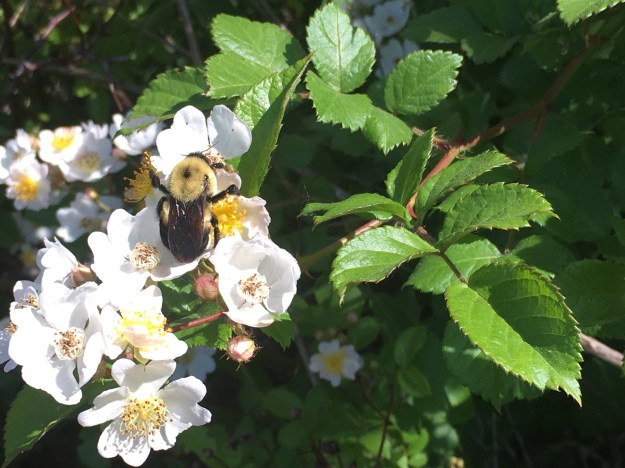
A bumble bee was collecting pollen from some late apple blossoms and storing it in pouches along its rear legs.  The myth that bumble bees defy the laws of physics by being able to fly seems to date back to 1934 and a book called Le Vol Des Insects.  There’s obvious flaws in the calculations that claim the wing size is too small to lift the weight of the creature.  If this were true I saw dozens of physics defying bees just on this brief hike.

IMG_4761

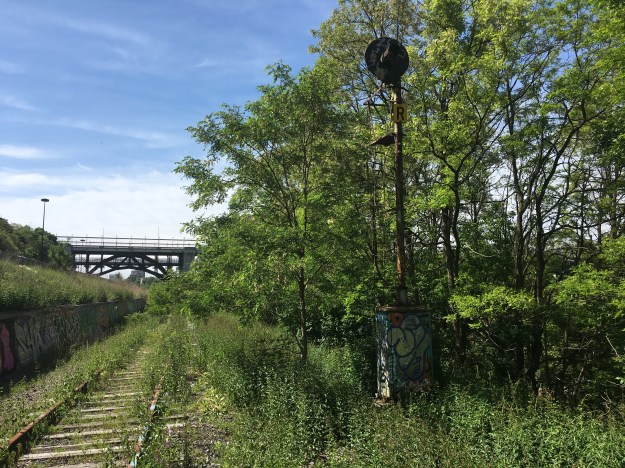
Just north of the Bloor Viaduct is an old switch light for directing train traffic.  This light would inform the engineer of the presence of other trains on the same track.

IMG_4771

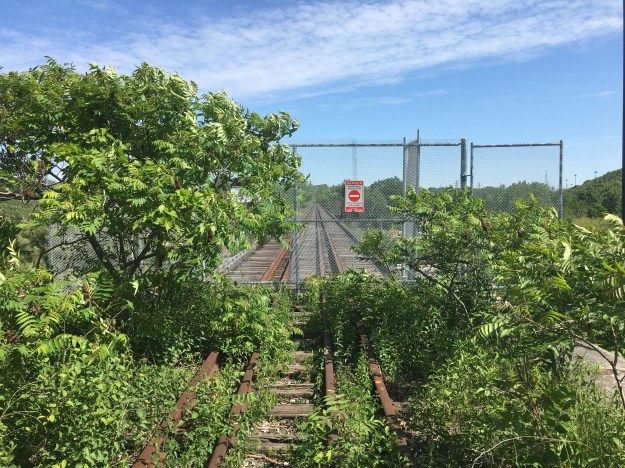
In recent times the half mile bridge over the DVP and Don River has been gated and posted No Trespassing.  There is also a help line number on the fence for those who have approached the bridge in a state of depression, thinking about ending it all.

IMG_4775

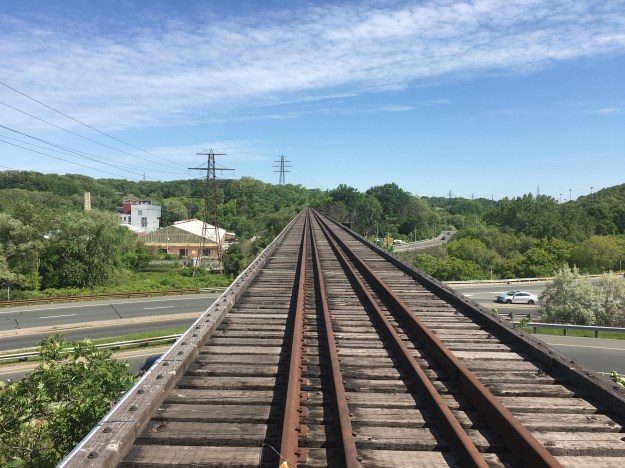
Someone has cut the fence to gain access to the bridge but several people have reported being stopped by police for being on the bridge and, luckily, they were only given warnings.  One of the main attractions is the spectacular view of the city from the bridge.  The Don Valley Brick Works (now Evergreen Brickworks) can be seen to the left of the tracks.  Beyond here, the line carries on toward Crother’s Woods.

IMG_4777

With a small investment for safety on the half mile bridge, a new rail trail could be established linking several existing parks and pathways which would help to integrate our network of trails in the city.

Google Maps Link: Half Mile Bridge

Like us at: http://www.facebook.com/hikingthegta

Follow us at http://www.hikingthegta.com


The Great Trail – Caledon East

Saturday, June 9, 2018

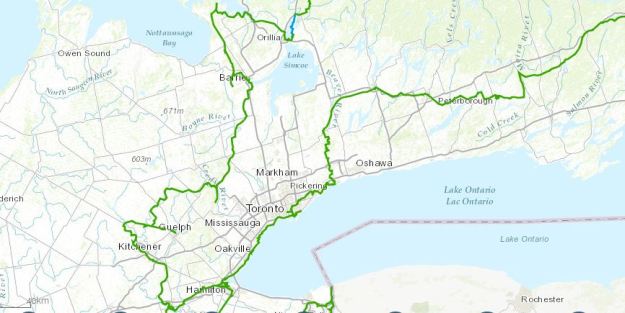
The idea for a Trans Canada Trail was given birth at the time that the country was celebrating 125 years of Confederation.  The plan was to complete a trail that would link all the provinces and territories by 2017 when the country celebrated 150 years.  In a quarter century a trail was created that extends over 42,000 kilometres and is the longest multi-use trail network in the world.  The trail passes directly through the GTA and then curves back along the top again as it heads north.  The map below was snipped from the official map https://thegreattrail.ca/explore-the-map/

Great Trail GTA

A non-profit organization called The Trans Canada Trail was established to raise funds for the creation and maintenance of the trail.  All levels of government contributed to the project and donations were sought from corporations and individuals.  The province of Prince Edward Island was first to complete their section which is known as Confederation Trail.  To explore the original section of the trail we parked in the small lot on The Gore Road just north of Old Church Road.  After a short walk east toward Mill Lane and Humber Station Road we made our way west to Caledon East.

IMG_4477

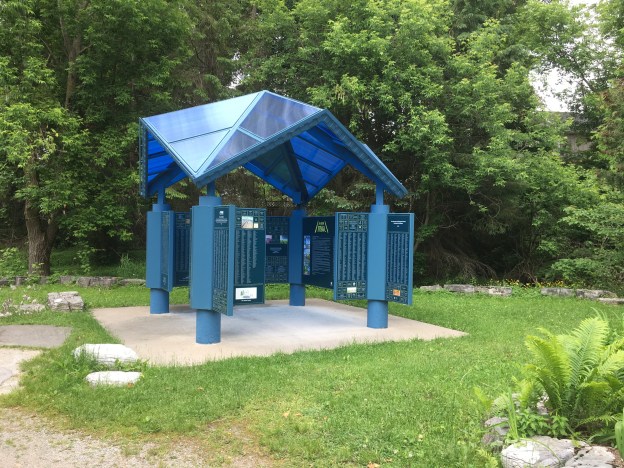
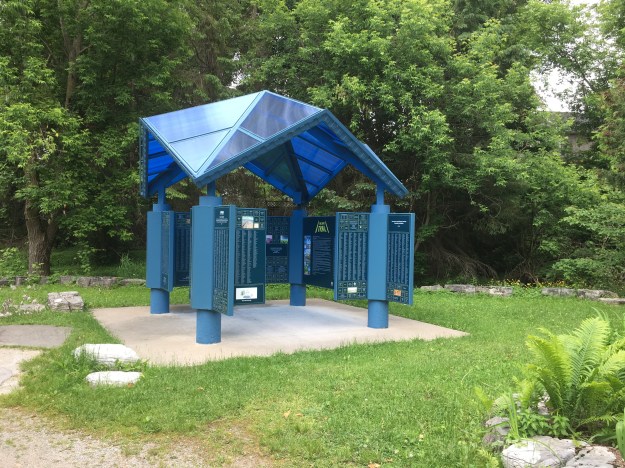
Pavilions have been established along the route where donors are recognized.  The first pavilion to be created is the one in Caledon East.  An inscription program was put in place for individuals who donated to finance a metre of the trail.  An inscription would be added to the pavilion of your choice.  My family had a inscription placed in the Calgary pavilion, the city where our late brother was born.  The inscription program was officially terminated in 2012 when it was determined to be a drain on resources that was hindering the actual development of the trail.  If you donate today, the federal government will give 50 cents on the dollar as donation matching.

IMG_4647

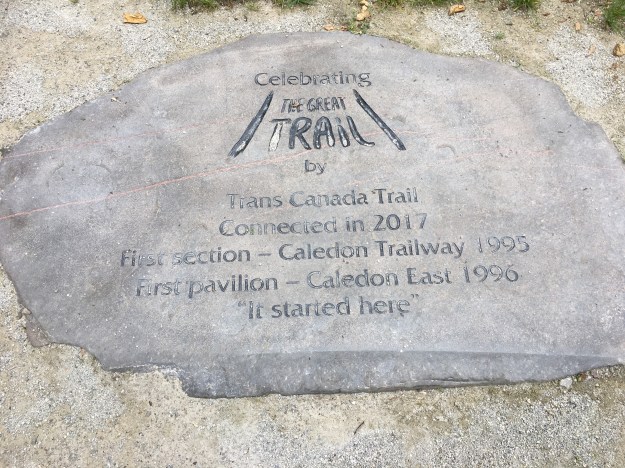
The trail has been established using existing trails as a foundation.  The first section to be opened was the Caledon Trailway in 1995.  When the trail was connected from The Atlantic to The Pacific and Arctic Oceans in 2017 a new stone and pavilion were placed in Caledon East where The Trans Canada Trail was first opened.  The stone bears the new name of the trail.

IMG_4648

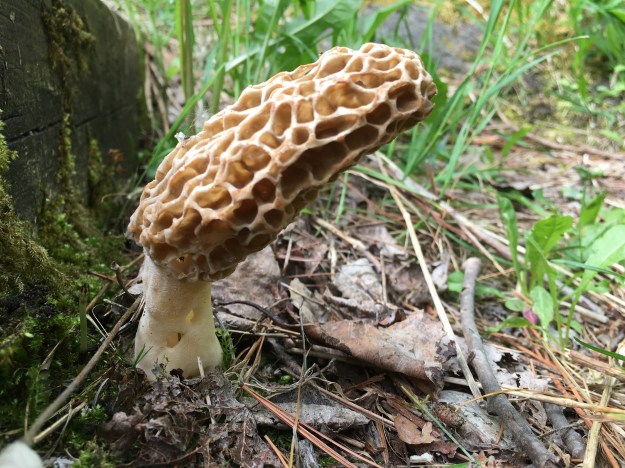
The trail has been connected from coast to coast but it is far from completed.  Large sections follow roadways which in some cases are temporary until green-ways can be developed.  In other areas the trail may always be stuck on the side of roadways, mostly rural but also including some busier sections.  Some portions, such as one in New Brunswick on the Saint John River cannot be hiked or cycled, but must be completed in a boat or canoe.  The trail is intended to promote six main activities: walking/hiking, cycling, paddling, horseback riding, cross-country skiing and snowmobiling.  Along the trail near Caledon East we found a single True Morel growing.  These fungus are edible and can be distinguished from similar inedible ones by the fact that they are hollow inside, from stem to tip of the mushroom.

IMG_4471

The section of trail that passes through Caledon East follows the route of the Hamilton and North Western Railway which was later amalgamated into the Canadian National Railway.  It was abandoned in the 1980’s and Caledon purchased the right of way in 1989.  In 1994 they started to convert it into a multi-use trail which opened the following year.  The trail along here continues to use the old rail bridges to cross streams and roadways.  This is the bridge over Mill Lane.

IMG_4460

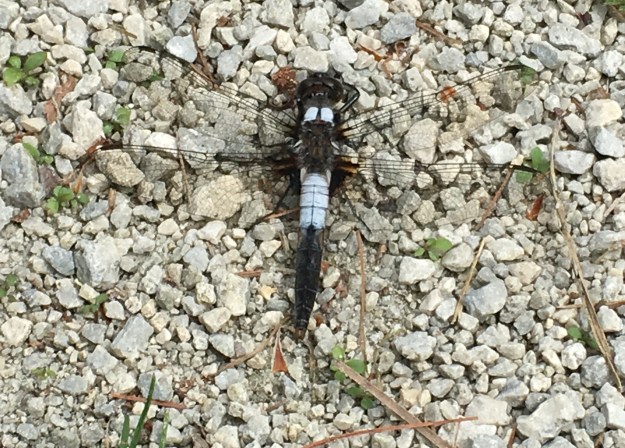
Dragonflies rest with their wings open while damselflies rest with them folded on their backs.  There are about 5,000 species of dragonflies in the world and 130 of these have been identified in Ontario.  We saw half a dozen different ones along the way.  This male Chalk Fronted Corporal was one of several that were soaking up the heat on the trail.  They tend to follow humans as they hike because they like to eat the mosquitoes and biting flies that are attracted to people.  For this reason it is always nice to see these insects.

IMG_4455

We found a patch of gooseberries growing along the trail.  They are not native to North America but have become naturalized, likely from garden escapees.  The fruit is cultivated and is an excellent source of vitamin C.  It can be eaten as is, cooked into pies or preserved in jams.  It is also used to flavour wines, sodas and teas.

IMG_4630

The Humber Valley Heritage Trail along with The Bruce Trail are accessible from the Great Trail near Caledon East.  In other places The Great Trail shares pathway with The Lakefront Trail and The Pan Am Trail.  The pedestrian bridge crossing the mouth of Highland Creek is one example of a shared trail.

IMG_4474

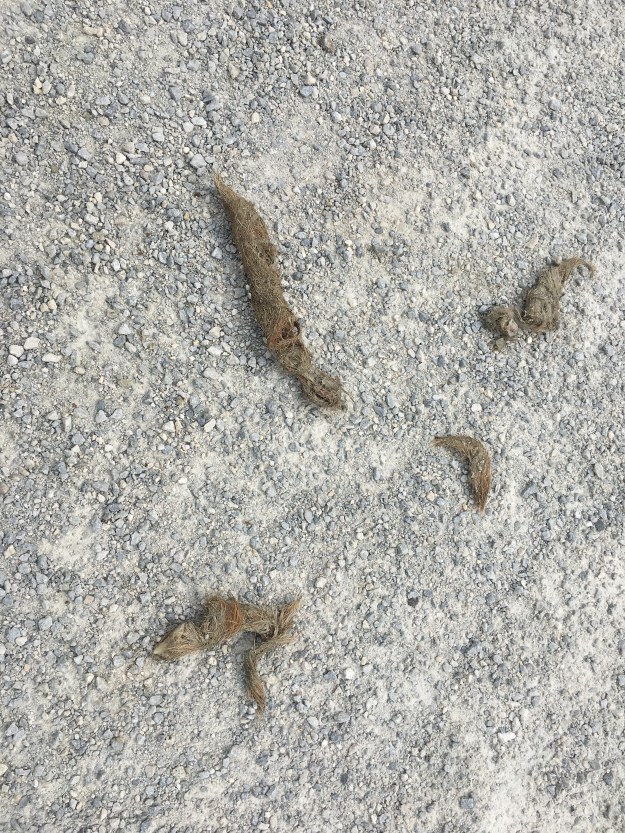
Based on the amount of fur in this scat it appears that someone is not doing the stoop and scoop after their coyote.

IMG_4643

Along the trail we saw several chipmunks and squirrels as well as this rabbit.  The hunting seems to be pretty good for the local coyote population.

IMG_4629

We’ve visited several sections of The Great Trail along the Waterfront Trail as well as on The Caledon Trailway.  At 42,000 kilometres in length, this is one trail that few will be able to complete end-to-end.

Google Maps Link: Caledon East

Like us at http://www.facebook.com/hikingthegta.com

Follow us at http://www.hikingthegta.com
Islington – Village of Murals

Sunday, June 3, 2018

The village of Islington was originally called Mimico when it was founded in 1814.  Dundas Street was the main route between York and the western part of Upper Canada. It became an important stopover on the stage coach route that ran along Dundas Street.  The village has been absorbed into the city around it but it’s original charm is being captured in a series of murals along Dundas Street.  The Islington Business Improvement Area (BIA) is a group charged with making the area attractive and preventing graffiti.  In 2004 they began to set aside a portion of the local taxes to be used to create outdoor murals that depict some of the history of the community.  To date there are 26 murals that cover over 25,000 square feet of public art.  Many of the murals were painted by John Kuna although several were painted by Sarah Collard and also Arts Etobicoke.  Each painting takes between 300 and 400 hours of work.

The paintings cover 5 blocks along Dundas Street and they are mostly painted on the sides of buildings.  The first two murals, however, are painted on bridges over Mimico Creek.  These young ladies are singing a welcome to visitors as they enter the community.

IMG_4499

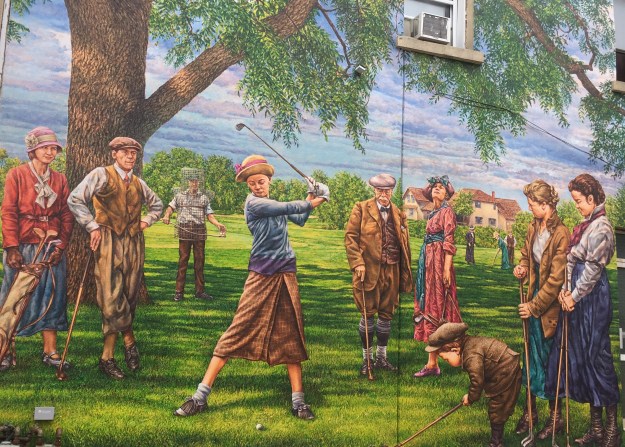
This mural depicts golfing in Islington in the 1920’s.  The Islington Golf Club was established in 1923 on the old Appleby Farm.  Notice the ball collector in this painting who is wearing a protective wire cage.

IMG_4501

The old Islington Hotel is seen in this mural that depicts Islington in 1912.  The drive shed where horses were stabled can be seen in the foreground and Clayton’s Butcher shop is just beyond the hotel.  This mural is part of a pair that together depict the street view of the town a hundred years ago.

IMG_4523

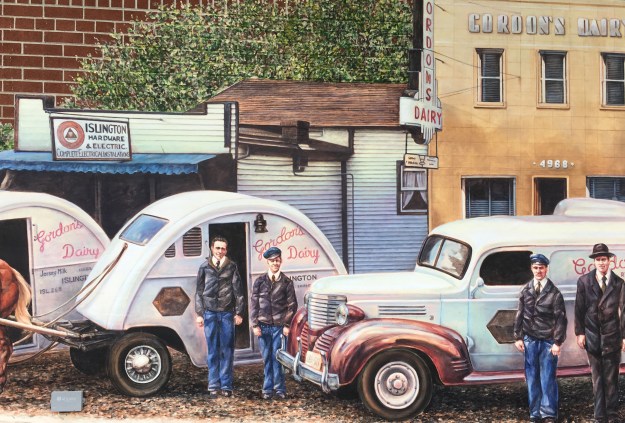
Gordon’s Dairy was a big part of everyday life in Islington.  Their milk wagons, and later milk trucks, delivered dairy products on a daily basis to homes in town.  The dairy was in a building that featured yellow tiles on the outside and had a lunch counter inside.  This mural shows the dairy as it existed around 1940.

IMG_4519

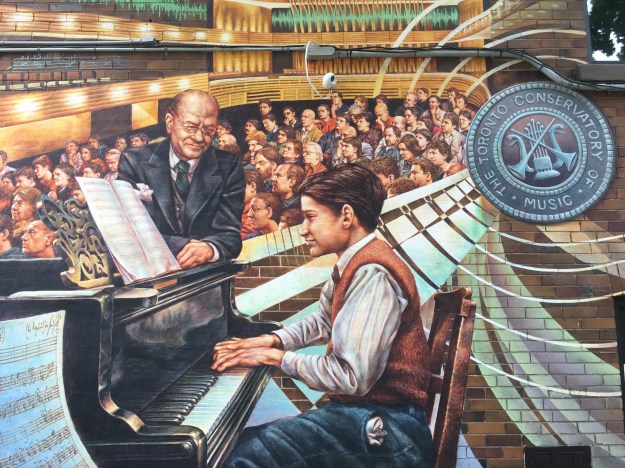
The Royal Conservatory of Music had a branch in Islington between the 1950’s and the 1980’s.  This mural features Glenn Gould who was one of the most famous people to come through the conservatory.

IMG_4533

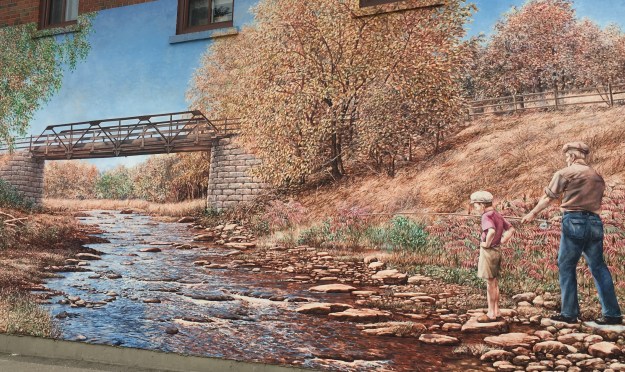
This mural depicts a father fishing with his children in Mimico Creek near the old rail bridge.

IMG_4525

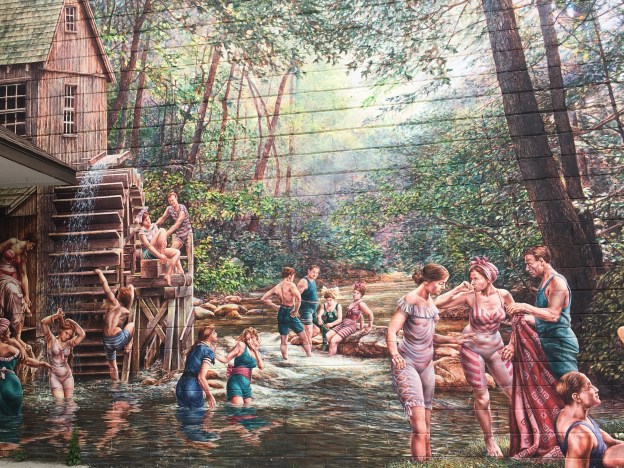
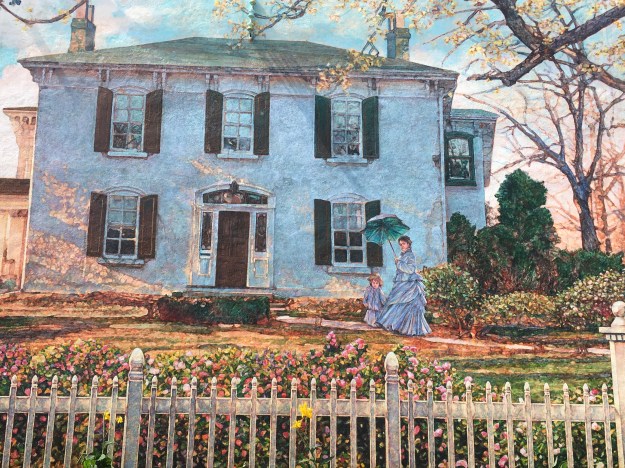
This is my personal favourite of all the murals in the collection and that is why it is also featured as the cover photo for this post.  It depicts the old swimming hole near the mill.  The bathers are dressed in fanciful bathing suits and are climbing on the waterwheel for the mill.

IMG_4541

This colourful mural depicts fishing in the creek.  The water below the children with their fishing lines depicts several of the species that were common in Mimico Creek a century ago.

IMG_4535

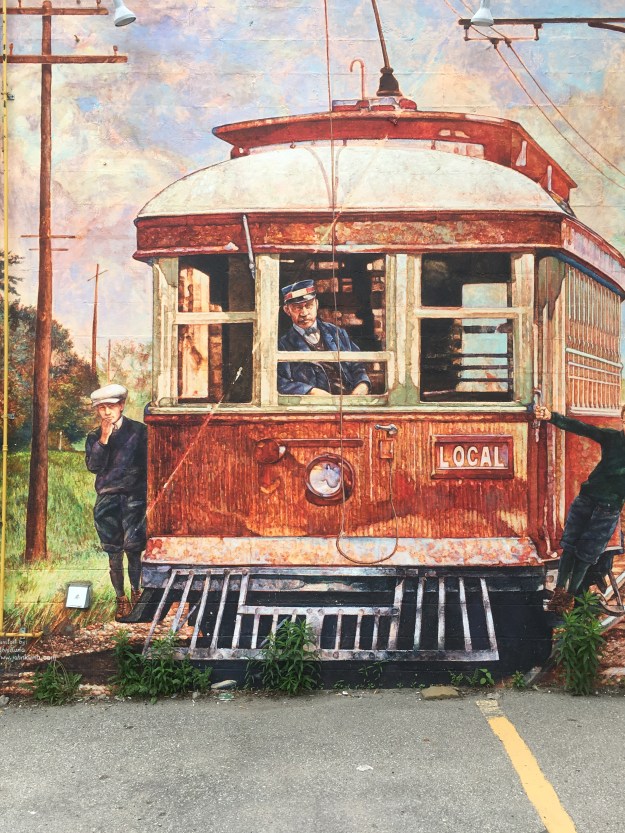
The Guelph Radial Line ran through the community on it’s way between Lambton Mills and Guelph.  The line opened in 1917 and ran until 1931 when it was closed due to the increase in popularity of the personal automobile which made the trip to Guelph along Highway 7.  The radial line ran behind the building with this mural on it.

IMG_4536

The Gunn House was also known as Briarly and was built in the 1840’s as a single story regency style cottage.  In the 1850’s it was expanded and given Italianate touches that were popular at the time.  The house was owned by the Montgomery family from 1870 until 1985.  It was demolished in 1989 to make way for some badly needed townhouses.  The house originally stood just east of Montgomery’s Inn.

IMG_4546

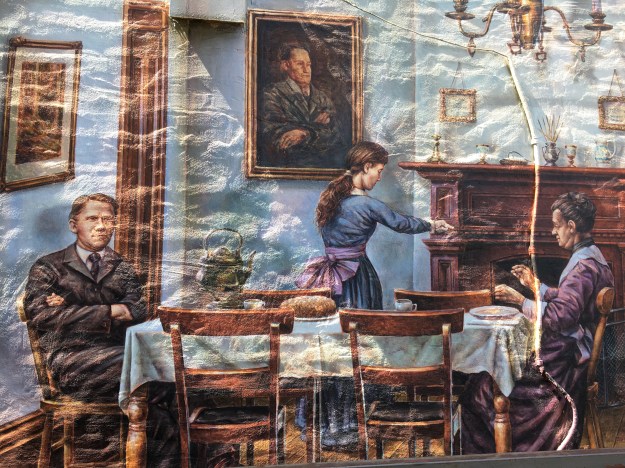
One of the more unique murals is painted on the side of the building that served as the  manse for the Weslyan Methodist Church.  The building has been painted in a manner that appears to have removed the outer wall and allowed us to view the interior as it may have looked around 1888.  The pastor is seated at the table while a committee of women from the church inspect the house with white gloves to ensure that the housekeeping is up to par.

IMG_4562

Montgomery’s Inn was built in 1830 by Thomas and Margaret Montgomery.  When Margaret died in 1855, Thomas stopped operating the inn and concentrated on farming the property instead.  The building was sold in 1945 to the Presbyterian congregation who used it as a church from 1946 until 1962.  The building sat abandoned until 1975 when the Etobicoke Historical Society managed to save it from demolition.  It has been turned into a museum and remains a valuable example of Georgian style architecture.

IMG_4486

The old community of Islington has been swallowed up by the city but through the display of public art it has managed to preserve the historical charm of a previous century.  This is just a selection of the beautiful artwork and one only need take a quiet stroll along Dundas Street from Islington to Kipling to appreciate the beauty that has been created here.

Google Maps link: Islington

Like us at http://www.facebook.com/hikingthegta

Follow us at http://www.hikingthegta.com
The Crothers Woods Stairs

Sunday, May 26, 2018

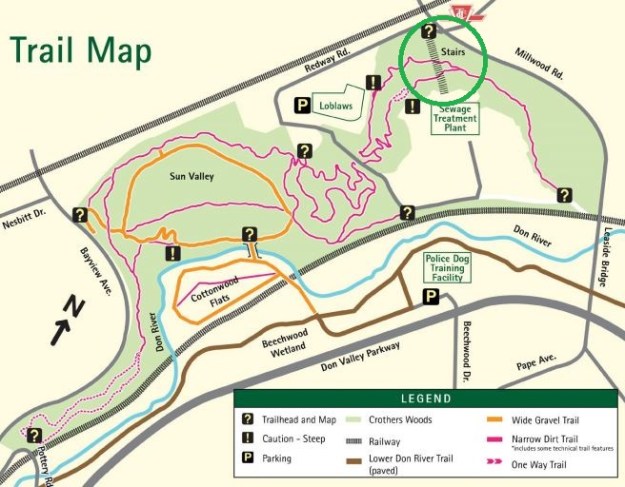
Previous posts on Crothers Woods and the Beechwood Wetlands have covered much of the early history of this area but we’ll touch on it briefly as we set the scene for the present story.  The valley was a much different place in 1929 than it is today but to understand one of the prominent features of the valley we need to step back nearly a century.  At that time most of the tree coverage had been removed from everywhere except the ravine slopes.  A saw mill had been in operation in the area shown as Cottonwood Flats on the map below until the local supply of lumber was exhausted in 1858.  After that, Cottonwood Flats was home to manufacturing with Domtar operating an insulation factory there until 1965.  The area known as Sun Valley had been home to a brick factory since 1900 and by 1929 there was a large strip mine where the clay had been removed.  The Don River had become one of the most polluted rivers in Canada by this time but it formed a natural border to the floodplain.  The area bounded by the ravine, the large clay mine and the river was chosen as the site for Toronto’s newest sewage treatment plant.
Crothers Woods

North Toronto was annexed to the city of Toronto in 1912. This led to the rapid infill of an area that had largely been farmland until that time.  With the influx of affluent people came an outflow of effluent.  Hooking up to the existing city sewer system was impractical because of the Yellow Creek Ravine and so a new sewage system and treatment plant was needed.  A site was selected in the industrial area we now call Crothers Woods because it was lower in elevation and no pumping was required to bring the sewage to the plant.  The close proximity of the Don River was a deciding factor as was the concept that the discharge was downstream from any agricultural or drinking water uses.
IMG_4382

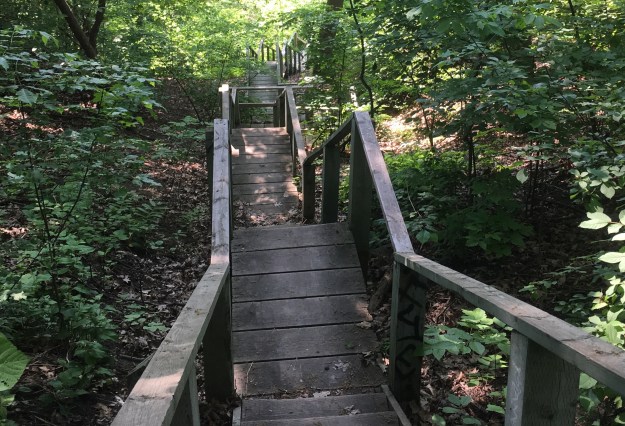
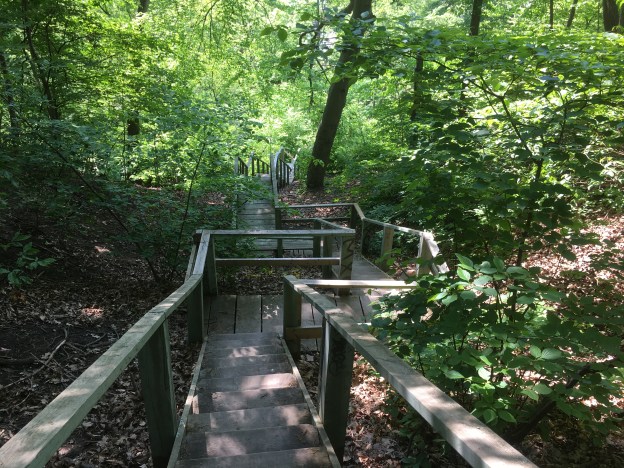
The whole facility sits in the floodplain and at the time was bounded by the ravine, a deep pit and a dirty river.  R. C. Harris was the commissioner of public works in 1926 when the project was approved by city council.  Harris was a man of foresight and when he built the Bloor Street Viaduct (1918) he installed a lower deck for a subway that wouldn’t use it until 1966.  When he built the R. C. Harris Filtration Plant he designed it so that it could be expanded by 50% when the time came.  When he commissioned the North Toronto Water Treatment Plant he was decades ahead of his time in ensuring worker safety.  An escape route was planned to allow employees to get out of the valley if an emergency occurred.  A wooden boardwalk leads to a set of wooden stairs then to the road above.  A small section has no hand rails to allow cyclists to enjoy one of 9 kilometers of trails that weave their way through the 52 hectare park.  There are two places where the trails cross the stairway.

IMG_4383

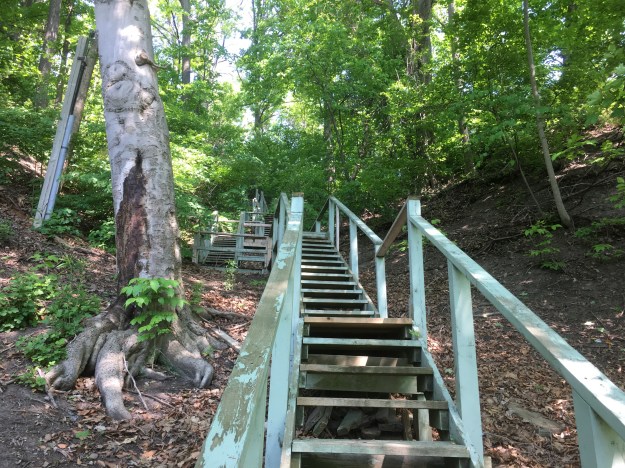
As the boardwalk approaches the ravine wall it starts a fairly steep climb.  This section of the woods is full of birds and the stairs provide an excellent place to find some quiet time when you can sit and watch for them.

IMG_4386

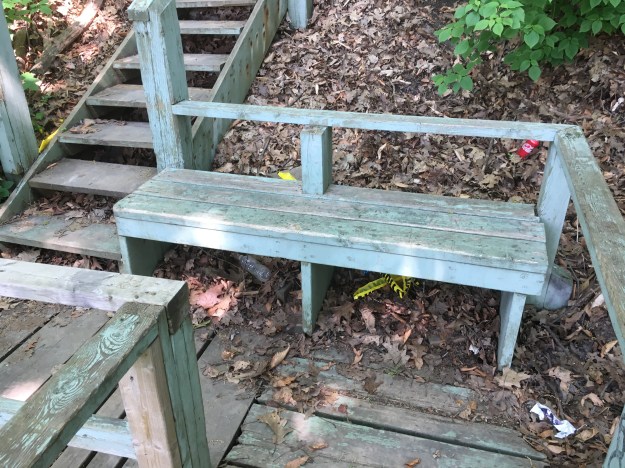
In the fall these stairs also provide excellent views of the changing colours in the Don River Valley.  About half way to the top is a bench for those who need a rest or just want to sit for awhile.

IMG_4390

One hundred ninety-five steps separate the wastewater treatment facility and the road at the top of the ravine.  The top of the stairs are almost hidden in the intersection of Millwood Road and Redway Road.  The stairs are obviously maintained because the deadwood has been removed and broken boards replaced.  Much of the blue paint is peeling from the structure and the new boards are still raw.  I wonder if a paint job is scheduled for the near future.
IMG_4388 (1)

When we visited Crothers Woods in December 2016 the stairway hadn’t seen much recent use.  Fresh snow covered the stairs at that time.  Today, there was only one other person using the stairs but dozens of others on the trails either hiking or riding their mountain bikes.

img_5175

It turns out that the set of stairs designed in 1929 to allow the water treatment plant workers to escape functions very well today as a place for personal escape.

Google Maps Link: Crothers Woods

Like us at http://www.facebook.com/hikingthegta

Follow us at http://www.hikingthegta.com